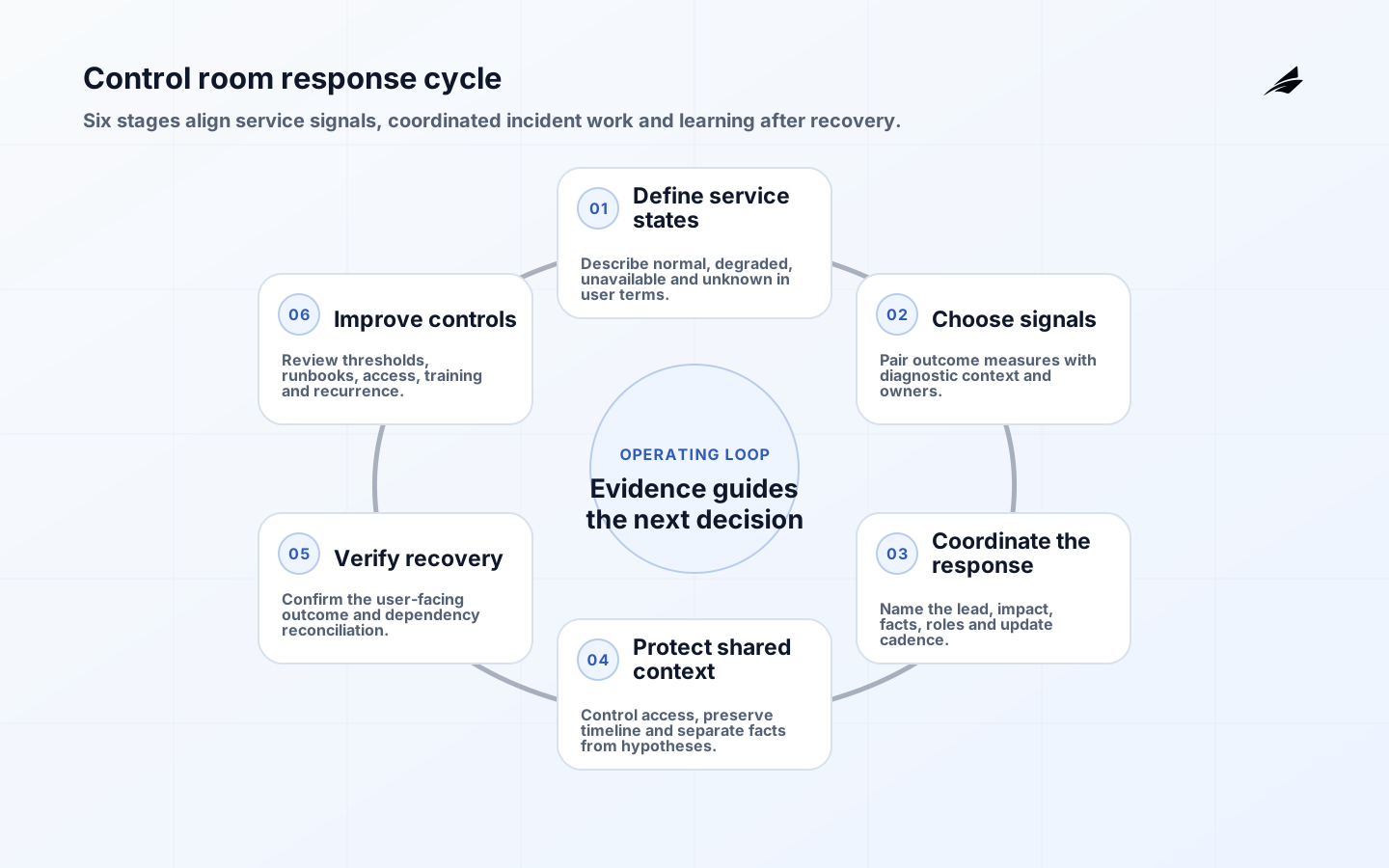
An operations control room is a capability for seeing and coordinating the condition of important services. It may be a physical room, a virtual incident channel, or a deliberately designed set of dashboards and routines. Its value is not the screen count. It is the shared ability to answer what customers are experiencing, what changed, who is coordinating, what action is safe, and whether recovery is real. A control room that only shows infrastructure health can miss a broken order flow or payment confirmation. One that only shows business totals can hide a rapidly worsening dependency. Build the operating view around service outcomes and the people who must make time-sensitive decisions.
Define service states
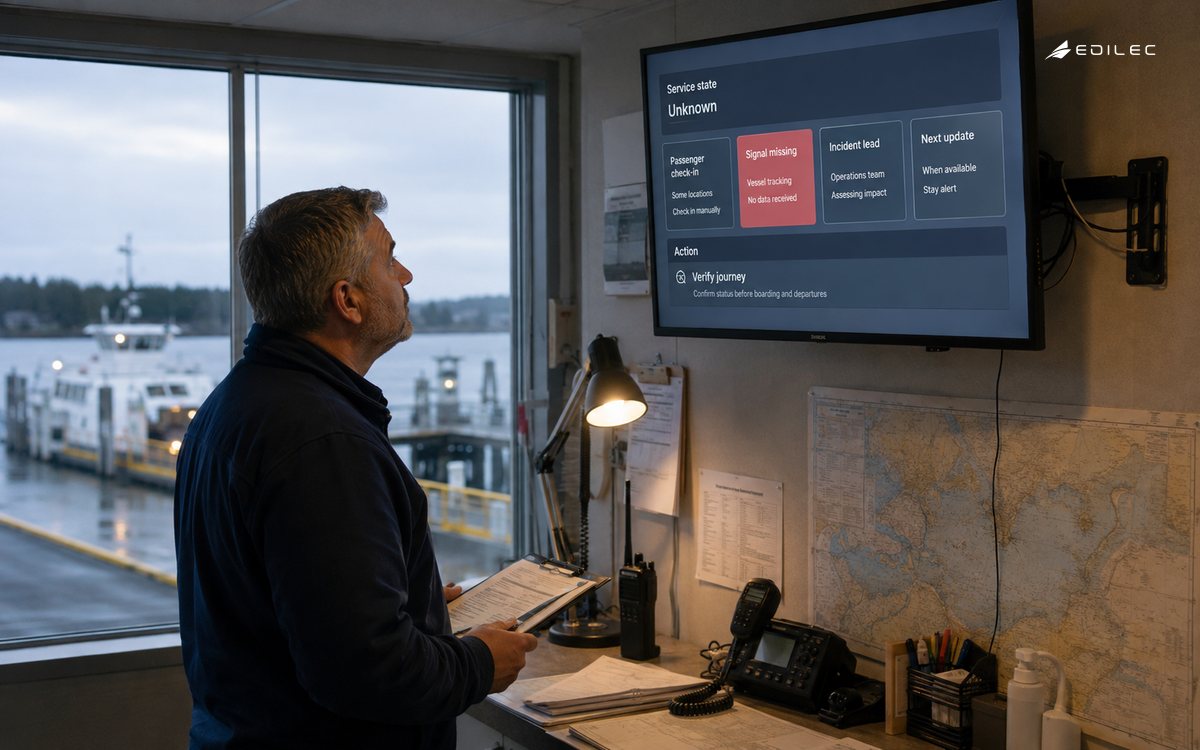
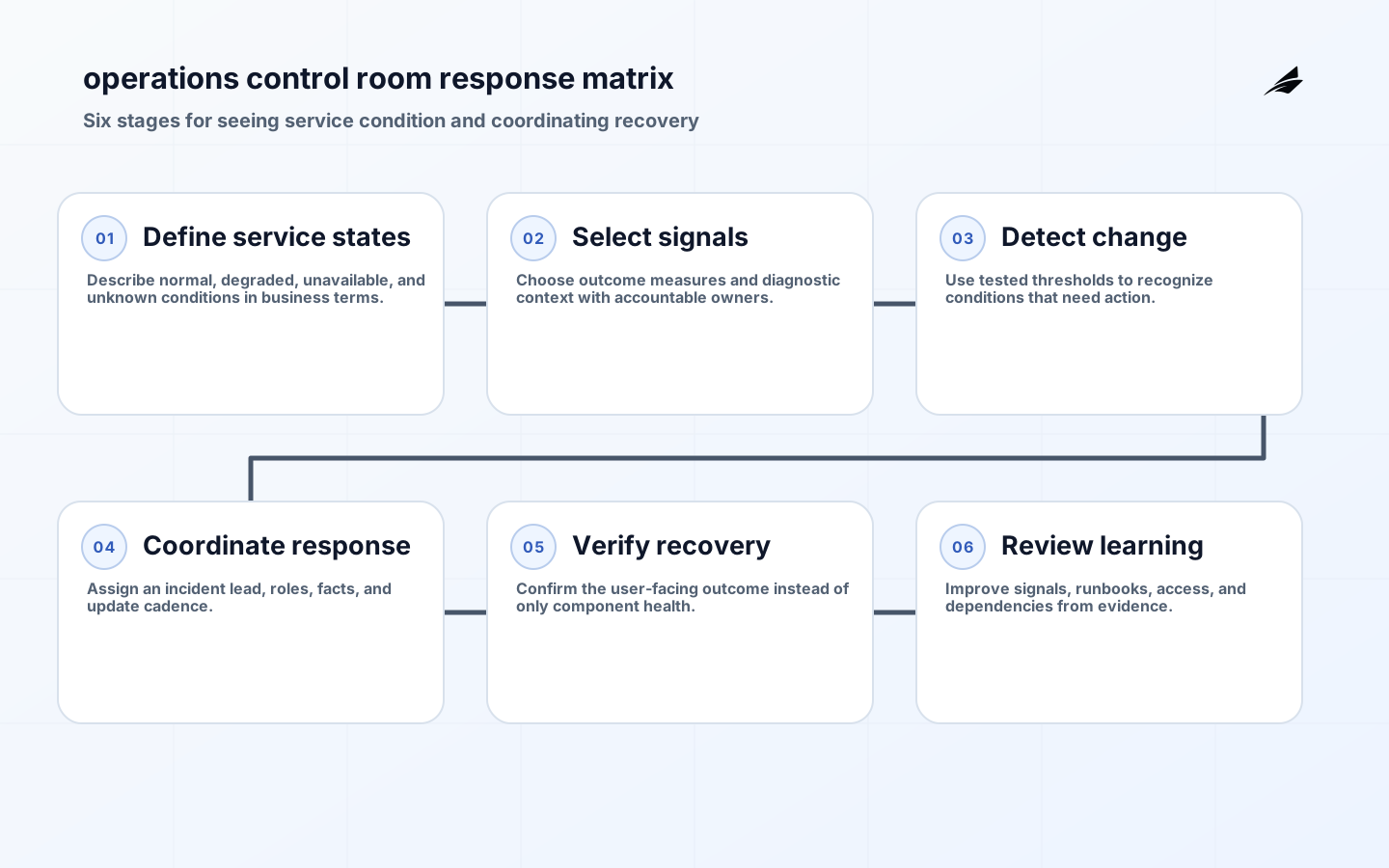
Describe normal, degraded, and unavailable conditions in terms that users and operations leaders recognize. For an ordering service, normal might mean orders can be placed and confirmed within the agreed window; degraded may mean orders are accepted but confirmation is delayed; unavailable means a meaningful population cannot complete the journey. Associate each state with evidence, impact threshold, communication need, and accountable decision-maker. The NIST Cybersecurity Framework provides a useful connected view of governance, identification, protection, detection, response, and recovery. A control room applies the same logic to any consequential operational condition: detection without a response path is merely observation.
| Service state | User outcome | Control-room response |
|---|---|---|
| Normal | Critical journey completes within expected bounds. | Watch trend and planned change. |
| Degraded | Some users face delay, fallback, or partial function. | Assign assessment and communicate scope. |
| Unavailable | A material journey cannot complete. | Open coordinated response and update cadence. |
| Unknown | Signals conflict or coverage is missing. | Investigate observability gap before declaring health. |
Choose signals that drive action
Choose a small number of signals that can change a decision, then link each to diagnostic context. Customer-journey success rate, queue age, transaction completion, inventory allocation, or payment authorization may matter more than CPU alone. Supporting signals such as error class, latency by dependency, deployment version, and regional traffic help responders explain the condition. Google SRE's monitoring guidance is particularly useful here: a monitor should be actionable, and the detailed context should assist diagnosis rather than produce an alert for every interesting graph. Record the expected baseline, threshold rationale, owner, and last review date for each material alert.
- Show the customer or operational outcome before the component view.
- Include data freshness and last-success timestamps on decision-critical displays.
- Link alerts to a runbook, current owner, and safe first checks.
- Use deploy, configuration, and dependency changes as timeline context.
- Test what happens when a signal is missing or contradictory.
Coordinate response without losing context
When a condition crosses the material threshold, appoint an incident lead even if the cause is not known. The lead coordinates the timeline, roles, decisions, and communications; they do not need to be the deepest technical specialist. Maintain a current statement of impact, known facts, hypotheses, action owner, and next update time. Keep investigation details available without letting chat speculation become official status. The operations control room checklist offers a practical pattern for separating detection, coordination, restoration, and learning. Escalate based on impact and decision rights, not on whoever happens to be online.
| Role | Responsibility | Evidence produced |
|---|---|---|
| Incident lead | Coordinates decisions and updates. | Timeline and impact statement. |
| Technical responder | Investigates and performs approved changes. | Findings and change record. |
| Operations liaison | Checks real-world workflow effects. | User and process impact. |
| Communications owner | Publishes verified audience updates. | Message history and commitments. |
Protect operational visibility
Dashboards and incident tools can reveal customer identities, employee data, vendor details, and system topology. Give users access to the detail they need for their role and minimize sensitive values in notification channels. The NIST Privacy Framework helps frame this as a governance choice: useful observability does not require broad uncontrolled visibility. Log access to sensitive views and protect the changes that alter thresholds, routing, or service-state declarations. The OWASP Application Security Verification Standard also reinforces the need for authorization and auditability in operational interfaces.
Prepare people for coordinated work
Set expectations for when the control room is advisory and when it is authoritative. A daily service review may simply surface risk to owners, while a declared disruption can require one lead to coordinate competing changes and communications. Publish that transition so teams do not wait for consensus when fast containment is needed, and so a temporary incident structure does not continue after the service has returned to ordinary ownership.
Arrange decision support around time horizons. A frontline responder needs the current impact and next safe action; a service owner needs trend, capacity, and change context; an executive may need a concise statement of material exposure and customer communication. Do not force every audience into the same dashboard or notification stream. Tailored views reduce noise while keeping the facts consistent, and they make it easier to identify when an operational condition requires a broader business decision.
Keep the control-room toolset intentionally small enough to operate. A status page, service view, current timeline, incident record, communication channel, and linked runbooks can be more effective than an elaborate command center whose parts do not agree. Periodically remove stale links, retired alerts, and unused views. Operational confidence comes from reliable shared references, not from accumulating screens.
Control-room design is also a training and decision-rights exercise. People need to know when they are expected to investigate, when they can make a reversible change, when they must pause a rollout, and who owns external communication. Write short runbooks for the conditions that recur or carry a high consequence, then rehearse them with a realistic but contained scenario. A useful exercise includes incomplete information, an unavailable dependency, a customer-impact question, and a handoff between time zones or teams. The aim is not to prove that everyone remembers a script; it is to expose uncertainty before it appears during a live disruption.
Keep the current operating picture easy to join. A responder arriving mid-event should be able to find the service affected, known user impact, change timeline, current hypothesis, actions under way, decision owner, and next update time without reading hundreds of chat messages. Create a concise incident record from the beginning and link deeper diagnostics from it. This allows technical detail to remain available while protecting the official narrative from speculation. It also supports a clean handoff when the incident spans shifts, vendors, or organizational boundaries.
Planned change deserves the same clarity. Before a high-risk release, identify the service outcome to watch, the observation window, the person able to stop or roll back, and the evidence required to declare success. Place the change on the control-room timeline so responders can correlate an emerging condition without assuming causation. After the window, record what was learned about signals, dependencies, and rollback readiness. This steady practice makes the control room useful on quiet days as well as during its most visible moments.
Review and improve the response
After material events, review the decision path while the evidence is still available. Ask what users experienced, how early the condition was detected, which signal or handoff delayed action, which controls helped, and which follow-up has an owner and due date. Avoid turning the review into a search for a person to blame; the useful output is a change to service definition, alert, runbook, access, dependency, or training. Measure detection time, time to coordinated ownership, recovery of the real service outcome, recurrence, and follow-up completion. The role-based operations guide is helpful when control-room responsibilities need clearer authority boundaries.
Control-room takeaways
- Define health in terms of a meaningful service outcome.
- Use actionable signals with linked diagnostic context and ownership.
- Coordinate incidents through explicit roles, current facts, and a communication cadence.
- Restrict sensitive operational data and audit changes to controls.
- Verify recovery from the user's perspective, then improve the system from evidence.
Control-room FAQ
Is a control room only for incidents?
No. It also supports planned change, capacity decisions, daily service review, and early detection of drift. Incident coordination is the highest-pressure use, but a well-run control room helps ordinary operations remain observable and prepared.
Which dashboard should come first?
Start with the service or customer journey whose interruption creates the clearest material consequence. Build an outcome view with a few explainable supporting signals before assembling a broad executive display.
Conclusion: operate the control room
A good operations control room turns scattered signals into a shared, accountable view of service condition. Anchor it in user outcomes, make response roles deliberate, and test recovery rather than assuming it from a chart.
Give the control room an operating rhythm
A control room needs more than a wall of metrics. Set a rhythm for normal review, material-change review, active incident coordination, and after-action learning. In normal review, inspect service outcomes and leading signals. During an incident, freeze the facts that matter, name the lead, publish the next update time, and keep hypotheses separate from confirmed impact. After recovery, verify the user-facing outcome before declaring success. Google SRE monitoring guidance is useful here because detection signals and diagnostic evidence serve different jobs.
| Mode | Primary question | Minimum artefact |
|---|---|---|
| Normal | Is the service inside its promised state? | Owner, trend and next action |
| Watch | What changed and who is checking it? | Signal annotation and review time |
| Incident | What decision is needed next? | Impact, facts, lead and update cadence |
| Learning | What should change before recurrence? | Action owner, due date and evidence |
For example, a control room may detect rising checkout failures while infrastructure metrics remain normal. The response should follow the customer outcome: confirm scope, correlate deployments and dependencies, assign an incident lead, and communicate a tested workaround. Do not wait for root cause before coordinating. Conversely, do not page every operator for a noisy signal that has no decision path. Tune thresholds against the service promise and sample false positives.
Protect the room itself. Limit who can change thresholds, incident state, or external communication; preserve the audit trail; and give responders an accessible, low-friction view. NIST's cybersecurity and privacy frameworks help separate governance and protection responsibilities, while OWASP ASVS provides a useful lens for testing the control surface. Review whether the room reduced time to ownership and recovery, not whether it produced more alerts.
The operations control rooms field guide, ticketing workflows field guide, and role-based operations guide extend this discussion into queue ownership, escalation, and access boundaries.
Control-room operating decisions
A strong control-room handoff is short and structured. State the service affected, user impact, start time, current confidence, incident lead, next decision and next update. Add links to the detailed timeline and diagnostic evidence rather than placing every log line in the status view. This helps executives, support teams and engineers use the same facts at different depths without competing versions of the incident.
Review alert quality by decision, not by volume. For each noisy signal, ask what action it should trigger, who can take that action, and how quickly the result can be checked. For each missed condition, identify whether the gap was service definition, instrumentation, threshold, access or training. The improvement backlog should contain a small number of owned changes with evidence deadlines, not a long list of observations nobody can close.