Master data management becomes a production concern when it starts making or changing records that other people must trust. The real subject is the customer, product, supplier, location, and account facts that several applications use. A pilot can look successful while users repair its mistakes by hand; production begins when the team must explain a late change, recover a failed action, and prove which record is current. This guide is for engineering teams who need a practical operating model, not a product tour. It treats the workflow as a set of decisions, durable facts, and recovery paths that remain understandable when volume, people, and integrations change.
What production changes for master data management
The first production question is not “can the system perform the happy path?” It is “what decision does this workflow make, and what evidence remains after it acts?” For master data management, define the boundary as the customer, product, supplier, location, and account facts that several applications use. Put the business outcome before interface design: name the triggering event, the accountable owner, the allowed states, the records changed, and the condition that means the work is complete. That framing exposes gaps early, particularly where a user expects a result but an integration or reviewer still has work to do.
Treat authority as a product requirement. In this case, authority means a named steward and one authoritative source for each critical field. A role label alone is too broad: the service must evaluate the current request, entity, policy, and state before it allows a consequential action. NIST's NIST SP 800-53 Rev. 5: Security and Privacy Controls is useful as a catalog of control objectives, while OWASP guidance reinforces that authorization decisions should be enforced on the server. The result should be an explicit, testable decision rather than a convention hidden in a screen or a spreadsheet.
Build an operating model before automating
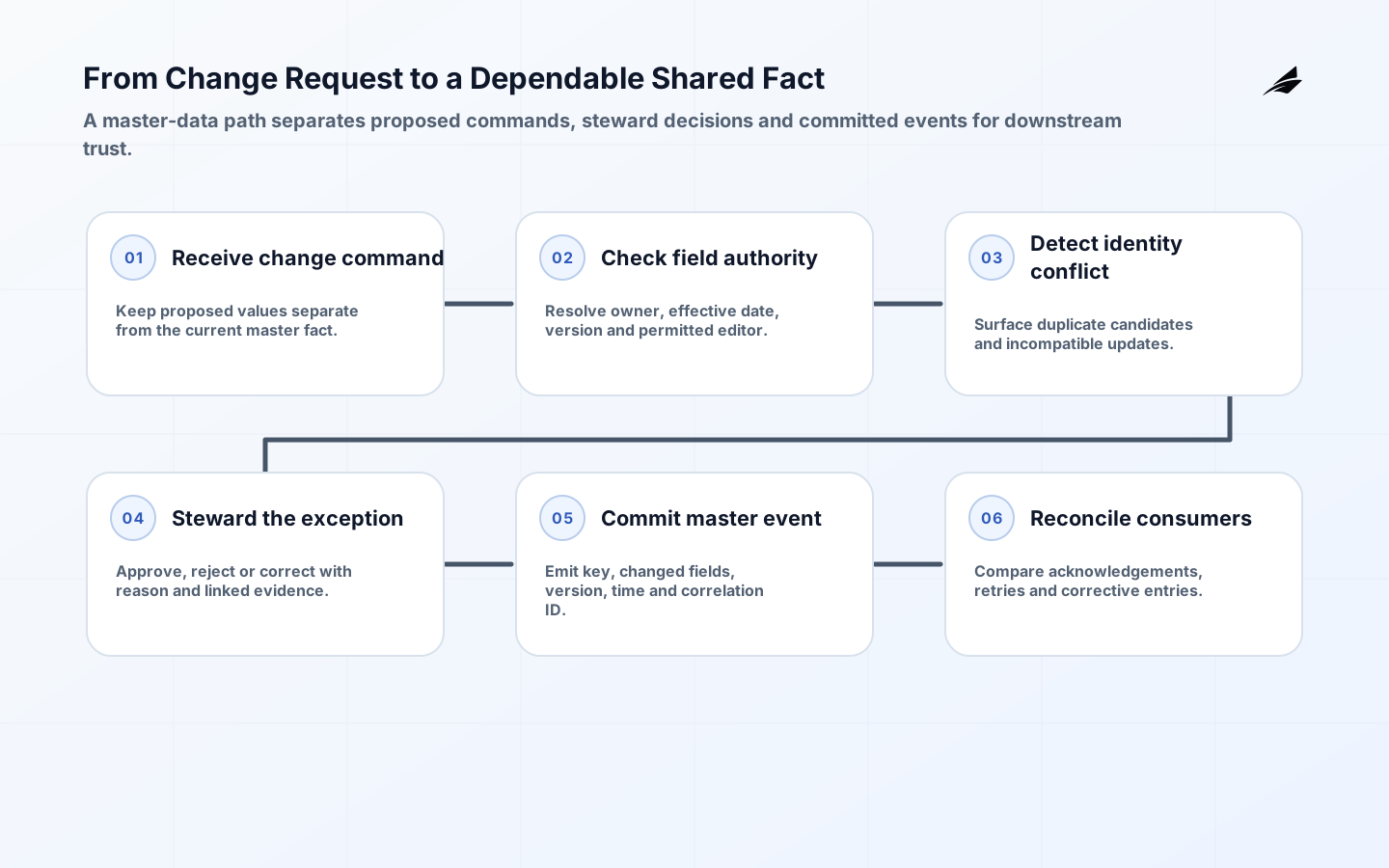
Start with a walk-through of several real cases: an ordinary case, an urgent case, a correction, and a failed dependency. For each, capture the source fact, the owner, the transition, the downstream consumer, and the evidence expected by support or audit. The workflow should create a versioned change event with the record key, changed fields, effective time, and correlation ID; it should not rely on a sequence of loosely related database updates. Stable identifiers let operations correlate a user report with the source event, retries, downstream writes, and the eventual result.
| Design question | Production decision | Evidence to retain |
|---|---|---|
| Authority | a named steward and one authoritative source for each critical field | Actor, policy or role basis, request version, and decision time |
| Source of truth | the customer, product, supplier, location, and account facts that several applications use | Stable identifier, provenance, effective date, and current version |
| Integration behavior | Deliver only committed business events and make retries safe | Correlation ID, schema version, response, and retry history |
| Exception route | a duplicate candidate, a conflicting field update, or a record that cannot meet its quality rule | Reason, impact, owner, deadline, and verified resolution |
Master data management architecture and data boundaries
Separate the command that asks to change something from the record of the resulting business fact. The command can be rejected, paused, or amended; the accepted outcome needs a durable identifier and a history. Keep current state convenient for users, but preserve the transitions that explain how it got there. That distinction matters when the system is asked to answer whether a correction replaced an earlier decision, whether a retry duplicated an effect, or whether a downstream consumer received the right version. For master data management, the durable outcome is a stewarded record version: the source system must retain both the superseded value and the reason the steward accepted the replacement.

Integrations need contracts written in business terms. Master data management should state who owns each field, when a change is effective, what event is emitted, and what the receiver must do with an unknown or repeated message. Build consumers to be idempotent and expose their dead-letter or retry state to operators. This is closely related to ticketing workflows: both succeed when shared facts have unambiguous ownership, lifecycle, and reconciliation instead of silent copies.
Logging is part of the design, not a forensic afterthought. NIST SP 800-92: Guide to Computer Security Log Management and NIST SP 800-161 Rev. 1: Cybersecurity Supply Chain Risk Management support a simple practice: log the action type, authoritative identifiers, actor or service identity, outcome, policy or rule version, and correlation ID; avoid indiscriminately logging sensitive values. Use a consistent event format and synchronized time so an on-call engineer can reconstruct the sequence across services. A log that cannot distinguish an accepted action from an attempted one creates false certainty during an incident. For master data management, make the event vocabulary specific to its sensitive records and operational decisions; generic activity logs do not provide enough context to safely resolve a disputed outcome.
Design the exception path as a first-class path
The defining production scenario is a duplicate candidate, a conflicting field update, or a record that cannot meet its quality rule. Do not bury it in an administrator note. Model it with a state, an owner, a visible reason, and a target for review. A good exception path prevents uncertain work from moving forward while preserving the facts needed to repair it. It also gives users a truthful status: waiting for input, under review, corrected, or unable to complete. That is more useful than a generic failure message that sends the same case through the system again.
Make retries selective. A timeout does not establish that the original operation failed, so a blind retry can create a second charge, posting, movement, or notification. Put an idempotency key at the business operation boundary, persist the first accepted outcome, and return it on subsequent attempts. Where a reversal is needed, record a separate compensating action with a reason and link it to the original record. The system should never “fix” a material history by overwriting the original fact. For master data management, retries must not create competing customer, supplier, or product identities; match against the canonical key before accepting a second create request.
| Failure mode | Preventive control | Recovery evidence |
|---|---|---|
| Repeated request or message | Idempotency key and conditional state transition | Original outcome, retry count, and correlation ID |
| Stale or conflicting data | Version check and named authoritative field owner | Expected and received versions plus resolution decision |
| Dependency unavailable | Bounded retry, queue visibility, and fallback owner | Attempt history, queue age, and recovered outcome |
| Material correction | Approval where policy requires it and immutable adjustment | Reason, approver, linked original record, and effective time |
Release controls that reduce operational surprises
Release the smallest meaningful path, but make it observable from day one. Start with a limited population, a feature gate, explicit rollback criteria, and a way to reconcile pre-release and post-release results. A release should answer: which rule version ran, which records were affected, how can the action be disabled, and who decides whether it expands? NIST's contingency planning guidance is a helpful reminder that resilience includes procedures and roles, not just infrastructure redundancy. For master data management, begin with one entity domain and compare every published version against the consuming applications before broadening stewardship.
- Write the master data management state model, including forbidden transitions and who can make each permitted transition.
- Assign a business and technical owner for every integration, queue, and manual recovery step.
- Exercise a duplicate candidate, a conflicting field update, or a record that cannot meet its quality rule in a staging environment with realistic identifiers and downstream responses.
- Add idempotency, correlation, and version fields before a dependent team begins consuming events.
- Set dashboards for volume, failure rate, queue age, and reconciliation differences, with a named responder.
- Run a controlled rollback or disablement rehearsal before expanding access or throughput.
Operating signals that deserve attention
Measure whether the workflow is producing the intended a dependable shared business fact rather than a copied value. Volume alone is not enough. Track the rate and age of exceptions, records requiring manual repair, retries that end in a different result, reconciliation differences, and time from detection to verified recovery. Pair those measures with a qualitative review of a small sample of cases each month. It is the fastest way to discover that a rule technically works but is forcing users into unnecessary workarounds.
Use thresholds to prompt investigation, not to automate blame. A rise in master data management exceptions may reflect a new upstream data source, a staffing change, or a real design defect. Segment the signal by integration, rule version, business entity, and outcome before acting. The operational view from finance systems is useful here: visibility should lead to an owner and an action, not merely to more charts. Retain enough context to compare the signal before and after a release.
Key takeaways
- Master data management should preserve the business facts and decisions that other teams must later trust.
- Make a named steward and one authoritative source for each critical field visible in the request, service boundary, and audit trail.
- Emit a versioned change event with the record key, changed fields, effective time, and correlation ID only after the business action is committed.
- Treat a duplicate candidate, a conflicting field update, or a record that cannot meet its quality rule as a designed operating path with a clear owner and resolution evidence.
- Use idempotency, versioning, and reconciliation to make integration failures recoverable rather than mysterious.
- Connect ongoing control work to HRMS workflows, where the same discipline applies to adjacent enterprise workflows.
FAQ
When is master data management ready for production?
Master data management is ready when the team can demonstrate the normal path, a failed dependency, a duplicate request, a correction, and a controlled disablement. Readiness also requires accountable owners, production access rules, identifiers that traverse the whole path, and monitoring that can distinguish backlog from loss. A polished interface is useful, but it is not evidence that the operating model can recover from ambiguous outcomes.
Should every exception require manual approval?
No. Reserve manual review for situations where the policy, evidence, or impact is uncertain. Repeated low-risk exceptions often point to a missing rule or poor data contract and can become safe automation after measurement. The important distinction is that an automated resolution must still state its conditions, preserve the source facts, and leave an auditable result. Never use automation to conceal a known uncertainty in master data management.
Which records should be reconciled?
Reconcile the population of source events, accepted actions, rejected actions, pending work, downstream acknowledgements, and corrective entries. Compare counts first, then investigate material value or status differences. The reconciliation interval should reflect business impact: near-real-time for customer promises or sensitive commitments, daily for many operational controls, and aligned to close for finance-sensitive records. A reconciliation is complete only when a difference has an owner and a recorded disposition. For master data management, reconcile canonical records, proposed changes, published versions, consumer acknowledgements, and duplicate-resolution decisions by entity and effective date.
Conclusion
Master data management earns trust in production when it can explain its decisions and recover without hiding the history. Begin with the business fact and accountable owner, specify durable contracts, instrument the exception path, and rehearse the recovery route. That approach gives engineering teams a practical basis for releasing a narrow workflow, learning from its real operating signals, and expanding it only when the evidence supports doing so.