Ticketing Workflows Decisions That Matter before the First Build
Ticketing workflows are not merely queues with status labels. They are a shared decision system for requests, incidents, approvals, and follow-up. A team needs one when work disappears in chat, priority is negotiated from scratch, or a customer cannot learn what happened to a request. The design target is modest but demanding: any participant should be able to see what was asked, what evidence supports its priority, who owns the next move, and when the record can be considered complete. That clarity matters more than a long catalogue of fields.
Separate intake from classification
Design the front door around the requester’s language, then classify internally. Require enough information to identify the affected service, requester, impact, and desired outcome, but do not force a requester to choose an internal resolver group. Triage can add category, urgency, sensitivity, and assignment after it examines the evidence. This separation improves both experience and data quality. It also prevents a workflow from being gamed by users who learn that a certain category or severity receives faster attention.

| Work type | Intake promise | Triage decision |
|---|---|---|
| Service request | Describe the outcome and affected person or asset. | Is it standard, needs approval, or needs specialist review? |
| Incident | Capture symptoms, time, affected service, and business impact. | Is there an active disruption and who leads containment? |
| Problem | Link repeating signals and known workarounds. | Does evidence justify root-cause investigation? |
| Change request | State purpose, risk, dependencies, and rollback approach. | Can it follow a standard path or require a change authority? |
Model states as commitments, not decoration
Use a small number of states whose meaning is testable. For example, queued means a receiving team has accepted responsibility; in progress means an owner is actively working; waiting means progress depends on a named external party; resolved means a proposed outcome is available; closed means required confirmation and recordkeeping are complete. Do not add a state just to describe every internal mood. Each transition should say who can make it, what information is required, what timer changes, and what notification or integration event follows.
BPMN 2.0 is useful for drawing handoffs and exception paths, while NIST SP 800-61 emphasizes preparation, detection, response, and lessons learned for incidents. NIST SP 800-92 explains why event records need usable collection and retention, and NIST SP 800-53 provides a control vocabulary for access and accountability. Together, they support a ticket record that can explain a decision rather than only prove a button was clicked.
| Transition | Required evidence | Automated action |
|---|---|---|
| Submit to triage | Requester, service, description, contact route. | Create immutable reference and acknowledge receipt. |
| Assign | Resolver group, accountable owner, target response. | Notify owner and start the applicable clock. |
| Escalate | Impact change, reason, decision owner. | Page or route according to the service policy. |
| Close | Resolution, requester confirmation or closure rule, related records. | Archive audit trail and invite focused feedback. |
Pilot one path with real exceptions
Begin with a single high-volume request or a clearly bounded incident class. Watch ten actual tickets from request through completion and record every unofficial handoff, missing datum, reopened item, and manual spreadsheet. Then configure only the fields and automations that remove those failures. Test duplicate submissions, a request from an unauthorized person, a missed assignment, a ticket that crosses teams, and a resolution the requester disputes. A workflow that passes these cases is more valuable than a beautifully configured portal no one trusts under pressure.
- Set response and resolution targets by service impact, not by the personal importance of the requester.
- Make assignment, reassignment, waiting, escalation, and closure visible in the record history.
- Use templates for recurring evidence, but allow an agent to document a meaningful exception.
- Link incidents, changes, knowledge articles, and affected assets instead of copying their history into every ticket.
Prevent queue theatre and silent expiry
A ticketing workflow fails when its measurements reward moving work rather than solving it. Closing and immediately reopening tickets, reclassifying aged work, or placing items in an unowned waiting state can make reports look healthy while customers wait. Another risk is over-automation: a rule can route a request quickly to the wrong team and bury the original context. Audit a sample of aged, reopened, and reassigned records. The pattern will show whether the queue represents real work or merely tracks administrative movement.
Measure flow and quality together
Useful measures include time to acceptance, time in each state, reassignment count, reopen rate, overdue items, and the share of work resolved through standard fulfilment. Segment them by request type and service, because a blended average can hide a stalled handoff. Pair numbers with record review: inspect a small sample of urgent tickets, tickets that missed a target, and tickets closed without requester confirmation. The goal is to improve decisions at the next handoff, not to publish a leaderboard for the support team.
Give the workflow a product owner
A workflow changes as services, teams, and risk tolerance change. Appoint a product owner who maintains the taxonomy, field definitions, service targets, and integration contracts with input from operators. Review proposed changes for their reporting impact and migration needs before deploying them. Retain old category mappings where historical analysis depends on them. This small governance practice prevents the ticketing system from becoming a collection of local customizations that no one can safely simplify.
Ticketing Workflows: Key takeaways
During the first month, hold a short queue review with requesters and resolvers; ticket states expose the commitment. Pick work that was reassigned, reopened, or delayed and read the record in time order; ticket states expose the commitment. Ask whether the intake made the issue understandable, whether triage had enough evidence, and whether each handoff created a clear next commitment; ticket states expose the commitment. Change one workflow rule at a time and compare the result. This keeps local workarounds from becoming hidden policy and gives the organization a practical way to improve service without mistaking a faster status change for a better outcome; ticket states expose the commitment. During the first month, hold a short queue review with requesters and resolvers; the queue owner can inspect the next step. Pick work that was reassigned, reopened, or delayed and read the record in time order; the queue owner can inspect the next step. Ask whether the intake made the issue understandable, whether triage had enough evidence, and whether each handoff created a clear next commitment; the queue owner can inspect the next step. Change one workflow rule at a time and compare the result. This keeps local workarounds from becoming hidden policy and gives the organization a practical way to improve service without mistaking a faster status change for a better outcome; the queue owner can inspect the next step.
For ticketing workflows, make the next review concrete: select a recent exception, trace the record from its first source through every handoff, compare the stated rule with the action taken, and record the owner of the correction. Include timing, access, communication, and reconciliation rather than treating the technical result alone as success; ticket states expose the commitment. This compact evidence exercise reveals where the workflow is unclear and gives the team a measured basis for its next improvement; ticket states expose the commitment.
- Ticketing workflows should make ownership, priority evidence, and next actions visible at every handoff.
- Keep requester intake simple; let trained triage classify work using shared rules.
- State changes need a testable commitment, recorded evidence, and an accountable actor.
- Related reading: operations control rooms, approval workflows, and HRMS workflows.
Ticketing Workflows: Frequently asked questions
Who should set priority?
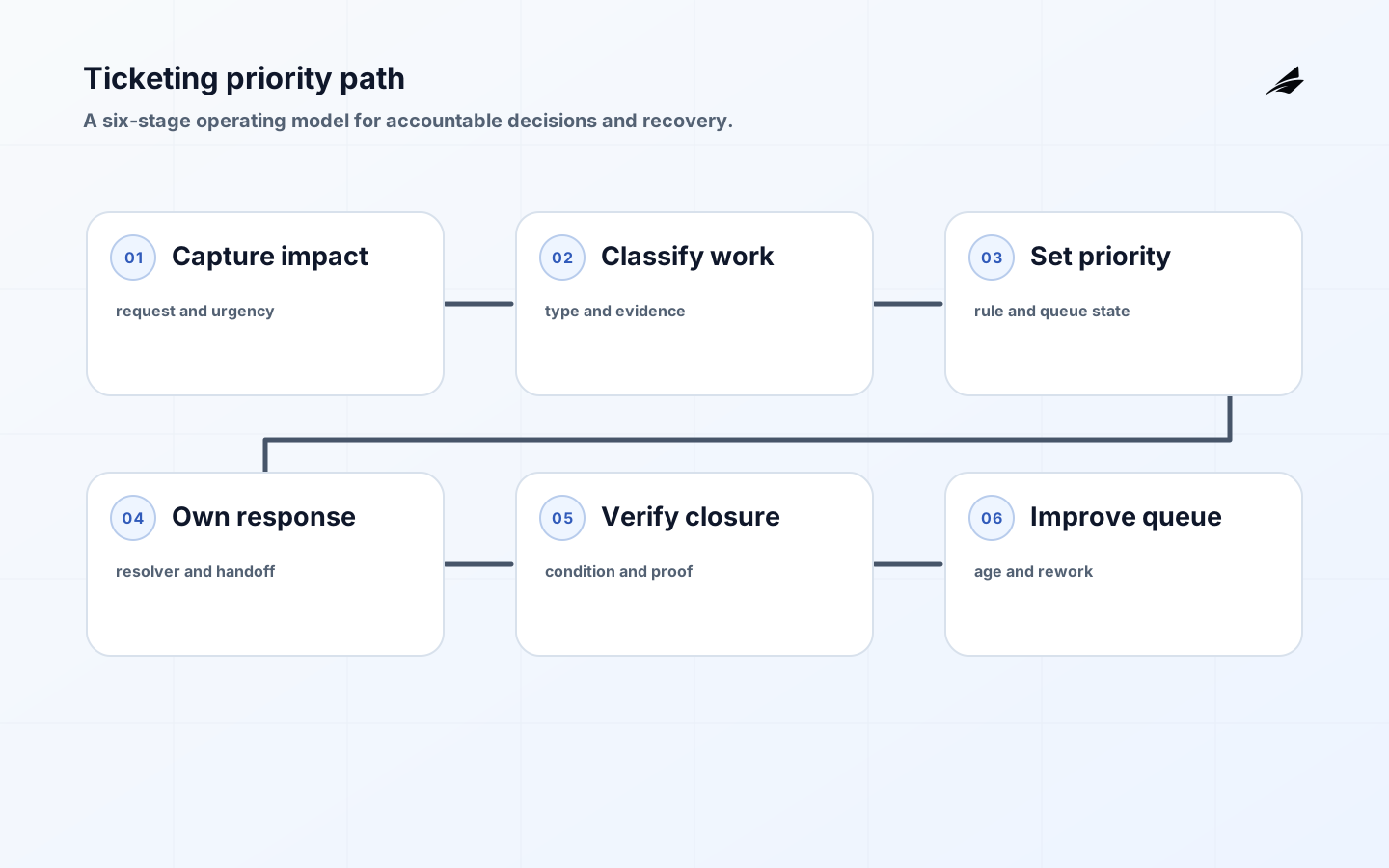
The requester supplies impact and urgency; the receiving organization applies a published priority model. This preserves essential context while protecting the queue from status-based escalation. For material incidents, an incident lead may adjust priority as evidence changes, but the reason and time should be recorded. A priority model is credible only when users can see how it is applied.
When is a ticket genuinely closed?
Close a ticket when the documented closure condition is met, not merely when a responder has sent a message. The condition may be requester confirmation, verified restoration, a completed standard request, or a published policy for no response after reasonable notice. Keep the resolution, linked work, and final state history available so later incidents do not begin from memory.
How should a ticket handle a dependency delay?
Name the dependency, impact, owner, next review time, and safe interim action; do not hide the wait by moving the ticket to a misleading status.
Conclusion: make handoffs inspectable
A good ticketing workflow gives ordinary work the same dignity as an urgent incident: a clear request, a responsible owner, evidence for choices, and a truthful end state. Build one route around the work people actually do, test it against uncomfortable exceptions, and use its records to improve the next handoff. The result is a calmer operation, not simply a more elaborate queue.
Ticketing Workflows operating checklist
A dependable ticketing workflow design makes the decision boundary visible. Define the user, the unit of work, the allowed action, the evidence required, the time boundary, and the owner who can correct a result. Apply the official controls already named in this article: provenance should connect entities, activities, and responsible agents; security controls should protect the action that matters; observability should describe a customer-relevant outcome rather than only a technical event. In practice, this means a late source, rejected request, disputed invoice, blocked service, or reconnecting device becomes an owned state with a next review, not an unexplained red badge. Use one representative path as the release test. For a data path, reconcile a sample against the source. For a portal, prove tenant isolation and safe correction. For a workflow, replay a duplicate and a dependency failure. For billing, reproduce the same charge from retained inputs. For MQTT, exercise expiry, reconnect, authorization, and downstream acknowledgement. The test should produce evidence that an operator can inspect without asking the original implementer. Read the related Edilec guides related guide, workflow exceptions, and production operations. | Review question | Evidence to retain | Decision when absent | |---|---|---| | What was requested? | scope, actor, time | clarify or reject | | What changed? | event, version, owner | investigate or replay | | What is trusted? | priority, queue state, closure proof | publish with caveat or hold | | How is it corrected? | before, after, reason | approve, reverse, escalate | | What improves next? | cause, trend, owner | schedule a bounded change | ### FAQ What belongs in the first release? One complete path with its highest-cost exception. Who owns the result? The person accountable for the business meaning, supported by a technical owner. When should scope expand? After normal work, failure recovery, access review, and correction are all measurable. ### Conclusion The durable form of ticketing workflows is an operating capability: explicit promise, controlled action, inspectable evidence, and a review loop. Start narrow, test the uncomfortable cases, and scale only when the evidence remains understandable.