A Field Guide to CRM Automation for Growing Teams
For CRM automation, cRM automation should remove routine coordination while keeping customer context, consent, and accountable judgment intact. At the trigger boundary, it is valuable when opportunities stall because follow-up is inconsistent, handoffs lose the reason for a conversation, or customer records cannot tell a support colleague what was promised. It is not a license to send more messages. During a rule review, the first design question is which customer-facing or internal decision needs reliable follow-through: qualify an inquiry, route a renewal risk, schedule a task, request approval, or create a service handoff. Automation should make that decision easier to inspect and improve.
For CRM automation, this guide uses NIST Privacy Framework, W3C Verifiable Credentials Data Model 2.0, W3C PROV-DM, NIST SP 800-53 Rev. On the customer follow-up path, 5 to connect the implementation boundary with authoritative evidence, operating checks, and a visible correction path. For automation owners, during the handoff, the references are applied to the concrete decisions, records, and failure cases discussed below.
CRM automation: choose an outcome before a trigger
Within this CRM workflow, describe the intended business outcome, eligible audience, owner, and stop condition before configuring a workflow. A form submission is a trigger, not an outcome. For CRM automation, for a lead-routing flow, define what makes a lead eligible, which territory or account rule applies, how conflicts are handled, and when the assignee must respond. At the trigger boundary, for a renewal flow, define the customer signal that merits attention and what a manager needs to see before acting. During a rule review, this keeps a CRM from accumulating automations that fire correctly yet create work with no customer value.

| Outcome | Trigger evidence | Stop condition |
|---|---|---|
| Qualified inquiry reaches an owner | Consent, account match, source, stated need. | Owner accepts, disqualifies, or routes the record. |
| Renewal risk receives review | Contract date, usage or service signal, account context. | Account plan is updated with next action. |
| Customer handoff is complete | Accepted deal, product scope, contacts, commitments. | Receiving team confirms readiness. |
| Data correction is resolved | Conflicting attribute and source evidence. | Steward approves correction or retains a documented exception. |
CRM automation: protect context and purpose in customer data
Model customer data by purpose. On the customer follow-up path, a sales contact, product user, billing contact, and privacy preference may refer to the same person but authorize different actions. For automation owners, retain the source and date for material attributes, especially consent, relationship role, lifecycle stage, and marketing preference. Within this CRM workflow, avoid a broad profile that makes sensitive details visible to every user merely because a CRM can store them. For CRM automation, role-aware access and purpose-limited fields protect customers and improve data quality because people are more likely to maintain information they understand and are authorized to use.
The NIST Privacy Framework offers a way to reason about privacy risk and organizational outcomes. W3C Verifiable Credentials Data Model 2.0 illustrates the importance of issuer, holder, and verifiable claims; W3C PROV-DM helps retain provenance; and NIST Cybersecurity Framework supports access and audit control thinking. At the trigger boundary, applied here, automation should preserve who supplied information, why it is being used, and which actor authorized consequential changes.
| Data element | Automation use | Required safeguard |
|---|---|---|
| Consent and preference | Determine permissible messages and channels. | Record source, scope, time, and withdrawal handling. |
| Account ownership | Route work and prevent duplicate outreach. | Resolve conflicts through an accountable assignment rule. |
| Lifecycle stage | Select a follow-up or handoff workflow. | During a rule review, define entry and exit evidence; do not infer it from activity alone. |
| Sensitive notes | Provide context for limited service or sales roles. | Restrict audience and establish retention expectations. |
CRM automation: pilot one sequence with a human escape route
On the customer follow-up path, run one automation from trigger through completion with real records and a named reviewer. For automation owners, test duplicate contacts, a changed account owner, a person who withdraws consent, an existing open opportunity, and a handoff rejected by the receiving team. Within this CRM workflow, every automated decision needs a way for an authorized user to pause, correct, or override it with a reason. That does not make automation weak. For CRM automation, it provides the feedback needed to identify a mistaken rule, an incomplete record, or a case where a human relationship deserves a different response.
- Use deterministic routing rules before introducing scoring or predictive recommendations.
- At the trigger boundary, show the rule, trigger time, previous owner, and resulting action in the record timeline.
- During a rule review, require a confirmation for actions that create commitments, change account ownership, or contact a customer.
- On the customer follow-up path, review automation exceptions weekly and turn recurring exceptions into a controlled rule change or a published policy.
CRM automation: avoid automation that amplifies bad signals
For automation owners, a poorly chosen activity score can turn attention into pressure: the most visible customers receive more outreach while quiet accounts with real needs disappear. Within this CRM workflow, duplicate syncs can send contradictory messages, and an outdated lifecycle field can trigger an embarrassing campaign. Build suppression and conflict rules before scale. For CRM automation, treat a customer response, a privacy request, a new owner, and an open service issue as signals that may halt or alter an automated sequence. At the trigger boundary, the best CRM automation is often the rule that prevents an unnecessary message.
CRM automation: review customer impact as well as throughput
On the customer follow-up path, measure acceptance by the receiving owner, time to first meaningful action, duplicate rate, suppression rate, manual overrides, and downstream outcomes such as qualified conversations or completed handoffs. Review a sample of records where automation was stopped or reversed. For automation owners, those cases reveal whether a rule is too broad, a source is stale, or a business definition needs refinement. Do not equate more tasks or more sent messages with success. The aim is fewer missed commitments and more relevant interactions.
CRM automation: operate automations as controlled business rules
Within this CRM workflow, give each production workflow an accountable business owner, technical maintainer, documented purpose, data dependencies, and review date. For CRM automation, changes should be tested with representative records and assessed for reporting, consent, and integration effects. Retire rules whose audience or process no longer exists. At the trigger boundary, this lightweight governance makes the CRM easier to trust because users know where a surprising action came from and whom to ask before changing it.
CRM automation: cRM automation checks to carry forward
During a rule review, on the release path, run a monthly rule review with sales, service, marketing, and data stewardship. On the customer follow-up path, in this review, inspect one record that received the intended action, one that was suppressed, and one that required a human override. Discuss the customer context, not just the configuration. For automation owners, at this checkpoint, the conversation identifies rules that are technically correct but commercially unhelpful, fields that are misleading, and obligations that should stop outreach. Document the chosen improvement and its owner. Within this CRM workflow, for the operating decision, this keeps CRM automation connected to real customer relationships as the business changes. For CRM automation, during the handoff, run a monthly rule review with sales, service, marketing, and data stewardship. At the trigger boundary, on the release path, inspect one record that received the intended action, one that was suppressed, and one that required a human override. Discuss the customer context, not just the configuration. During a rule review, in this review, the conversation identifies rules that are technically correct but commercially unhelpful, fields that are misleading, and obligations that should stop outreach. Document the chosen improvement and its owner. On the customer follow-up path, at this checkpoint, this keeps CRM automation connected to real customer relationships as the business changes.
For automation owners, for CRM automation, make the next review concrete: select a recent exception, trace the record from its first source through every handoff, compare the stated rule with the action taken, and record the owner of the correction. Within this CRM workflow, during the handoff, include timing, access, communication, and reconciliation rather than treating the technical result alone as success. For CRM automation, on the release path, this compact evidence exercise reveals where the workflow is unclear and gives the team a measured basis for its next improvement.
- At the trigger boundary, cRM automation should deliver a defined customer or team outcome, not merely react to a database event.
- During a rule review, keep consent, source, relationship role, and account context visible where automation makes a decision.
- On the customer follow-up path, provide an accountable human escape route and use overrides as evidence for improving the rule.
- Related reading: master data management, approval workflows, and HRMS workflows.
CRM automation: questions before enabling a rule
Questions before enabling a rule
Usually no. For automation owners, start with a transparent routing or follow-up rule tied to evidence that operators already trust. Within this CRM workflow, scoring can be useful after the organization has reliable definitions, feedback outcomes, and a way to inspect why a record received a recommendation. For CRM automation, a score should guide review, not conceal a decision about whom the business chooses to serve.
Questions before enabling a rule
Set permissions by purpose. At the trigger boundary, sales users may update relationship context, service teams may update service evidence, and stewards may resolve shared identity or preference conflicts. During a rule review, high-impact fields such as consent, ownership, and contract status need clear sources and audit history. On the customer follow-up path, the goal is not to make edits difficult; it is to keep changes understandable when a workflow acts on them.
Conclusion: automate follow-through, not assumptions
For automation owners, cRM automation is trustworthy when it carries a useful commitment forward without inventing customer intent. Within this CRM workflow, start with one outcome, preserve the evidence behind each trigger, and invite operators to correct the rule when real relationships do not fit the model. For CRM automation, that approach produces fewer dropped handoffs and more respectful customer interactions than a large collection of unattended sequences.
Make automation earn its place in the CRM
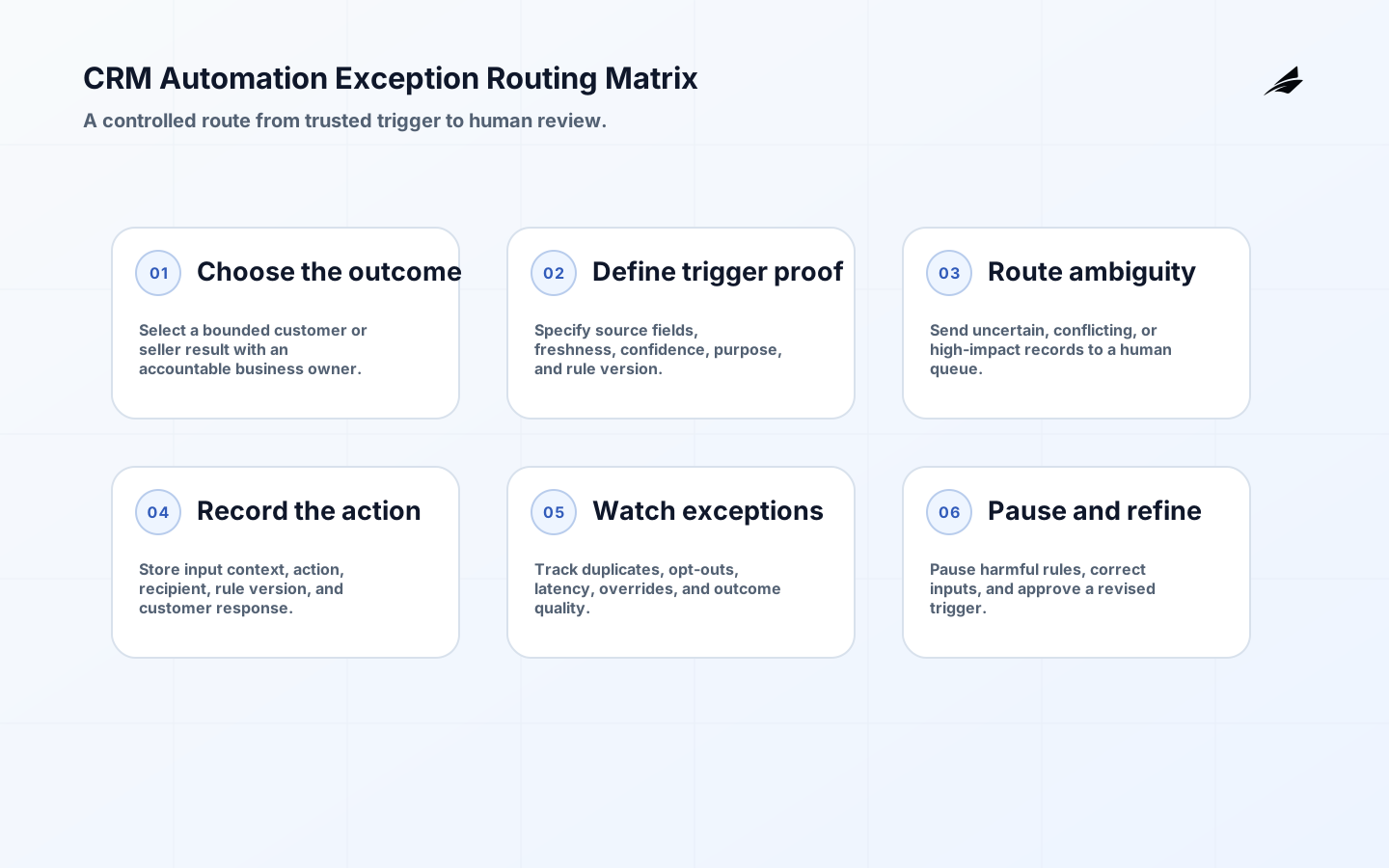
At the trigger boundary, start with a CRM automation that removes a repeatable handoff without concealing a judgment. During a rule review, for instance, a qualified lead can be assigned to a regional queue when required fields are present, while an ambiguous record is routed to a human owner. On the customer follow-up path, define the trigger, the data it may read, the action it may take, the retry behavior, and the person who receives an exception. For automation owners, then run ordinary, duplicate, delayed, and revoked-consent cases before allowing the automation to write broadly.
Within this CRM workflow, the Privacy Framework and W3C provenance model point toward two practical disciplines: purpose limitation and traceability. For CRM automation, keep a readable history of the triggering facts, rule version, actor or service identity, and resulting change. At the trigger boundary, if an automation sends a message or changes a customer status, the record should show why. During a rule review, growing teams should also set a stop rule: pause the flow when duplicate rate, failure rate, or unresolved exceptions cross an agreed threshold. On the customer follow-up path, that creates a controlled operating system rather than a pile of invisible rules.
For automation owners, for CRM automation, pair event analytics notes, KPI governance principles, and finance reporting fixes with accountable outreach decisions when triggers affect customer-facing work carefully.