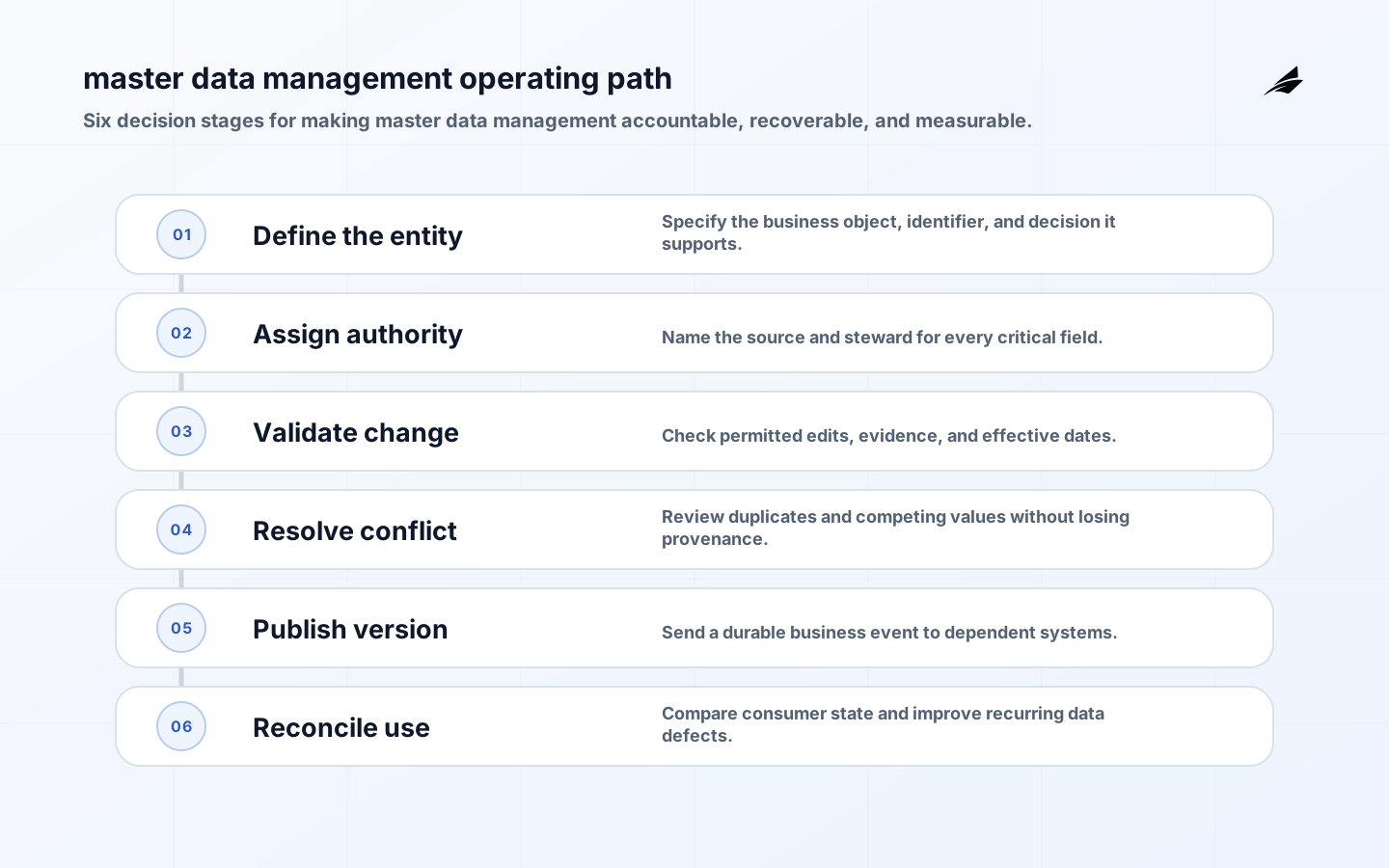
A customer record that means one thing in sales and another in finance is not a reporting inconvenience; it is an operational defect. Master data management moves into production when people rely on shared identities, classifications, and relationships to approve work, serve customers, or close the books. The hard work is choosing which system can change each attribute, how a new value is verified, and how downstream teams learn that a record has changed.
Set the decision boundary for master data management
Define the first release around one business entity and one decision. A supplier profile used for purchasing, a customer account used for credit, or a product hierarchy used for pricing is a better starting point than an enterprise-wide cleanup program. Write down its identifier, mandatory attributes, owners, permitted transitions, and the moment a change becomes effective. This creates a contract people can test instead of a vague promise that data will become clean.
| Design concern | Decision to make | Evidence to retain |
|---|---|---|
| Business entity | Customer, supplier, product, location, or employee identity | One business owner and a documented steward |
| Identifier | Cross-system key and source reference | A durable ID that is never recycled |
| Change authority | Field-level source and approver | A policy rule and an audit event |
| Conflict path | Duplicate, stale, or disputed value | A queue, reason code, and decision deadline |
Keep records that explain the outcome
The authoritative record does not have to contain every useful field. It must, however, be unambiguous about which source wins for each field and why. Keep source identifiers, update time, steward decision, match confidence, and a version or event reference with material changes. That evidence lets a steward correct a survivor decision without erasing the history that explains why a consumer saw the earlier value.
Design master data management as an accountable flow
Use a governed change path: capture a proposed change, validate it against policy, resolve matches and conflicts, commit the approved version, and publish a business event. Consumers should receive a stable identifier and version rather than infer change from a full-file refresh. A consumer that cannot process a new value should be visible as behind, not silently left with a competing copy.

| Operating stage | Control to design | Signal to review |
|---|---|---|
| Inbound change | Schema, required fields, and source permission | Rejected record count and steward workload |
| Match decision | Confidence threshold and reviewer rule | False merge and unresolved candidate samples |
| Published update | Version, event ID, and effective date | Consumer lag and replay failures |
| Reconciliation | Hub versus consumer comparison | Differences by entity and aged exceptions |
Put authority and evidence into the controls
Treat duplicate detection as decision support, not a license to merge records automatically. A high-confidence match can be queued for review; a low-confidence conflict should retain both candidates and a reason code. Limit who can alter identity fields, separate approval from execution for sensitive domains, and record the basis for overrides. These choices map naturally to access, audit, recovery, and governance practices described by NIST.
For master data management, NIST's Cybersecurity Framework is useful as a governance lens: identify the data-dependent business outcome, protect critical change authority, detect consumer failures, and recover from bad publication. SP 800-53, SP 800-34, and SP 800-92 reinforce the need for access control, contingency procedures, and auditable record changes.
Release with exceptions in view
Pilot with a domain where one steward group can make timely decisions and where downstream consumers can reconcile. Rehearse a merge reversal, a rejected import, and a consumer replay before broadening the domain. The release is complete only when business users can explain where to request a correction and operators can show whether every approved event reached its consumers.
Measure operating reliability, not activity alone
Measure duplicate rate by source, steward decision time, rejected-change reasons, consumer lag, and reconciliation differences between the hub and important subscribers. A falling duplicate count is not enough: it can be caused by suppressing candidates. Pair it with sampled accuracy and the number of records whose ownership is explicit. Review recurring exceptions with the teams producing the source data, because correction without process feedback merely moves the queue.
Pre-build decision register
- For master data management, confirm stable business identifiers and source references; write the rule, named owner, effective time, audit evidence, failure signal, and recovery action into the build decision record before release.
- For master data management, test stable business identifiers and source references with normal, delayed, corrected, and failed inputs; retain the result so the operating team can explain and safely repeat the decision.
- For master data management, confirm field-level ownership for names, addresses, and classifications; write the rule, named owner, effective time, audit evidence, failure signal, and recovery action into the build decision record before release.
- For master data management, test field-level ownership for names, addresses, and classifications with normal, delayed, corrected, and failed inputs; retain the result so the operating team can explain and safely repeat the decision.
- For master data management, confirm effective-date rules for current and planned changes; write the rule, named owner, effective time, audit evidence, failure signal, and recovery action into the build decision record before release.
- For master data management, test effective-date rules for current and planned changes with normal, delayed, corrected, and failed inputs; retain the result so the operating team can explain and safely repeat the decision.
- For master data management, confirm match thresholds for automated candidate creation; write the rule, named owner, effective time, audit evidence, failure signal, and recovery action into the build decision record before release.
- For master data management, test match thresholds for automated candidate creation with normal, delayed, corrected, and failed inputs; retain the result so the operating team can explain and safely repeat the decision.
- For master data management, confirm human review criteria for ambiguous duplicate records; write the rule, named owner, effective time, audit evidence, failure signal, and recovery action into the build decision record before release.
- For master data management, test human review criteria for ambiguous duplicate records with normal, delayed, corrected, and failed inputs; retain the result so the operating team can explain and safely repeat the decision.
- For master data management, confirm survivorship rules when trusted sources disagree; write the rule, named owner, effective time, audit evidence, failure signal, and recovery action into the build decision record before release.
- For master data management, test survivorship rules when trusted sources disagree with normal, delayed, corrected, and failed inputs; retain the result so the operating team can explain and safely repeat the decision.
- For master data management, confirm reversible merge procedures for material identity errors; write the rule, named owner, effective time, audit evidence, failure signal, and recovery action into the build decision record before release.
- For master data management, test reversible merge procedures for material identity errors with normal, delayed, corrected, and failed inputs; retain the result so the operating team can explain and safely repeat the decision.
- For master data management, confirm required evidence for a steward override; write the rule, named owner, effective time, audit evidence, failure signal, and recovery action into the build decision record before release.
- For master data management, test required evidence for a steward override with normal, delayed, corrected, and failed inputs; retain the result so the operating team can explain and safely repeat the decision.
- For master data management, confirm event versions and consumer acknowledgement behavior; write the rule, named owner, effective time, audit evidence, failure signal, and recovery action into the build decision record before release.
- For master data management, test event versions and consumer acknowledgement behavior with normal, delayed, corrected, and failed inputs; retain the result so the operating team can explain and safely repeat the decision.
- For master data management, confirm schema-change notice for subscriber teams; write the rule, named owner, effective time, audit evidence, failure signal, and recovery action into the build decision record before release.
- For master data management, test schema-change notice for subscriber teams with normal, delayed, corrected, and failed inputs; retain the result so the operating team can explain and safely repeat the decision.
- For master data management, confirm reconciliation frequency for high-value consumers; write the rule, named owner, effective time, audit evidence, failure signal, and recovery action into the build decision record before release.
- For master data management, test reconciliation frequency for high-value consumers with normal, delayed, corrected, and failed inputs; retain the result so the operating team can explain and safely repeat the decision.
- For master data management, confirm sample-based accuracy review after bulk corrections; write the rule, named owner, effective time, audit evidence, failure signal, and recovery action into the build decision record before release.
- For master data management, test sample-based accuracy review after bulk corrections with normal, delayed, corrected, and failed inputs; retain the result so the operating team can explain and safely repeat the decision.
Key takeaways for master data management
- Start with a decision-critical entity, not a universal data model.
- Assign authority at field level when different systems legitimately own different facts.
- Publish versioned business events so consumers can detect gaps and replay safely.
- Keep match decisions, overrides, and merge reversals auditable.
Frequently asked questions
Is master data management a replacement for every source system?
No. It coordinates authoritative facts and stewardship decisions; operational systems can remain the best place to capture their own transactions.
When should a team merge duplicate records?
Merge only when the matching evidence and business policy support it. Preserve the source references and a reversible history for material identity changes.
What is a practical first success measure?
Pick one downstream decision, such as supplier approval or customer credit review, and show fewer conflicting records and faster resolution.
Conclusion
A dependable master data management implementation is a system of explicit choices: what is authoritative, who can decide, which state is real, how an exception is recovered, and how the team verifies the result. Build the smallest flow that proves those choices with real evidence, then extend it deliberately. Related reading: system of record design, enterprise reporting, CRM automation.