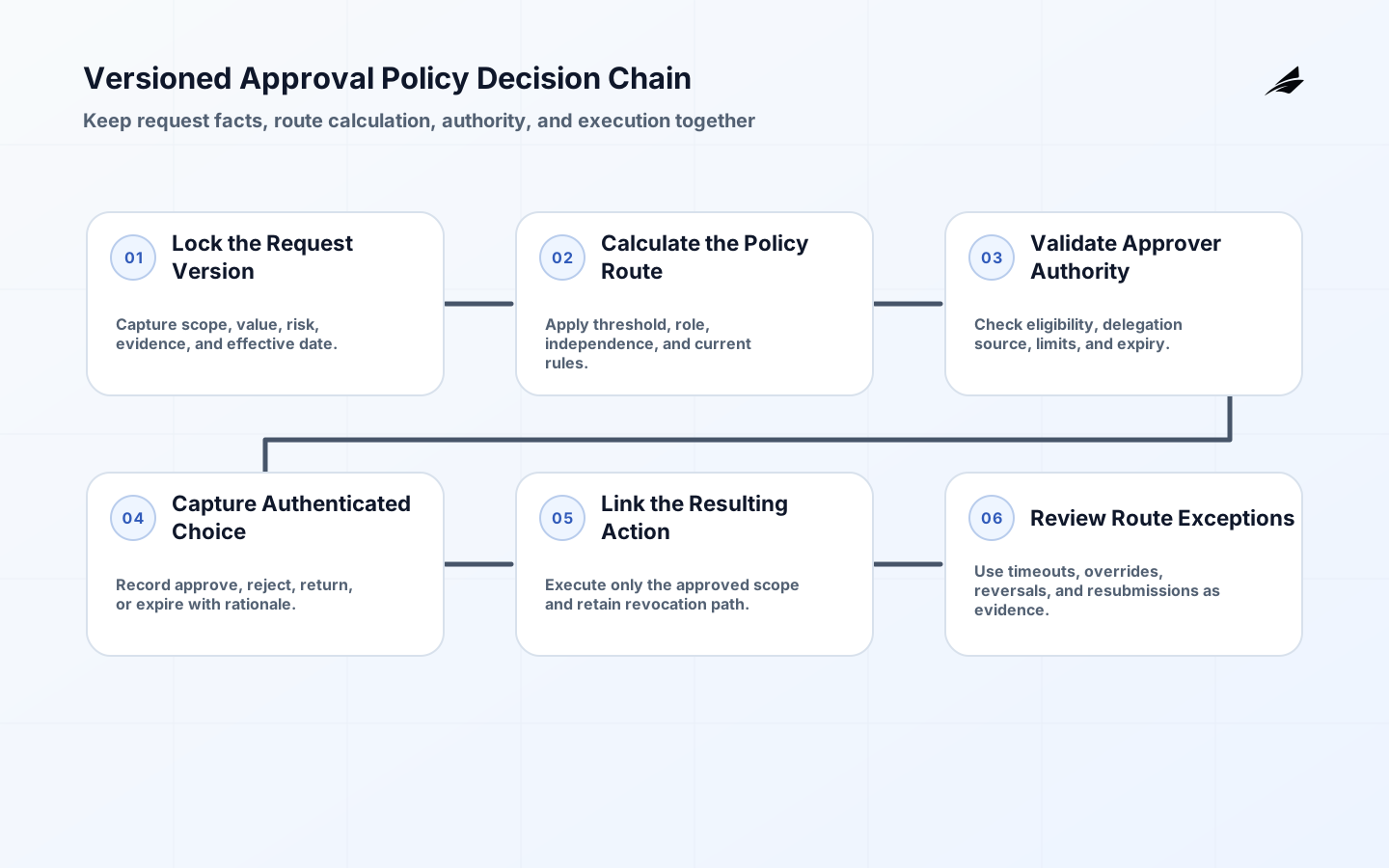
Approval workflows look simple until a decision affects money, access, policy, or customer commitments. A production design must show what is being approved, which policy applies, who has authority at that moment, how delegation works, and what happens when a request changes while it waits. The point is not to maximize clicks; it is to make the decision reliable, timely, and reviewable.
Set the decision boundary for approval workflows
Define the decision object and the policy boundary before building screens. A purchase request, credit exception, access grant, or contract deviation needs a specific amount or scope, requester, evidence set, and effective date. State whether approval creates authority to act or only permits the next review. That distinction prevents a workflow from accidentally treating a recommendation as a binding commitment.
| Design concern | Decision to make | Evidence to retain |
|---|---|---|
| Decision object | Request scope, value, risk, and effective date | Versioned request and supporting evidence |
| Policy route | Threshold, role, independence, and delegation rules | Policy version and calculated route |
| Decision | Approved, rejected, returned, or expired | Authenticated actor and reason |
| Execution | Purchase, access, payment, or contract action | Linked outcome and revocation path |
Keep records that explain the outcome
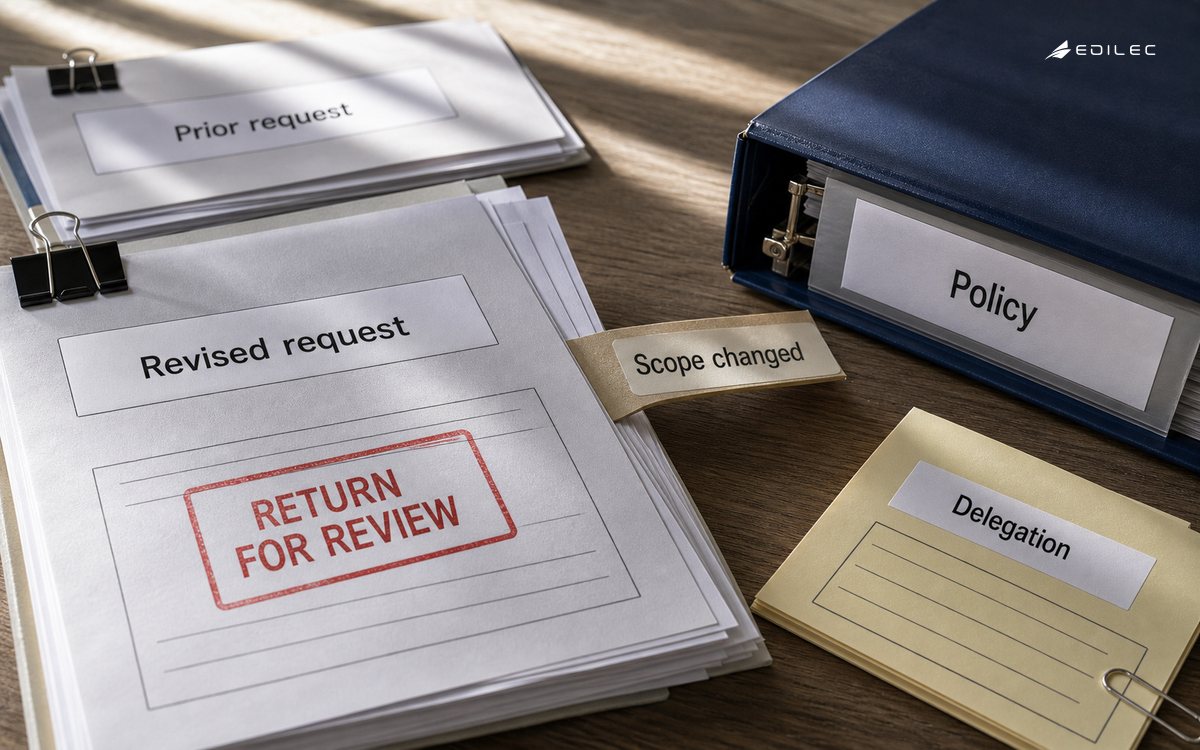
An approval record should contain the request version, policy version, calculated route, approver role, delegation evidence, decision, comment or reason, timestamp, and resulting action reference. Preserve superseded versions when the request materially changes. An approver who saw a 10,000 request did not approve a later 25,000 revision merely because the record ID is unchanged.
Design approval workflows as an accountable flow
Keep policy evaluation separate from user interface and notification delivery. The policy engine should determine eligible approver roles and separation-of-duties constraints from declared facts; the workflow orchestrator should manage state and timeouts. A decision event should carry the request and policy versions so a later audit can reproduce the route without relying on whatever rule is live today.
| Operating stage | Control to design | Signal to review |
|---|---|---|
| Request intake | Required facts and evidence validation | Incomplete and resubmitted request rate |
| Route evaluation | Role, threshold, and separation checks | Override and ineligible-approver rate |
| Decision capture | Authentication and version locking | Expired or changed-request decisions |
| Policy review | Timeliness and reversal analysis | Timeout, delegation, and exception trends |
Put authority and evidence into the controls
Enforce least privilege and prevent self-approval where the policy requires independence. Make delegation time-bounded and attributable, and re-evaluate the route when role, amount, or scope changes. Notifications are prompts, not evidence of approval. The durable record must show an authenticated decision and any exceptional authority that was used.
For approval workflows, NIST's Cybersecurity Framework aligns with the need to identify policy-dependent decisions and protect the authority that makes them. SP 800-53, SP 800-34, and SP 800-92 support separation of duties, exception recovery, and durable decision evidence.
Release with exceptions in view
Pilot one policy family with documented exceptions. Walk through a normal approval, a delegated decision, an expired delegation, a changed request, and a timeout escalation. Ask internal audit or the policy owner to inspect the reconstructed decision record. Their questions will reveal missing fields long before the workflow handles a disputed or high-value case.
Measure operating reliability, not activity alone
Track route completion time, timeout frequency, delegation use, policy override rate, resubmission rate, and post-approval reversals. Segment by policy type and threshold. Long approval time can be a capacity issue, but a high resubmission rate often means the requester cannot understand the evidence required for a valid decision.
Pre-build decision register
- For approval workflows, confirm decision objects with a material business consequence; write the rule, named owner, effective time, audit evidence, failure signal, and recovery action into the build decision record before release.
- For approval workflows, test decision objects with a material business consequence with normal, delayed, corrected, and failed inputs; retain the result so the operating team can explain and safely repeat the decision.
- For approval workflows, confirm evidence required before a route is calculated; write the rule, named owner, effective time, audit evidence, failure signal, and recovery action into the build decision record before release.
- For approval workflows, test evidence required before a route is calculated with normal, delayed, corrected, and failed inputs; retain the result so the operating team can explain and safely repeat the decision.
- For approval workflows, confirm policy versions tied to each request; write the rule, named owner, effective time, audit evidence, failure signal, and recovery action into the build decision record before release.
- For approval workflows, test policy versions tied to each request with normal, delayed, corrected, and failed inputs; retain the result so the operating team can explain and safely repeat the decision.
- For approval workflows, confirm thresholds that select the right authority; write the rule, named owner, effective time, audit evidence, failure signal, and recovery action into the build decision record before release.
- For approval workflows, test thresholds that select the right authority with normal, delayed, corrected, and failed inputs; retain the result so the operating team can explain and safely repeat the decision.
- For approval workflows, confirm separation-of-duties restrictions for approvers; write the rule, named owner, effective time, audit evidence, failure signal, and recovery action into the build decision record before release.
- For approval workflows, test separation-of-duties restrictions for approvers with normal, delayed, corrected, and failed inputs; retain the result so the operating team can explain and safely repeat the decision.
- For approval workflows, confirm time-bound delegation and revocation behavior; write the rule, named owner, effective time, audit evidence, failure signal, and recovery action into the build decision record before release.
- For approval workflows, test time-bound delegation and revocation behavior with normal, delayed, corrected, and failed inputs; retain the result so the operating team can explain and safely repeat the decision.
- For approval workflows, confirm request changes that require re-evaluation; write the rule, named owner, effective time, audit evidence, failure signal, and recovery action into the build decision record before release.
- For approval workflows, test request changes that require re-evaluation with normal, delayed, corrected, and failed inputs; retain the result so the operating team can explain and safely repeat the decision.
- For approval workflows, confirm authenticated decisions and required rationale; write the rule, named owner, effective time, audit evidence, failure signal, and recovery action into the build decision record before release.
- For approval workflows, test authenticated decisions and required rationale with normal, delayed, corrected, and failed inputs; retain the result so the operating team can explain and safely repeat the decision.
- For approval workflows, confirm timeout escalation without silent approval; write the rule, named owner, effective time, audit evidence, failure signal, and recovery action into the build decision record before release.
- For approval workflows, test timeout escalation without silent approval with normal, delayed, corrected, and failed inputs; retain the result so the operating team can explain and safely repeat the decision.
- For approval workflows, confirm execution scope created by an approval; write the rule, named owner, effective time, audit evidence, failure signal, and recovery action into the build decision record before release.
- For approval workflows, test execution scope created by an approval with normal, delayed, corrected, and failed inputs; retain the result so the operating team can explain and safely repeat the decision.
- For approval workflows, confirm override authority and exception evidence; write the rule, named owner, effective time, audit evidence, failure signal, and recovery action into the build decision record before release.
- For approval workflows, test override authority and exception evidence with normal, delayed, corrected, and failed inputs; retain the result so the operating team can explain and safely repeat the decision.
- For approval workflows, confirm review of reversals and policy disputes; write the rule, named owner, effective time, audit evidence, failure signal, and recovery action into the build decision record before release.
- For approval workflows, test review of reversals and policy disputes with normal, delayed, corrected, and failed inputs; retain the result so the operating team can explain and safely repeat the decision.
Key takeaways for approval workflows
- Treat an approval as a versioned policy decision, not a button click.
- Record route calculation, authority, delegation, and resulting action together.
- Re-evaluate eligibility when the request’s material facts change.
- Use overrides and reversals as signals to improve policy clarity and request intake.
Frequently asked questions
What makes an approval decision auditable?
A request version, applicable policy, eligible authority, authenticated decision, rationale when needed, and a link to the action that followed.
Can delegation be permanent?
Avoid indefinite delegation for consequential decisions. Time-bound it, identify the delegator, and review it when roles or policy change.
When should a request restart its approval route?
Restart or re-evaluate after a material change in value, scope, risk, policy, or approver eligibility.
Conclusion
A dependable approval workflows implementation is a system of explicit choices: what is authoritative, who can decide, which state is real, how an exception is recovered, and how the team verifies the result. Build the smallest flow that proves those choices with real evidence, then extend it deliberately. Related reading: approval workflows in production, role-based operations, business process automation.