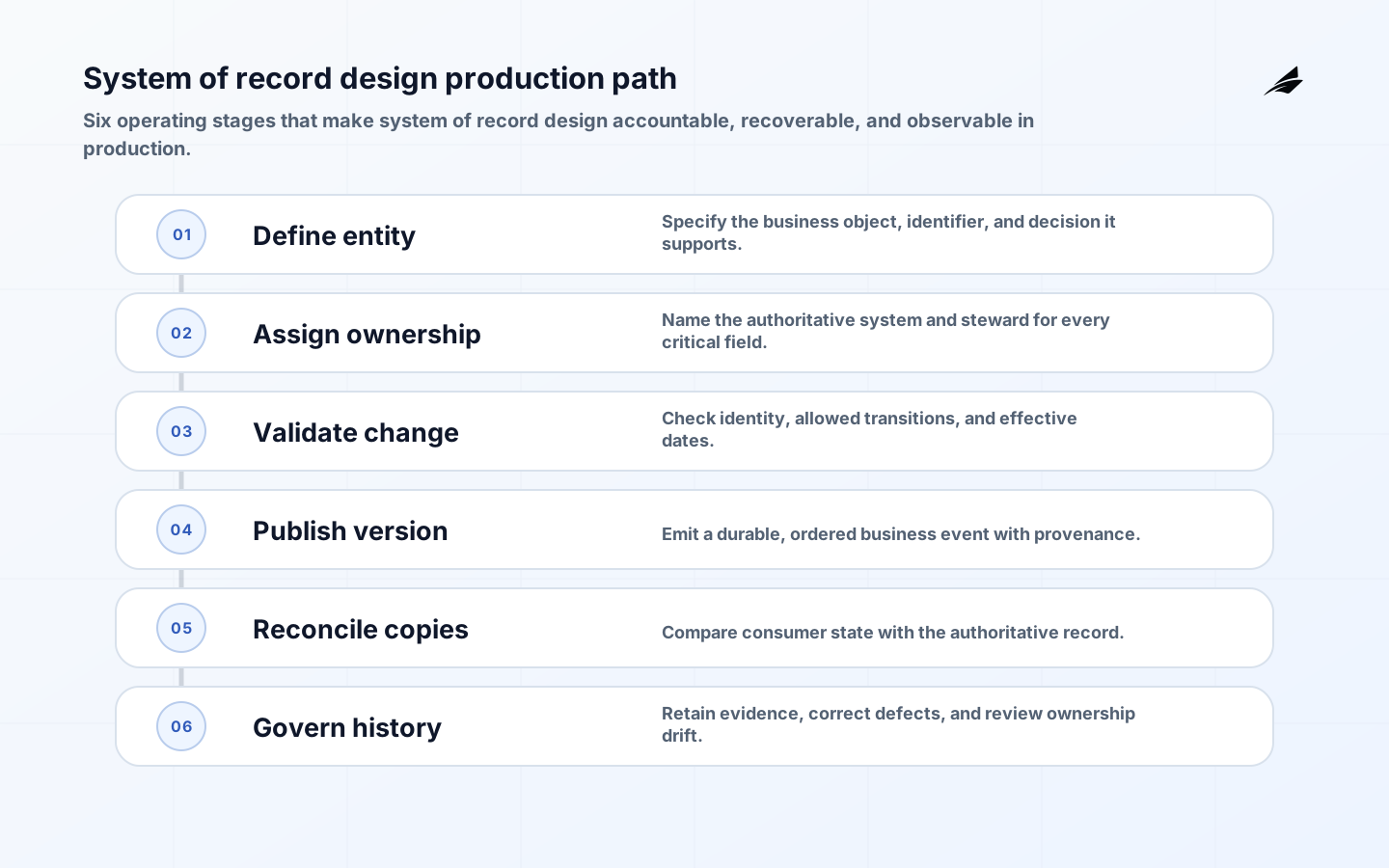
System of record design becomes a production system when it must produce a trustworthy result repeatedly, not merely demonstrate a screen or a single happy path. In this setting the flow spans creation, update, ownership, synchronization, retention, and historical reconstruction. The operating question is practical: who may initiate the work, which facts are authoritative, what state is visible, and how does a team recover when a dependency or decision fails? A credible design gives users a clear outcome while leaving operators enough evidence to explain it later. For this data handoff, name the accountable owner, supporting evidence, exception route, and next measurable check.
Set the production boundary for system of record design
Start by drawing the boundary around an outcome rather than an application. For system of record design, name the triggering event, the party receiving value, the accountable owner, the committed records, and the final condition. The common early failure is that two applications both claim authority, so downstream teams repair conflicts manually. That is a boundary failure, not simply an integration bug. A useful workshop follows one ordinary request, one urgent request, and one rejected request from entry to closure; each walk-through should expose data handoffs, human decisions, and promises made to another system. Within this data handoff, name the accountable owner, supporting evidence, exception route, and next measurable check.
| Design question | Decision for this service | Evidence to retain |
|---|---|---|
| Who is accountable? | data owner, steward, system owner, integration owner, and consumer team | Named owner, decision time, and escalation target |
| Which facts are trusted? | business identifiers, field ownership, versions, effective dates, provenance, and retention rules | Stable identifier, source, version, and effective time |
| What ends the workflow? | A verified result rather than a successful API response | Outcome state, correlation ID, and recipient confirmation |
| What requires review? | conflicting writes, ambiguous identity, out-of-order events, orphaned records, and unavailable history | Reason, impact, due date, and resolution record |
Model system of record design as explicit states and decisions
A production workflow needs states that people can recognize and systems can enforce. Use a small set such as received, validated, in progress, blocked, completed, and cancelled, then define who can make each transition. Do not collapse a missing input, an authorization denial, and a downstream outage into a generic error. They demand different owners and recovery actions. A transition should record the actor or service, the prior and next state, the policy or rule version, the relevant identifier, and a correlation ID. That record makes retries safer and turns support from guesswork into reconstruction. When implementing this data handoff, name the accountable owner, supporting evidence, exception route, and next measurable check.
System of record design architecture: keep facts, commands, and effects separate
Separate the request to act from the business fact that an action was accepted. A request can be invalid, duplicated, or withdrawn; an accepted outcome needs a durable identity and history. Store current state for fast use, but retain the transitions that explain how it became current. Publish downstream effects only after the authoritative change is committed, and design consumers to tolerate a repeated message. This discipline is especially important where business identifiers, field ownership, versions, effective dates, provenance, and retention rules are copied across systems. The approach complements Master Data Management for Enterprise Systems: a Practical Guide: both depend on clear ownership and visible reconciliation rather than silent copies. Before releasing this data handoff, name the accountable owner, supporting evidence, exception route, and next measurable check.
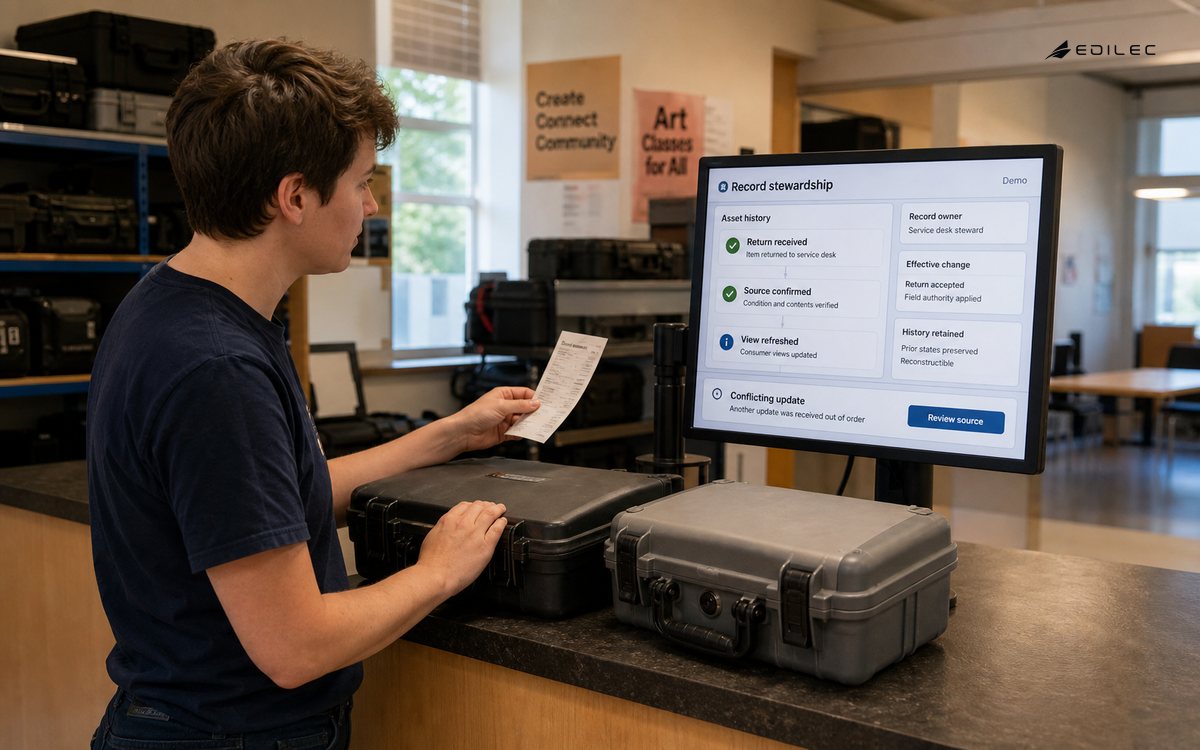
Control objectives from NIST SP 800-53 Rev. 5: Security and Privacy Controls are a helpful way to test this design. They do not prescribe one product or database pattern; they prompt teams to make access, change control, auditability, and recovery explicit. For system of record design, translate those objectives into concrete checks at the decision points: validate the request, restrict consequential actions, preserve a defensible account of the outcome, and route anomalies to a person who can decide. The result is a service contract that engineering, operations, and business owners can inspect together. While operating this data handoff, name the accountable owner, supporting evidence, exception route, and next measurable check.
Control access and data exposure in system of record design
For delivery teams working on system of record design, this information boundary should connect workflow authority, system-of-record ownership, approvals, exceptions, reconciliation, and reporting to evidence an accountable owner can inspect. Permissions should be tied to the action and the record context, not inferred from a broad screen-level role. Define what a person or workload may view, initiate, approve, amend, export, and administer. Then test denial paths as seriously as success paths. Sensitive flows also need purpose limits: a support user may resolve a problem without gaining permanent visibility into all historical records. NIST SP 800-92: Guide to Computer Security Log Management provides topic-specific guidance that helps teams turn this principle into verification cases. Keep the authorization decision server-side and log the decision basis without placing secrets or unnecessary personal data in routine logs. In this production review, move beyond the information boundary only after the owner can show the accepted result, the exception path, and the signal for another review.
| Failure mode | Design response | Operational signal |
|---|---|---|
| Duplicate or late request | Use an idempotency key, version check, and safe replay path | Duplicate rejection and replay count |
| Missing or inconsistent data | Hold the workflow in a visible exception state | Age, owner, and cause of blocked work |
| Dependency outage | Queue a bounded retry and expose a recovery deadline | Retry attempts and backlog age |
| Unauthorized or risky action | Deny, record the decision context, and offer a controlled escalation | Denials by action and review outcome |
Prepare system of record design for failure, support, and recovery
The exception path is where an enterprise service earns trust. List the plausible cases before launch: conflicting writes, ambiguous identity, out-of-order events, orphaned records, and unavailable history. For each, define detection, containment, accountable owner, customer or stakeholder communication, and a verified closure condition. Avoid automatic retry for every failure; a retry can duplicate a commitment or mask a policy problem. A recovery runbook should tell the on-call operator what they may safely replay, what needs approval, how to compensate a completed action, and how to reconcile systems once service returns. During support for this data handoff, name the accountable owner, supporting evidence, exception route, and next measurable check.
RFC 3339: Date and Time on the Internet is useful context for this work because contingency and service recovery practices link procedures to business impact and testing. Pair that with RFC 8785: JSON Canonicalization Scheme when designing records and event logs: capture enough context to reconstruct the sequence, protect the log from casual alteration, and regularly test whether support can find a real case quickly. Run a tabletop exercise using a realistic failed handoff. If the team cannot state the last confirmed fact, the next safe action, and the owner within minutes, the production design is still incomplete. To validate this data handoff, name the accountable owner, supporting evidence, exception route, and next measurable check.
Measure whether system of record design is improving the operating outcome
Choose measures that reveal flow and quality together. For this service, watch conflict rate, unmatched identifiers, synchronization lag, stale-record count, and reconciliation completion. Pair each number with a decision rule. A rising completion rate can hide more manual work; a short average can hide a small group of severely delayed cases. Segment metrics by route, customer or business unit where appropriate, and exception cause, then compare them with the baseline captured before rollout. Review the definitions with the people who act on them, because a metric with ambiguous timing or ownership will create arguments instead of improvement. To govern this data handoff, name the accountable owner, supporting evidence, exception route, and next measurable check.
A practical system of record design implementation sequence
- Map one high-volume system of record design path and one high-risk exception with the people who perform the work.
- Write state, ownership, record, and access decisions before choosing automation details.
- Deliver the smallest route that produces a durable outcome and a supportable audit trail.
- Test duplicate input, missing data, authorization denial, dependency failure, and corrected replay.
- Pilot with a bounded group, reconcile the results, and expand only after exception ownership is working.
Key takeaways
- System of record design is a business decision flow, not only a user interface or integration.
- A stable identifier, explicit state model, and accountable owner make support and reconciliation possible.
- Access controls and logging must cover consequential actions and denial paths, not merely sign-in.
- The quality of recovery and exception handling is a better production test than a polished happy path.
Frequently asked questions
What should a team build first for system of record design?
Build one bounded path whose outcome matters to users and can be reconciled. Include the authoritative records, access decision, state transitions, and one exception route. A broad portal or automation layer without those foundations only moves uncertainty faster. When explaining this data handoff, name the accountable owner, supporting evidence, exception route, and next measurable check.
Who owns system of record design after launch?
Ownership is shared but not vague. The business owner defines the outcome and acceptable trade-offs; the system owner operates the service; data and control owners govern records and permissions; support owns the first response. Put those responsibilities in the runbook and review them when the workflow changes. For this data handoff, test one expected case, one ambiguous case, and one failure with a documented recovery action.
Conclusion
Production-ready system of record design makes the next action, current fact, and accountable owner clear even when work is blocked. Begin with a narrow, observable path; design for evidence and recovery; then use real exception data to refine the policy and the system. That is how a useful workflow grows without becoming a brittle collection of hidden handoffs. Within this part of the system, test one expected case, one ambiguous case, and one failure with a documented recovery action.