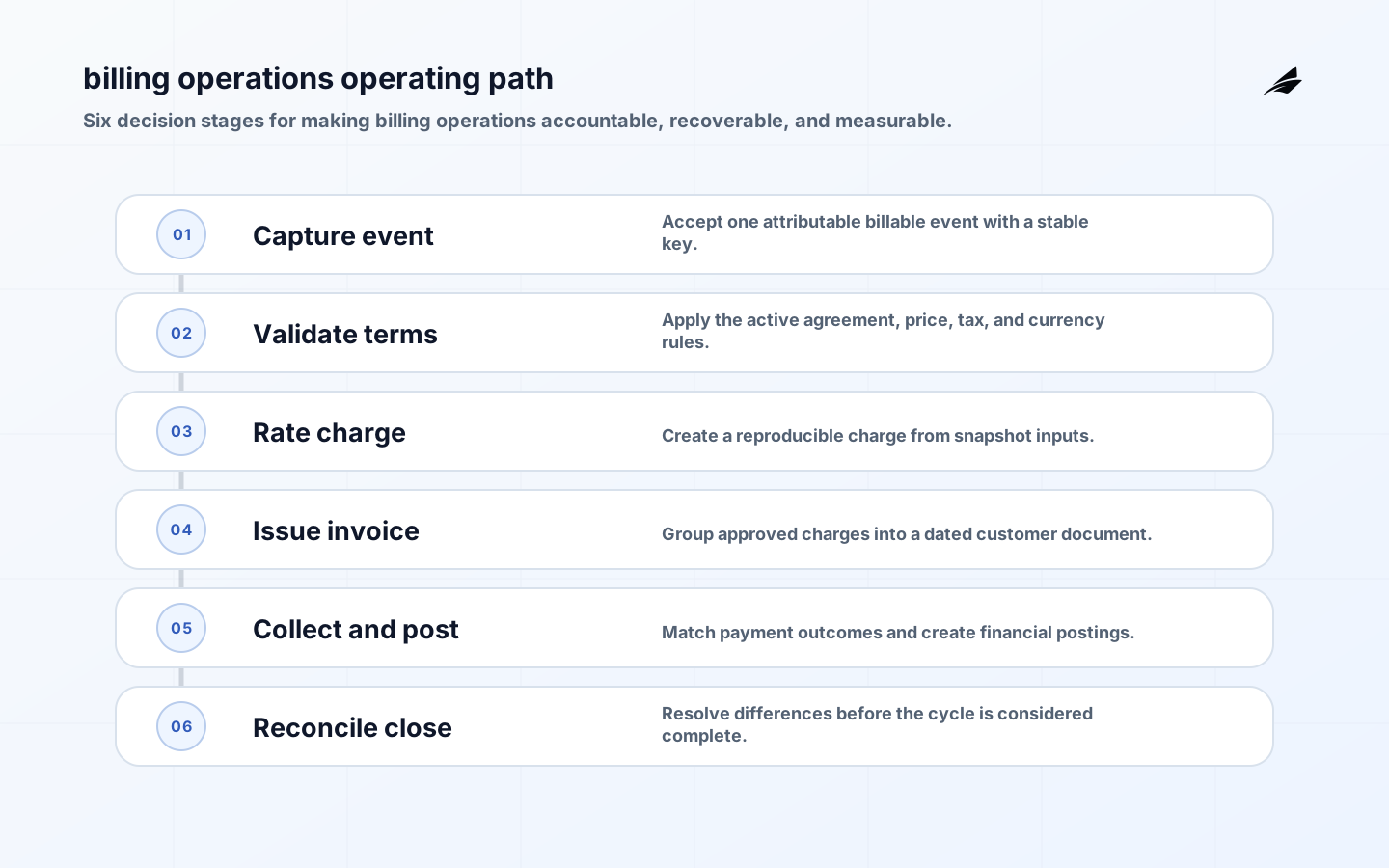
Billing operations enter production when a charge, credit, invoice, collection action, and ledger posting must agree even when calls are retried or a commercial term changes. The visible invoice is the end of a chain of decisions about entitlement, price, tax, currency, timing, and approval. Treating that chain as a simple monthly export creates disputes that are expensive to investigate after money has moved.
Set the decision boundary for billing operations
Start with one billable event and one contract type. Define the commercial event, the effective price and currency, the customer account, the tax and invoice rules, and the accounting consequence. Decide what is immutable after invoicing and how a correction is expressed. In a robust model, a correction is a dated credit or adjustment with a reason, not a silent overwrite of the original charge.
| Design concern | Decision to make | Evidence to retain |
|---|---|---|
| Billable event | Usage, order, subscription, or milestone | Source ID, timestamp, and customer scope |
| Commercial rule | Price, discount, tax, and currency | Versioned agreement or rate reference |
| Invoice outcome | Issued, delivered, paid, disputed, or voided | Invoice ID and linked adjustments |
| Ledger impact | Receivable, revenue, cash, or liability entry | Posting reference and reconciliation status |
Keep records that explain the outcome
Keep the versioned agreement or price reference, source event ID, usage window, calculation inputs, invoice identifier, payment reference, and adjustment relationship. A billing record needs enough context for finance and support to reproduce the answer without reading application code. Snapshot price inputs at the time of rating, because re-running a calculation against current prices can produce a historically incorrect result.
Design billing operations as an accountable flow
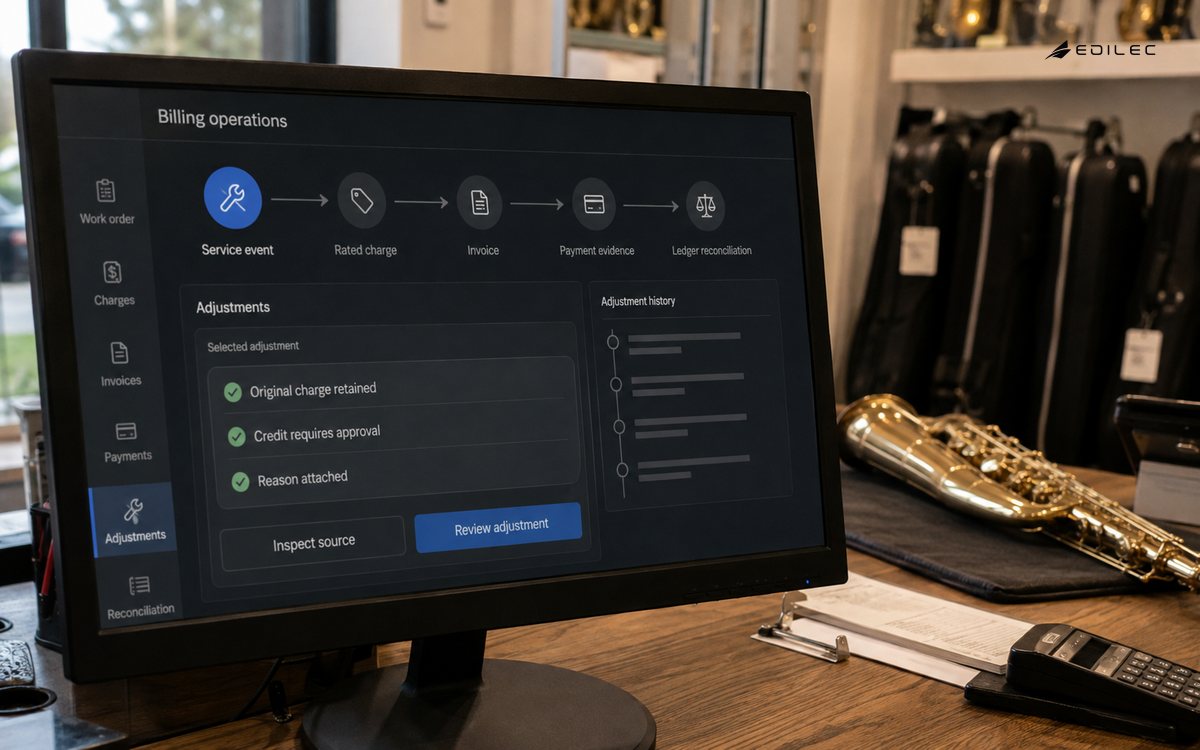
Separate event capture, rating, invoicing, payment collection, and financial posting. Give each stage an idempotency key and an explicit state. A payment provider confirmation should be reconciled to the intended invoice, not assumed to mean the full billing workflow succeeded. Publish status changes as business events so the customer portal, collections process, and ledger integration do not race on partially updated data.
| Operating stage | Control to design | Signal to review |
|---|---|---|
| Event ingestion | Validation and idempotency control | Duplicate and rejected event count |
| Rating | Snapshot inputs and calculation evidence | Unrated eligible events and calculation failures |
| Collection | Provider confirmation matching | Payment mismatch and retry outcome |
| Close | Invoice-to-ledger reconciliation | Aged differences and manual adjustment value |
Put authority and evidence into the controls
Protect pricing and adjustment authority as carefully as payment operations. Require appropriate approval for manual credits, retain the original charge and the reason for every exception, and limit access to payment and personally identifiable information. The control objective is traceability: an independent reviewer should be able to see who authorized a change, what it affected, and how it reached the ledger.
For billing operations, NIST's Cybersecurity Framework frames the work as protecting a money-moving business process and recovering from exceptions without losing evidence. SP 800-53 supports controlled access and accountability, while SP 800-34 and SP 800-92 inform resilient reconciliation and reviewable event histories.
Release with exceptions in view
Reconcile a pilot cycle end to end before scaling volume. Compare source events, rated charges, invoices, payment confirmations, and ledger entries by stable identifiers. Exercise a duplicate event, a failed payment webhook, a backdated correction, and a partial refund. The launch plan must include customer support language and an owner for aged mismatches, because those cases are operational work rather than edge conditions.
Measure operating reliability, not activity alone
Monitor unbilled eligible events, rating failures, invoice delivery failures, payment-to-invoice mismatches, manual adjustment value, and reconciliation age. Segment these measures by contract type or payment method so a single problematic integration does not hide inside an aggregate. A growing manual-credit rate often signals an upstream pricing or entitlement problem rather than a finance-team productivity issue.
Pre-build decision register
- For billing operations, confirm stable event IDs for every billable occurrence; write the rule, named owner, effective time, audit evidence, failure signal, and recovery action into the build decision record before release.
- For billing operations, test stable event IDs for every billable occurrence with normal, delayed, corrected, and failed inputs; retain the result so the operating team can explain and safely repeat the decision.
- For billing operations, confirm effective pricing and contract version selection; write the rule, named owner, effective time, audit evidence, failure signal, and recovery action into the build decision record before release.
- For billing operations, test effective pricing and contract version selection with normal, delayed, corrected, and failed inputs; retain the result so the operating team can explain and safely repeat the decision.
- For billing operations, confirm tax and currency treatment for each charge; write the rule, named owner, effective time, audit evidence, failure signal, and recovery action into the build decision record before release.
- For billing operations, test tax and currency treatment for each charge with normal, delayed, corrected, and failed inputs; retain the result so the operating team can explain and safely repeat the decision.
- For billing operations, confirm snapshot inputs required to reproduce a calculation; write the rule, named owner, effective time, audit evidence, failure signal, and recovery action into the build decision record before release.
- For billing operations, test snapshot inputs required to reproduce a calculation with normal, delayed, corrected, and failed inputs; retain the result so the operating team can explain and safely repeat the decision.
- For billing operations, confirm idempotency behavior for retries and webhooks; write the rule, named owner, effective time, audit evidence, failure signal, and recovery action into the build decision record before release.
- For billing operations, test idempotency behavior for retries and webhooks with normal, delayed, corrected, and failed inputs; retain the result so the operating team can explain and safely repeat the decision.
- For billing operations, confirm invoice grouping and delivery rules; write the rule, named owner, effective time, audit evidence, failure signal, and recovery action into the build decision record before release.
- For billing operations, test invoice grouping and delivery rules with normal, delayed, corrected, and failed inputs; retain the result so the operating team can explain and safely repeat the decision.
- For billing operations, confirm authority for manual credits and write-offs; write the rule, named owner, effective time, audit evidence, failure signal, and recovery action into the build decision record before release.
- For billing operations, test authority for manual credits and write-offs with normal, delayed, corrected, and failed inputs; retain the result so the operating team can explain and safely repeat the decision.
- For billing operations, confirm payment confirmation matching to invoice references; write the rule, named owner, effective time, audit evidence, failure signal, and recovery action into the build decision record before release.
- For billing operations, test payment confirmation matching to invoice references with normal, delayed, corrected, and failed inputs; retain the result so the operating team can explain and safely repeat the decision.
- For billing operations, confirm handling for disputes, refunds, and reversals; write the rule, named owner, effective time, audit evidence, failure signal, and recovery action into the build decision record before release.
- For billing operations, test handling for disputes, refunds, and reversals with normal, delayed, corrected, and failed inputs; retain the result so the operating team can explain and safely repeat the decision.
- For billing operations, confirm ledger posting outcomes and hold conditions; write the rule, named owner, effective time, audit evidence, failure signal, and recovery action into the build decision record before release.
- For billing operations, test ledger posting outcomes and hold conditions with normal, delayed, corrected, and failed inputs; retain the result so the operating team can explain and safely repeat the decision.
- For billing operations, confirm cycle-close reconciliation by count and value; write the rule, named owner, effective time, audit evidence, failure signal, and recovery action into the build decision record before release.
- For billing operations, test cycle-close reconciliation by count and value with normal, delayed, corrected, and failed inputs; retain the result so the operating team can explain and safely repeat the decision.
- For billing operations, confirm customer-support ownership for aged mismatches; write the rule, named owner, effective time, audit evidence, failure signal, and recovery action into the build decision record before release.
- For billing operations, test customer-support ownership for aged mismatches with normal, delayed, corrected, and failed inputs; retain the result so the operating team can explain and safely repeat the decision.
Key takeaways for billing operations
- Make charges and corrections dated, attributable records instead of mutable totals.
- Snapshot commercial inputs so historical invoices can be reproduced.
- Use idempotent keys across rating, invoicing, payment, and posting.
- Reconcile every stage against stable identifiers before declaring a billing cycle complete.
Frequently asked questions
Why are idempotency keys important in billing operations?
They prevent a retry, duplicate webhook, or repeated import from creating an additional charge or payment action.
Can an issued invoice be edited?
Use the organization’s accounting and legal policy, but operationally prefer a traceable correction such as a credit or adjustment over a silent rewrite.
Which mismatch should be investigated first?
Prioritize money-moving and customer-facing discrepancies, then age and value of unresolved items.
Conclusion
A dependable billing operations implementation is a system of explicit choices: what is authoritative, who can decide, which state is real, how an exception is recovered, and how the team verifies the result. Build the smallest flow that proves those choices with real evidence, then extend it deliberately. Related reading: billing operations practical guide, finance systems, ERP integration.