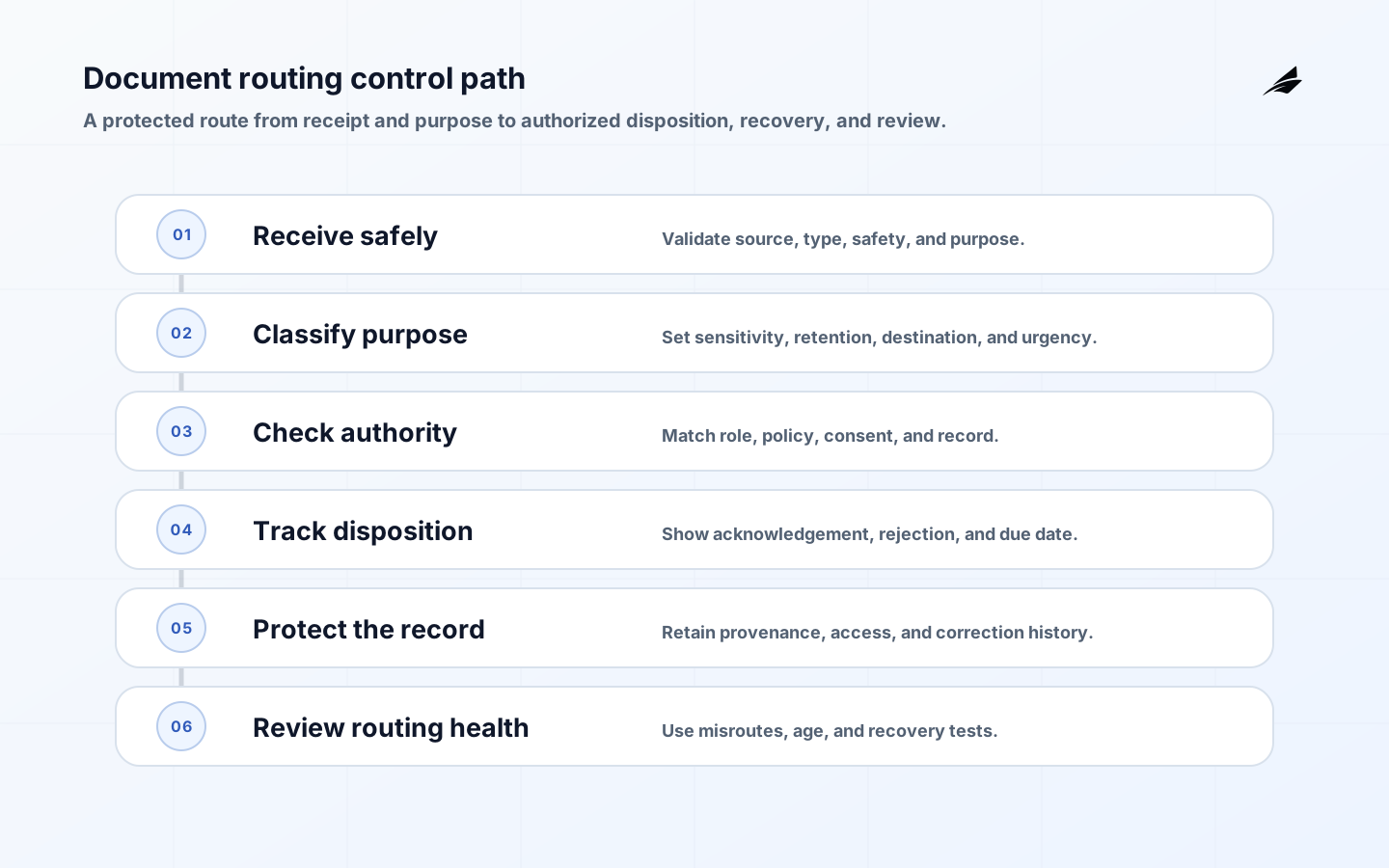
Document routing becomes valuable when it makes a real business outcome dependable across people and systems. Start by following one consequential item from arrival to closure: identify the requester, trusted facts, decision rights, execution point, and recovery route (for document-routing governance). Treat a completed workflow as evidence only when the route has an owner, the protected record changed as intended, and a new operator can inspect why. OWASP File Upload Cheat Sheet provides a grounded reference for this domain, while NIST Cybersecurity Framework 2.0 frames governance and control as operational responsibilities. The aim is a path that behaves predictably when data is incomplete, a dependency is slow, or an authorized person challenges the outcome (for document-routing governance). Keep the routing review record visible to the accountable owner so it can be used during the next exception.
Define the document routing boundary
Describe the decision in one sentence before choosing screens, queues, or integrations (for document-routing governance). For document routing, write what triggers the work, what falls outside the first release, and what event proves completion. Then name the business owner, technical owner, and support owner; these roles can be held by different people, but they cannot be left implicit (for document-routing governance). Keep business state separate from implementation status.A user needs to know whether the work is waiting for information, approved, in progress, blocked, or complete, not merely that a background job has a status code (for document-routing governance). The nearby approval workflow guide is useful when a handoff requires a human decision (for document-routing governance). Store the routing review with the operating rule so a new owner can understand the reason for the current path.
| Design question | Working rule | Evidence to keep |
|---|---|---|
| Boundary | State the outcome, exclusions, and condition that makes the work consequential. | Scope statement, real examples, and lifecycle states. |
| Authority | Name who can create, decide, correct, pause, and close each state. | Role, delegation, policy version, and decision time. |
| Source facts | Keep the source and effective time for values that influence an outcome (for document-routing governance). | Stable identifiers, lineage, and change rationale. |
| Recovery | Give blocked work an owned route rather than an unstructured inbox. | Queue, reason, impact, next action, and disposition. |
Model document routing as accountable work
Separate request, evaluation, action, and evidence. The incoming request may be incomplete or replayed; evaluation applies the policy and current context; action changes an operational record; evidence explains the result later (for document-routing governance). Give consequential transitions durable identifiers and an idempotency rule so a safe retry cannot duplicate an effect (for document-routing governance). Record the rule and data version used when the decision was made (for document-routing governance). NIST SP 800-53 Rev. 5 is particularly relevant because it supports least-privilege, server-side authorization instead of trusting interface visibility. The ERP integration guide helps teams make acknowledgements and correction behavior explicit at system boundaries (for document-routing governance). Make the review record part of the route history rather than reconstructing it after an incident.

- Use business states that the people running document routing can recognize and explain.
- Preserve the source identifier beside internal identifiers to support reconciliation.
- Make manual intervention part of the same history, not a private spreadsheet or chat thread (for document-routing governance).
- Define which actions are reversible, who may authorize reversal, and what remains immutable (for document-routing governance).
- Test normal, late, duplicate, disputed, and partially completed inputs before expanding scope (for document-routing governance).
Build the routing control around evidence
A dependable path makes it possible to reconstruct why an outcome occurred without granting broad production access (for document-routing governance). The OWASP Authorization Cheat Sheet gives document-routing operators a checklist for server-side permission checks at the protected record. In practice, retain the input reference, correlation ID, rule result, actor or service identity, timestamp, downstream acknowledgement, and correction event (for document-routing governance). Use effective time for facts whose business meaning changes and processing time for when the platform learned them (for document-routing governance). That distinction avoids the tempting but misleading claim that a late correction was true at the time of an earlier decision (for document-routing governance). Give support staff direct access to the review decision and its evidence, subject to the document's sensitivity.
| Failure pattern | Safe response | Signal for review |
|---|---|---|
| Dependency timeout | Retain the state and retry with the original correlation key. | Pending age, acknowledgement gaps, and repeated attempts. |
| Conflicting data | Hold the consequential action and route a focused discrepancy. | Source, field, impact, and accountable steward. |
| Unauthorized attempt | Deny the action without revealing protected details. | Actor, resource, policy result, and alert threshold. |
| Manual correction | Require a reason and preserve before-and-after values. | Correction rate, repeat cause, and approval evidence. |
Operate routing exceptions as first-class work
A failure queue should help an operator decide, not demand detective work across several applications (for document-routing governance). Present the affected business item, impact, trigger, current state, safe options, owner, and deadline together (for document-routing governance). Classify transient technical problems separately from missing data, policy questions, security concerns, and customer disputes (for document-routing governance). Each category needs a different response and authority. Do not automatically retry an action that might create a duplicate, bypass a check, or overwrite a correction (for document-routing governance). Instead, preserve context, let a qualified person choose the next step, and send the final disposition back into the record history (for document-routing governance). The system improves when recurring exceptions are traceable to a rule, source, or handoff (for document-routing governance). Revisit the routing review when purpose, authority, retention, or downstream risk changes.
Measure routing outcomes and recovery
Choose measures that reveal whether document routing is serving its intended decision. Track end-to-end completion time, percentage completed without rework, age of blocked items, rate of authorized overrides, stale ownership, and reconciliation differences (for document-routing governance). Segment results by source, policy version, workload type, and dependency so a single average does not hide a harmful pattern (for document-routing governance). Review sampled records beside dashboards; a low error rate can coexist with unrecorded workarounds (for document-routing governance). Set a cadence where business and technical owners select one evidence-backed improvement, define the expected effect, and revisit it after release (for document-routing governance). This turns measurement into governance rather than a retrospective scorecard. Link the review to the affected route and sample so a later operator can verify the control.
Use adjacent security guidance only after document purpose and routing authority are explicit; this guide stays centred on controlled receipt, disposition, and recovery.
Receive documents with a trustworthy chain
A routed document needs an accountable purpose before it enters a queue. Record what arrived, who sent it, which decision it supports, the sensitivity class, and the recipient authority. A queue state such as received, rejected, awaiting evidence, accepted, or completed should carry a clear next action. This lets an operator explain why an item moved or stopped without granting every participant access to the document itself.
Classify purpose before routing
Separate content safety from business routing. Validate file type and malware controls at receipt, then apply classification, retention, authorization, and recipient rules before an action changes a protected record. Preserve the source identifier, rule version, actor, and timestamps. When a route is rejected, show the sender a useful reason while withholding sensitive details. The OWASP Authorization Cheat Sheet is a practical reference for checking those authority decisions.
Route only where authority is established
Review routing with accepted, malformed, misaddressed, restricted, and delayed items. Measure misroutes, manual forwards, blocked age, acknowledgement time, correction effort, and the share of outcomes that can be reconstructed. Use the OWASP File Upload Cheat Sheet when testing receipt controls, and keep the NIST Cybersecurity Framework 2.0 and SP 800-53 links in the control record for governance and access review. A route is mature when the exception owner can act without searching for missing context.
- Name the document routing decision, owner, timing, evidence, and unacceptable failure.
- Distinguish current, provisional, blocked, corrected, and recovered states.
- Test normal, late, duplicate, denied, partial, and recovery outcomes before expansion.
- Keep source, identity, policy, version, and authority close to consequential actions.
- Review one real exception with operators and record the correction.
Continue with ERP integration guide, approval workflow guide, ticketing workflow guide. These routing references help a reader compare receipt, authorization, disposition, and recovery decisions across adjacent systems.
Document routing takeaways
- Start with one consequential document routing path and an accountable outcome.
- Keep authority, source data, rule version, and corrective actions visible in the record (for document-routing governance).
- Design retries and manual intervention so neither creates an untraceable duplicate.
- Give each exception an owner, safe options, a deadline, and a documented disposition (for document-routing governance).
- Use outcome and recovery measures to decide when the scope is ready to grow (for document-routing governance).
Frequently asked questions
What belongs in the first release? One high-value path with a clear decision owner, trusted inputs, normal route, and exception route (for document-routing governance). Should every edge case be automated? No. Automate only where the rule is stable and the result can be safely observed; route ambiguity to a qualified reviewer (for document-routing governance). How much audit detail is enough? Keep what lets an authorized investigator explain the decision, including source, rule, actor, timestamps, and changes, while protecting sensitive data through access controls (for document-routing governance). Can a team improve document routing without replacing every system? Yes. Establish a clear boundary and integration contract first; coexistence is workable when ownership, acknowledgement, correction, and reconciliation are explicit (for document-routing governance). Record the review outcome beside the effective rule, not in a separate private note.
Run an evidence-led routing review
For document routing, run a controlled review with a permitted document, a malformed upload, a wrongly addressed item, a restricted record, and a delayed recipient acknowledgement. Verify classification, metadata validation, malware or file-safety checks, route selection, access enforcement, retention treatment, and the customer-facing status. The receiving team should be able to prove what it received and whether it accepted or rejected it; the sender should see a reason without receiving protected details. Review misroutes and manual forwarding as design defects, not inevitable office work. Improve the metadata contract, recipient directory, validation rule, or escalation path that would have prevented the error.
The review record for document routing should include the question tested, the sample selected, the observed outcome, the decision made, the owner, and the date for rechecking the change. That modest discipline keeps a useful distinction between a proposed improvement and a control that has actually changed daily work (for document-routing governance). It also gives leadership a way to compare trade-offs: a faster route may be acceptable for low-impact work, while a higher-risk route may need stronger evidence or a slower independent decision (for document-routing governance). Preserve the review beside the operating artefacts so future teams can understand why the current rule exists (for document-routing governance).
A routing rule should be reviewed when the document purpose, authority, retention need, or downstream risk changes. Keep a small sample of accepted, rejected, misrouted, and corrected items so the owner can distinguish a rare exception from a rule that no longer reflects the operation. This evidence also makes training and handover more concrete.
Conclusion
Treat document routing as an operating capability rather than a collection of forms and integrations.A narrow, evidence-led path exposes the authority, data, and recovery design that broad programmes often postpone (for document-routing governance). Once that first path is understandable and stable, expansion is guided by observed outcomes instead of hopeful assumptions (for document-routing governance). Use the next review date to keep the routing decision current as recipients and records change.