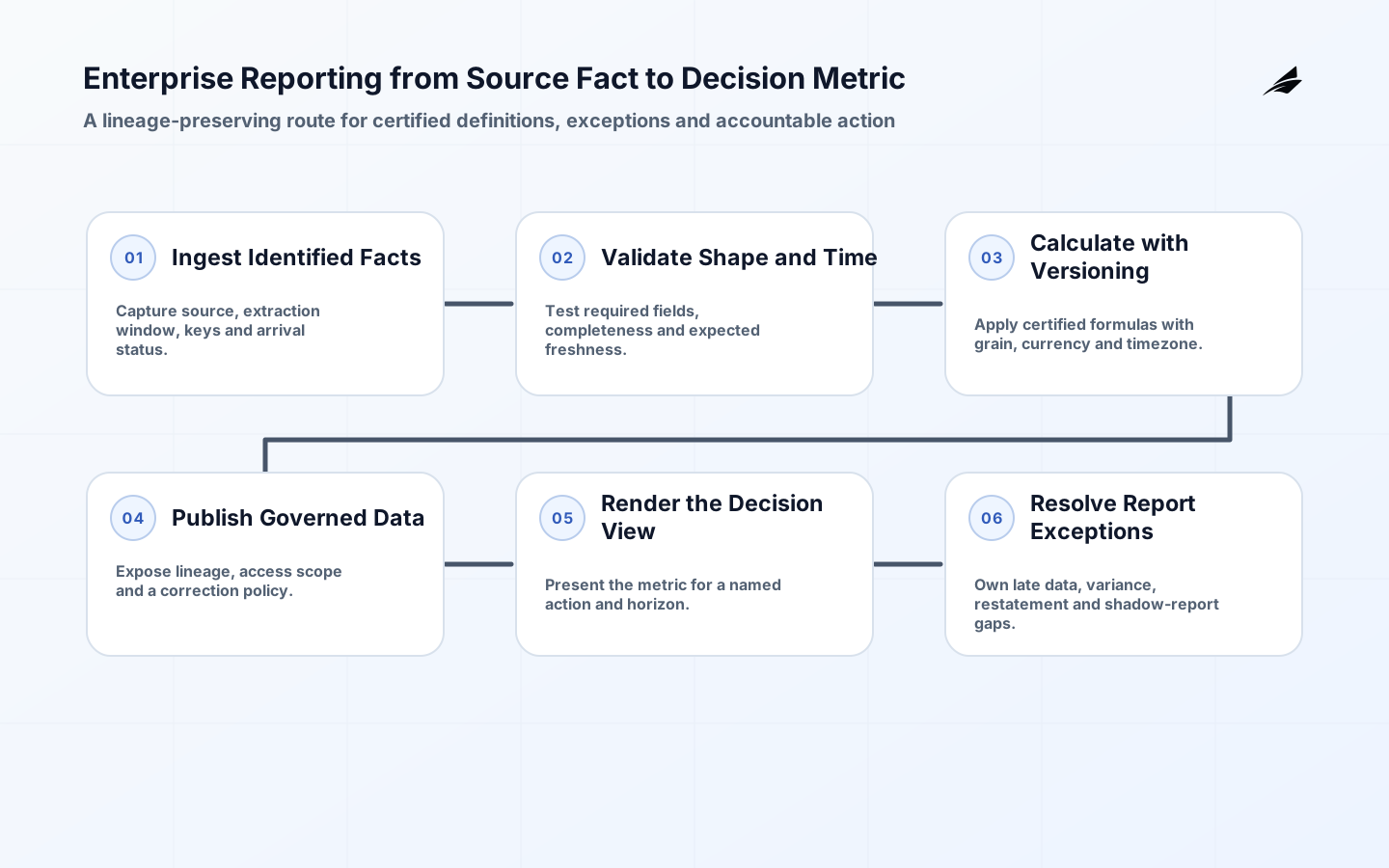
A report can be polished and still be operationally dangerous. When finance, sales, and operations calculate the same metric from different extracts, leadership argues about numbers instead of deciding what to do. Enterprise reporting produces decision-ready information: a metric has a definition, owner, time boundary, source lineage, access policy, and known behavior when data is late or corrected.
Build enterprise reporting around a clear operating model
Start with the decision, not the dashboard. What is revenue is too broad; which contracted services are at risk of missing a quarterly target has a user, action, and time horizon. Define numerator, denominator, inclusion, currency, timezone, grain, and refresh expectation in language a business owner can approve. Map components to authoritative sources. Reporting cannot make an ambiguous fact unambiguous.

| Decision | Practical definition | Why it matters |
|---|---|---|
| Element | Definition | Failure |
| Grain | What one row represents | Mixing invoice and line item |
| Time | Timezone and cut-off | Late event shifts close |
| Scope | Included status and entities | Cancelled order counted |
| Owner | Business and technical accountability | No approved change |
Design the enterprise reporting workflow and handoffs
A dependable pipeline ingests identified source data, validates shape and timeliness, transforms with versioned logic, publishes a governed dataset, and renders a reader-appropriate view. The system of record design guide explains why source authority matters. Keep raw, transformed, and presentation concerns distinct so a chart change does not silently alter a metric. Show definition, last refresh, and material quality condition.
- Name the business outcome and accountable owner.
- Use stable identifiers for records and related entities.
- Document the normal path before configuring automation.
- Make authority, limits, and effective dates explicit.
- Route uncertainty to a named role with a response target.
- Test correction and reconciliation with representative records.
Keep enterprise reporting data and evidence usable
Lineage is useful when it helps investigate a surprising value. Record source, extraction window, transformation version, dataset version, metric definition, and refresh outcome. For financial or regulated reporting, retain evidence to reproduce published results under policy. Apply access controls to datasets and exports, not only screens. A download can enable combinations the original view was designed to prevent.
Control enterprise reporting exceptions without hiding them
Avoid calculations hidden in individual workbooks or visualization expressions that cannot be reviewed. Put reusable logic in tested version-controlled layers and restrict production changes. Define treatment for late events, backfills, and restatements. A source change is a business-contract change; notify users. A report changing meaning without warning damages trust even when arithmetic is correct.
| Control area | Signal to review | Action when it fails |
|---|---|---|
| Signal | Inspect | Action |
| Freshness breach | Last source and dataset run | Mark status and repair |
| Variance | Control total | Trace and restate |
| Access anomaly | Unexpected export | Review entitlement |
| Shadow report | Manual decision copy | Close data gap |
Deliver enterprise reporting in a manageable sequence
Choose a recurring decision with known pain and build one certified metric set before expanding. Reconcile it against the current manual process and record purposeful definition differences. Pilot with decision makers, not only analysts, and observe whether the view changes meetings or workflow. Add alerts after agreeing which signal merits intervention.
Use enterprise reporting signals that lead to action
Measure freshness, completeness, reconciliation variance, data-quality incident time, adoption by intended decision role, and question-to-answer time. Usage alone is weak evidence; people may open a dashboard because they distrust it. Track locally maintained shadow reports as a signal that governed data or access is missing.
Run a practical enterprise reporting design review
A useful design review for enterprise reporting begins with a specific operating decision rather than a product demonstration. Put the requester, operator, policy owner, and technical maintainer around the same example. Ask what starts the work, which record is authoritative, what decision changes the state, and what evidence must remain available afterwards. This makes assumptions visible before they become configuration. It also reveals where a label such as approved, active, delivered, or closed has different meanings to different teams. For this design choice, name the accountable owner, supporting evidence, exception route, and next measurable check.
Next, test the boundary conditions that make enterprise reporting costly in real life: incomplete input, a duplicate request, changed authority, a late event, a conflicting record, or a dependency that never responds. For each condition, state whether the system should stop, queue work, request information, apply a bounded rule, or escalate. The answer should include a named role and a time expectation. A workflow that only describes successful completion gives operators no useful instruction when normal conditions break. Within this design choice, name the accountable owner, supporting evidence, exception route, and next measurable check.
Walk through a metric changing after a late source event. Trace metric contract, transformation version, and reporting period from the first event to final confirmation. The group should identify every handoff, ID, and external effect, then deliberately repeat the scenario after a timeout or correction. This exercise exposes hidden manual reconciliation and identifies actions that must be idempotent. It is more concrete than a high-level architecture review because it asks whether the evidence available to the next person is enough to make a defensible decision. When implementing this design choice, name the accountable owner, supporting evidence, exception route, and next measurable check.
Treat data changes as part of the operating model. Enterprise reporting needs clear validation at the point where facts enter, a way to record why a value changed, and a controlled route to repair a bad value. Downstream readers need to know whether they are seeing a current result, a historical result, or a pending correction. Without that distinction, teams compensate with spreadsheets and informal messages, which makes later reconciliation slower and less trustworthy. Before releasing this design choice, name the accountable owner, supporting evidence, exception route, and next measurable check.
For delivery teams working on enterprise reporting, this operating signal should connect workflow authority, system-of-record ownership, approvals, exceptions, reconciliation, and reporting to evidence an accountable owner can inspect. Make the human interaction deliberate. Automation can route, calculate, notify, or prevent an unsafe action, but it cannot remove responsibility for ambiguous business context. Give people a concise queue with the reason work arrived, the impact of delay, the decision they are permitted to make, and links to the evidence they need. Give them an explicit way to return, reassign, or escalate work. This produces faster decisions than a generic task list because it respects the limits of the rule. In this operating review, move beyond the operating signal only after the owner can show the accepted result, the exception path, and the signal for another review.
In enterprise reporting, delivery teams should make the relationship between workflow authority, system-of-record ownership, approvals, exceptions, reconciliation, and reporting explicit and reviewable. Plan day-two operations while the design is still small. Name who monitors failures, who approves policy changes, who owns source data, and who decides that a recurring exception deserves redesign. Define the minimum logs, alerts, and reconciliation routine before launch. The aim is not exhaustive monitoring. It is a short set of signals that makes an emerging problem visible while a responsible team can still correct the system, notify affected people, and preserve an accurate record. This operating review should close the operating signal only when the result, unresolved exception, and next review condition are recorded.
A dependable enterprise reporting design makes workflow authority, system-of-record ownership, approvals, exceptions, reconciliation, and reporting visible to the owner responsible for this operating signal. Set release acceptance around observable outcomes. A release should demonstrate a normal record, an invalid record with a useful explanation, an authorized exception, and a correction that reaches dependent systems without a duplicate effect. Include access and audit checks where the workflow handles sensitive data or consequential decisions. Record the test data and expected result so later changes can be compared. This kind of acceptance evidence protects both operators and engineers when pressure builds to expand scope. The next step in this operating review is justified when the team can trace the accepted outcome, the fallback route, and the owner of follow-up.
Validate enterprise reporting through a complete operating case
Use this operating guide to validate enterprise reporting with one complete operating case before widening the scope. Delivery teams should trace one business case across intake, validation, approval, system updates, downstream handoffs, and an operator-visible completion state. Begin with the initiating business record, accountable role, approval state, integration handoff, exception reason, and reconciled outcome, cross each policy and dependency boundary, and finish in a durable state that a customer or operator can recognize. Record the expected state at every handoff, who may change it, and which evidence proves that the next step was justified. This walkthrough gives product, engineering, security, and support a shared acceptance case instead of allowing each team to assume that another layer owns the transition. Use representative roles, realistic timing, and the constraints that exist during an ordinary operating day.
The operating guide should also test a second enterprise reporting case that deliberately challenges the design. Include a disputed record, unavailable approver, duplicate handoff, policy exception, or mismatch between systems of record. The purpose is not to demonstrate that every dependency always succeeds; it is to prove that the service can stop safely, preserve useful evidence, and expose the next responsible action. Review record version, approval evidence, queue age, exception owner, reconciliation result, and service outcome together so the team can distinguish a policy refusal from bad input, a software defect, a delayed dependency, or an operator decision. A useful result is specific enough for a support or incident owner to act without reconstructing the entire journey from unrelated logs and messages.
Turn both cases into release evidence for enterprise reporting. Keep the input conditions, expected states, observed result, decision owner, and unresolved exceptions in one reviewable record. Define the recovery action in advance: protect the authoritative record, isolate the disagreement, assign the exception, reconcile affected systems, and document the resolution. Re-run the same cases after a material policy, interface, data, model, infrastructure, or entitlement change so that improvements do not silently weaken an earlier control. For this operating guide, readiness means that the normal path is usable, the failure path is understandable, and ownership remains visible after launch rather than ending when implementation work is declared complete.
- Choose one representative enterprise reporting journey and state the customer or operator result in plain language.
- Capture the initiating business record, accountable role, approval state, integration handoff, exception reason, and reconciled outcome as evidence, with a named owner for each consequential handoff.
- Exercise a disputed record, unavailable approver, duplicate handoff, policy exception, or mismatch between systems of record before broader exposure and verify that the safe state is visible.
- Review record version, approval evidence, queue age, exception owner, reconciliation result, and service outcome after release and assign every unresolved exception to a person and date.
Key enterprise reporting takeaways
- Enterprise reporting should support a concrete business outcome, not a generic feature list.
- Authority, identifiers, and correction paths need design before scale.
- A visible exception route is safer than an informal bypass.
- Logs and history should help an accountable person reconstruct an outcome.
- Pilot one consequential path with real operators and awkward cases.
- Use signals to improve work, not only count activity.
Enterprise reporting FAQ
Is a dashboard reporting? It is one presentation format; reporting also includes contract, pipeline, governance, and response. Who owns a metric? A business owner owns meaning and use; technical owners maintain implementation. How fast refresh? Match decision cadence. Near-real-time cost is not justified when daily controlled results suffice.
Conclusion: make enterprise reporting dependable in ordinary work
Enterprise reporting becomes trusted when every number can answer what it means, where it came from, when it was confirmed, and who will act. Design those answers before scaling presentation.