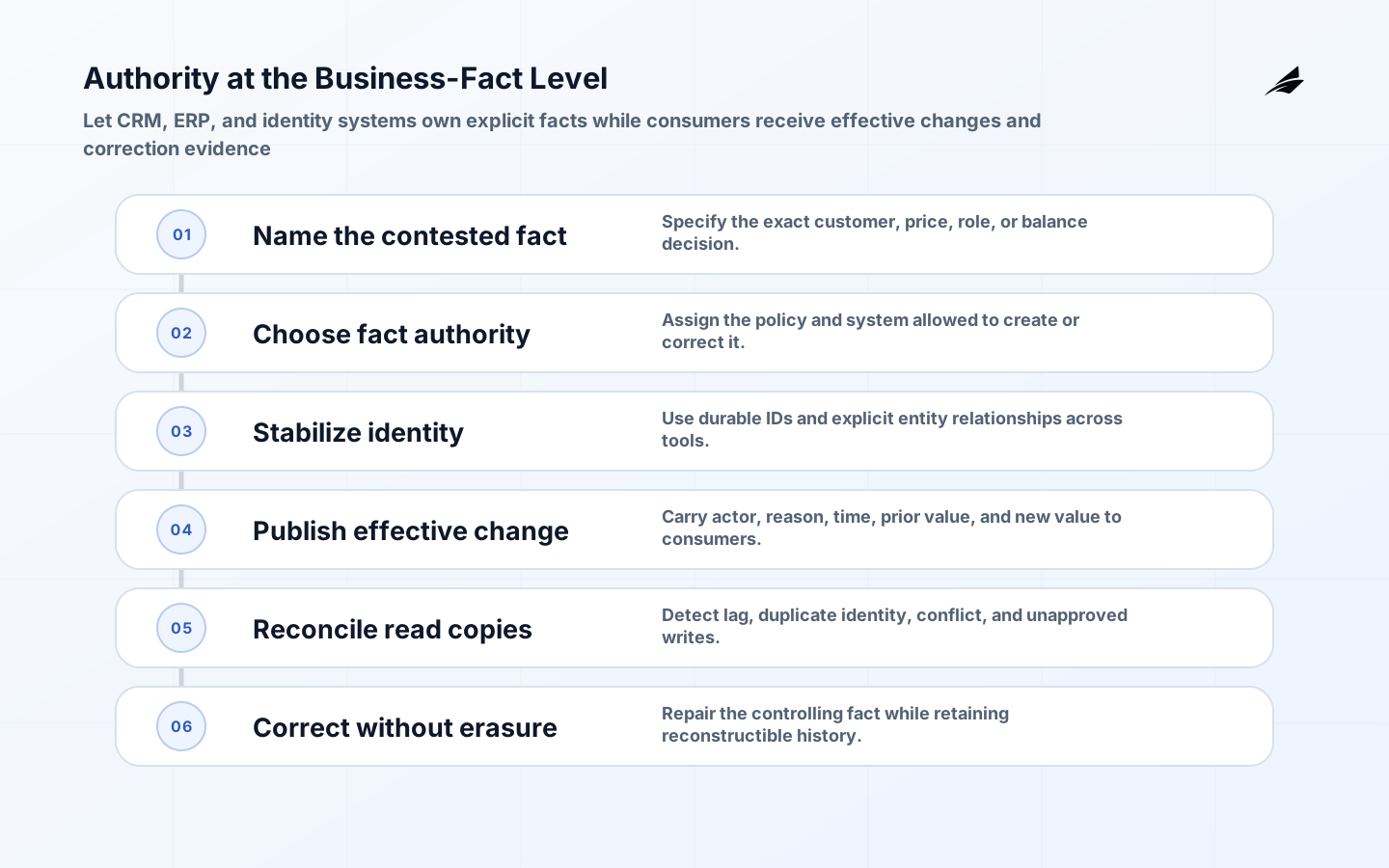
Organizations rarely begin with a bad database. They begin with reasonable tools for sales, billing, support, and operations, then add integrations and spreadsheets as business changes. Confusion arrives when two systems both appear to own the same fact: which customer is active, which price is effective, or whether an invoice was paid. System of record design makes authority explicit so people and software do not settle important questions by intuition.
Build system of record design around a clear operating model
A system of record is authoritative for a defined business fact, at a defined time, under a defined policy. One application need not own every attribute about an entity. A CRM may own relationship status, an ERP the legal customer and balance, and an identity service the credential. Name the fact, lifecycle, identifier, update authority, consumers, and correction route. Saying that one system owns the customer is too vague to guide integration.

| Decision | Practical definition | Why it matters |
|---|---|---|
| Fact | Possible authority | Consumer use |
| Legal customer | Finance or ERP | Billing and tax |
| Sales relationship | CRM | Account planning |
| Credential | Identity provider | Authentication |
| Entitlement | Entitlement service | Access decision |
Design the system of record design workflow and handoffs
Start with a decision harmed by inconsistent information, then trace the event changing the fact and every system using it. A customer becoming billable may require an approved legal entity in finance, not merely a sales-stage update. The master data management guide is useful for shared identifiers and stewardship when an entity appears in multiple tools. Publish controlled changes; consumers should not infer authority from stale replicas.
- Name the business outcome and accountable owner.
- Use stable identifiers for records and related entities.
- Document the normal path before configuring automation.
- Make authority, limits, and effective dates explicit.
- Route uncertainty to a named role with a response target.
- Test correction and reconciliation with representative records.
Keep system of record design data and evidence usable
An authoritative change needs a reason, actor or service, effective time, prior and new value where appropriate, and a link to the business event. This matters for effective-dated prices, roles, addresses, and contract terms. Keep immutable history where audit or correction requires it, while applying retention and privacy policy to personal information. A record that cannot explain how it became current is difficult to trust in a dispute.
Control system of record design exceptions without hiding them
Avoid copying all data everywhere and centralizing every operation through one brittle service. Consumers need fit-for-purpose read models, but writes must return to or be validated by authority. Define conflict behavior before bidirectional sync. If sources send incompatible updates, reject, queue, or apply a documented rule; last-write-wins is a policy choice, not technical neutrality. Restrict direct database edits and provide a correction path.
| Control area | Signal to review | Action when it fails |
|---|---|---|
| Decision | Question | Test |
| Identifier | Which ID survives change? | Reconcile duplicate |
| Write authority | Who may change it? | Reject unauthorized update |
| Propagation | How do consumers learn? | Replay missed event |
| Correction | How repair error? | Restore and explain history |
Deliver system of record design in a manageable sequence
Create an authority map for one customer or order lifecycle, not an enterprise-wide program. List facts driving a real decision and label current and intended owner. Test normal changes, late events, duplicate identity, and correction propagation. Migrate incrementally: read through a designated interface, stop new unauthorized writes, then reconcile historical differences. This exposes dependencies while operations keep moving.
Use system of record design signals that lead to action
Measure the cost of uncertainty: conflicting updates, reconciliation discrepancies, rejected changes for missing authority, consumer lag, correction completion time, and manual exports used to settle a question. The aim is not zero copies. It is that a team can identify the controlling fact and repair an error without creating competing truths.
Run a practical system of record design review
A useful design review for system of record design begins with a specific operating decision rather than a product demonstration. Put the requester, operator, policy owner, and technical maintainer around the same example. Ask what starts the work, which record is authoritative, what decision changes the state, and what evidence must remain available afterwards. This makes assumptions visible before they become configuration. It also reveals where a label such as approved, active, delivered, or closed has different meanings to different teams. For this data handoff, name the accountable owner, supporting evidence, exception route, and next measurable check.
Next, test the boundary conditions that make system of record design costly in real life: incomplete input, a duplicate request, changed authority, a late event, a conflicting record, or a dependency that never responds. For each condition, state whether the system should stop, queue work, request information, apply a bounded rule, or escalate. The answer should include a named role and a time expectation. A workflow that only describes successful completion gives operators no useful instruction when normal conditions break. Within this data handoff, name the accountable owner, supporting evidence, exception route, and next measurable check.
Walk through a customer legal-name correction arriving after invoicing. Trace fact ownership, effective date, and downstream replicas from the first event to final confirmation. The group should identify every handoff, ID, and external effect, then deliberately repeat the scenario after a timeout or correction. This exercise exposes hidden manual reconciliation and identifies actions that must be idempotent. It is more concrete than a high-level architecture review because it asks whether the evidence available to the next person is enough to make a defensible decision. When implementing this data handoff, name the accountable owner, supporting evidence, exception route, and next measurable check.
Treat data changes as part of the operating model. System of record design needs clear validation at the point where facts enter, a way to record why a value changed, and a controlled route to repair a bad value. Downstream readers need to know whether they are seeing a current result, a historical result, or a pending correction. Without that distinction, teams compensate with spreadsheets and informal messages, which makes later reconciliation slower and less trustworthy. Before releasing this data handoff, name the accountable owner, supporting evidence, exception route, and next measurable check.
Make the human interaction deliberate. Automation can route, calculate, notify, or prevent an unsafe action, but it cannot remove responsibility for ambiguous business context. Give people a concise queue with the reason work arrived, the impact of delay, the decision they are permitted to make, and links to the evidence they need. Give them an explicit way to return, reassign, or escalate work. This produces faster decisions than a generic task list because it respects the limits of the rule. While operating this data handoff, name the accountable owner, supporting evidence, exception route, and next measurable check.
Plan day-two operations while the design is still small. Name who monitors failures, who approves policy changes, who owns source data, and who decides that a recurring exception deserves redesign. Define the minimum logs, alerts, and reconciliation routine before launch. The aim is not exhaustive monitoring. It is a short set of signals that makes an emerging problem visible while a responsible team can still correct the system, notify affected people, and preserve an accurate record. When changing this data handoff, name the accountable owner, supporting evidence, exception route, and next measurable check.
Set release acceptance around observable outcomes. A release should demonstrate a normal record, an invalid record with a useful explanation, an authorized exception, and a correction that reaches dependent systems without a duplicate effect. Include access and audit checks where the workflow handles sensitive data or consequential decisions. Record the test data and expected result so later changes can be compared. This kind of acceptance evidence protects both operators and engineers when pressure builds to expand scope. During support for this data handoff, name the accountable owner, supporting evidence, exception route, and next measurable check.
Key system of record design takeaways
- System of record design should support a concrete business outcome, not a generic feature list.
- Authority, identifiers, and correction paths need design before scale.
- A visible exception route is safer than an informal bypass.
- Logs and history should help an accountable person reconstruct an outcome.
- Pilot one consequential path with real operators and awkward cases.
- Use signals to improve work, not only count activity.
System of record design FAQ
Can a warehouse be authoritative? It is usually a reporting consumer, but can own a governed derived metric. Can one fact have two owners? Split it into clearer facts or establish precedence; ambiguous shared ownership fails under change. When use events? When consumers need timely durable notice, while retaining a way to retrieve current authoritative state.
Conclusion: make system of record design dependable in ordinary work
Good system of record design makes authority boring and dependable. Define ownership at the fact level, preserve change evidence, and choose correction behavior before integrations multiply ambiguity.