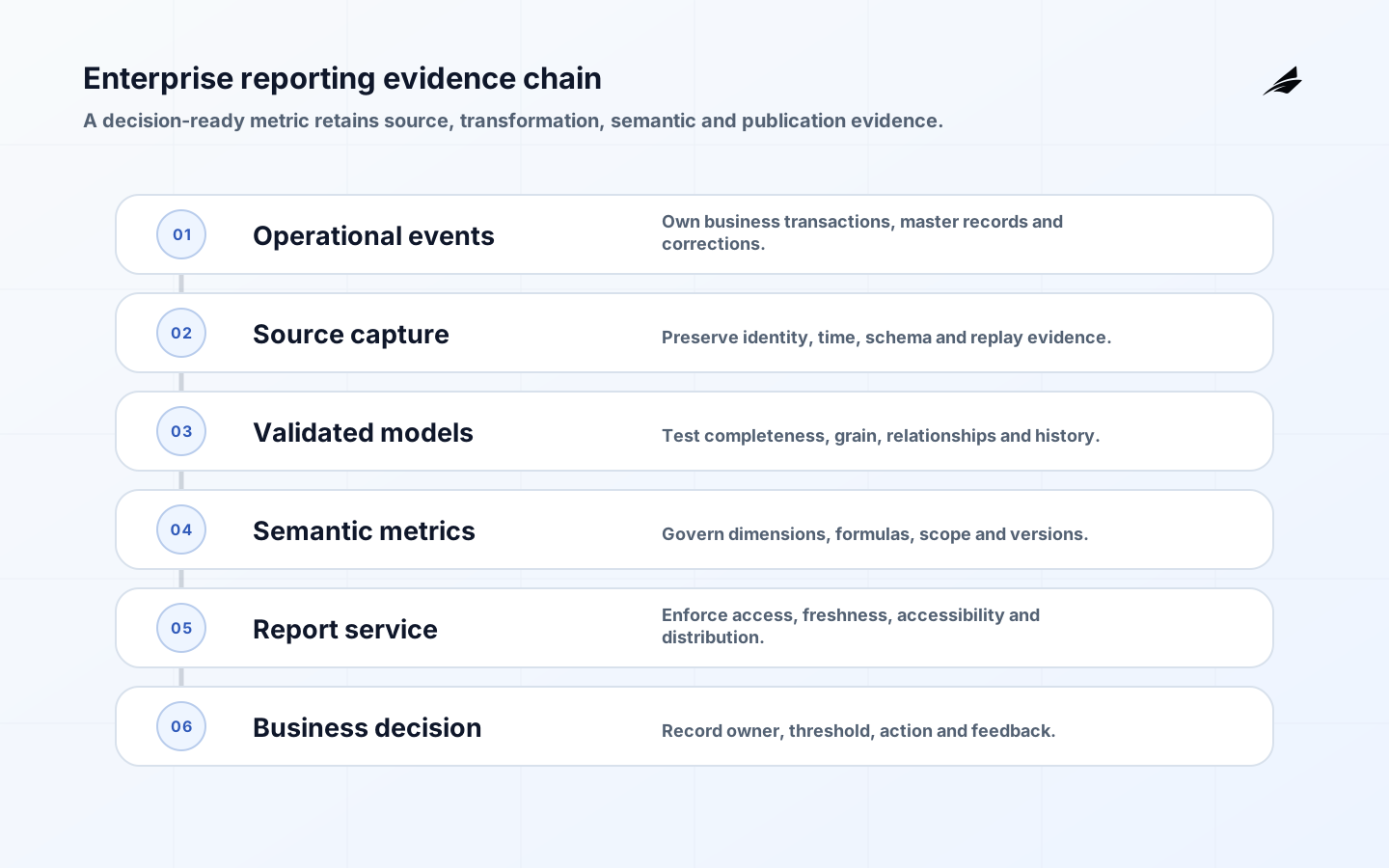
Enterprise Reporting Architecture: From Source Data to Trusted Decisions requires more than selecting tools or assembling a feature list. The implementation must connect a defined business outcome to data, authority, failure behavior and permanent ownership. This guide explains the decisions a buyer, product leader and delivery team should settle before committing the full build. It uses current primary standards where they define a useful control, while keeping the architecture proportional to the actual workflow and consequence.
The practical goal is an operable service: people can complete the intended work, understand state and exceptions, and recover when a dependency or decision fails. Scope therefore includes discovery, design, integration, security, delivery, rollout and support. The sections below can be used for proposal review, architecture workshops and acceptance planning. Related reading includes Enterprise Reporting Architecture: A Practical Guide for Product Leaders, Enterprise Reporting Architecture for Trusted Operating Decisions, Data Contracts Between Systems and Teams.
Begin with decisions and accountability
Inventory recurring decisions before inventorying dashboards. For each decision, name the owner, cadence, threshold, required dimensions, tolerated latency and consequence of error. Separate regulatory or financial statements from operational exploration. A report is a product with users and service expectations, not the final step of a data pipeline. Remove measures that have no owner or action. Where two departments need different legitimate views, record the context instead of forcing a misleading universal number. The architecture should make disagreements about definition, source and timing visible and resolvable.
Create a reporting catalog organized by decisions, not departments. Link each report to owner, audience, cadence, source, metric version and downstream distribution. Mark reports used for external disclosure or automated action. Review the catalog with real meeting agendas and operating procedures. If a report is viewed but no decision depends on it, reduce its service tier or retire it rather than applying the same governance cost as a material control report.
Establish authoritative sources and capture boundaries
Document the operational system that owns each business event and master record. Ingestion should preserve source identifiers, occurrence and extraction time, deletion semantics and raw evidence needed for replay. Use change data capture or APIs according to source guarantees, not fashion. Land immutable or append-oriented source history where feasible, then validate completeness and duplication before transformation. A layered lakehouse can separate raw, validated and consumption-ready data, but layer names do not create quality; acceptance checks and ownership do.
For APIs and files, record extraction watermark, source query, schema and retrieval result. Detect partial success such as one missing business unit. Coordinate source schema change through contracts, but keep anomaly monitoring because valid changes can still alter meaning. Backfills should use a separate run identity and preserve original publication history. Source teams need feedback about data defects so reporting does not become a permanent repair layer.
| Area | Decision | Evidence |
|---|---|---|
| Architecture layer | Responsibility | Evidence |
| Source capture | Preserve operational facts and extraction context | Completeness, identifiers and replayable history |
| Validation | Standardize types and reject invalid records | Quality results and quarantined exceptions |
| Business model | Represent entities, history and relationships | Reviewed grain and reconciliation |
| Semantic layer | Define governed measures and dimensions | Versioned metric contracts |
| Consumption | Serve reports, alerts and analysis | Freshness, access and usage state |
Create governed semantic and metric models
Define business entities, grain, dimensions, measures, filters and time logic in a reviewed semantic layer. A metric contract should state numerator, denominator, included population, exclusions, currency, timezone, owner and effective version. Reuse dimensions only when identity and slowly changing history are understood. Prevent each dashboard from reimplementing joins and ratios. Version material definition changes and show effective dates. Historical reports may need to retain the old definition while planning views use the new one, so semantic governance must distinguish correction from policy change.
Define conformed dimensions only where enterprise identity is governed. Customer, product and location often differ by process; forced matching can create false precision. Maintain mapping stewardship and unresolved categories. Use tests for grain before joins to prevent fan-out. Separate additive, semi-additive and non-additive measures. Provide certified metric examples with expected outputs so changes to SQL, semantic tools or calendar logic can be compared deterministically.
Make provenance inspectable
A trusted result should answer which source records, transformations, code version, configuration and run produced it. The W3C PROV family defines entities, activities and agents for interoperable provenance, while OpenLineage models jobs, runs and datasets with extensible facets. Capture lineage automatically where possible and enrich it with ownership and business meaning. Lineage is not merely a graph for architects: use it for impact analysis, incident response, access review and certification. Preserve run identifiers in report refresh metadata so a disputed number can be tied to the actual processing event.

Lineage collection must cover orchestration, transformations, semantic models and report refreshes; gaps should be visible rather than inferred. Attach dataset schema and column lineage where reliable, but avoid presenting approximate parser output as fact. Use lineage to identify reports exposed to a source incident and to stage schema migration. Access to lineage can itself reveal sensitive system and field names, so govern it by operational need.
Test data quality at decision boundaries
Test schema, uniqueness, referential integrity, accepted values, timeliness and reconciliation, but connect each test to a decision risk. A technically valid table can still be wrong if a source stopped sending a region. Monitor row counts and distributions by meaningful dimensions, compare control totals and reconcile material metrics to source operations. Define whether a failed test blocks publication, marks the report stale or opens an incident. Expose freshness and quality state to readers rather than serving a polished dashboard whose last successful refresh is hidden.
Assign every material test an owner, threshold and response. Quarantining invalid rows can keep pipelines green while making totals wrong, so report excluded volume. Compare current data with seasonality and planned business events to reduce noisy alerts. For financial or regulated measures, reconcile to independent control totals and document sign-off. Track repeated waivers; an exception that renews indefinitely is an unimplemented requirement, not temporary tolerance.
| Area | Question | Control |
|---|---|---|
| Reporting incident | Immediate action | Durable correction |
| Source feed missing | Mark affected outputs stale and notify owner | Monitor completeness by source partition |
| Metric definition changed | Freeze comparison and identify effective date | Version the semantic contract |
| Duplicate processing | Stop publication and reconcile control totals | Make ingestion idempotent |
| Access policy gap | Revoke exposure and preserve evidence | Move enforcement to governed data boundary |
| Dashboard abandoned | Confirm no decision dependency | Retire asset and release ownership |
Align access with data sensitivity and purpose
Apply authorization at governed data and semantic boundaries, not only in the visualization tool. Consider organization, role, geography, purpose and field sensitivity. Test row- and object-level policies against exports, subscriptions, cached extracts and drill-through. Masking is not sufficient if aggregates reveal small populations. Separate production access from development and use representative protected test data. Record privileged queries and report sharing where consequences justify it. Accessibility also matters: tables, labels, color, keyboard navigation and downloadable alternatives should support the full reporting task.
Use purpose-specific datasets and aggregates to reduce exposure, not only dynamic filters on a universal model. Review service accounts and embedded-report identities. Subscription emails and downloaded files may escape platform access controls, so apply classification, expiry and distribution policy. Test changes with multiple roles and small populations. Provide a secure correction route when a user sees inaccurate personal or account information in a report.
Operate reports through change and incidents
Assign owners for source feeds, data products, metrics, reports and business decisions. Publish service expectations for refresh, incident response and planned change. Use dependency-aware deployment, contract tests and representative report comparisons before promoting transformations. When a number is wrong, identify affected reports and decisions, pause distribution, correct data through a governed process and communicate the scope. Measure time to detect, time to restore, recurring defects, stale-report exposure and adoption by decision workflow. Retire unused reports so governance attention remains concentrated on material assets.
Treat definition changes as releases with impact, review, deployment and communication. Keep prior metric versions available where historical decisions must be interpreted. During incidents, publish scope and last known good period. After restoration, confirm subscriptions and downstream extracts were corrected, not only the central dashboard. Use support demand and duplicate report creation as signals that semantics or discovery are failing. Fund stewardship as ongoing product work.
Key takeaways
- Design reporting around owned decisions and explicit tolerance for delay or error.
- Centralize metric meaning without erasing legitimate contextual views.
- Capture lineage, run identity and quality state for dispute and impact analysis.
- Govern access, change, incidents and retirement as part of the architecture.
Frequently asked questions
Does enterprise reporting require a lakehouse?
No. A warehouse, lakehouse or federated design can work. Choose based on data types, latency, governance, skills and workload. Trusted reporting depends more on contracts, semantics, provenance and ownership than the storage label.
Can one dashboard become the single source of truth?
A dashboard is a view, not usually the authoritative source. Trust comes from governed source records, transformations and metric definitions that can support several appropriate presentations.
Should enterprise reports be real time?
Only when the decision window requires it and sources can provide meaningful timely events. Many planning and financial decisions are better served by complete reconciled batches with visible publication time.
Conclusion
Enterprise reporting architecture turns operational records into trusted decisions by governing meaning, provenance, quality and responsibility across the full path. The goal is not one giant dashboard or one storage platform. It is a reporting service where readers can understand the metric, source, freshness and owner, and where teams can detect, explain and repair errors before they silently influence the business. Review the reporting portfolio regularly so trusted assets receive ownership while redundant or misleading outputs are retired.