Role-Based Operations is useful only when it makes a consequential operating decision easier to perform, inspect, and recover. A person can be trustworthy and still be assigned the wrong scope after a team change, temporary assignment, acquisition, or customer escalation. Role design therefore has to represent the work people actually perform, the data they need, and the boundaries they must not cross. The first design task is to follow one real item of work from entry to outcome and list the people, records, rules, and handoffs that change its meaning. That evidence is more valuable than a long feature list because it shows exactly where the enterprise currently relies on memory or informal messages. For this part of the system, name the accountable owner, supporting evidence, exception route, and next measurable check.
Set the boundary for role-based operations
Choose a narrow outcome and name its owner. For role-based operations, the owner should be able to change the operating rule, not merely maintain a screen. Ask what must be true before work can proceed, what result proves completion, and who may accept an exception. This distinguishes a dependable operating path from a collection of status fields. It also makes the work intelligible to operations leaders, who need a decision they can sponsor and evaluate. Within this decision boundary, name the accountable owner, supporting evidence, exception route, and next measurable check.
Describe responsibilities in terms of actions and evidence. A service agent may gather facts, a billing specialist may verify a policy condition, a procurement approver may authorize the next step, and a platform administrator may resolve a technical failure. One person can occupy several roles in a small team, but the authority should still be explicit. Unnamed responsibility is where urgent work becomes difficult to audit later. When implementing this decision boundary, name the accountable owner, supporting evidence, exception route, and next measurable check.
| Operating question | Authoritative evidence | Named decision |
|---|---|---|
| What work is in scope? | a customer account and product line | Accept, route, or reject the item |
| May the action proceed? | a billing ledger and legal entity | Approve, pause, or escalate |
| Who may act now? | a spend threshold and supplier | Grant the least useful authority |
| What proves the outcome? | the production tenant and audit log | Close, reverse, or reopen |
Role-Based Operations architecture
For operations leaders working on role-based operations, this operating decision should connect workflow authority, system-of-record ownership, approvals, exceptions, reconciliation, and reporting to evidence an accountable owner can inspect. Build the architecture around a durable work identity and an appendable history. The record needs a stable identifier, current state, accountable owner, relevant business scope, and links to source evidence. Material transitions should record actor, time, reason, and correlation identifier. This does not mean copying every upstream field. It means retaining the facts necessary to explain why this item took this path after connected systems have moved on. In this operating review, move beyond the operating decision only after the owner can show the accepted result, the exception path, and the signal for another review.
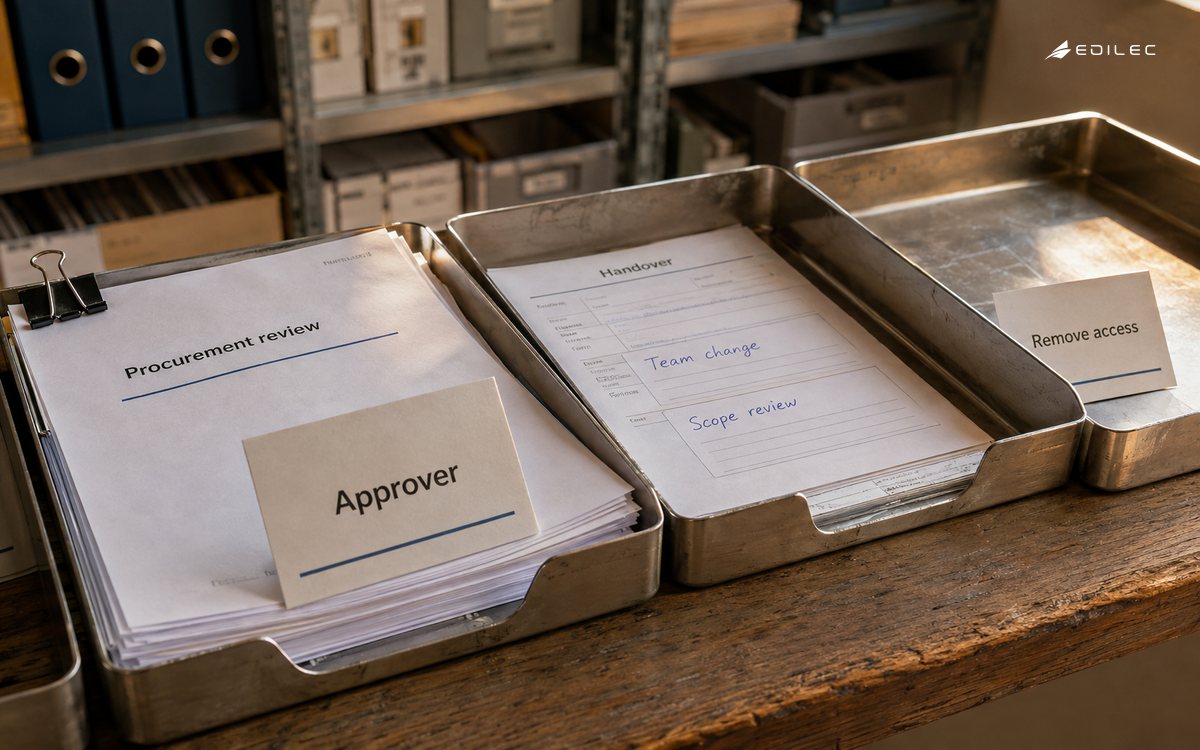
In role-based operations, operations leaders should make the relationship between workflow authority, system-of-record ownership, approvals, exceptions, reconciliation, and reporting explicit and reviewable. Integrate at business events rather than by treating one application's user interface as another application's database. Publish an event when an accountable decision commits, include a version or effective time, and make consumers safe to retry. If a dependency cannot confirm the decision, show a truthful pending or denied state. That approach pairs well with workflow exception handling because uncertainty becomes a visible part of the model instead of a silent background failure. This operating review should close the operating decision only when the result, unresolved exception, and next review condition are recorded.
Design for change, error, and recovery
A dependable role-based operations design makes workflow authority, system-of-record ownership, approvals, exceptions, reconciliation, and reporting visible to the owner responsible for this recovery path. List the ways the normal path can become unsafe: incomplete source data, a stale relationship, a duplicated request, a material change after approval, an unavailable integration, or an attempt to act outside scope. For each, define whether the system should reject, pause, retry, route for review, or permit a time-bounded override. The response should preserve the original request and evidence; overwriting it removes the context needed to investigate a later discrepancy. The next step in this operating review is justified when the team can trace the accepted outcome, the fallback route, and the owner of follow-up.
This recovery path for role-based operations is strongest when workflow authority, system-of-record ownership, approvals, exceptions, reconciliation, and reporting can be reviewed as one operating record. Access decisions deserve particular care. Authenticate the actor, then authorize the specific action against the scoped record on the server. Avoid broad roles that survive organizational change because they are convenient at setup time. Log material changes and denials in a consistent, protected event stream without recording passwords, tokens, or unnecessary personal data. Good evidence lets an owner distinguish a policy gap from a software defect and a user mistake from a suspicious pattern. Acceptance in this operating review requires a visible outcome, a bounded exception path, and a measurable reason to revisit the decision.
| Failure mode | Preventive design | Recovery evidence |
|---|---|---|
| Required fact is missing | Validate before irreversible action | Missing field, source, and accountable resolver |
| Source changes after approval | Version or reauthorize material change | Prior decision and changed facts |
| Delivery to another system fails | Idempotent retry with bounded backoff | Correlation ID and final outcome |
| Actor lacks authority | Server-side action and record scope check | Policy version, actor, and denial reason |
Roll out with representative work
Pilot role-based operations on a real but contained slice of work. Capture a baseline of cycle time, correction rate, exception age, and customer or operator effort before launch. During the pilot, review individual examples with the people who perform the work; aggregate metrics alone cannot tell whether a new rule is useful. Keep a reversal plan for configuration and integrations, then expand only after the owner can explain the cases that did not follow the normal route. To validate this part of the system, name the accountable owner, supporting evidence, exception route, and next measurable check.
Operations leaders can keep role-based operations accountable by recording how workflow authority, system-of-record ownership, approvals, exceptions, reconciliation, and reporting shape this operating decision. Migration needs an explicit decision about legacy records. Decide which active items must be moved, which historical items remain readable in place, how identifiers are cross-referenced, and who corrects mismatches. Do not promise a perfect historical conversion when source evidence is weak. A small, well-documented set of exceptions is safer than synthetic precision that later contaminates enterprise reporting. For this operating review, the responsible owner should be able to explain what passed, what remains exceptional, and which signal reopens review.
Measure quality of the operating path
For role-based operations, the evidence behind this acceptance decision should cover workflow authority, system-of-record ownership, approvals, exceptions, reconciliation, and reporting. Use a compact scorecard that joins flow and control quality. Time to complete is helpful, but pair it with first-pass success, reopened work, aged pending items, unauthorized attempts, and percentage of changes with complete evidence. Segment only where a team can act on the difference. The aim is a review conversation that ends in one improvement, not a dashboard that reports every available number with no accountable response. Do not widen the scope from this operating review until the evidence supports the result, the recovery route, and the next operating check.
- Review the oldest open role-based operations items with the person who can unblock them.
- Sample completed decisions to test that evidence and final state agree.
- Track manual workarounds; they often reveal a missing rule, integration, or role.
- Treat recurring exceptions as candidates for redesign, not merely training reminders.
Key takeaways
- Role-Based Operations should make a real decision and its evidence visible.
- Keep stable work identity, clear authority, and retry-safe integration boundaries.
- Make failure states truthful, owned, and recoverable.
- Use live case evidence to improve the path before expanding it.
Frequently asked questions
Where should role-based operations begin? Begin with the smallest repeated decision that is currently expensive, risky, or opaque. A narrow boundary gives the team time to agree on ownership and evidence before a platform becomes a substitute for unresolved policy. For this part of the system, test one expected case, one ambiguous case, and one failure with a documented recovery action.
The team responsible for role-based operations should examine workflow authority, system-of-record ownership, approvals, exceptions, reconciliation, and reporting together before accepting this operating decision. Can a spreadsheet manage this at first? A spreadsheet can be useful for discovery or a short pilot, provided ownership and access are controlled. Move to a managed workflow when the work requires concurrent updates, reliable audit history, integration, or customer-facing commitments that a file cannot safely provide. Within this part of the system, test one expected case, one ambiguous case, and one failure with a documented recovery action. A reviewer using this operating review should be able to reconstruct the decision, route an exception, and identify the next trigger without relying on private context.
A reviewable role-based operations workflow ties this operating decision to workflow authority, system-of-record ownership, approvals, exceptions, reconciliation, and reporting. Who owns data quality? The owner of the business decision should own fitness for use, with data stewards and technical teams responsible for the agreed controls. This field-level clarity is central to system of record design. When implementing this part of the system, test one expected case, one ambiguous case, and one failure with a documented recovery action. Completion in this operating review means the accepted state, correction route, and future review signal are all visible to the operating team.
Assurance review
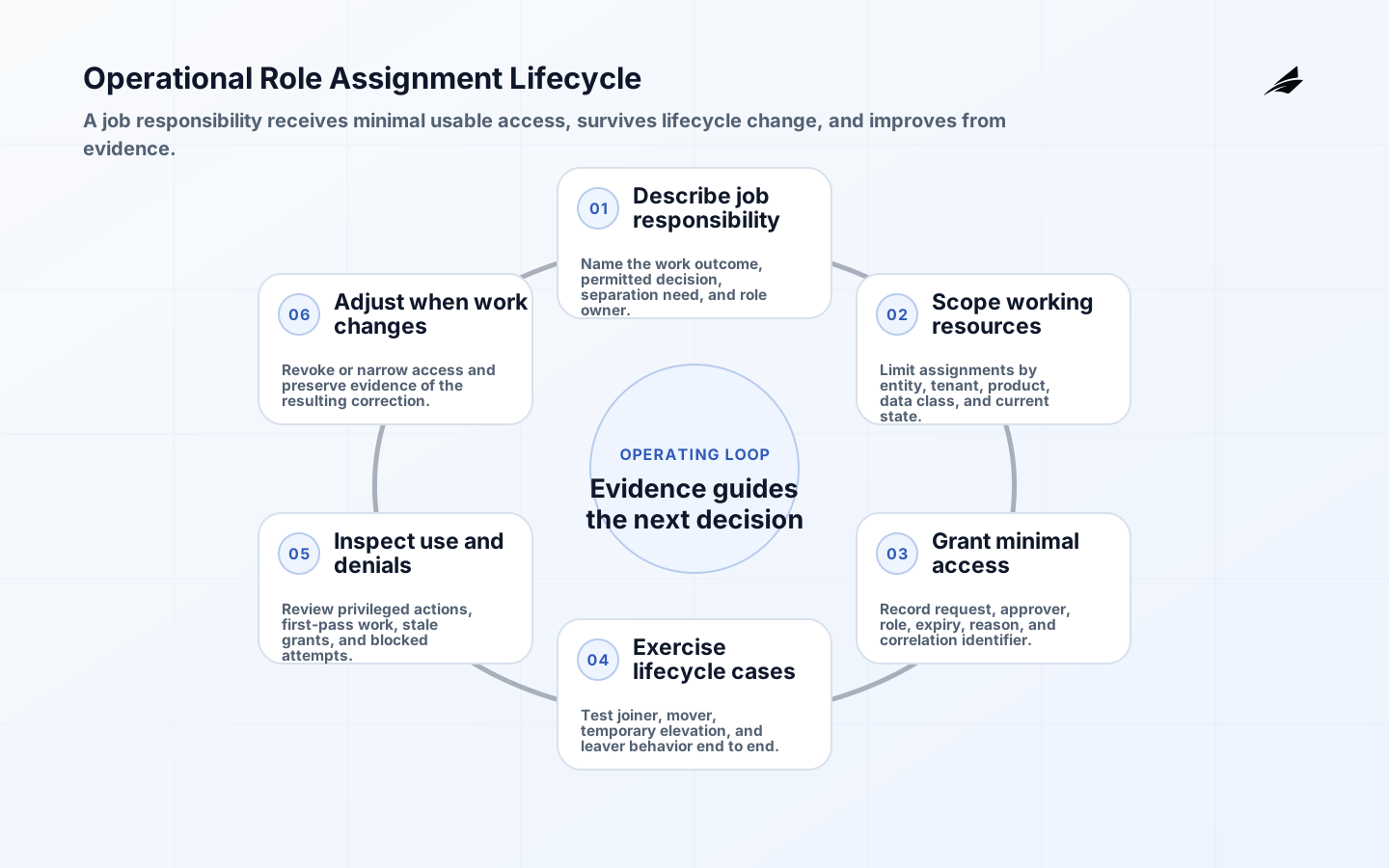
For role-based operations, review a role with a business owner and a person who actually performs the work. Confirm the role permits the necessary action but not adjacent customer, finance, or administrative actions. Exercise joiner, mover, temporary elevation, and leaver scenarios rather than checking only a static matrix. The result should be a practical lifecycle rule: who requests access, who attests to it, how long it lasts, and how an urgent need is handled safely.
The assurance review should produce a small, owned change rather than a broad redesign. For role-based operations, write down the observed condition, the decision it affected, the owner who will correct it, and the signal that will show whether the correction worked. Revisit the same class of work after the change. This closes the loop between policy, system behavior, and the people who depend on the outcome.
Conclusion
The point of role-based operations is not to remove people from work. It is to give people dependable context, bounded authority, and a visible way to recover when reality refuses the happy path. Start with one consequential decision, preserve its evidence, and let the operating signals determine the next improvement. Before releasing this part of the system, test one expected case, one ambiguous case, and one failure with a documented recovery action.