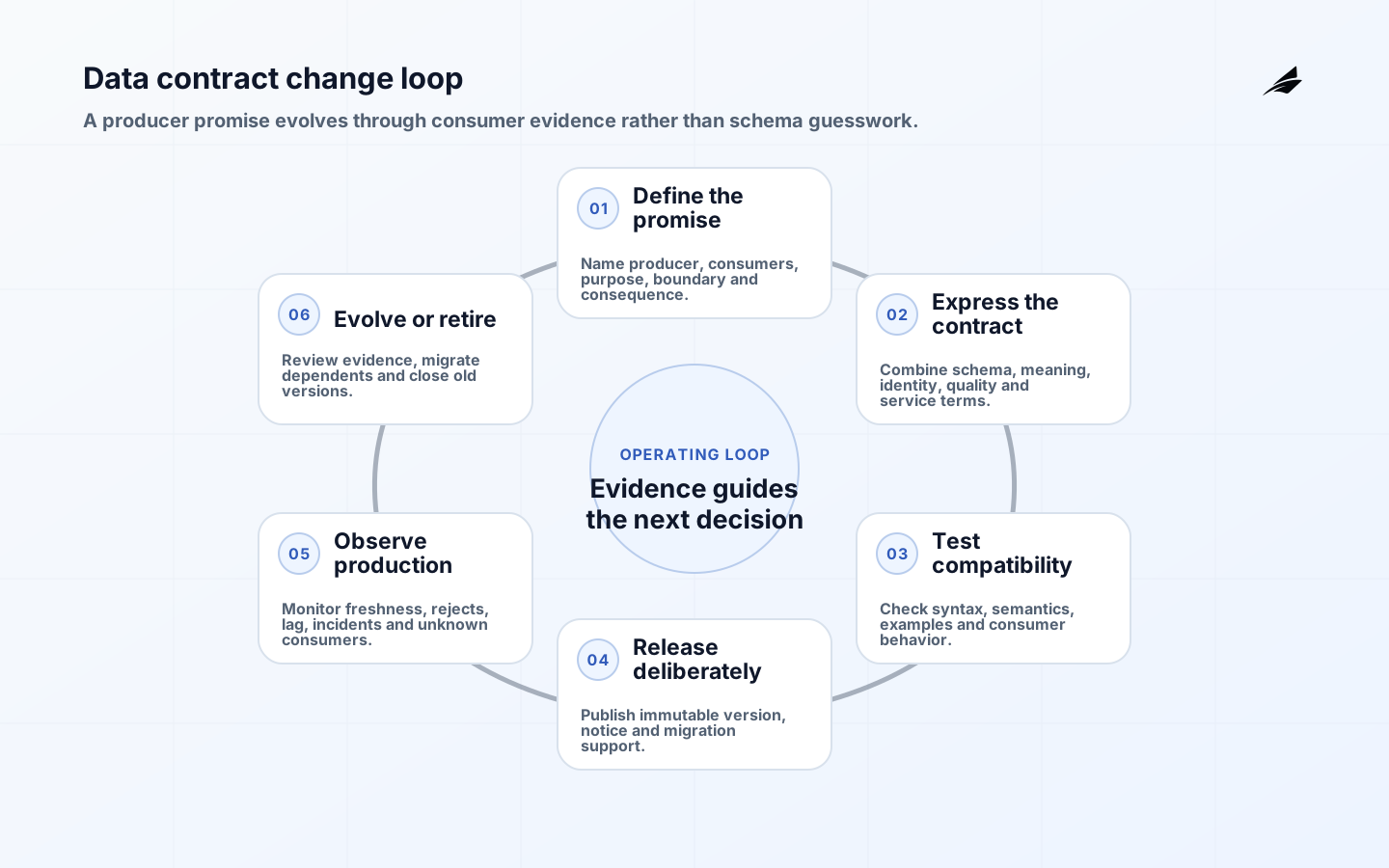
Data contracts for product teams make a producer’s promise to consumers explicit enough to test and operate. A schema is part of that promise, but not the whole of it. Consumers also depend on meaning, identifiers, freshness, quality, access, ownership and change behavior. A contract should reduce coordination cost while preserving the producer’s ability to evolve, not freeze every field forever.
This guide focuses on contracts for APIs, events, warehouse tables and data products. The production data-lineage guide helps trace dependencies; the warehouse modeling guide covers analytical structure; and the real-time analytics guide addresses operating event-driven consumption at low latency.
Define the promise and its boundary

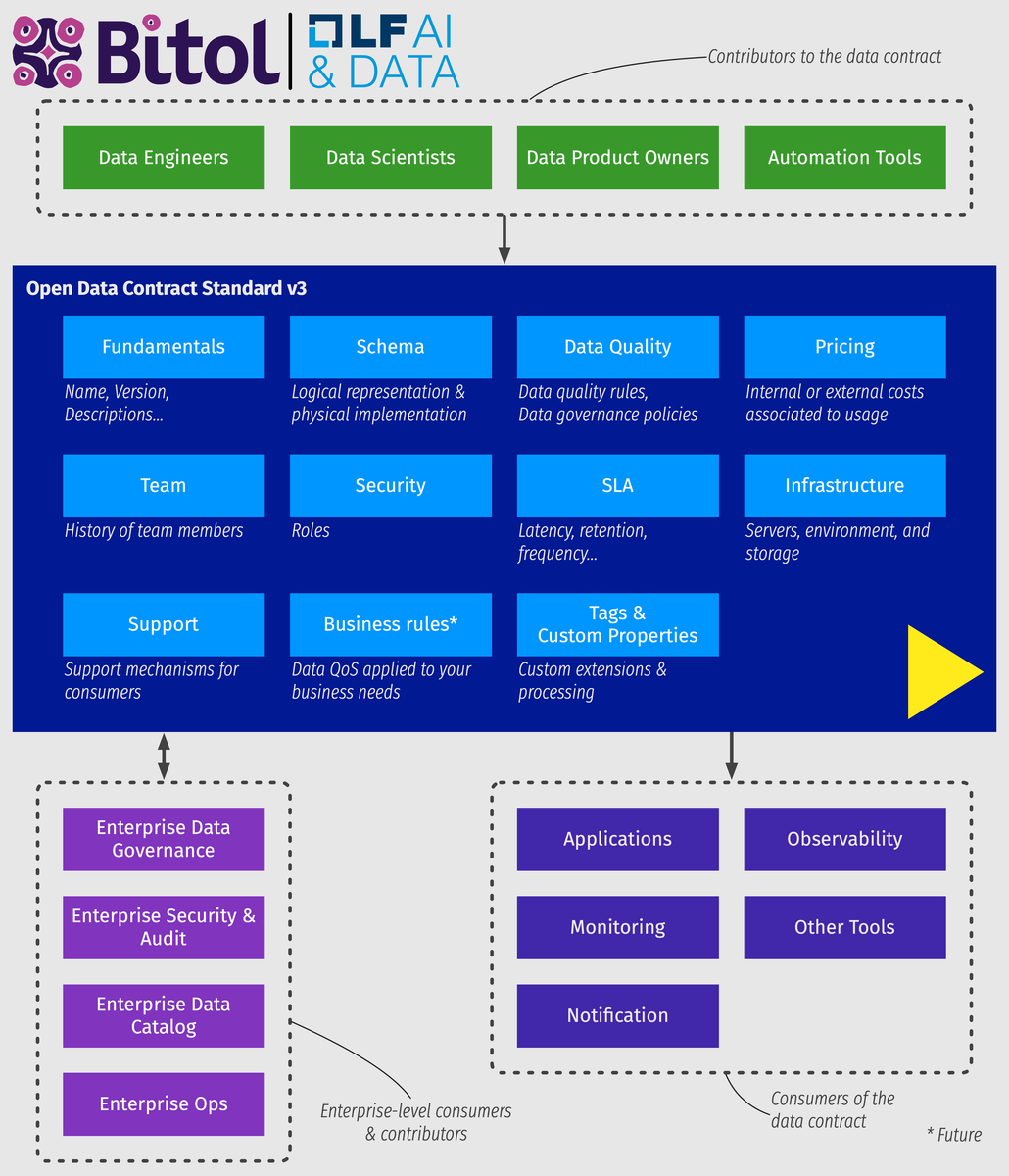
Start with a named product or service boundary and known consumer decisions. Record producer owner, technical contact, consumers, purpose, authoritative identifiers, delivery interface, classification and support route. State what the producer controls and what it does not. A contract for order_status_changed can promise event identity and order state at occurrence time, but it should not promise that every consumer has completed downstream processing.
Choose enforcement according to consequence. A public or cross-team interface may need formal review, automated compatibility checks and a deprecation window. An exploratory dataset may begin with owner, grain and quality expectations. Avoid contracts on raw implementation details no consumer should depend on. Contract stable domain meaning and observable service behavior; allow storage layout, internal jobs and nonpublic fields to change behind the boundary.
| Contract dimension | Question | Testable expression |
|---|---|---|
| Identity | What uniquely identifies record or event? | Required stable key with uniqueness rule |
| Structure | Which fields, types and formats exist? | Versioned machine-readable schema |
| Meaning | What does each value represent and when? | Definitions, units, timezone and examples |
| Quality | Which defects are unacceptable? | Completeness, validity and reconciliation thresholds |
| Service | When and how is data delivered? | Freshness, availability, retention and support objectives |
| Change | How can the promise evolve? | Compatibility policy, notice and retirement dates |
Combine machine-readable and human meaning
Represent structure in a standard suited to the interface. The OpenAPI Specification describes HTTP APIs, while AsyncAPI 3.1 describes message-driven interfaces across protocols. JSON Schema can validate JSON instances and express constraints. Tooling can generate documentation, fixtures and compatibility checks, but the team still must define business semantics and operating policy.
For every public field, document definition, unit, format, null behavior, source, sensitivity and example. Define enumeration ownership and unknown values. State whether timestamps describe occurrence, processing or publication, with timezone and precision. For tables, declare grain and key. For events, distinguish event identifier, subject identifier and correlation identifier. For APIs, define idempotency and pagination behavior. Keep documentation next to the versioned contract and review it with representative consumers.
Design event contracts for asynchronous reality
Events may be delayed, duplicated, reordered or replayed. Include a unique event identifier, source, type, subject, occurrence time, schema version and trace or correlation context where useful. CNCF’s CloudEvents specification provides common event metadata and protocol bindings, improving portability without defining domain payload meaning. Consumers should be idempotent and should not infer global ordering unless the producer explicitly provides a scoped sequence guarantee.
Define delivery and retention separately from processing. At-least-once transport means duplicates are normal; a broker acknowledgement does not prove a consumer’s business effect. Establish retry, expiry, dead-letter and replay policy. Decide whether corrections produce a new event, replacement snapshot or compensating event. Protect sensitive fields and avoid using an event bus as an indefinite database by accident. Provide a safe consumer test environment or recorded fixtures.
Specify quality and service objectives
Quality rules should connect to consumer harm. State eligible population, threshold, window and response. “Email valid” may mean syntactic validation at capture; it does not prove deliverability. “Order amount reconciles to ledger within 0.1 percent by 07:00 UTC” is measurable. Include freshness, completeness, validity, uniqueness, referential integrity and reconciliation only where relevant. Define warning and breach levels, exception ownership and whether bad records are rejected, quarantined or published with status.
Service terms can cover availability, publication deadline, retention, incident communication and support hours. Do not promise stronger objectives than the source process and platform can operate. Provide observable status and stale-data indicators. Name the consumer action when a contract is breached: pause a report, fall back, continue with warning or block an automated decision. A contract without failure behavior encourages every consumer to invent a different response.
| Change | Usually compatible? | Required handling |
|---|---|---|
| Add optional field | Often, if consumers ignore unknowns | Compatibility test and documentation |
| Add enum value | Not always | Consumer tolerance test and notice |
| Rename or remove field | No | New version, migration and deprecation |
| Change unit or meaning | No, even if type matches | New field or version with explicit conversion |
| Tighten nullability | Potentially breaking | Measure existing data and consumer use |
| Change freshness objective | Operationally breaking | Impact review, notice and fallback update |
Version by compatibility and meaning
Define compatibility from actual consumers, not syntax alone. Adding an optional field is often safe for tolerant readers, but adding an enumeration can break exhaustive switches. A type-preserving change from gross amount to net amount is semantically breaking. Maintain automated producer and consumer tests for known patterns, then review changes that tooling cannot reason about. Version when a consumer cannot adopt independently inside the agreed window.
Run a change process: proposal, affected-consumer discovery, compatibility classification, sample data, test, notice, dual publication where needed, migration tracking and retirement. Give deprecations owners and dates. Avoid permanent v1/v2 duplication by funding consumer migration. Emergency changes need a defined route and retrospective. Preserve old contract and transformation logic long enough to explain historical data. Record approved waivers with expiry.
Enforce contracts in delivery and production
Validate contracts in pull requests and continuous integration. Lint structure, check examples, generate fixtures, test compatibility against the released version and run business-quality assertions on production-shaped data. At runtime, validate at the producer boundary when feasible and monitor rejects. Consumers should also validate consequential assumptions. Avoid validating every payload twice at prohibitive cost without understanding the risk; enforcement placement is an architecture decision.
Publish contracts in a discoverable registry or catalog with owner, status, versions, consumers and change policy. Make released versions immutable. Control access to sensitive examples and schemas. Link code, dashboards, incidents and lineage. OpenLineage describes an extensible model for datasets, jobs and runs, which can help discover which processing paths consume or produce a contracted dataset. Instrumentation does not replace explicit consumer registration for critical interfaces.
Operate the contract as a product relationship
Monitor freshness, quality, volume, schema rejects, consumer lag, deprecation progress and incidents. Hold reviews for high-impact products with producer and consumers. Track time to approve a safe change and the number of unregistered dependencies. A contract that makes every change slow has become bureaucracy; one that detects no breakage is too weak or poorly observed. Adjust governance by consequence and reuse patterns across teams.
Provenance supports explanation. The W3C PROV overview models relationships among entities, activities and agents. Use that thinking to capture which process and version produced data, from which inputs and under whose ownership. During an incident, identify affected outputs, notify consumers, correct or replay data and record resolution. Feed recurring misunderstandings into definitions and examples.
Example: an order-status event contract
Define order.status.changed as one event per accepted transition, uniquely identified by event_id, with order_id, previous and new status, occurrence time, actor class, reason and schema version. State allowed transitions, timezone, redacted fields, at-least-once delivery, seven-day replay and no global order. Require consumers to deduplicate by event identifier and reconcile unknown transitions through an order snapshot API.
The producer tests transition validity, required fields, tenant ownership and compatibility. It monitors event delay, rejected payloads and broker publication. A fulfilment consumer tests idempotency and unknown enum handling; analytics validates counts against authoritative order transitions. A proposed status addition includes sample data, affected-consumer results, notice and a release date. This is a useful contract because it combines structure, semantics, service and change.
Introduce contracts without blocking delivery
Begin with one high-consequence interface that already causes coordination or quality failures. Document current consumers and meaning, place the existing schema under version control, add representative examples and automate a small set of compatibility and business checks. Do not demand every historical interface conform to a new template before proving value. Publish reusable patterns as the pilot reveals which fields and gates teams actually need.
Expand by consequence tiers. A private experimental interface may need an owner and expiry; a shared internal product adds service and change commitments; a regulated or external interface requires stronger approval, evidence and retention. Measure prevented breakages, change lead time, unregistered consumers and incident diagnosis. Simplify controls that add delay without detecting risk, and strengthen areas where production evidence shows blind spots.
- Select a painful shared interface with identifiable producers and consumers.
- Capture its current behavior before declaring an ideal future contract.
- Automate compatibility and quality checks that address observed failures.
- Provide templates, examples and registry workflows through the platform team.
- Scale governance by consumer reach and consequence, not one universal process.
- Review whether contracts improve safe change and incident resolution over time.
Key takeaways
- Contract the stable producer-consumer boundary and known decision, not every internal implementation detail.
- Combine machine-readable schemas with grain, meaning, ownership, quality and service expectations.
- Design asynchronous contracts for duplicates, delay, replay, correction and unknown outcomes.
- Classify breaking changes from consumer behavior and semantics, then fund migration and retirement.
- Monitor contracts in production with lineage, incident response and a proportional governance path.
Frequently asked questions
Is a data contract the same as a schema?
No. A schema defines structure and constraints. A useful contract also defines meaning, ownership, quality, service behavior, security and change policy. Schema validation can automate part of enforcement but cannot determine whether a field means what consumers believe.
Who owns a data contract?
The producing product or domain should own the promise and operation, with consumers participating in design and change review. Platform teams can provide standards and tooling, but they should not become semantic owners for every domain.
Does every table need a formal contract?
No. Apply rigor according to reuse, consequence and organizational boundary. Public APIs, shared events and decision-critical data products deserve strong contracts. Internal staging tables may need ownership and tests without a broad compatibility commitment.
Conclusion
Data contracts work when they create an operable relationship, not another static document. Define the promise around consumer decisions, express structure and meaning, automate proportionate checks and make change and failure behavior explicit. Product teams can then evolve independently while preserving the trust that shared data requires.