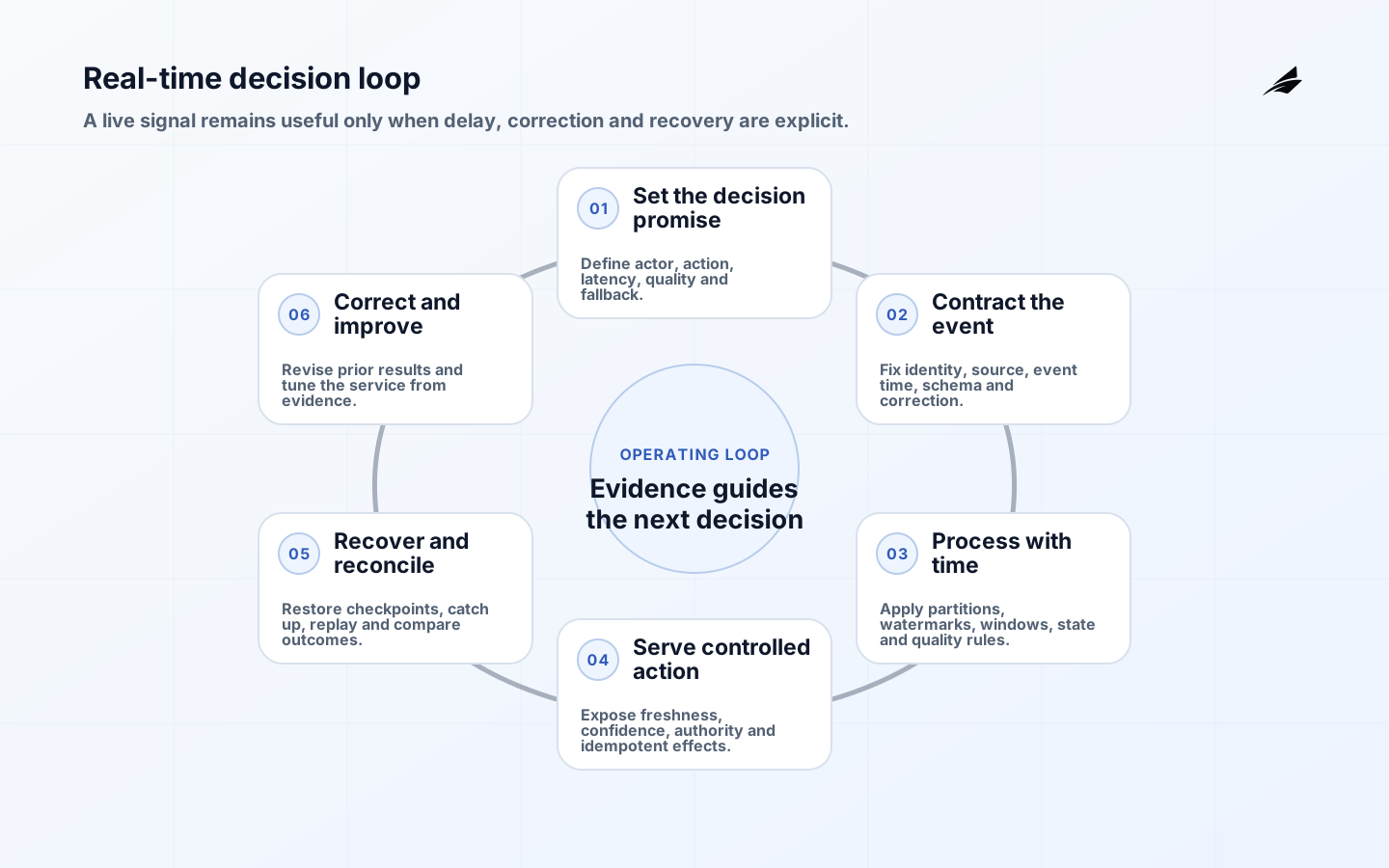
Real-time analytics is valuable when a fresher signal enables a better action before the opportunity or risk expires. It is not synonymous with a moving dashboard. The operating challenge is to preserve meaning through delayed, duplicated, corrected and missing events while keeping state recoverable and the decision service observable. IT managers should govern it as a production service with a consumer promise, not as an unbounded request for lower latency.
The architecture should extend Edilec's guidance on data contracts, data pipeline ownership and analytics documentation. Those disciplines remain necessary when data moves faster; streaming increases the cost of ambiguous time, ownership and correction.
Start with the decision latency budget
Name the actor, decision, event and action. Decompose the allowed delay into source detection, network, ingestion, processing, serving, user or automation and response. A five-second dashboard is irrelevant if a manager reviews it hourly; a two-minute fraud signal may be useful if it reaches an intervention workflow. State the fallback when the signal is late, incomplete or unavailable. Some decisions should fail closed, others should use last-known state with a visible age, and others should revert to manual review.
Define freshness, completeness, correctness, availability and correction objectives for each decision product. Separate event age from processing lag. A fast pipeline can publish an incomplete source population, while a slower pipeline may provide a reliable result. Keep a batch or source reconciliation where it is the economical way to detect loss. Do not promise real time as one universal service tier; different sources and actions need different budgets.
| Decision element | Question | Contract field | Failure behavior |
|---|---|---|---|
| Event | What happened and who asserts it? | Type, source, identity and schema | Reject or quarantine invalid event |
| Time | When did it occur and become known? | Event and ingestion timestamps | Mark late or uncertain |
| Result | What population and window does it represent? | Grain, window and version | Publish qualified or withhold |
| Action | What may consume the result? | Authority and confidence | Fallback or human review |
| Correction | How can prior state change? | Revision and reconciliation policy | Update, compensate or notify |
Make event time and late data explicit
Processing time answers when the platform handled an event; event time answers when the represented occurrence happened. Mobile devices, gateways and upstream systems can buffer, retry and arrive out of order. Apache Flink's timely stream processing guidance uses watermarks to represent progress in event time and treats events behind that progress as late. A watermark is a policy signal, not proof that no earlier event can ever arrive.
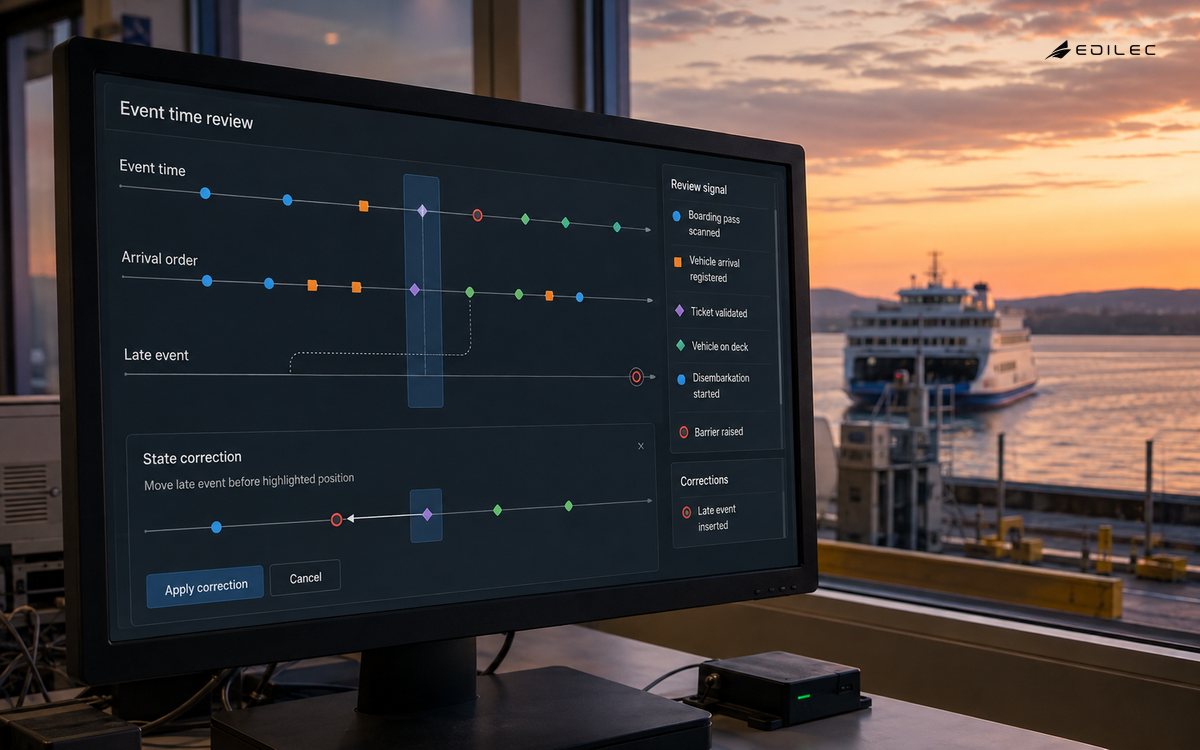
Choose windows, allowed lateness and triggers from the decision. Produce an early provisional result and later correction where users can understand revision; wait longer where consistency matters more than speed. Define idle sources so one quiet partition does not stall all progress. The Apache Beam programming guide offers a portable model of windows, watermarks and triggers that helps teams discuss when results are emitted and refined independently of one engine.
Design the streaming architecture and delivery semantics
A typical path includes producers or change capture, durable transport, schema validation, stateful processing, serving stores and action consumers. Partition by an entity key when per-entity order matters, and state that ordering scope. Give every event a stable identity and source position. Retain sufficient source history for expected recovery and backfill. Separate raw accepted events from derived views where policy permits, because replay after a defect requires the original meaning and code version.
Apache Kafka's design documentation explains producer, broker and consumer delivery semantics. End-to-end exactly-once behavior still depends on the sink and external side effects. Make consumers idempotent, use transactional boundaries where supported and reconcile actions such as notifications, inventory changes or case creation. State the deduplication retention window; an identifier forgotten after seven days cannot prevent an eight-day replay.
Control quality, lineage and access
Validate schema, identifiers, units, ranges, enumerations and time plausibility before publication. Quarantine does not mean forget: assign reason, owner and correction route. Monitor source volume and distribution as well as record validity. A syntactically valid stream can still omit one region or product. Contract changes need producer notice, compatibility tests and consumer inventory; an additive enum value can break downstream logic even when serialization remains compatible.
Record run, job, input, output, schema and code context. OpenLineage facets provide an extensible model around jobs, runs and datasets. Apply access control and data minimization at ingestion, state and serving boundaries. Avoid placing personal or high-cardinality identifiers in metrics. Protect replay and backfill authority because reprocessing historical events can recreate messages or business actions if sinks are not isolated.
| Signal | What it detects | Useful dimension | Operator response |
|---|---|---|---|
| Source progress | Stopped or missing input | Source and partition | Contact producer or switch fallback |
| Event age | Decision freshness loss | Product and priority | Degrade, pause or communicate |
| Late-event rate | Time-policy mismatch | Source and event type | Tune or correct source |
| Checkpoint health | Recovery exposure | Job and state size | Repair before state loss |
| Reconciliation | Loss, duplicate or divergent result | Decision product | Correct and assess actions |
Test state, replay and recovery
Stateful jobs need durable checkpoints tied to source positions. Flink's fault-tolerance documentation describes snapshots containing source pointers and operator state. Measure checkpoint duration, failure and restoration with realistic state. Test worker loss, broker unavailability, corrupted records, sink throttling, expired credentials and a full restart. Recovery time includes backlog catch-up, not just process start.
Make replay a controlled product feature. Record reason, source interval, code and schema versions, target, side-effect mode, approver and reconciliation. Reprocess into a shadow destination first when correction risk is high. Compare counts, keys and business totals, then publish or merge according to a documented policy. Notify consumers when previously issued results or actions materially change.
Operate performance, observability and cost together
Connect consumer completion to service, version and event path. OpenTelemetry signals distinguish traces, metrics and logs; use them to correlate ingestion, processing and serving without copying full payloads. Alert on user-impacting age, incompleteness and error-budget burn, then provide lag, throughput, back pressure, state and dependency signals for diagnosis. Every alert needs an owner and prepared action.
Model cost from event rate, payload, partitions, retention, replication, state, checkpoints, compute, serving, egress, observability and support. Include peaks, replay and catch-up. A lower latency target often raises fixed capacity and operational complexity. Compare that marginal cost with the action value and choose tiers. Retire unused streams and derived views; a stream without an active consumer promise still creates security, cost and change obligations.
Example: live operations exceptions
An operations team needs a delivery exception within three minutes. Devices emit status with event and sequence time; the platform keys by shipment, waits up to ninety seconds for normal disorder and publishes provisional exceptions. Late corrections update the case and show revision. A durable stream supports replay, while the case API uses an idempotency key. Operators see source age and completeness. Acceptance covers offline devices, duplicated events, stale updates, processor restart, case API outage and nightly reconciliation to the authoritative shipment system.
Acceptance tests for a real-time decision service
Build a deterministic fixture with in-order, out-of-order, duplicate, late, missing and corrected events. State the expected provisional and final outputs before running it. Advance event time deliberately and verify the watermark and trigger policy. Repeat the same source with different arrival order and confirm where results should remain equivalent. A test that only checks the happy path cannot validate the product's time contract.
Exercise state and side effects together. Stop a processor after writing to the sink but before recording progress, restart from a checkpoint and inspect duplicates. Throttle the serving store, remove one source partition and expire a credential. Confirm that operators see affected decisions, not only component errors. Replay a bounded interval into an isolated target, reconcile it and then merge according to the approved correction path.
Load tests should use representative keys, event disorder, state size and sink behavior. Measure steady latency, age, back pressure, checkpoint duration, restart, catch-up and cost. Hot keys and quiet partitions matter more than an even synthetic rate. Record the tested boundary and limiting resource. The capacity statement should say when new partitions, workers or architecture changes are required and how long they take to activate.
Complete acceptance with the decision owner, not only the platform team. Show provisional, delayed, corrected and unavailable states in the actual user or automation surface. Ask the owner to choose the expected action for each condition and compare it with the documented fallback. This final step often reveals that technically distinct states are displayed identically, leaving operators unable to tell a genuine zero from a stalled source.
Key takeaways
- Justify real time with a named decision and end-to-end latency budget.
- Define event time, watermarks, lateness and correction in the consumer contract.
- Treat exactly-once as an end-to-end property, including sinks and side effects.
- Monitor business completeness and age alongside infrastructure health.
- Make checkpoints, replay, catch-up and reconciliation tested operating capabilities.
- Use latency tiers and retire streams whose decision value no longer pays for complexity.
Real-time analytics FAQ
Is streaming always faster than batch? It can lower availability delay, but back pressure, windows and dependencies still matter. Do watermarks discard late data? They mark event-time progress; operator policy decides whether late events are dropped, routed or used to update results. Does exactly-once prevent every duplicate action? No; external sinks need idempotency or a coordinated transaction. How much history should a stream retain? Enough for recovery, consumer outage and approved replay, balanced against cost and data policy. When should a dashboard be real time? When the reader can act within that interval and the status clearly communicates freshness and correction.
Conclusion: operate the decision, not just the stream
Real-time analytics earns its complexity when a timely signal remains understandable through delay and failure. Give every stream a consumer promise, time policy, correction route, recovery test and owner. Expand only after the complete decision service, including its fallback, survives representative disruption.