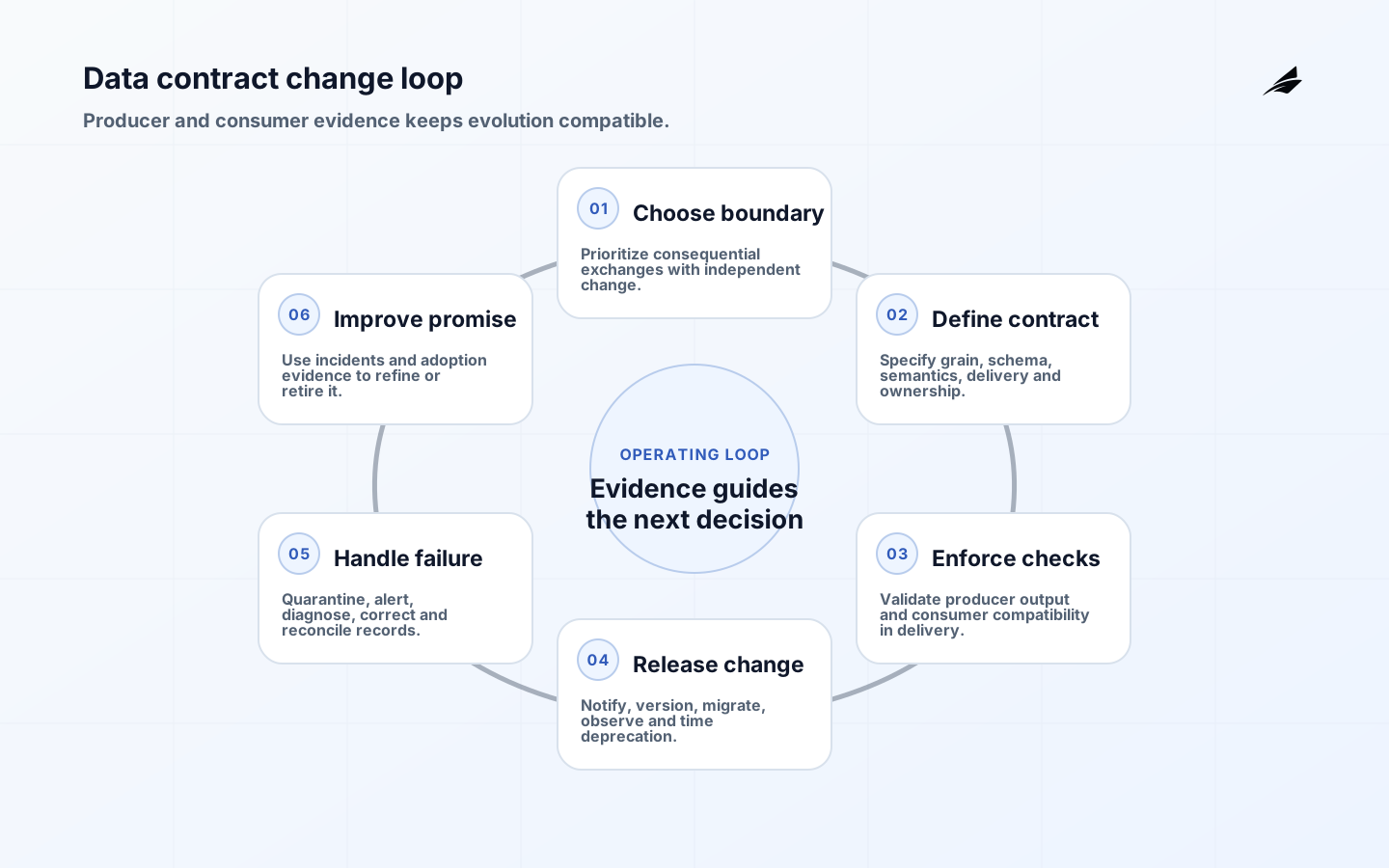
A data contract is an explicit agreement between the people producing data and the people relying on it. It states what is delivered, what the fields mean, which identifiers are stable, when the data should arrive, how sensitive values are handled, and how a breaking change will be announced. For a founder, the value is not a new governance ceremony. It is less surprise when a product event, billing feed, or customer record changes and silently damages a decision. A contract is most useful where a broken feed changes revenue recognition, customer communication, eligibility, or operational work.
Choose a business risk worth contracting
Data contracts are most valuable at a boundary where a quiet upstream change can damage a downstream decision, payment, or customer workflow. They are not a requirement to describe every column in a warehouse. Choose one producer-consumer exchange, state what an arriving record means, and agree on keys, allowed values, delivery timing, sensitivity, and the owner who can approve a change. dbt model contracts show the practical shape of an enforceable promise: a declared model contract can be checked during a build rather than discovered in a spreadsheet after release. Apache Avro documentation also illustrates why schema evolution needs deliberate compatibility rules, not just a new field name. A useful contract includes the non-happy path: what happens when a source is late, a field is absent, or a producer must correct historical data. That turns an abstract governance statement into a usable production agreement.
Do not begin by trying to document every table. Start with a producer-consumer boundary that has caused rework or could create material harm. A subscription service might contract the invoice status feed used by finance; a marketplace might contract the order event used by fulfillment and notifications. Name the consumer decision and the consequence of a late, missing, duplicated, or reinterpreted record. That gives the contract a priority and prevents teams from treating every nullable field as equally urgent. The data quality cost guide is helpful context: quality controls should follow the cost of being wrong, not a generic score.
| Contract element | Question to settle | Example |
|---|---|---|
| Identity | Which key represents one business object? | order_id remains stable through status changes |
| Meaning | What does the field represent? | booked_at is the confirmed booking time, not page-view time |
| Delivery | What is the arrival expectation? | hourly files by 15 minutes past the hour |
| Change | How are incompatible changes handled? | Version the schema and notify consumers before removal |
Write a usable promise
A useful data contract is short enough to review and precise enough to test. State the dataset or event, producer and consumer owners, key fields and types, allowed values, grain, freshness objective, classification, and failure route. Separate an advisory description from an enforceable rule. For example, “status is understandable” is vague; “status is one of pending, confirmed, cancelled, or completed” can be checked. A source may legitimately be late or corrected, so record the permitted lateness and whether consumers should receive a replacement, a deletion marker, or a backfill. That clarity is more valuable than promising immutability where the business itself changes history.
- Put the contract close to the producer's code, schema, or pipeline so it changes with the system.
- Include a named business owner for meaning and a technical owner for delivery and incident response.
- Test identifiers, required fields, enumerations, volume changes, and arrival windows that matter to the consumer.
- Classify sensitive fields and specify whether they may appear in development, exports, or downstream products.
- Keep a decision log for exceptions, especially temporary manual corrections and source migrations.
Build a contract operating model
The operating model can be lightweight: a registry or repository, automated checks at ingestion or transformation, an alert routed to the right owner, and a review before a breaking change. The crucial design choice is to make failure visible to both sides. If a producer adds a new payment status, consumers should not discover it only when a dashboard declines. If a consumer needs a new field, the request should explain the decision it enables and the deadline. Data lineage tools can show where a dataset travels, while data lineage architecture explains why lineage alone is not a promise about correctness or timing.

| Failure | Immediate response | Longer-term control |
|---|---|---|
| Required field becomes null | Quarantine or flag affected records and notify consumer | Add producer-side validation and release test |
| Schema type changes | Stop incompatible load before corruption spreads | Version the interface and publish migration steps |
| Delivery misses window | State the impact on the dependent decision | Measure lateness and review capacity or dependency design |
| Sensitive field appears unexpectedly | Restrict access and investigate exposure | Add classification checks and approval gates |
Avoid contract theatre
A document nobody can find or test is not a data contract; it is a hopeful description. Avoid copying column lists without explaining grain, source precedence, or change behavior. Also avoid treating an alert as a resolution. A late feed may be acceptable for a weekly trend but unsafe for a payment hold, so consumers need a stated fallback. Founders should ask whether a contract shortens an investigation, protects a decision, or makes a change safer. If it does none of those things, narrow it. The first goal is a dependable exchange at a high-value boundary, not an enterprise catalog completed in one quarter.
Work through a practical case
Imagine a founder whose retention team sends renewal offers from a customer subscription feed. The contract defines subscriptionid, plan, renewaldate, cancellation state, currency, and the time at which a change is considered final. It also says that a correction can arrive within seven days and that records with an unknown state must not trigger an offer. When the billing provider introduces a new paused status, the producer versions the enumeration, the campaign consumer routes those records to review, and finance receives a reconciliation notice. The contract did not remove the change; it stopped a new value from quietly becoming a false renewal signal.
Plan the next review
Run a short contract review after the first release and again after the first meaningful incident. Gather the producer owner, consumer owner, and person who maintains the check. Look at which fields were actually used, which alerts were actionable, how often exceptions occurred, and whether the delivery promise matched the business need. A contract that is too broad encourages bypasses; one that is too narrow lets harmful changes through. Review source migrations, new classifications, and temporary allowances explicitly. The useful output is a change to a tested promise, an owner, or an escalation path, not a longer document. This cadence creates a learning loop in which data-contract management follows the real cost of changes rather than imagined completeness.
- Reconfirm the consumer decision and deadline before tightening or relaxing a delivery expectation.
- Examine failed checks to distinguish source defects from overly brittle validation rules.
- Remove fields or requirements that have no consumer, risk, or operational owner.
- Record whether an exception is temporary, who approved it, and the date it must be revisited.
- Test a planned breaking change in a compatible version before declaring the old interface retired.
A founder can keep the practice lightweight by reviewing contracts alongside product and integration changes. Add a contract check to the release checklist only where the change crosses a meaningful boundary, and make the consumer impact easy to read. This is also a useful way to expose hidden dependencies before a partner migration or acquisition. If no person can explain who consumes a feed and what action it enables, that uncertainty is itself a risk worth recording. The aim is a small set of explicit promises that teams can confidently maintain as the business changes.
Connect the practice to the wider data system
A contract does not replace lineage, tests, or pipeline operations; it gives those practices a shared expectation to protect. Pair it with data quality to decide which checks are meaningful, data lineage to understand impact, and data pipelines to make ownership and recovery visible from ingestion to publication.
Contract evidence becomes more useful when it is connected to provenance and governance. OpenLineage documentation describes an open framework for lineage metadata around jobs, runs and datasets, which can help teams identify affected consumers after a failed change. NIST's developing Data Governance and Management Profile is a useful reminder that contract mechanics sit inside broader decisions about data processing, accountability and risk. Growing teams should adopt only the metadata needed to investigate, communicate and recover; collecting lineage without an owner or response path simply creates another dataset to maintain.
Key takeaways
- Use data contracts at high-consequence producer-consumer boundaries first.
- Define identity, meaning, timing, sensitivity, ownership, and change behavior in testable language.
- Make contract checks and failures visible to both producers and consumers.
- Version incompatible changes instead of silently redefining a field.
- Keep the process small enough that delivery teams will use it during normal releases.
FAQ
Are data contracts only schemas? No. Schema is important, but a contract also covers grain, business meaning, delivery expectations, ownership, sensitivity, and response to change. Do small companies need them? Yes, selectively. A small company often has fewer people available to reconstruct why an event or field changed. Start with the few feeds that power customer messaging, money movement, or a core operating metric, then expand only when the practice is helping teams ship with fewer surprises.
Conclusion
Founders should use data contracts to protect decisions, not to bureaucratize data work. A concise, testable promise at an important boundary gives product, engineering, and operations a shared language for changes and incidents. Begin with one costly failure mode, attach owners and checks, and learn from exceptions. That creates a durable habit: important data changes are reviewed as changes to a product interface, with consumers and consequences visible. As the company grows, use contract coverage to guide investment: expand first where an exchange has several consumers, sensitive data, frequent change, or a high cost of reconstruction. Do not make a contract a substitute for product discovery. The producer and consumer should still be able to explain why a field or service-level objective exists. A clear contract also makes acquisition and vendor integration less mysterious, because incoming data can be assessed against known identity, timing, and classification expectations. The objective is a practical portfolio of dependable interfaces, each proportionate to the risk it carries.