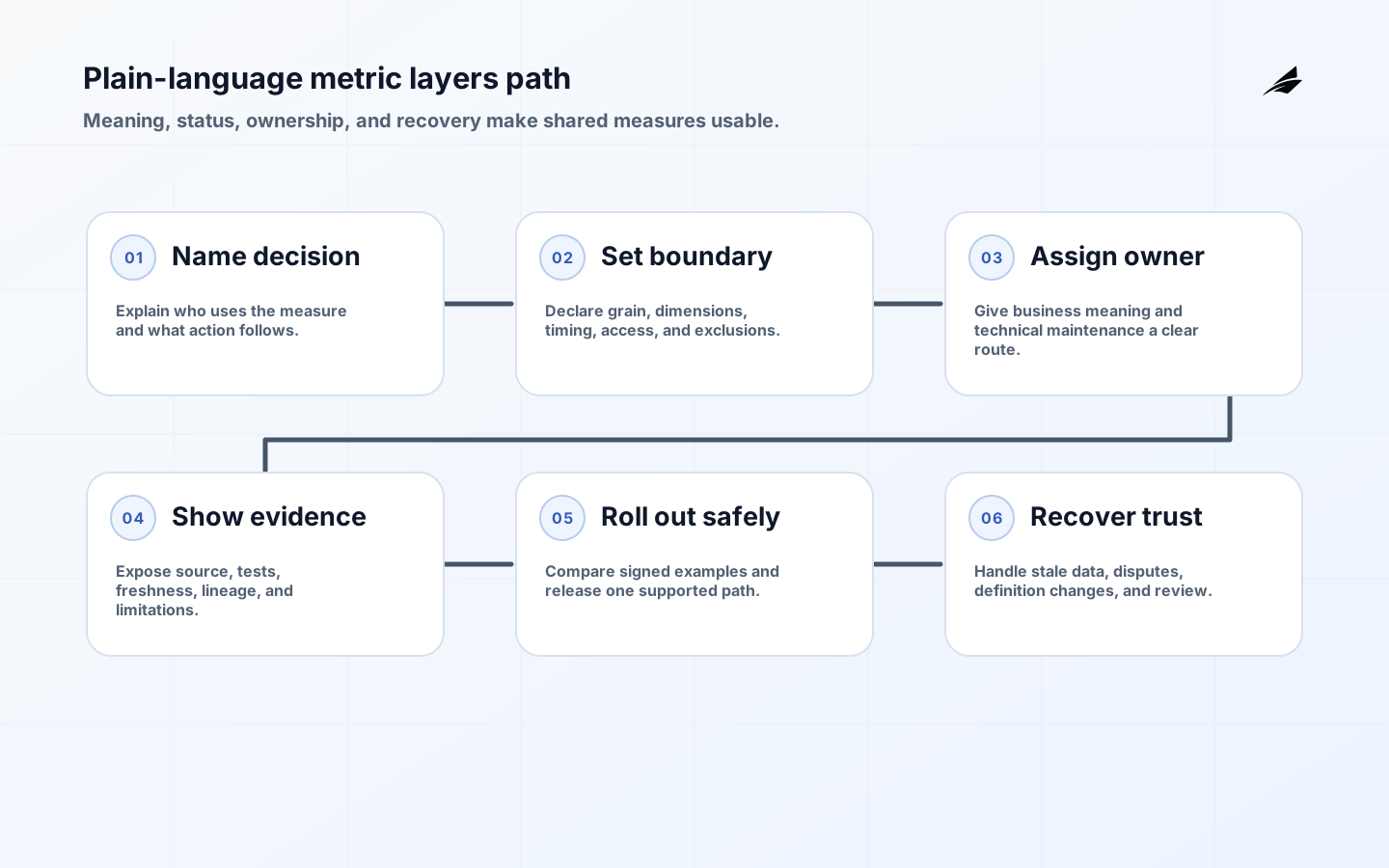
The Plain-language Guide to Metric Layers approaches metric layers as an operating capability. It begins with a reused measure that currently causes reconciliation work and needs a shared understanding of formula, input grain, supported dimensions, time rule, owner, and version policy. dbt Semantic Layer and dbt data tests are useful primary references. Related implementation context is available in Metric Layer Implementation Checklist: Definitions, Models and Release Controls, KPI Governance from First Principles: Definitions, Ownership and Decision Rights, and How Product Teams Should Think About Metric Layers.
Set the metric layers decision: analytics platform rollout
Start with a reused measure that currently causes reconciliation work. This prevents metric layers from becoming a generic platform project.
| Design concern | Question to settle | Evidence to keep |
|---|---|---|
| Decision boundary | What use of metric layers must improve? | Named owner and workflow |
| Definition | What entity, measure, or event is represented? | Written grain, scope, and examples |
| Service expectation | How fresh, complete, or controlled must it be? | Threshold and visible status |
| Change rule | Who approves a revision? | Review record and effective date |
Map the controlled rollout boundary under a recovery drill
Define formula, input grain, supported dimensions, time rule, owner, and version policy before extending scope. This work is not administrative polish. It determines whether two readers can reach the same conclusion from the same output and whether a response team can distinguish an ordinary delay from a material failure

Write the normal route and degraded route together. The review record names its evidence boundary and owner.
Assign the operator and reviewer for a customer-facing decision
Ownership for metric layers is not a title on a slide.
- Name the business decision owner and technical operator.
- Record definition, boundary, and acceptable failure state.
- Restrict change authority while keeping feedback available.
- Set approval routes for normal, urgent, and breaking changes.
- Keep access and distribution decisions visible beside delivery.
- Schedule a review that can retire an assumption.
Put Freshness and Limits Beside the Number
Measure test failures, distribution shifts, local copies, exceptions, and adoption. dbt documentation and OpenLineage facets help make validation, dependencies, and change history visible.
| Signal or failure | What it reveals | Operating response |
|---|---|---|
| Health signal | test failures, distribution shifts, local copies, exceptions, and adoption | Review at the named operating cadence |
| Known risk | unsafe ratios, dashboard overrides, definition splits, or obscure migrations | Decide whether to stop, warn, repair, or rollback |
| Evidence path | Can a reader trace the result to its source? | Link lineage, tests, and change notes |
| Recovery check | What evidence shows that metric layers has returned to a safe operating state? | Practice and record the response |
Release One Supported Path
Release the smallest metric layers path that can produce real evidence.
- 1. Choose measure: make the decision, owner, and evidence explicit at this stage.
- 2. Declare formula: make the decision, owner, and evidence explicit at this stage.
- 3. Test calculation: make the decision, owner, and evidence explicit at this stage.
- 4. Serve consumers: make the decision, owner, and evidence explicit at this stage.
- 5. Observe interpretation: make the decision, owner, and evidence explicit at this stage.
- 6. Version changes: make the decision, owner, and evidence explicit at this stage.
Make Disputes and Corrections Visible
The most expensive metric layers failures are plausible outputs that should not have been trusted. Watch for unsafe ratios, dashboard overrides, definition splits, or obscure migrations.
Recovery planning belongs in the design. Maintain a metric-layer recovery guide that names pause authority, warning ownership, and the identifiers needed to trace a disputed result. Then exercise a bounded response scenario.
For metric layers, make every certified measure explain its inputs at the point of use. A reader should be able to discover the definition, grain, time treatment, owner, and latest change without reverse engineering a dashboard formula. Use a small set of reference cases for releases, including boundary dates and excluded populations. The cases make a definition change discussable in business terms and prevent a technically tidy refactor from silently changing the meaning that finance, product, or operations relies on.
A practical metric layers review should finish with an explicit decision log. End the review with a compact metric-layer note: capture the observed value, the assumption under examination, the accountable follow-up, and the verification date. Cross-reference the metric definition, fixture result, incident, or release record that made the decision intelligible.
Read a Metric Layer Like a Contract
Plain language is not a shorter definition; it is a usable contract. A reader should be able to answer five questions without opening a model: what decision does this metric support, what is one row about, which time rule applies, when is the result current, and who can correct it? If the page says “active customer” but leaves account merges, pauses, cancellations, and backdated changes unstated, the number is easy to quote and hard to defend.
Use a small example to expose the boundary. Suppose a customer has two subscriptions, cancels one on the last day of a month, and receives a late usage record the next morning. The metric contract should say whether the customer is counted once, whether the cancelled subscription remains eligible, which date controls the period, and whether the late record revises the closed month. Dbt’s Semantic Layer documentation and data-test guidance support central definitions and executable assertions; OpenLineage adds a useful lineage reference for tracing the result to its producing jobs.
Put limitations beside the value, not in a distant appendix. Show freshness, test state, excluded populations, and the effective date of a definition change. When a user challenges a metric, route the question to the owner with the signed example and query context. That turns a disagreement into a bounded review and lets the team improve the contract without forcing every consumer to reverse-engineer the warehouse.
A useful review ends with a decision, not a vague request to clarify. Mark the definition accepted, accepted with a stated limitation, or blocked pending evidence; give each outcome an owner and next review date.
This contract also gives leaders a principled way to fund the next change. Improve the metric when the decision cost of ambiguity exceeds the cost of better evidence; do not expand the layer merely because another tool can consume it.
Takeaways for Plain-Language Metrics
- Anchor work in a named decision and accountable owner.
- Make definitions, boundaries, and access expectations visible.
- Keep operational evidence close to the change that produced it.
- Test degraded conditions, not only the successful path.
- Retire obsolete or competing paths before ambiguity accumulates.
Plain-language metrics work when a reader can move from a number to a defensible action without consulting the author. Put the definition, grain, timing rule, allowed dimensions, status, and owner beside the result. Use one worked example with ordinary data and a second example that exposes a boundary, such as a late record or a many-to-many join. The contrast teaches readers what the measure includes and what it deliberately refuses to claim. It also gives engineering a small fixture that can be rerun whenever a source, model, or access rule changes.
A metric dispute should follow a visible route. First preserve the exact result, query or model version, source state, and reader context. Then classify the disagreement: definition, freshness, access, data quality, or presentation. The owner can choose a correction, annotation, pause, or documented non-change only after that classification is recorded. A short decision note is more useful than a chain of approvals because it tells the next reader what changed and why historical comparisons may or may not remain valid.
For adoption, test the metric with someone who did not design it. Ask that reader to state the unit, use the result for a real decision, identify its current status, and find the person who handles a challenge. If any step depends on oral explanation, improve the consumer surface or the evidence link before adding another dashboard. That small exercise keeps the semantic layer connected to the work it is meant to support.
The language should also name the uncomfortable boundary. Say when the value is stale, when a join is unsupported, when a permission blocks access, and when the owner will publish a correction. Readers trust a measure more when its refusal conditions are as clear as its normal formula.
Metric layers FAQ
That gives the team something small enough to test and improve. How much governance is necessary? Keep governance proportional: a material change needs a reviewable and recoverable route, while definitions, access rules, tests, and a change record should tell the operator what to do What proves this is working? Evidence of success includes the listed signals, a completed adverse-path exercise, and an owner who can explain and act on degradation. The technical references are dbt Semantic Layer, dbt data tests, dbt documentation, OpenLineage documentation.
Conclusion: make metric layers dependable
Reliable metric layers are neither a one-time configuration nor a document completed in isolation.
A reader should not need to know whether the implementation uses dbt, a warehouse view, or a BI model to use the metric safely. They need the definition, grain, timing promise, quality state, permitted slices, and route for a challenge. Keep technical lineage one click away, but put decision meaning first. When a source is late or a rule is under review, preserve the status instead of smoothing it into a number. This is how a plain-language metric layer supports product speed and operational honesty.
Plain language succeeds when a reader can state the metric’s decision, grain, timing promise, evidence state, and correction route without opening the model. Keep those five answers beside the result, and let each definition change carry an effective date and signed example so trust is maintained through ordinary business change.