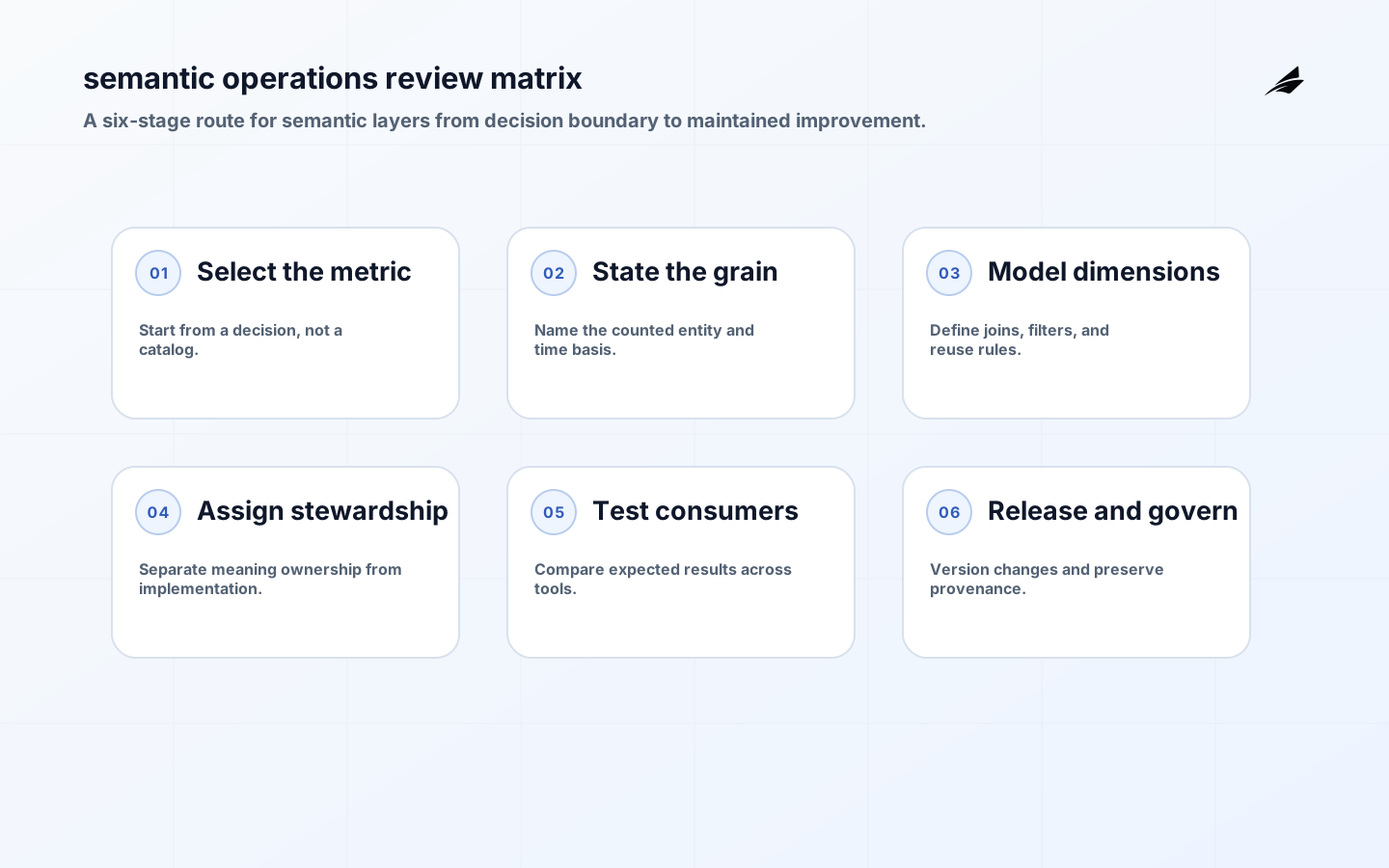
A semantic layer is not a purchase decision or a document that can be completed once. For engineering teams, it is a way to make common business measures mean the same thing across analysis tools and applications. The useful starting point is a governed metric definition: a bounded thing with a named owner, a clear promise to its reader, and evidence for when it should or should not be trusted. “Active customer” may be counted by account, contact, or subscription. A shared label is useful only when its entity and eligibility rule are explicit for every consumer. This guide keeps the discussion practical by connecting semantic layers to KPI governance from first principles, semantic layers planning guide, and executive dashboards operations playbook.
How shared metrics become usable
Plain language matters because teams often give a semantic layer a broad label and then make incompatible assumptions about its job. Here, semantic layers mean a governed metric definition designed to serve a known decision or operational need. Its accountable owner is the business metric steward with an engineering maintainer. Its working inputs are entity grain, dimensions, joins, filters, calculation logic, and ownership. That definition is deliberately narrower than “all available data.” It gives a team something it can review, test, and improve in semantic-layer definitions, with lineage and metric interpretation in view. Avoid centralizing labels while leaving the underlying grain and filter behavior ambiguous. The dbt Semantic Layer documentation provides useful implementation context, while dbt models documentation helps frame provenance, accessibility, or contract evidence that readers may need.
- Name the decision, the person who makes it, and the deadline before choosing tools or visuals for semantic-layer definitions.
- Write the unit of analysis and the boundary: what is included, excluded, estimated, or still pending in semantic-layer definitions, with lineage and metric interpretation in view.
- Give the reader a visible freshness, completeness, or release state rather than implying certainty for semantic-layer definitions.
- Keep an owner and a recovery route beside the definition so questions do not become anonymous support work in semantic-layer definitions, with lineage and metric interpretation in view.
Limit the promise before adding variants
A small boundary makes the trade-offs visible. Begin with one audience, one decision cadence, and one source-to-consumer path for semantic-layer definitions. Then ask what can go wrong at each point: a late source, a changed definition, a denied permission, a partial rerun, or an action that is not recorded in semantic-layer definitions, with lineage and metric interpretation in view. The answer does not need to be elaborate; it needs to be operational for semantic-layer definitions. For semantic layers, the essential components are modeled entities, declared metrics, reusable dimensions, access-aware joins, and versioned definitions. A team should be able to point to the owner for each component and show where its current state is recorded in semantic-layer definitions, with lineage and metric interpretation in view. That is more useful than declaring a platform “trusted” without a way to inspect its behavior for semantic-layer definitions.
| Boundary question | Concrete answer to record | Why it changes decisions |
|---|---|---|
| Reader and action | Which engineering teams member uses a semantic layer, and what action follows? | Prevents a general-purpose artifact from becoming an unowned report. |
| Meaning and grain | What does one record, value, or result represent? | Stops apparently similar totals from being compared as if they were equivalent for semantic-layer definitions. |
| Timing promise | What cut-off, lateness window, or release cadence applies? | Lets readers distinguish current signals from settled results. |
| Failure route | Who investigates an unexpected, late, or unavailable result? | Turns uncertainty into a controlled operational response. |
Fit definitions to the decision path
Design choices should make correct use easier than accidental misuse. Put scope and status close to the result, then offer detail only where it supports investigation for semantic-layer definitions. Separate business meaning from implementation mechanics but connect them through stable identifiers and links in semantic-layer definitions, with lineage and metric interpretation in view. This is especially important when the same output reaches different teams or tools for semantic-layer definitions. The W3C PROV overview is a useful reference for recording lineage and operational context; the OpenLineage object model provides a control-oriented lens for access, change, and recovery. Neither replaces local decisions about who may use the result and what evidence they need for semantic-layer definitions. For semantic layers, the W3C PROV overview clarifies provenance concepts, and the OpenLineage object model helps connect those concepts to operational metadata.

- Make the default view answer one named question; use drill-down for diagnosis rather than placing every field on the first screen in semantic-layer definitions, with lineage and metric interpretation in view.
- Expose source or model status where a reader can see it before acting on an incomplete result for semantic-layer definitions.
- Treat identifiers, classifications, and access rules as part of the design, not post-launch administration in semantic-layer definitions, with lineage and metric interpretation in view.
- Keep release notes short and decision-focused: what changed, when it takes effect, who is affected, and where to ask questions in semantic-layer definitions, with lineage and metric interpretation in view.
| Design choice | Good operational behavior | Failure it avoids |
|---|---|---|
| Explicit status | Show the stated timing promise for a governed metric definition. | A reader mistakes an in-progress result for a final one. |
| Named ownership | Display or link to the business metric steward with an engineering maintainer. | A question waits while teams debate who should respond. |
| Traceable change | Link release, source, or transformation evidence. | A changed number becomes impossible to explain after the fact. |
| Proportionate access | Give each role only the detail required for its decision. | Sensitive data spreads through convenient exports or broad workspaces. |
Publish one metric with its evidence
The first semantic-layer release should prove the reader-facing contract before it adds coverage. Build the smallest path that reaches a real reader, then test both normal and degraded conditions. Compare a fixed set of accepted examples across the semantic layer, a dashboard, and a downstream API. Keep the test data and expected outcome available for future change review for semantic-layer definitions. A successful run is not the same as a useful result: the acceptance check should include data outcome, timing, permissions, documentation, and the reader's ability to act in semantic-layer definitions, with lineage and metric interpretation in view. This sequence also reveals whether an upstream agreement or a business definition needs work before the design is replicated elsewhere in semantic-layer definitions, with lineage and metric interpretation in view.
Keep meaning current as inputs change
After release, use real operating evidence to decide what deserves improvement. Review definition changes with the people who own the business decision, then publish a migration note. Record incidents in terms readers can understand: what decision product was affected, what promise was missed, what scope changed, and how the result was corrected in semantic-layer definitions, with lineage and metric interpretation in view. Pair that record with technical signals such as freshness, job state, contract violations, test results, or access events in semantic-layer definitions, with lineage and metric interpretation in view. The point is not to create an endless dashboard about dashboards; it is to make it possible for the responsible person to see risk early and choose an appropriate response in semantic-layer definitions, with lineage and metric interpretation in view.
Start with two measures that currently disagree across tools, not with an inventory of every metric. For each, capture the counted entity, accepted dimensions, approved comparison period, and a few known edge cases. Resolve those examples with the business steward before broad adoption. The resulting definition becomes a useful template precisely because it has survived a real disagreement rather than an abstract design exercise.
Key takeaways
- Semantic layers earns trust through a clear decision boundary, not through volume or visual polish.
- A named owner, visible timing promise, and tested failure route make the output usable when conditions change in semantic-layer definitions, with lineage and metric interpretation in view.
- Test accepted examples and degraded paths before scaling to more teams, consumers, or source systems in semantic-layer definitions, with lineage and metric interpretation in view.
- Treat every material definition or access change as a release that affected readers can understand for semantic-layer definitions.
Frequently asked questions
When is semantic layers ready for wider use? It is ready when a real reader can explain its purpose, scope, timing, owner, and action route, and the team has tested a credible failure scenario. Does a tool create semantic layers by itself? No. Tools can enforce structure or expose evidence, but the organization still has to choose meaning, ownership, and the decision promise in semantic-layer definitions, with lineage and metric interpretation in view. How much documentation is enough? Enough for the intended reader to use the result safely and for a responder to investigate a change; link to deeper technical material instead of forcing every detail into one page. What should change first after an incident? Repair the immediate decision risk, then update the definition, control, test, or runbook that would have made the failure visible earlier.
A simple review for semantic layers
Take one metric that people already use and ask three plain questions: what does it count, when is it current, and what should happen when it is wrong? Trace one value to its model and source, then test a duplicate entity, a late record and a restricted role. If the answer changes by consumer, document the legitimate variant rather than forcing a universal label. If no one knows who approves a correction, the semantic layer has a governance gap even if its SQL is correct. A short review like this makes the relationship between meaning and operation visible.
Use disputes as design evidence. A repeated question about denominator may require a metric definition; a repeated wait for yesterday’s data may require a freshness promise; a repeated access exception may require a different serving boundary. Keep the source model, definition version and consumer examples together so a future change can be compared with a known baseline. The plain-language standard helps engineering and business readers make the same decision about trust without translating every concern into implementation vocabulary first.
A semantic layer should make disagreement easier to resolve, not harder to see. Keep before-and-after examples for material definition changes, identify affected consumers and record the effective date. If two metrics share a name but use different populations or time rules, separate them and explain their relationship. If a user cannot tell whether a number is current, provisional or restated, the layer needs a clearer operating boundary. These small habits preserve trust as the model and the organization evolve.
Finally, make retirement visible. A metric with no current owner, source or decision should not remain the most discoverable answer because it is old or familiar. Mark it deprecated, point to the replacement or explain why no replacement exists, and retain enough history for readers to understand prior reports. A smaller, maintained semantic layer is easier to trust than a catalogue that never forgets.
Keep the retirement note close to the replacement and explain the effective date. This lets a reader distinguish a genuine business trend from a change in definition, and it gives support a clear answer when an older report is still circulating.
A maintained layer also records who approved the retirement and which historical views remain supported. That small record prevents teams from reviving an obsolete metric simply because its old name is familiar, while preserving enough context to explain earlier decisions during audits or planning reviews.
Useful technical references are the dbt Semantic Layer, dbt models documentation, W3C PROV overview and the OpenLineage object model. They help teams discuss definitions, models and lineage precisely while leaving local ownership and policy decisions explicit.
Take a real disagreement about a metric and use it to test the plain-language contract. Ask two readers to calculate the result from the same bounded period, then compare entity grain, filters, exclusions, currency, and freshness. If they disagree, label the difference instead of forcing a single number: one version may count subscriptions while another counts accounts. Record the steward, technical model, effective date, and consumer impact for the accepted definition. Then test a late input and a restricted role so the review covers both meaning and operation. This exercise gives a semantic layer a practical purpose: it reduces repeated interpretation work while making legitimate variants visible to the people who must act.
Conclusion
Shared metrics stay useful when their meaning survives a new source, a changed filter, and a reader who was not in the original design meeting. Keep the definition narrow, publish its grain and timing, assign stewardship, and rehearse the response to imperfect inputs. Expand only after those checks produce evidence that another team can interpret and use.
In plain language, a semantic layer should tell a reader what a metric counts, when it is current, who owns it and how to challenge it. That clarity makes shared analytics useful as organizations change.