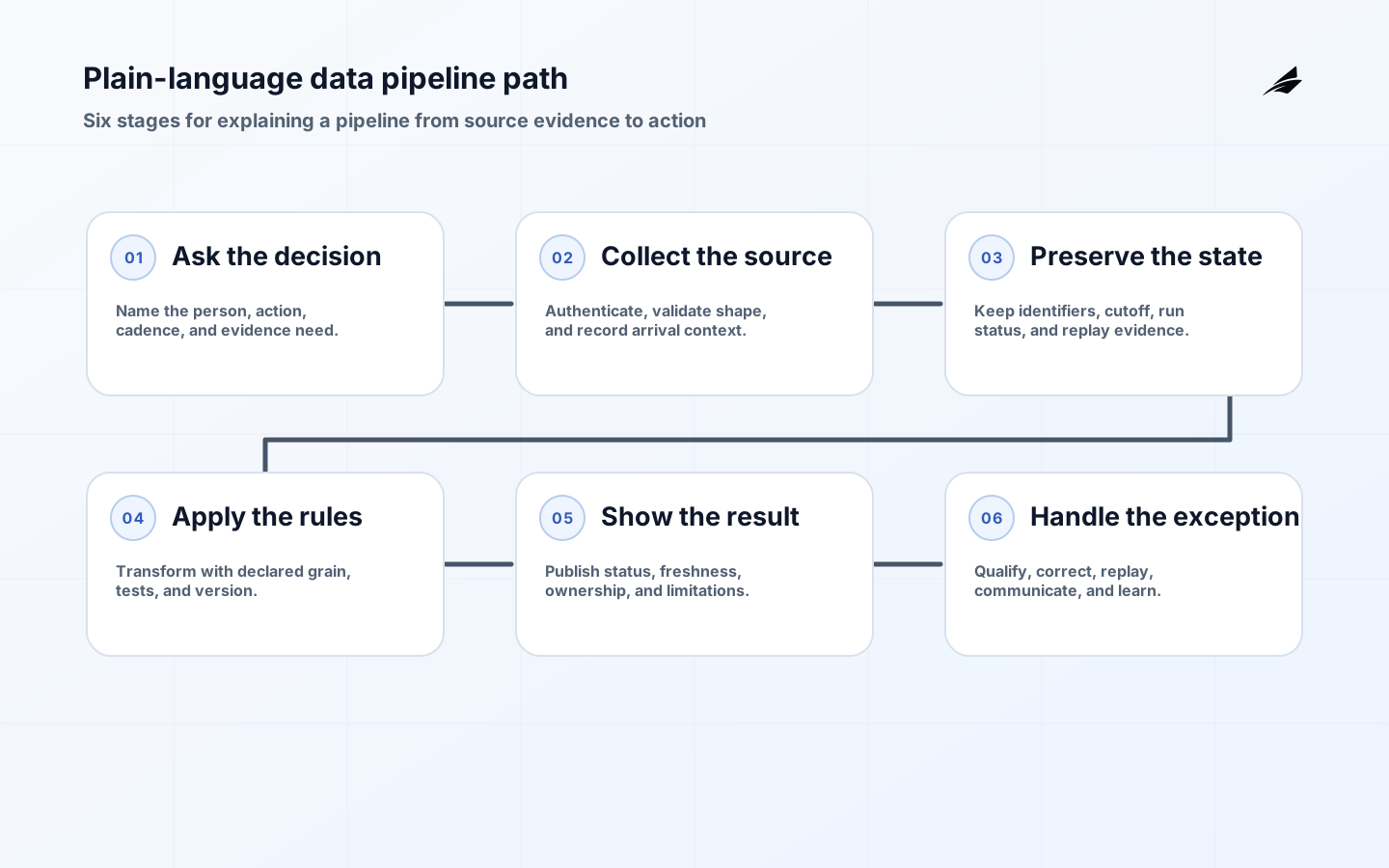
Plain-Language Data Pipelines: A Reader's Guide
Data pipelines become understandable when a reader can follow evidence from source to decision without learning the platform's private vocabulary. The route may be a scheduled job, an event stream, or warehouse models, but the promise is consistent: the result should be timely enough, protected, explainable, and recoverable. If a sales report is missing a region, the user should see the qualified state rather than receive a polished incomplete total. Explain source, timing, transformation, quality, ownership, and recovery in the same language the decision-maker uses.
Explain the source-to-decision journey
A pipeline moves, filters, joins, enriches, aggregates, or publishes data. It does not automatically make an ambiguous definition correct, turn an unreliable source into reliable evidence, or decide whether a person should act on an exception. Write the business sentence first: “Every morning, the support lead uses open-case age to assign capacity.” That sentence tells the team which records matter, when the cutoff occurs, who owns the decision, and what a late source means. From there, the pipeline contract can name the source, key, schedule, output, tests, permissions, and response. Apache Airflow's core concepts are useful for understanding scheduled workflows, while Kafka's design documentation helps when the need is continuous event delivery rather than a batch.
| Plain-language term | Technical meaning | Question to ask |
|---|---|---|
| Source | System or file that supplies records or events. | Who owns it and what proves it is complete? |
| Schedule or trigger | Time or event that starts work. | What is the cutoff and what happens when it is late? |
| Transform | Rules that select, join, reshape, or calculate. | Which definition and version produced the output? |
| Destination | Table, stream, API, or report used by a consumer. | Who acts on it and what status can they see? |
Give every handoff a name and an owner
A dependable path has five practical boundaries: collect evidence, preserve it, transform it, publish it, and observe it. Collection should retain source identity and arrival time. Preservation should support replay and audit within policy. Transformation should have tests, version history, and an explicit grain. Publication should show freshness, definition, limitations, and access. Observation should tell an owner about failure, delay, unusual volume, and downstream impact. OpenLineage's metadata model illustrates why jobs, runs, and datasets need relationships, not only task names. Model contracts from dbt add another useful idea: a model can declare an interface that makes an incompatible schema change visible before consumers fail.
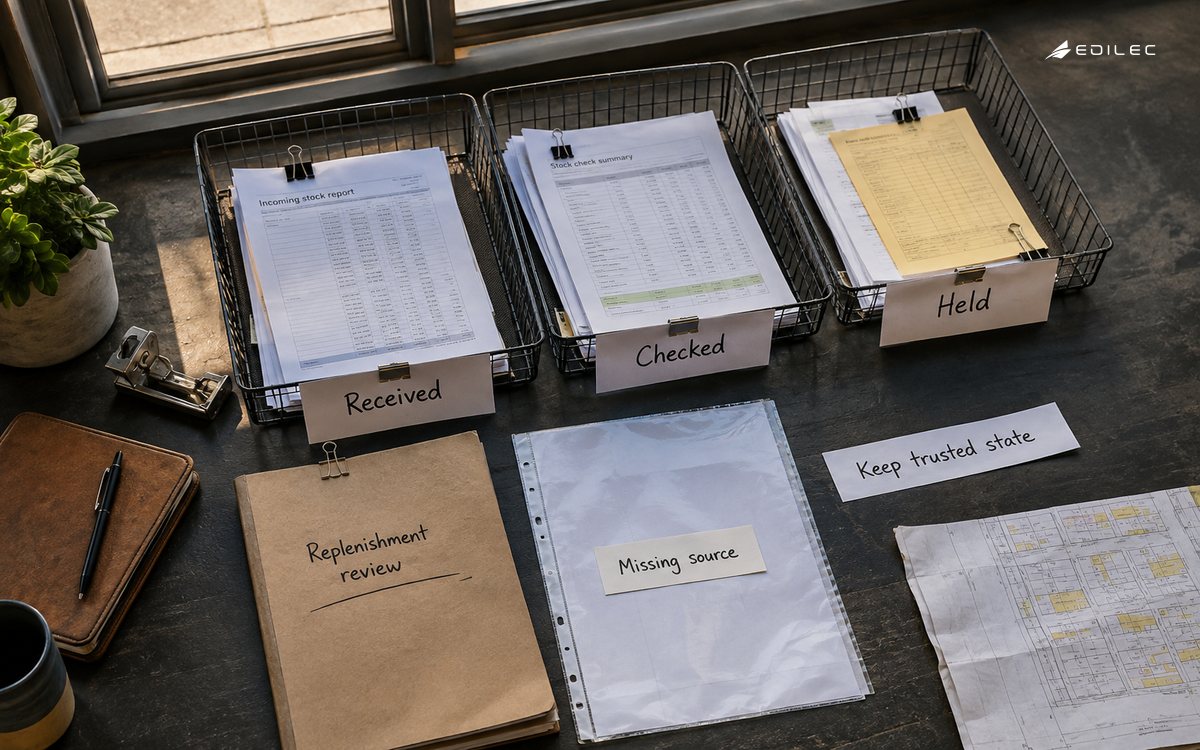
The architecture can be small. A scheduled extract, a raw landing table, a tested model, and a governed report may be enough for a daily decision. Add streaming, queues, stateful windows, or multiple zones only when the decision requires them. Avoid a hidden second source of truth created by manual spreadsheet fixes. If a correction is necessary, record it as an input or adjustment with owner, reason, and effective period. The field guide to data pipelines goes deeper on recovery objectives and run evidence; use it when a simple flow becomes an operating service.
| Boundary | Good practice | Visible failure |
|---|---|---|
| Collect | Authenticate, validate shape, and record arrival. | Missing source, invalid schema, unexpected volume. |
| Preserve | Keep identifiers, input range, and run state. | No replay point or unclear historical state. |
| Transform | Declare grain, rules, tests, and version. | Duplicate keys, join explosion, or failed assertion. |
| Publish and observe | Show status, ownership, access, alerts, and impact. | Stale report, unowned alert, or unexplained movement. |
Show when a pipeline result is safe to use
Quality is not a single number. Ask whether the records are complete enough, valid enough, fresh enough, consistent with authoritative totals, and appropriate for the intended population. A 98 percent completeness score may be acceptable if the missing two percent is a harmless test record; it may be unacceptable if it is the largest customer segment. Define blocking conditions and qualification messages. A report should say “certified through 08:00 UTC” or “warehouse B is missing” rather than simply being green or red. Test both normal and uncomfortable examples: duplicate event, late file, changed status, corrected amount, and permission failure. Link to analytics documentation so users can interpret the state at the point of use.
Launch a small path with a repair route
The first release should follow one decision from source to action. Have the owner review a normal result and an exception. Show input cutoff, records received, records rejected, transformation version, output status, and the person who responds. Then perform a correction: replay a bounded period, compare old and new outputs, and decide how downstream consumers are notified. If the system uses Airflow, make task retries and dependencies visible; if it uses Kafka, make consumer progress, partitions, retention, and replay boundaries visible. A successful run is evidence that code executed, not proof that the answer is fit for use.
Operating signals should connect to choices. Track freshness against promise, failure and retry rate, reconciliation, late data, test failures, cost, and recovery time. Review these with the person who acts on the data. Retire measures and checks that no longer change behavior, and add controls after an incident that revealed a missing assumption. This feedback loop is how a growing team avoids both extremes: a fragile hand-built script and a platform that is technically impressive but nobody can explain.
Use a late file to test the explanation
Imagine a retailer receives an inventory file at 06:00 and uses it to decide replenishment at 08:00. The source contract names the file owner, expected date, warehouse key, units, and delivery cutoff. The landing step stores the file and arrival time. A validation step checks schema, duplicate product-warehouse rows, negative units, and expected warehouse coverage. The transformation calculates available stock and flags quarantined rows. The published table shows the certified cutoff and any missing warehouse. If the file is late, the system keeps the prior certified state with a visible warning rather than presenting a partial total as current.
The example also clarifies ownership. The source team fixes delivery; the pipeline owner repairs validation or replay; the inventory owner decides whether the prior state is safe; the replenishment lead acts on the published status. A later file correction is loaded as a new input, compared with the prior output, and communicated as a revision. The architecture can use Airflow, Kafka, a warehouse, or another stack, but the responsibilities and evidence remain the same. This is why plain language is useful: it lets technical and business people test the same path together.
Related Edilec reading: data pipeline architecture, ELT planning, and how operations leaders should think about data pipelines add practical decision context.
Source context: Airflow core concepts explains scheduled workflow boundaries; Apache Kafka 4.3 Design covers event delivery and durability; OpenLineage connects jobs, runs, and datasets; and dbt model contracts show how to declare a model interface.
Key takeaways
- A pipeline is a decision-support path, not merely a job that moves rows.
- Define source, timing, transformation, quality, access, ownership, and recovery in plain language.
- Preserve enough evidence to explain and replay a result without creating a second truth.
- Use batch or streaming only when the decision needs the associated latency and complexity.
- Review real exceptions with users and improve the contract after each meaningful failure.
Frequently asked questions
What tool should a small team start with?
Start with the tool that can make the narrow path observable, testable, secure, and recoverable. A simple scheduled workflow may be better than a streaming stack for a daily decision. Evaluate orchestration, storage, transformation, and monitoring as a service boundary, not by feature count.
Who decides if data quality is good enough?
The decision owner accepts whether an exception blocks or qualifies use; the technical owner maintains checks and evidence; source owners fix upstream causes. This keeps quality connected to consequence rather than an arbitrary score.
When is a stream worth the complexity?
Use one when a decision materially benefits from continuous events and the team can operate ordering, state, retention, late data, and replay. If the action is daily, a controlled batch may provide better reliability and simpler correction.
Explain one daily sales report to a new operations manager. Name the source, arrival cutoff, preserved identifiers, transformation rule, quality checks, certified state, and person who handles a late file. Then introduce a missing region and ask the reader whether to use the total, qualify it, or wait. If the answer depends on an engineering-only term such as watermark or backfill, add a plain-language definition and the action it changes. Clarity is part of control because people act on the result before they inspect the machinery.
Plain-Language Data Pipelines: a decision you can operate
Plain language does not mean removing the controls that make a pipeline trustworthy. Name the source, timing, transformation, quality state, owner, limitation, and recovery action in terms the decision-maker can use. Start with one report or workflow, test the explanation with a real reader, and add detail only where it changes an action.
A small team can explain a pipeline by writing one sentence for each handoff. The source team owns the inventory file and its cutoff; the landing step preserves the original file and arrival evidence; the validation step decides which rows are quarantined; the transformation owner defines available stock; the report owner publishes the certified state; and the replenishment lead decides whether to order from the result. Each sentence should name an input, an observable state, and a response when that state is not fit for use. This makes the architecture discussable across technical and business roles. It also exposes where a tool cannot answer the question: a retry may show that code ran again, but only an idempotent key or controlled merge proves that rows were not duplicated.
Use a five-minute exception rehearsal with the person who acts on the data. Show a late file, a duplicate event, a malformed amount, and a permission failure without revealing more data than the role permits. Ask the decision owner to state whether the output is current, qualified, or blocked; ask the pipeline owner to identify the replay boundary; and ask the source owner to explain the upstream correction. Record the words that appear on the report, the evidence kept in the run record, and the action taken. If users still need a private message to understand the state, the pipeline is not yet plain-language operationally, even if its SQL is well tested.
A pipeline is understandable when someone outside the build team can decide whether to use, qualify, or hold the result and can find the next responsible person.