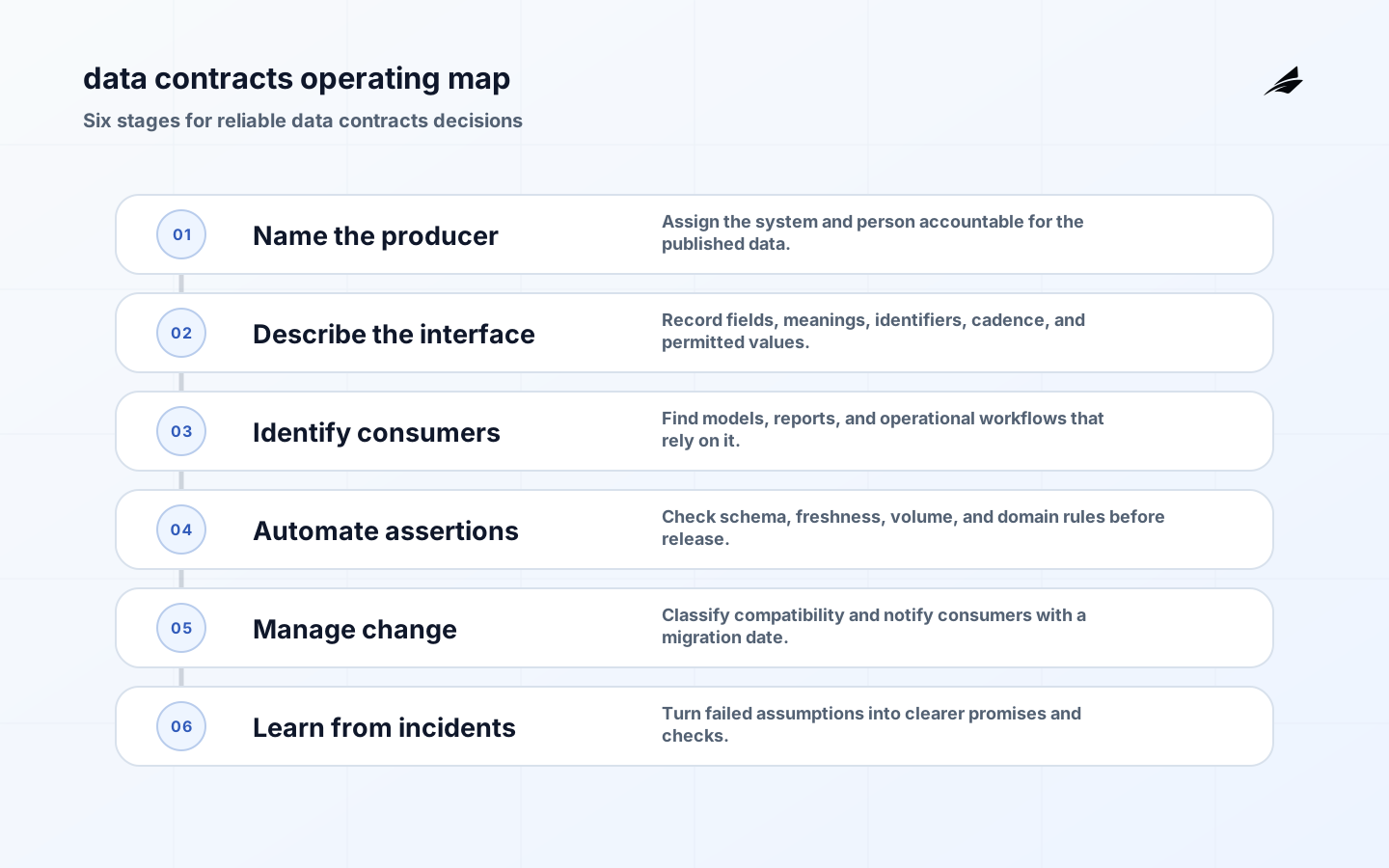
Data contracts become valuable when they help the producer and consumer who depend on a shared dataset make a better decision, not when they merely add another technical artifact. The practical question is whether a producer change can ship without silently changing a downstream analytic result. Begin with the dataset, fields, semantics, delivery expectation, and compatibility promise. That framing prevents a common failure: teams optimise an interface, schema, or job before agreeing how a reader will interpret its output in analytics data contracts, with producer-consumer compatibility in view. Consider an order feed whose status field gains a new value. The producer may regard the change as harmless; finance may treat unknown status as excluded revenue. A useful contract records allowed values, the owner of interpretation, how new values are announced, and what a consumer should do until it has been updated. A dependable implementation makes the state of the evidence visible, gives people a way to challenge it, and leaves a trace when a definition or result changes in analytics data contracts, with producer-consumer compatibility in view.
Anchor the contract in a consequential decision
Treat a data contract as a service around a recurring decision. Write down who acts, what they can change, which population is included, which clock applies, and what consequence follows if the information is wrong or late in analytics data contracts, with producer-consumer compatibility in view. The service boundary should also say what it does not promise. For data contracts, the relevant inputs are field definitions, identifiers, accepted values, delivery cadence, ownership, and downstream use. This is more useful than a generic requirements list because it lets a reviewer ask whether each input has a known owner, an expected arrival pattern, and an understandable exception state in analytics data contracts, with producer-consumer compatibility in view. The immediate aim is a small, observable path that earns trust before the scope expands for analytics data contracts.
| Decision question | Specific answer to record | Evidence to retain |
|---|---|---|
| Who acts? | Name the role with authority to change the outcome. | Owner, escalation route, and review cadence. |
| What is true? | State the grain, time policy, inclusion rules, and known exclusions. | Definition, examples, and version history. |
| When is it usable? | Declare freshness or latency expectations and correction behavior. | Status signal, run evidence, and incident notes. |
| What happens on doubt? | Offer a safe challenge, containment, or fallback path. | Ticket, decision log, and correction record. |
State what the producer and consumer may rely on
A data contract earns its name when it turns business language into checks that a consumer can observe. For this topic, capture field definitions, identifiers, accepted values, delivery cadence, ownership, and downstream use. Then state versioned expectations with automated checks and a review path for breaking changes. Avoid vague claims such as “single source of truth” unless the scope and authority are named: many useful sources can coexist when their purpose is clear in analytics data contracts, with producer-consumer compatibility in view. Define identifiers, expected values, ownership, and compatible change rules at the point where a consumer can inspect them in analytics data contracts, with producer-consumer compatibility in view. A schema can remain syntactically valid while its business meaning drifts. Clear promises make handoffs calmer. A new analyst or responder can see which result is authoritative for a particular question and which result remains provisional, rather than reconstructing the answer from chat messages in analytics data contracts, with producer-consumer compatibility in view.
- Name a business owner and a technical owner for data contracts; either role alone is insufficient.
- Record the entity or event grain before publishing aggregate metrics or summaries for analytics data contracts.
- Put freshness, completeness, access, and known limitations near the result people use for analytics data contracts.
- Make material changes reviewable, dated, and understandable to affected readers.
- Keep an auditable exception route instead of silently correcting surprising records.
- Use realistic failure cases as acceptance criteria, not only a successful happy path for analytics data contracts.
Make compatibility visible before release
An analytics data contract must define how an asset changes without surprising its consumers. Break the work into a declared input boundary, a transformation or interpretation step, a published result, and a feedback route, with producer-consumer compatibility in view. Assess a change for meaning, access, performance, and downstream effect before releasing it. Consider a subscription feed whose cancellation date arrives after the billing record. The producer may regard the late correction as routine; finance may already have recognized revenue. A useful contract records the effective-time rule, correction window, owner of interpretation, and what a consumer should do until the correction is incorporated. Production data pipelines are often part of the dependency story, so their contract and recovery behavior deserve the same attention as the final interface. Prefer a small release with measured use over a broad launch. It produces evidence about confusion, latency, and missing context while the cost of correction is still low.
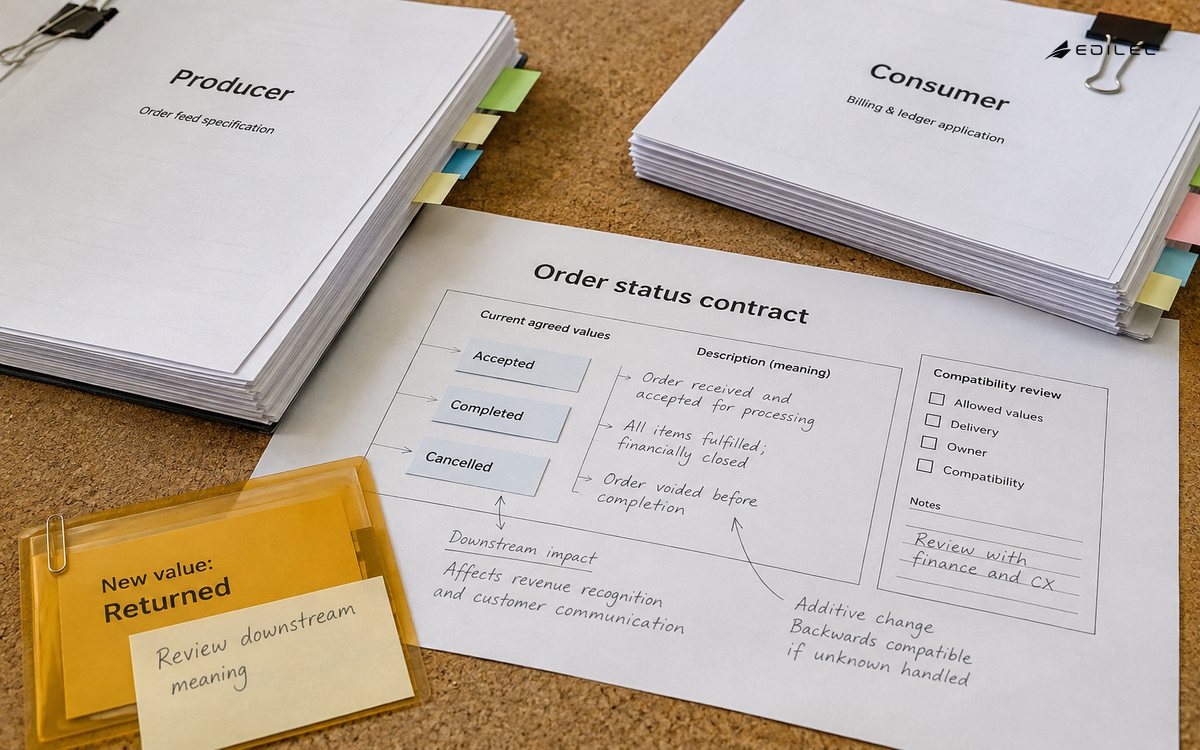
Exercise late, invalid, and new-value cases
A production test is a question about behavior under conditions that actually occur for analytics data contracts. Verify that a proposed change is rejected or clearly classified before a dashboard or model receives it. Test the normal path, but also test empty input, changed definitions, delayed delivery, access denial, partial completion, and correction after publication in analytics data contracts, with producer-consumer compatibility in view. Use a small set of representative records or fixtures whose expected outcome is understood by both a domain reviewer and an engineer in analytics data contracts, with producer-consumer compatibility in view. This makes a discrepancy informative: it points to a rule, a contract, or a source rather than a vague claim that “the data looks wrong.” Where an action has financial, customer, or compliance consequences, make the safer fallback explicit and ensure the support team can invoke it in analytics data contracts, with producer-consumer compatibility in view.
| Operating moment | Control | Useful signal |
|---|---|---|
| Before release | Review definitions, ownership, permissions, and consumer impact. | Approval and test evidence linked to the change. |
| Normal operation | Publish status with the result and monitor declared checks. | Freshness, completion, quality, and usage trend. |
| Exception | Contain impact, preserve evidence, notify readers, and correct safely. | Time from detection to understandable status. |
| After correction | Explain material movement and improve the failed control. | Repeat incident rate and unresolved follow-up. |
Keep the promise current in daily work
After launch, the work shifts from construction to stewardship. Monitor contract coverage, failed checks, time to notify consumers, and the number of emergency fixes. These measurements should support a conversation, not become targets detached from the decision for analytics data contracts. A low error count can mean a reliable service, or it can mean users have stopped reporting problems because the route is unclear in analytics data contracts, with producer-consumer compatibility in view. Review a sample of real decisions: did the reader understand the time boundary, did the evidence change the action, and could the owner explain a discrepancy in analytics data contracts, with producer-consumer compatibility in view. Keep a brief incident record that captures affected consumers, source state, containment choice, and durable fix in analytics data contracts, with producer-consumer compatibility in view. That record turns operational noise into design input for the next release for analytics data contracts.
Use consumer evidence to judge change
Adoption and reliability are complementary. Usage without trust produces ritual; reliability without use produces an unused asset for analytics data contracts. Establish a baseline before changing the workflow, then compare observed behavior after release for analytics data contracts. For data contracts, watch contract coverage, failed checks, time to notify consumers, and the number of emergency fixes. Segment those signals by audience and use case, because an executive reader, an operator, and an analyst may need different latency, detail, and correction policies in analytics data contracts, with producer-consumer compatibility in view. Pair quantitative evidence with short interviews or support reviews. The strongest improvement candidates are the places where users repeatedly leave the service, create a shadow calculation, or ask the same interpretation question in analytics data contracts, with producer-consumer compatibility in view.
Key takeaways
- Data contracts start with a named decision and a clear boundary, not a tool choice.
- Definitions, ownership, freshness, and exceptions are part of the product the reader receives for analytics data contracts.
- Production readiness includes recovery, communication, and change control as well as a working build in analytics data contracts, with producer-consumer compatibility in view.
- Test representative failure modes and preserve evidence so corrections are explainable.
- Measure trusted use and decision quality alongside technical delivery signals.
Frequently asked questions
When are data contracts ready to use? They are ready for a limited audience when the intended decision, source boundary, owner, status signal, and exception path are explicit and have been exercised with realistic data. Wider release should follow evidence that readers can interpret the result and responders can correct it safely in analytics data contracts, with producer-consumer compatibility in view.
Who should own data contracts? The producing system owner is accountable for publishing the promise, while each material consumer owns its interpretation and migration. A data platform team can provide tooling, yet it cannot invent the business meaning of a field or approve a breaking change alone.
How often should data contracts be reviewed? Review data contracts whenever a producer proposes a schema or semantic change, and periodically for contracts with high-impact consumers. A contract should also be revisited after a failed assertion or a consumer incident so the published promise reflects what was learned.
Test the contract with a consumer, not only a producer
A producer can confirm that a schema is valid while a consumer still receives a broken decision input. Include the consumer in acceptance. Ask a finance analyst to reconcile a known period, a product manager to filter a cohort, or an operations lead to identify a late record. Watch for hidden assumptions about denominator, timezone, duplicate identity, deleted entities and correction timing. Capture the question, the query or report, the expected answer and the route used when the answer differs. This evidence makes the contract concrete and reveals whether documentation is written for the people who actually use the data.
Use the result to divide improvements into three types. A structural problem belongs in the schema or model contract; a semantic problem belongs in the definition and owner review; an operational problem belongs in freshness, alerting, replay or communication. The distinction keeps teams from responding to every failure by adding another column or dashboard. Retain a small library of consumer cases and rerun them after material changes. A contract that answers real user questions are more valuable than one that only passes producer-side checks.
Make exception handling part of the promise. A contract should say whether a late source blocks the result, whether an invalid record is quarantined, how a correction is announced and which historical window may be restated. Keep the failing rows and the owner decision together. This gives consumers a dependable expectation even when the data itself is imperfect, and it gives producers a fair way to improve the source without treating every issue as a surprise or a blame exercise.
The contract should also identify the evidence needed to close an exception. That may be a corrected source extract, a reconciliation query, a consumer sign-off or a documented decision to accept the limitation. Without a closure condition, exception queues become permanent and consumers learn to ignore them.
For implementation detail, compare dbt model contracts with dbt data tests: the former makes selected model assumptions enforceable, while the latter returns failing records that a team can investigate. The Apache Avro specification is useful when a producer publishes a typed schema, and the OpenLineage API specification helps preserve producer, run, job, and dataset context. None of these references chooses the local business meaning or response to a breach; that remains the contract owner’s decision.
Related practices include real-time analytics, warehouse modeling in production and dashboard adoption.
Version the promise where consumers make decisions
A producer’s change review is not complete until a consumer can tell what will happen to an existing decision. For the order-status example, keep a fixture containing an accepted status, a newly introduced status, a duplicate order, a late correction, and a deleted entity. Run the fixture against the proposed contract and record whether the consumer should include, exclude, quarantine, or restate each case. Publish the effective date and migration owner beside the version. If the result changes historically, preserve the prior run evidence and explain the affected period. This makes compatibility a concrete consumer promise rather than a producer’s assumption that a nullable field or additive value is harmless.
Conclusion
A data contract proves its value when a reader can interpret a result, a producer can change it without surprise, and both sides know how a breach closes. Keep meaning, examples, failing rows, and ownership beside the published promise. Start with one consequential decision and let consumer evidence determine which controls deserve wider use.
A data contract is useful when a consumer can explain the data, a producer can change it safely and both sides know how a breach closes. Keep examples, failing rows and ownership close to the published promise.
Include a consumer acceptance case: reconcile a known period, filter a representative cohort and inspect a late or corrected record. Keep the expected answer and owner decision with the contract.