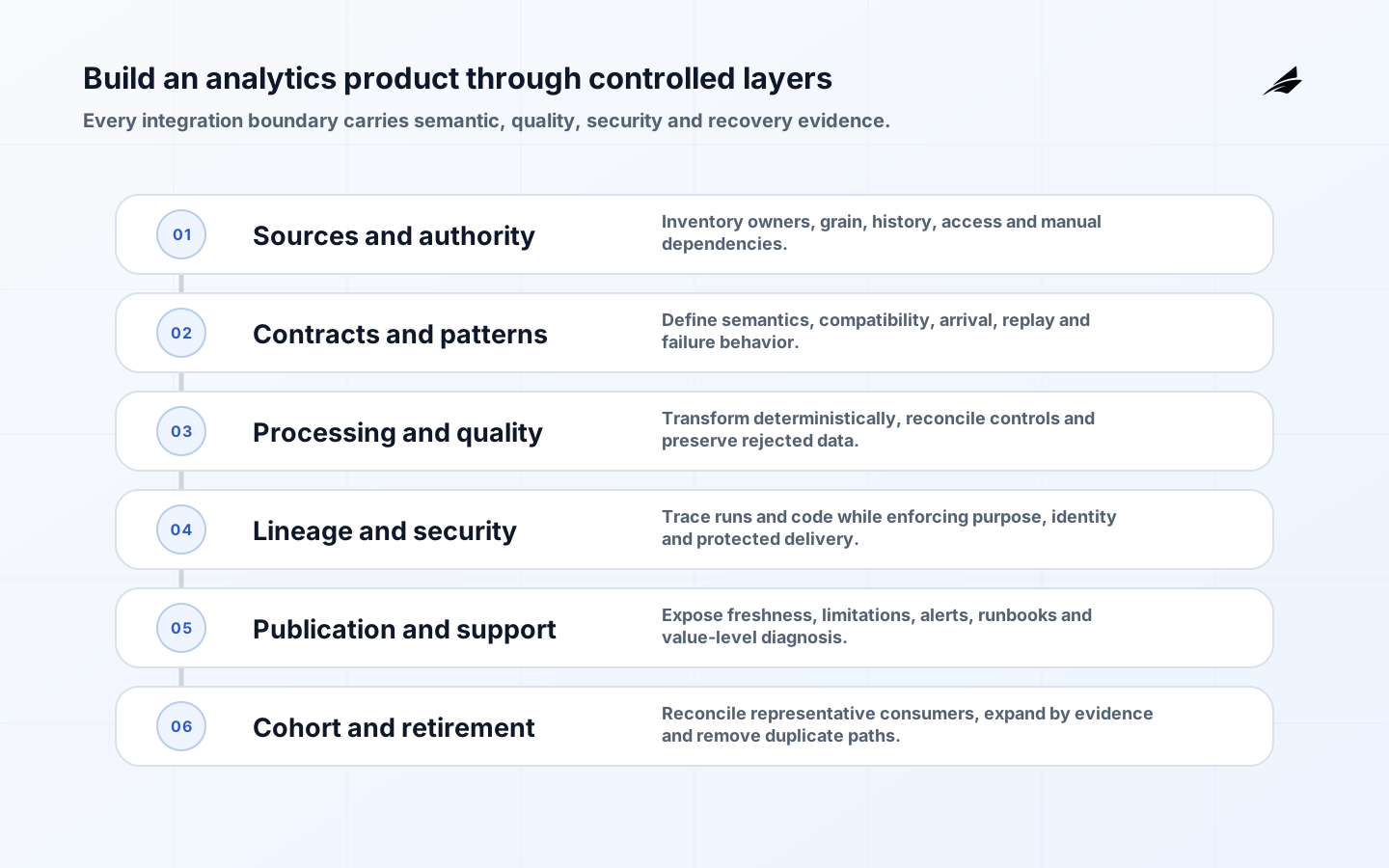
Use this checklist to implement analytics integration as an operated data product, not a one-time movement of records. Every item needs an owner, evidence, exception status and review date. Tailor depth to sensitivity and decision impact, but do not mark a control complete because a tool is installed. The test is whether a consumer can use the information safely, understand its meaning and obtain support when it fails. The companion analytics integration FAQ explains the choices behind these gates.
Gate 1: Define the decision and ownership
- Name the decision or workflow and its accountable business owner.
- Identify consumers, frequency, consequence of wrong or late data and current workaround.
- Define product purpose, service expectations, excluded uses and baseline.
- Assign source, data product, technical, security, privacy and support owners.
- Record decision rights for definitions, source change, quality exceptions, release and retirement.
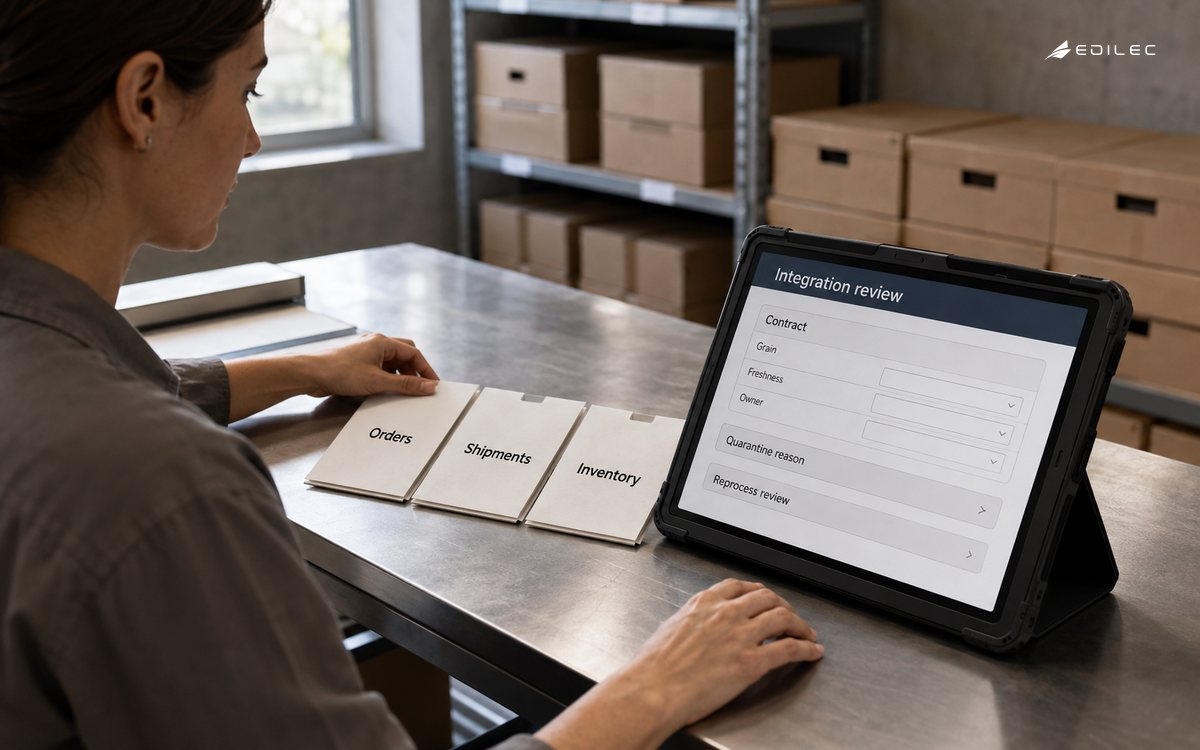
Avoid scopes such as integrate sales and operations. A workable boundary is an approved fulfillment review using order, shipment and inventory data. It has a coherent consumer, grain and acceptance path. Approve a product brief, responsibility map, source inventory, consumer register and measurement plan.
Gate 2: Inventory sources, consumers and processing
| Item | Required detail | Validation |
|---|---|---|
| Source | Owner, authority, fields, grain, history and access | Owner walkthrough and sample profile |
| Pipeline | Inputs, outputs, schedule, code and runtime owner | Observed execution and repository |
| Consumer | Role, decision, fields, freshness and access | Interview and usage evidence |
| Metric | Definition, filters, time and approver | Examples and reconciliation |
| Sensitive processing | Purpose, location, retention and sharing | Security and privacy review |
| Legacy output | Report, extract, email or spreadsheet dependency | Retain, rebuild, consolidate or retire |
Include manual files, desktop transformations and visualization calculations. They are part of actual integration even outside the platform. DCAT 3 supplies an interoperable catalog model, but local metadata still requires ownership and lifecycle.
Gate 3: Approve semantic and technical contracts
- Define identifiers, keys, grain and event or effective time.
- Document meaning, units, allowed values, null and correction behavior.
- State compatibility, versioning, notice and deprecation policy.
- Set arrival, freshness, completeness and availability conditions.
- Describe authentication, authorization, encryption and permitted purpose.
- Assign producer and consumer duties for tests, incidents and backfills.
Add examples for late, duplicate, deleted and corrected records. Define ordering and idempotency for events; limits and timeout for APIs; manifests and quarantine for files. A valid payload can still violate meaning, so acceptance includes business examples.
Gate 4: Select patterns and failure behavior
| Pattern | Checklist | Failure design |
|---|---|---|
| Batch or file | Window, watermark, manifest and rerun | Quarantine incomplete arrival |
| Change capture | Ordering, snapshot, schema and replay | Resume from known position |
| Event | Fact, producer, key, version and retention | Deduplicate and replay safely |
| API | Identity, limits, timeout and cache | Bound retry and show stale state |
| Transformation | Deterministic logic and promotion | Trace output to code and inputs |
| Serving | Access, semantics, freshness and isolation | Prevent partial publication |
Document where state lives and how partial failure is detected, retried and reconciled. Do not infer exactly-once business outcomes from transport terminology. Idempotent consumers, transaction boundaries and control totals determine whether replay is safe.
Gate 5: Implement use-specific quality
Define quality from the decision. W3C’s Data Quality Vocabulary can express measurements and annotations; the team still defines methods and owners. Each rule states dataset, field, grain, window, expected condition and severity. Reconcile relevant counts, balances or identifiers. Use event time where business freshness requires it. Quarantine failures with reason and safe reprocessing. Show limitations to consumers and version threshold changes.
Gate 6: Capture metadata and lineage
- Give datasets, jobs and runs stable identifiers.
- Record runtime start, completion, failure, inputs, outputs and deployed version.
- Connect consumed metrics to transformations and upstream datasets.
- Publish ownership, classification, schema, quality and freshness metadata.
- Declare manual and visualization transformations that automation misses.
- Exercise impact analysis and root-cause tracing with representative change.
OpenLineage models dataset, job and run events. Start at dataset and job level, then add column detail for sensitive fields or complex calculations. Instrument operational questions, not lineage volume.
Gate 7: Verify security, privacy and delivery
| Control | Question | Evidence |
|---|---|---|
| Identity | Are people and services least-privileged? | Policy export and access test |
| Sensitive data | Are purpose, minimization and location approved? | Data flow and privacy review |
| Secrets | Are credentials protected and rotated? | Configuration and rotation |
| Test data | Are production copies avoided or controlled? | Provenance and access list |
| Supply chain | Are artifacts traceable to reviewed source? | Pipeline and dependency inventory |
| Response | Can access and vulnerable components be contained? | Exercised runbook |
NIST’s Privacy Framework supports processing-risk governance, while SSDF covers secured software and vulnerability response. Pipelines are software: connector images, packages, notebooks and orchestration code need review, provenance and response ownership.
Gate 8: Build end-to-end observability
Correlate metrics, logs and traces with dataset, job, run and contract context. OpenTelemetry describes common signals, but data status must be designed. Monitor source arrival, extraction position, duration, rejects, publication and consumer availability. Publish freshness and known limitations. Alerts must identify impact, owner and response; support must trace a disputed value to data version, run, code and inputs.
Gate 9: Test behavior and recovery
| Test | Scenario | Pass evidence |
|---|---|---|
| Contract | Compatible and breaking change | Expected accept or block |
| Semantic | Known examples and edge cases | Approved calculated result |
| Quality | Missing, duplicate, late and invalid data | Correct quarantine or warning |
| Replay | Repeated event, rerun and backfill | No unintended duplicate state |
| Security | Unauthorized role or field access | Denied and logged |
| Recovery | Runtime, store or network interruption | Restored and reconciled publication |
| Capacity | Expected and burst load | Objectives hold safely |
Gate 10: Roll out by evidence
- Rehearse the complete production path with representative data.
- Release one approved consumer cohort with visible freshness and quality.
- Reconcile against current reports and source controls.
- Classify differences as defect, timing, rule, source or intended correction.
- Set success, stop, rollback and support criteria before expansion.
- Expand only while ownership and operations remain sustainable.
- Retire replaced reports, jobs, access and extracts after retention needs are met.
Rollback may pause publication, restore a prior transformation or route consumers to an approved report. Preserve source facts and record exposure. When information was wrong, correction and communication matter as much as technical reversal.
Example: fulfillment analytics
A fulfillment product combines open orders, shipment events and inventory snapshots. The first release defines order-line grain, event-time rules and source authority. It lands order extracts, consumes shipment events and validates inventory through control totals. It publishes freshness by input and flags late events rather than presenting unexplained totals.
The team traces each partition to input versions and code, tests duplicates and late data, and reconciles exceptions with operations. A small cohort compares the new product with the old report for a bounded period. Expansion waits for semantic differences to be approved and support to demonstrate diagnosis.
Gate 11: Review open risks
| Risk | Control evidence | Escalation |
|---|---|---|
| Conflicting definitions | Approved register and examples | Material unresolved variance |
| Source instability | Contract tests and contact | Repeated unannounced break |
| Stale publication | End-to-end freshness | Consumer cannot judge currency |
| Sensitive proliferation | Catalog and review | Unknown copy |
| Unreliable replay | Idempotency and reconciliation | Backfill changes valid state |
| Orphaned product | Business and technical owners | Project-only support |
| Legacy persistence | Retirement and usage review | No end date |
Key takeaways
- Start with one decision domain and assign business, source and technical ownership.
- Make grain, timing, semantics and change policy explicit in contracts.
- Treat quality, lineage, privacy and observability as deliverables.
- Test failures, replay, recovery and interpretation, not only movement.
- Expand in controlled cohorts and deliberately retire duplicate paths.
Frequently asked questions
When is an item complete?
When named evidence demonstrates behavior in the intended environment and an accountable owner accepts residual risk. A configured connector or policy is not enough when access, replay, recovery or semantics remain untested.
Which source goes first?
Choose one essential to the first decision domain and representative of meaningful risk. The easiest source may prove little; the largest enterprise migration may delay learning.
How long should parallel reporting run?
For a pre-agreed reconciliation period covering representative cycles and exceptions. Set owner, method and retirement criteria. Open-ended parallel output creates cost and competing truth.
Can tools automate the checklist?
They can validate schemas, collect lineage, enforce access and monitor signals. They cannot assign business meaning, approve purpose or decide materiality. Automation produces evidence for accountable decisions.
Conclusion
Add a post-launch review gate after the first representative operating cycle. Confirm that consumers still use the product for the named decision, quality exceptions have active owners, access reflects current roles, lineage answers an impact question, and support can resolve a disputed value without the project team. Review capacity, unit consumption and retained legacy paths as operational facts rather than assumptions. Record whether contracts, freshness objectives or reconciliation rules need revision, then route changes through the same tested promotion process. Finally, set a recurring lifecycle review for ownership changes, unused outputs, privacy obligations, vulnerable dependencies and retirement. An integration that cannot be safely changed or retired is not fully governed, even when its daily runs succeed.
Dependable integration makes meaning and operating state as visible as data movement. Complete these ownership, contract, quality, lineage, security, recovery and rollout gates for one useful data product, then scale the proven pattern without losing domain accountability. Keep the checklist with the product after launch: attach evidence links, review dates and current owners so later changes are assessed against living controls rather than project memory. Archive superseded evidence with its effective period so audits and incident reviews can reconstruct what rules, access and data state applied at the time.