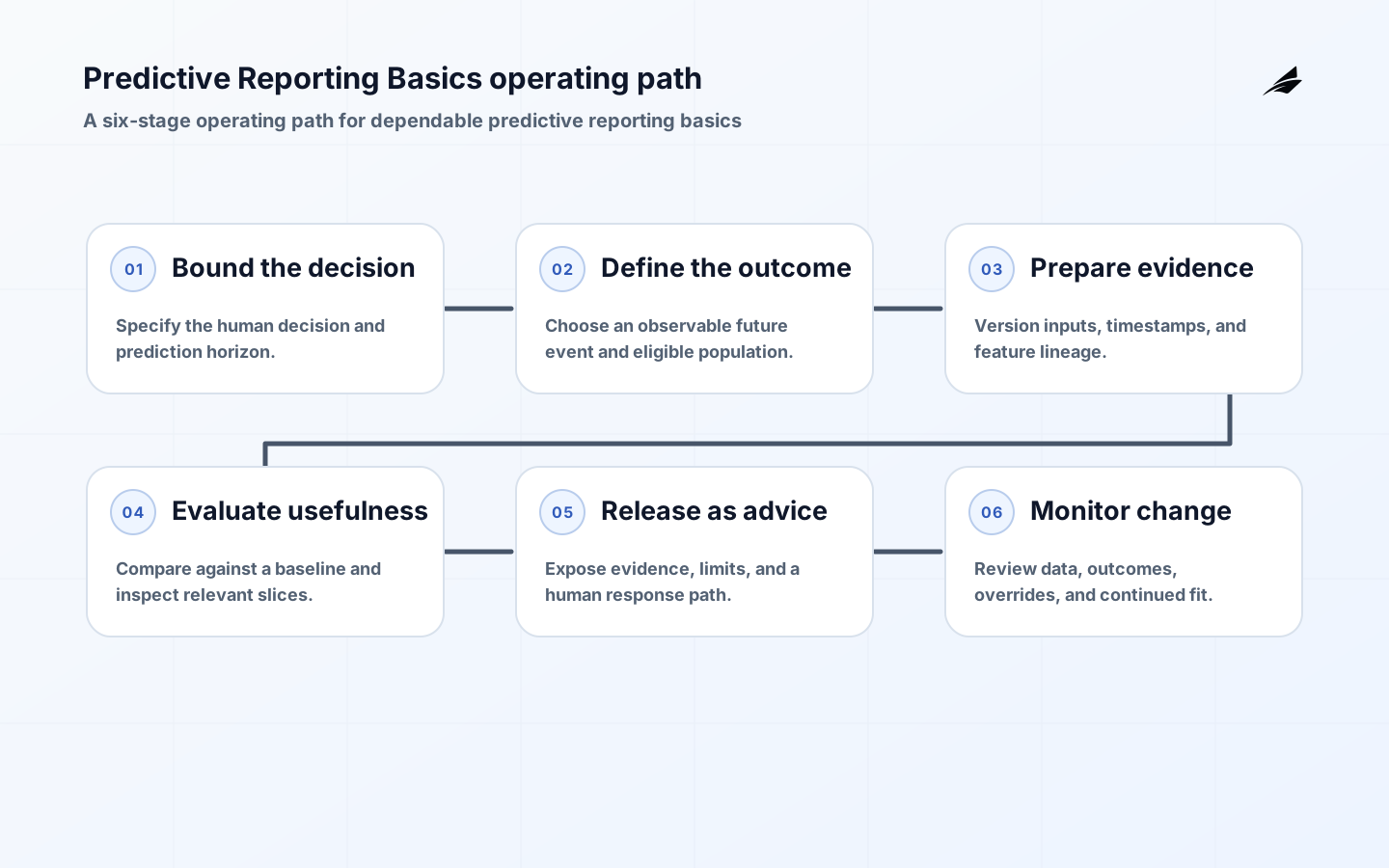
Predictive Reporting Basics: A Governance Checklist for Decision Makers starts with a practical question: can technical decision makers evaluating where a forecast can assist, rather than replace, operational judgment use a governed predictive reporting practice to decide whether an estimated future outcome should alter prioritization, staffing, outreach, or a human review without reconstructing the number in a spreadsheet or asking for private context? The answer depends less on how many charts or automated steps exist than on whether the reader can inspect meaning, scope, timing, and responsibility. Predictive Reporting Basics is useful when it connects a stated decision to evidence that is current enough for that decision, and when it makes uncertainty visible instead of quietly averaging it away. This guide focuses on the operating choices that make the result explainable in routine work and defensible when a result is challenged.
Start with the decision predictive reporting basics must support
Describe the work moment before designing the data product. For this subject, the relevant decision is whether an estimated future outcome should alter prioritization, staffing, outreach, or a human review. Ask the people who take that decision which record they inspect first, what would make them wait, and what response follows a material change. Their answers establish a decision horizon, a tolerable freshness window, and the detail needed to investigate. A weekly planning discussion has different needs from an intraday exception queue. Treating both as the same reporting requirement usually creates a crowded interface and an ambiguous service level. A compact decision statement also provides a useful scope boundary: every field, transformation, and visual should improve the action, the explanation, or the recovery path.
- Choose a decision that can be measured after action, not a vague desire to predict.
- Use only inputs available at the moment the prediction will be used.
- Keep the outcome horizon explicit so future information cannot leak into the result.
- Design an understandable alternative path when a score is unavailable.
Make evidence inspectable in predictive reporting basics
The working evidence for predictive reporting basics is a defined outcome, time-stamped training data, feature lineage, evaluation slices, current performance checks, and a human response path. Put this information where a reader can use it, not only in a handover document. State what one row or event represents, distinguish business time from load and publication time, and preserve identifiers that make a published result traceable. A source can be authoritative for one question but not for every question; document that boundary. Where records are matched across systems, make the matching rule, ambiguity handling, and effective date reviewable. This is especially important when a summary combines events, snapshots, or manual corrections, because an unnoticed one-to-many join can produce a credible-looking but wrong total.
| Element | Question to settle | Evidence to retain |
|---|---|---|
| Decision use | What action may change because of the prediction? | A bounded workflow and accountable human. |
| Target outcome | What future event is estimated and by when? | An observable label and prediction horizon. |
| Input lineage | Which fields are used and when are they available? | Versioned features and source references. |
| Evaluation | How will usefulness be judged for relevant groups? | Documented measures and review slices. |
Design controls and exceptions before publication
The central risk is that a prediction can look precise while using stale relationships, a shifted population, or a proxy that decision makers do not understand. Controls should therefore test a specific promise, not merely confirm that software completed a run. Check source arrival against the decision window, validate required fields and permitted values, and reconcile material totals with their accountable record. Define what happens for each severity: a low-impact issue may call for a visible warning, whereas an issue that changes a commitment, priority, or externally used result should hold the measure or report. Every condition needs an owner, a response route, and a record of disposition. The Microsoft governance guidance similarly emphasizes ownership, documented policies, and controls that fit normal work rather than creating an opaque gate.
- Evaluate the system against a simple baseline before adding complexity.
- Review error patterns for operationally important segments.
- Make confidence and limitations legible to the person acting.
- Set a review date before the first production use.
A controlled operating path for predictive reporting basics
Build the first release around an advisory workflow where people can compare a prediction with the underlying evidence and record their response. Use representative records, including an uncomfortable edge case, to test the definitions and the handoffs. Confirm that readers have only the access they need, that a resolver can see enough detail to act, and that a failed check is understandable outside the delivery team. Quality checks work best when they sit close to the transformation or publication step they protect; dbt data tests is a useful technical reference for treating assertions as executable checks. Release notes should identify changed meaning, affected history, and any limitation that a reader needs to carry into a decision.
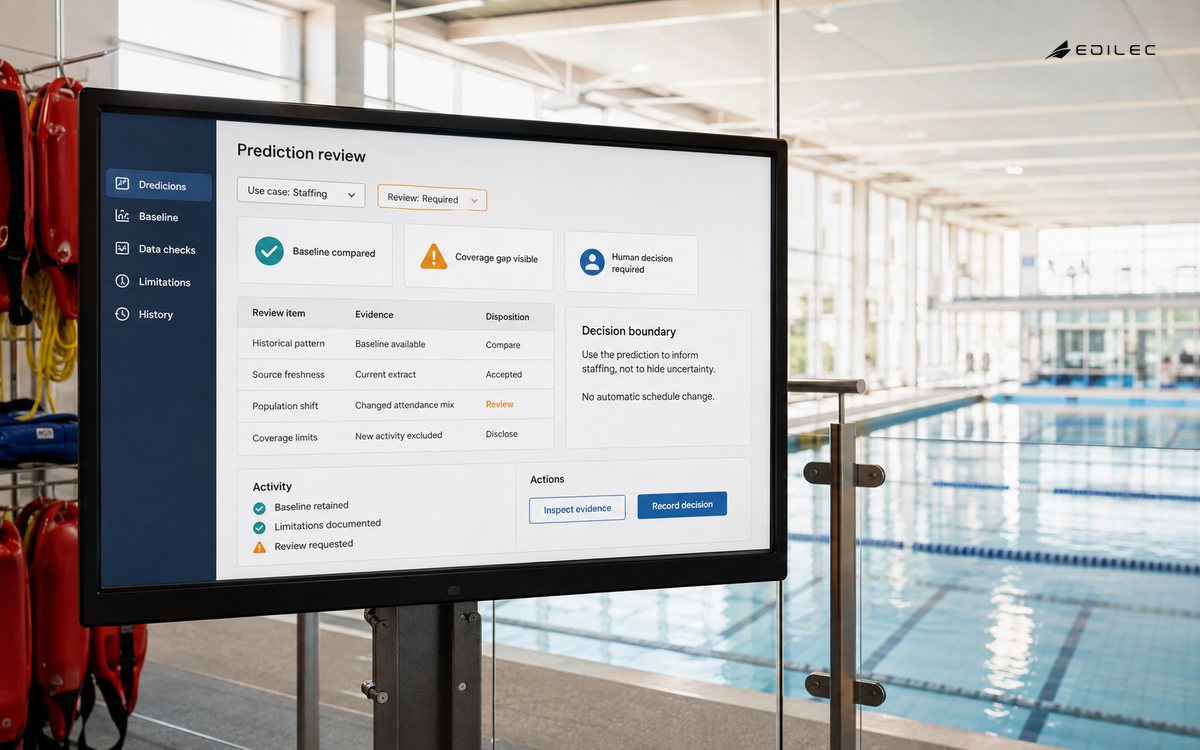
| Situation | What to check | Expected response |
|---|---|---|
| Training-serving mismatch | Compare live input definitions with the approved version. | Pause or qualify use until aligned. |
| Population shift | Inspect coverage and key segments. | Review applicability before relying on scores. |
| Performance change | Measure outcomes after a usable delay. | Adjust, retrain, or retire with evidence. |
| Human override | Capture reason and resulting outcome. | Use patterns to improve workflow and model governance. |
Operate predictive reporting basics as a maintained service
A release is not evidence that the service is dependable. Monitor data drift, outcome drift, coverage gaps, false confidence, feedback delays, and differences between groups that matter to the decision. Review a small sample of results with the domain owner and compare the published value with the source evidence, especially after a change in process, policy, or instrumentation. Separate a data defect from a legitimate change in the business; both matter, but their remedies differ. Keep a lightweight log of questions and incidents so recurring ambiguity becomes a definition, model, or workflow improvement rather than another local workaround. The NIST Data Governance and Management Profile work is useful context here: governance is an organizational practice that connects data management choices to accountable risk decisions.
Implementation choices that protect the decision
Choose tooling after the decision contract is clear. A warehouse, semantic layer, orchestration service, or BI platform can support predictive reporting basics, but none removes the need to decide grain, ownership, timing, and recovery. Prefer interfaces that preserve lineage from a summary to its inputs, role-based access that matches the work, and observable status for freshness and controls. The Google Cloud data analytics architecture guidance provides a useful architecture perspective on separating ingestion, processing, storage, and consumption concerns. The same principle applies across platforms: a clean boundary makes changes easier to test and failures easier to explain. For further implementation context, see a related planning guide, a related planning guide, a related planning guide, a related planning guide.
Change management is part of dependable predictive reporting basics, not a cleanup task for a later phase. Keep a compact change record whenever a source field, business rule, threshold, model, or access decision changes. It should say what changed, why it changed, who approved it, which readers or historical periods may be affected, and how the team checked the result. Use a staged release for material changes: compare old and proposed calculations on representative records, obtain the domain owner’s interpretation, and communicate the effective date before the next decision cycle. When a historical value is intentionally restated, preserve both the reason and the scope so readers do not mistake a definition change for operational movement. This practice is especially valuable when new teams inherit the service, because it turns inherited assumptions into inspectable evidence. It also gives business and delivery owners a shared way to decide whether a change needs a simple note, a controlled rollout, or a temporary hold.
Frequently asked questions about predictive reporting basics
How many measures should the first release include? Include only the measures needed for the stated decision and its investigation path. A smaller set with definitions, freshness, and accountable owners is more useful than a broad catalog of unexplained values. Add a measure after a real reader can name the decision it changes, the source that supports it, and the person who will maintain its meaning. In predictive reporting basics, that restraint keeps the first release tied to a decision rather than a catalog.
What should happen when data quality is uncertain? Do not make readers infer the situation. Show affected scope and freshness, then follow the agreed response: qualify a low-risk result, hold a material result, or route an exception to the named resolver. The key is consistency. A visible exception with a known owner protects trust better than a clean-looking result whose limitations are discovered later. For predictive reporting basics, that visible response protects readers from acting on an uncertain result.
Key takeaways for predictive reporting basics
- Anchor predictive reporting basics to one recurring decision and a defined time horizon.
- Make grain, ownership, source authority, freshness, and limitations visible to readers.
- Attach every material quality condition to an agreed response and resolver.
- Release in the real work setting, then improve definitions from questions and incidents.
Conclusion: make predictive reporting basics useful under scrutiny
Predictive Reporting Basics earns trust when it helps people act without asking them to take the logic on faith. Begin with the decision, document the evidence and its limits, make exceptions operational, and keep the result reviewable as source systems and business rules change. That discipline turns a one-time dashboard, model, or scheduled job into a service that can support real work.