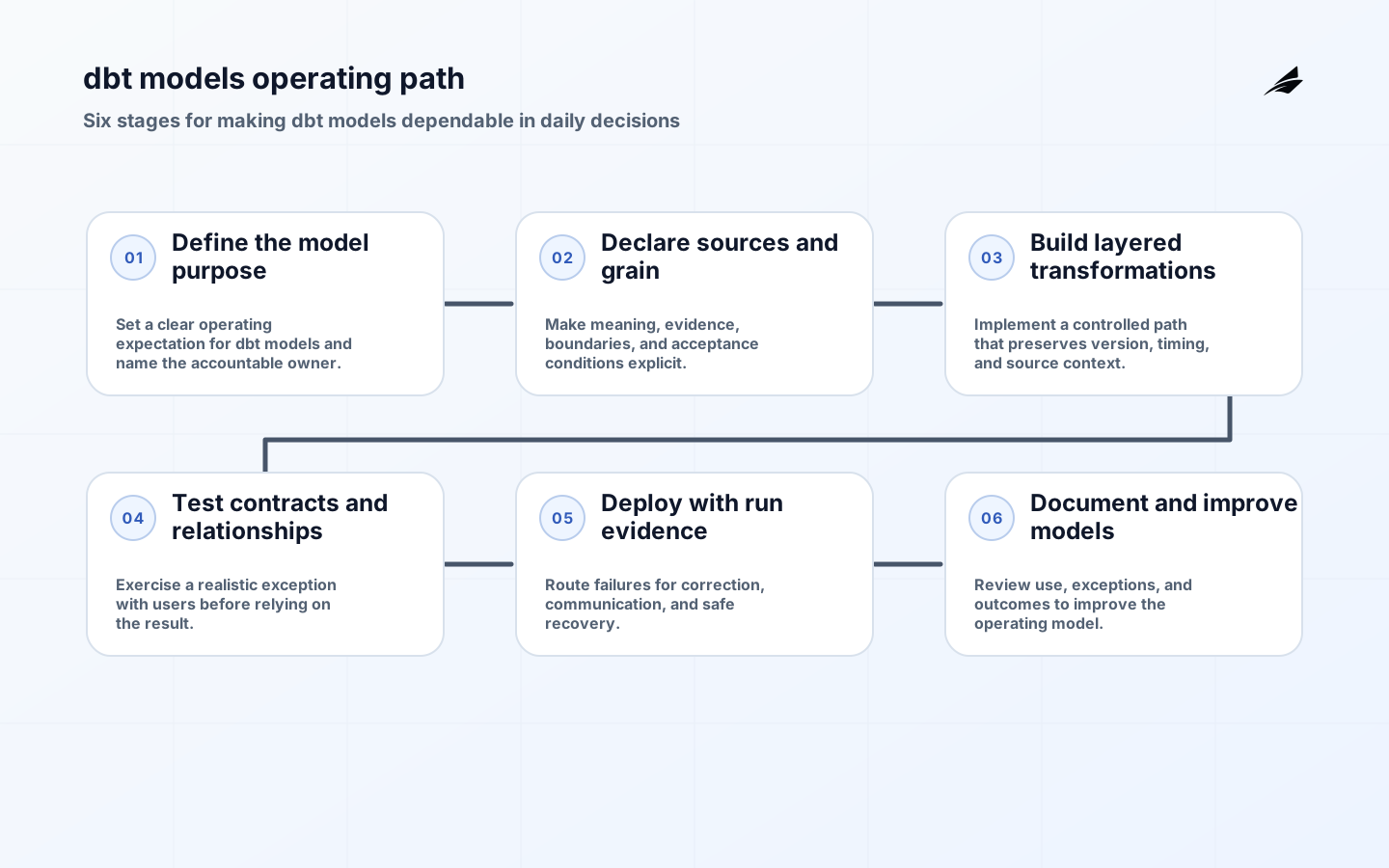
A Field Guide to dbt Models for Growing Teams
A dbt model practice is not the act of installing a tool or publishing a technical asset. For engineering teams, they are a discipline for making a particular decision dependable at a known moment, with evidence a colleague can inspect. The value is reviewable transformation work that turns raw records into trusted analytical building blocks. Start by writing down the decision, who takes it, what changes it, and what happens when available evidence is incomplete An analyst may fix a revenue calculation directly in a dashboard query; the immediate result can be right, but the next dashboard may duplicate the old logic and the correction cannot be tested or reviewed with transformation code. The dbt workflow gives teams a disciplined place for that work. This boundary keeps the discussion focused on behavior and consequences rather than a long inventory of features.
Begin with the decision, reader, and time window
Before committing a team, describe the recurring decision in one sentence: “At this cadence, this person decides this action using these measures.” Then collect real cases, including an uncomfortable exception For dbt models, the useful scope is often narrower than the requested platform: one planning meeting, operational handoff, or governed dataset. The deliverable is a model contract recording purpose, grain, materialization, dependencies, owner, tests, freshness assumptions, documentation, and consumers. A named owner must accept the definition, request a change, and decide whether an exception blocks the result or merely qualifies it That makes accountability testable before implementation expands.
| Question | Decision to make | Evidence to keep |
|---|---|---|
| Who acts? | Name the accountable user and decision. | Decision statement and cadence. |
| What must be true? | Specify records, definitions, and uncertainty. | Examples, source IDs, acceptance criteria. |
| When does dbt models create enough value to justify its operating cost? | Set a business freshness or response expectation. | Timestamp, cutoff policy, exception state. |
| Who responds? | Assign correction and communication ownership. | Escalation route and incident record. |
Set the promise and the limits of a model
A useful definition prevents technology from becoming a vague cure for every reporting problem. A dbt model should make one kind of evidence easier to produce, understand, reuse, or act on; it does not remove judgment about policy, incentives, or changing business conditions. The important work is semantic: what does an identifier represent, which time applies, which exclusions are intended, and which audience can see the result. Put those answers where a reviewer can find them. Ambiguity in A Field Guide to dbt Models for Growing Teams is reduced by clarifying the decision, evidence, and owner rather than adding another surface.
The caution is concrete: a model that passes syntax checks yet produces duplicates because join and uniqueness assumptions were never encoded as tests. Treat that as a design test. Ask a domain expert to walk through the example, then make expected handling executable where feasible and visible where automation would be unsafe W3C PROV explains why provenance matters, while the W3C Data Quality Vocabulary frames quality characteristics in context Both are useful anchors when a team must explain what it knows and why.
Connect model layers to ownership and evidence
The architecture should make claims traceable. For this topic, that means source declarations, layered SQL models, version control, isolated development, continuous integration, data tests, generated documentation, lineage, and production run observability. Keep authoritative evidence separate from presentation, and retain the version, time, and owner behind consequential outputs Design each boundary for a real operating question: can the team identify a missing input, distinguish delayed from absent data, understand a change's blast radius, and recover without inventing a second source of truth A simple path that is observable and recoverable is more valuable than an elaborate design that only works in the happy case dbt models documentation and dbt data tests documentation provide implementation references for model structure and checks.

| Layer | Responsibility | Failure signal |
|---|---|---|
| Evidence | Preserve source identity, time, and relevant context. | Missing keys, unusual volume, unavailable source. |
| Controlled logic | Apply approved rules with versioned change history. | Test failure, reconciliation gap, incompatible change. |
| Published result | Expose scope, freshness, limitations, and definition route. | Stale output, unexplained shift, access mismatch. |
| Operations | Monitor, communicate, repair, and learn. | Unowned alert, repeated workaround, slow recovery. |
Ship a small transformation that can be challenged
A first release should prove the decision path, not standardize every adjacent workflow. Build from representative data and real users; include the unhappy path before calling work complete Exercise an input delay, a definition change, a permission problem, and unexpected volume. Review the result with the decision owner, not only implementers. For dbt models, release criteria include a working explanation, a support owner, and evidence that the result can be checked against a known case. This is how capability becomes repeatable rather than dependent on one expert.
- Write the minimum contract and decision statement for dbt models before building broad surfaces.
- Choose one owner for meaning and one technical owner for operation.
- Show freshness, version, or exception state wherever a user may act.
- Reconcile known cases with people closest to the source process.
- Rehearse correction, rollback, or replay before the first important cycle.
Use run history and reader feedback to steer change
After launch, measure test pass rate, freshness, deployment lead time, failed-run recovery, documentation coverage, model cost, and manual corrections outside the repository. These are not universal targets; their purpose is to make trade-offs discussable and surface whether the service remains fit for its decision Review recent examples on a cadence: a normal run, an exception, a change request, and a user question Record what was learned, who owns the next action, and whether the definition, control, or training needs revision This closes the loop between what the team designed and how work actually happens, without pretending a successful deployment ends operational responsibility
Models in dbt work best when pull-request review includes both SQL logic and analytical behavior. Reviewers should ask what one row represents, what source assumptions are being made, which test would catch a duplicate, and how a changed model affects dependent outputs. Use development data or bounded samples for fast feedback, but validate consequential changes against production-like cases before release. Generated documentation and lineage are then not a separate chore; they are the operating record of what the transformation is intended to do.
A mature dbt models practice should make routine change safer as well as make today’s result useful. Review the boundaries in the architecture when a source, owner, policy, or business question changes, and record which published outputs depend on the old assumption The design risk remains: a model that passes syntax checks yet produces duplicates because join and uniqueness assumptions were never encoded as tests. This gives the team a concrete scenario for release review, support training, and recovery rehearsal Operational decisions become more dependable when people can see the limitation before it becomes an incident, rather than reconstructing intent from a result after it has already been used
One practical test for dbt models is decision reversibility. Before relying on a result, ask what evidence a reviewer would need to challenge it, correct it, or explain a different outcome tomorrow Preserve that evidence with the output: the relevant period, scope, definition version, source state, and accountable owner dbt models do not need to make every decision automatic. It needs to make appropriate human judgment faster and better informed, especially when the facts are incomplete or an exception has material consequences
Key takeaways for dbt models
- dbt models succeed when they support a named decision and accountable user.
- Definitions, time boundaries, and exceptions are product behavior, not after-the-fact paperwork.
- The first build should preserve evidence and make recovery possible before it reaches every audience
- Usage matters, but effective use means people can explain the result and act appropriately.
- Reviewing real failures is the quickest way to improve ownership, controls, and scope.
Questions about dbt models for growing teams
Do we need a large platform first for dbt models? No. Begin with the smallest decision needing dependable evidence and make its path observable. Who owns it? An operational owner owns meaning and decision fit; a technical owner operates the data path How do we know it is ready? Test named cases, show freshness and limitations, assign support, and have intended users complete real work What should change first after launch? In dbt-model delivery reviews, fix repeated ambiguity, unowned exceptions, and evidence gaps before adding surface area
Conclusion
dbt models are worth building when they make an important decision more explainable, timely, and recoverable. Keep the first commitment concrete: one decision, one owner, constrained evidence, and a review loop containing real exceptions Related data guide, ELT planning guide, and warehouse modeling guide provide adjacent practices. The technical references in this article help teams make definitions, lineage, controls, and operating responsibilities explicit; local owners still decide what evidence is sufficient for their readers.
For a growing team, the useful dbt operating record is small: model purpose, grain, sources, materialization, owner, freshness promise, tests, consumers, and the last exception reviewed. Keep it beside the change history so a new contributor can understand what the model is meant to protect before editing SQL. That context prevents scale from turning a readable transformation into an anonymous dependency.
Before expanding a dbt model to another consumer, run one representative normal case and one degraded case through the declared source, tests, documentation, and release path. Ask the decision owner to explain the output and the technical owner to show how it would be corrected. Widen only when both explanations agree with the recorded grain, timing, and failure route.
A dbt model review should connect SQL behavior to the warehouse relation and the decision that consumes it. Check grain, joins, materialization, tests, grants, freshness, and the effect of a late or corrected source. Run the model against representative edge cases and keep the compiled result with the review evidence. This gives the team a practical basis for deciding whether a model change is safe, reversible, and understandable to its downstream owners.