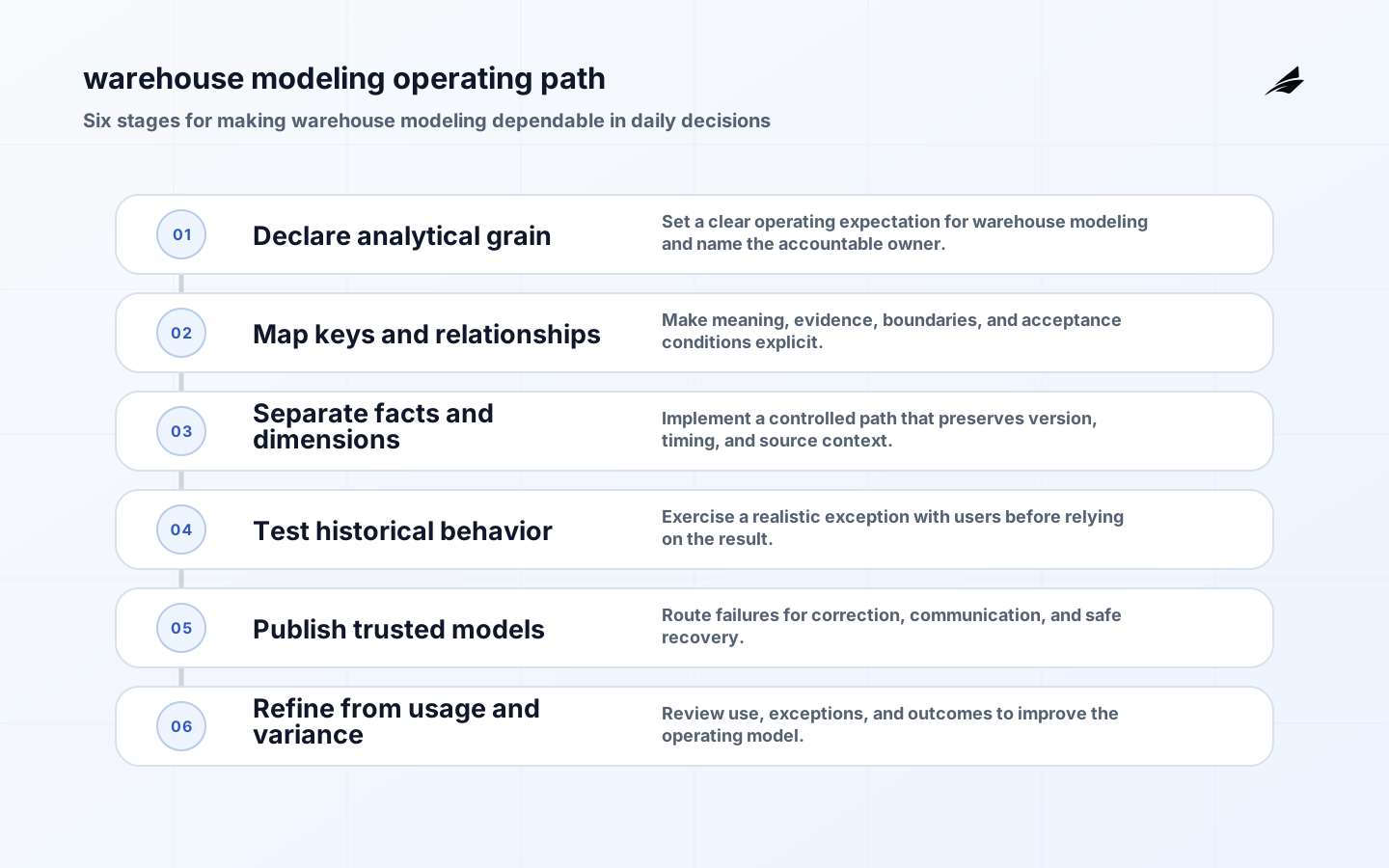
Start with a decision, grain, and responsible reader
Warehouse modeling is not the act of installing a tool or publishing a technical asset. For CTOs, it is the discipline of making a particular decision dependable at a known moment, with evidence a colleague can inspect The value is durable analytical structures that make change, performance, and meaning manageable. Start by writing down the decision, who takes it, what changes it, and what happens when available evidence is incomplete A team joins order records to customer snapshots and gets more revenue after adding a dimension. The query ran correctly, but the model did not make grain or relationship explicit. Modeling must make that multiplication detectable before it reaches a KPI. That practical boundary keeps the work focused on behavior and consequences rather than a long inventory of features — For warehouse modeling, apply the test to grain, keys, history, and reconciliation.
State the promise and its exclusions
Before committing a team, describe the recurring decision in one sentence: “At this cadence, this person decides this action using these measures.” Collect real cases, including an uncomfortable exception. For warehouse modeling, the useful scope is often narrower than the requested platform: one planning meeting, operational handoff, or governed dataset. The design record should state grain, identifiers, relationship cardinality, history policy, business rules, owner, quality checks, and intended use. Give the owner authority to approve the definition, request a change, and classify an exception before implementation expands.
| Question | Decision to make | Evidence to keep |
|---|---|---|
| Who acts? | Name the accountable user and decision. | Decision statement and cadence. |
| What must be true? | Specify records, definitions, and uncertainty. | Examples, source IDs, acceptance criteria. |
| When does warehouse modeling create enough value to justify its operating cost? | Set a business freshness or response expectation. | Timestamp, cutoff policy, exception state. |
| Who responds? | Assign correction and communication ownership. | Escalation route and incident record. |
Map facts, dimensions, and provenance
A useful definition prevents technology from becoming a vague cure for every reporting problem — For warehouse modeling, apply the test to grain, keys, history, and reconciliation. Warehouse modeling should make one kind of evidence easier to produce, understand, reuse, or act on; it does not remove judgment about policy or changing business conditions. Ask what an identifier represents, which time applies, which exclusions are intended, and which audience can see the result. Put those answers where a reviewer can find them. W3C PROV gives this guide a vocabulary for tracing a modeled result, while the W3C Data Quality Vocabulary helps describe the quality dimensions that matter to its intended reader.
The caution is concrete: a convenient wide table can mix incompatible grains and become the unexamined source for every report. Treat that as a design test. Ask a domain expert to walk through a fan-out example, make expected handling executable where feasible, and record the provenance and quality assumptions that remain human judgment. W3C PROV and the W3C Data Quality Vocabulary provide useful language for that review.
Release a model that can be checked
The architecture should make claims traceable. For this topic, that means staged source models, conformed dimensions, fact tables at declared grain, incremental transformations where appropriate, key and relationship tests, documentation, and monitored query behavior. Keep authoritative evidence separate from presentation, and retain the version, time, and owner behind consequential outputs Design each boundary for a real operating question: can the team identify a missing input, distinguish delayed from absent data, understand a change's blast radius, and recover without inventing a second source of truth A simple path that is observable and recoverable is more valuable than an elaborate design that only works in the happy case

| Layer | Responsibility | Failure signal |
|---|---|---|
| Evidence | Preserve source identity, time, and relevant context. | Missing keys, unusual volume, unavailable source. |
| Controlled logic | Apply approved rules with versioned change history. | Test failure, reconciliation gap, incompatible change. |
| Published result | Expose scope, freshness, limitations, and definition route. | Stale output, unexplained shift, access mismatch. |
| Operations | Monitor, communicate, repair, and learn. | Unowned alert, repeated workaround, slow recovery. |
Review variance, usage, and exceptions
A first release should prove the decision path, not standardize every adjacent workflow — For warehouse modeling, apply the test to grain, keys, history, and reconciliation. Build from representative data and real users; include an unhappy path before calling work complete. Exercise an input delay, definition change, permission problem, and unexpected volume. Review the result with the decision owner, then record the explanation, support owner, and known-case reconciliation evidence so another operator can repeat the check.
- Write the minimum contract and decision statement for warehouse modeling before building broad surfaces.
- Choose one owner for meaning and one technical owner for operation.
- Show freshness, version, or exception state wherever a user may act.
- Reconcile known cases with people closest to the source process.
- Rehearse correction, rollback, or replay before the first important cycle.
Operate through evidence, not impressions
After launch, measure reconciliation variance, key and relationship failures, model runtime, query cost, attribute-change time, and downstream reports affected by revision. Treat these as diagnostic signals rather than universal targets. Review a normal run, an exception, a change request, and a user question on a defined cadence; record the lesson, next owner, and whether the definition, control, or training needs revision. This keeps the model tied to the way decisions are actually made.
Warehouse modeling benefits from making grain visible in the model name, documentation, and tests. Before joining, state what one row represents and whether each relationship should be one-to-one, many-to-one, or many-to-many. Then test the assumption with keys and reconciliation totals. Historical rules deserve the same care: a slowly changing attribute can be right for one question and misleading for another. Retaining the design rationale helps future teams change the model without losing the original analytical intent.
A mature warehouse modeling practice should make routine change safer as well as make today’s result useful. When a source, owner, policy, or business question changes, record affected outputs and test the convenient-wide-table failure case. Use that case for release review, support training, and recovery rehearsal so people can see the limitation before it becomes an incident.
One practical test for warehouse modeling is decision reversibility. Before relying on a result, ask what evidence a reviewer would need to challenge it, correct it, or explain a different outcome tomorrow Preserve that evidence with the output: the relevant period, scope, definition version, source state, and accountable owner Warehouse modeling does not need to make every decision automatic. It needs to make appropriate human judgment faster and better informed, especially when the facts are incomplete or an exception has material consequences — For warehouse modeling, apply the test to grain, keys, history, and reconciliation.
Growing teams should treat model interfaces as shared operating agreements. A published model needs a stable grain, an explicit timing promise, a clear status, and a support route that does not depend on the person who first wrote the transformation. When a source or business process changes, assess both the direct model and the downstream reports that may still appear plausible. Keep representative reconciliation cases in the release record so a new reviewer can distinguish a real business movement from a join, history, or freshness defect before the model gains another audience.
Key Takeaways
- Warehouse modeling succeeds when it supports a named decision and accountable user.
- Definitions, time boundaries, and exceptions are product behavior, not after-the-fact paperwork — For warehouse modeling, apply the test to grain, keys, history, and reconciliation.
- The first build should preserve evidence and make recovery possible before it reaches every audience — For warehouse modeling, apply the test to grain, keys, history, and reconciliation.
- Usage matters, but effective use means people can explain the result and act appropriately — For warehouse modeling, apply the test to grain, keys, history, and reconciliation.
- Reviewing real failures is the quickest way to improve ownership, controls, and scope — For warehouse modeling, apply the test to grain, keys, history, and reconciliation.
Frequently Asked Questions
The structured answers below focus on making warehouse modeling useful to a real decision: define grain, assign ownership, test degraded cases, and select post-launch signals that reveal reconciliation or usage problems.
Use an order-history slice as the acceptance example. Define one row as one order line at the order timestamp, then show how a customer correction, late shipment, cancelled line, and changed product attribute should appear. Reconcile the slice to the source system before publishing a daily aggregate. Keep the sample rows, expected totals, history rule, and reviewer decision together. When a later model change alters the total, the team can tell whether the cause is a legitimate business revision, a join fan-out, a late record, or a broken transformation. That distinction makes warehouse modeling safer for planning and support because the next operator has an evidence path instead of a plausible number.
Conclusion
Warehouse modeling is worth building when it makes an important decision more explainable, timely, and recoverable. Commit the first model to one named decision, one responsible owner, bounded evidence, and an explicit review cadence. ELT workflows, semantic layers, and metric layers provide adjacent practices. For technical grounding, consult Microsoft Power BI star schema guidance, dbt model contracts documentation, W3C Data Quality Vocabulary, and W3C PROV data model.
A growing team should accept a warehouse model only when a reader can explain grain, time boundary, source state, and intended decision. Keep definition, tests, provenance, and owner attached to the published model so a changed number can be investigated.
Make one review concrete: reconcile a representative period, test a relationship and late attribute, then ask the decision owner to interpret the output. If technical checks pass but a business exception cannot be explained, fix the contract before adding consumers.