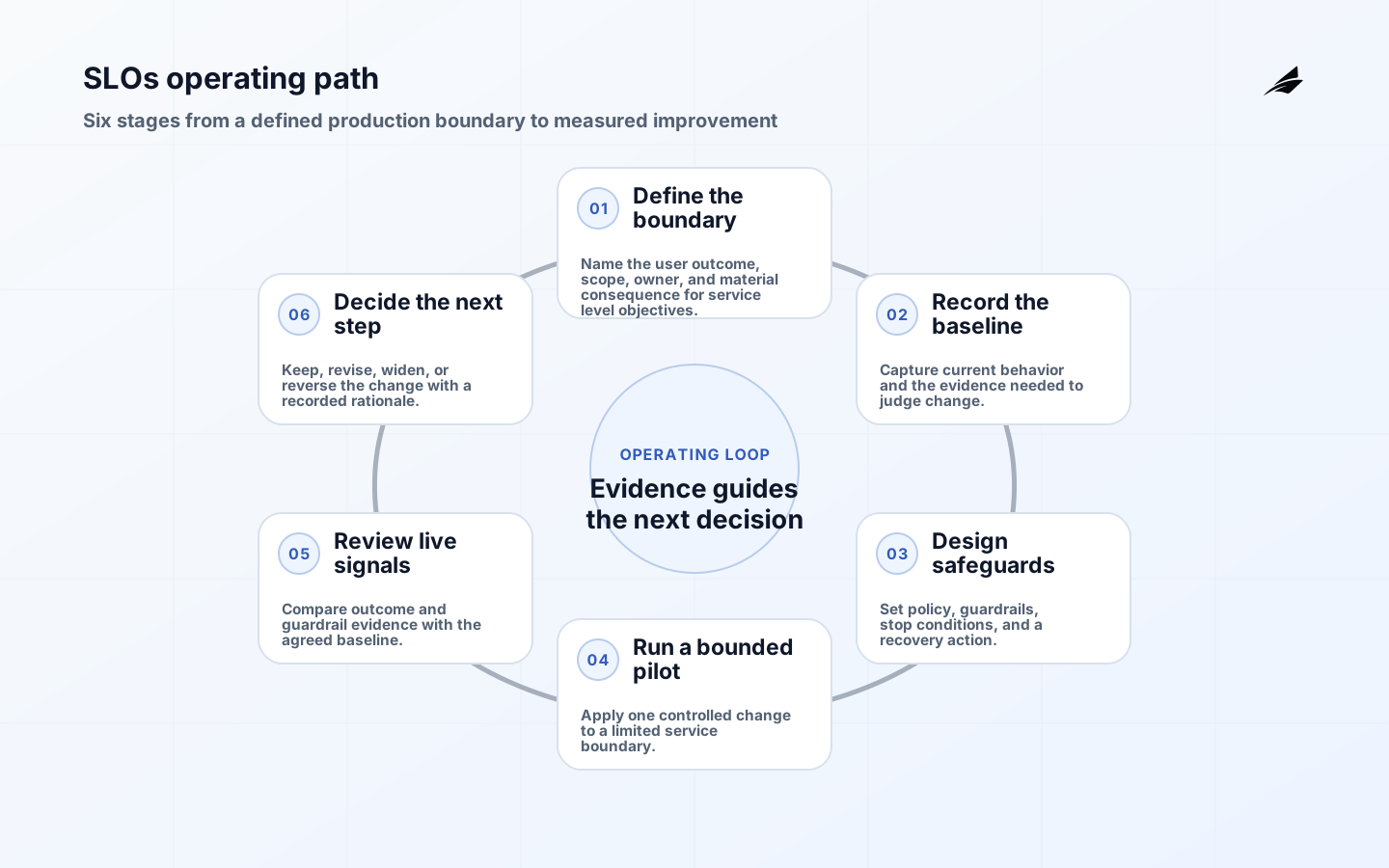
SLOs turn reliability from a vague aspiration into a measurable promise about a user journey. They work best when product and engineering agree on what success looks like: a completed payment, a returned search result, or a processed submission, not simply a reachable pod. Google’s Art of SLOs resources frame SLI, SLO, and error-budget decisions in user-focused terms, while Google Cloud service monitoring shows the mechanics of tracking compliance. The number is only useful if it changes what the team does next.
Define the SLO Boundary: SLO ownership and review
The production boundary is grounded in the Google SRE Art of SLOs, the SRE Workbook guidance on alerting on SLOs, Google Cloud service monitoring, and the OpenSLO specification. Together they clarify the objective, alerting, implementation, and portable vocabulary; the local team still has to name the owner, policy, and recovery action.
The first production artifact is an objective document that defines the user journey, service-level indicator, target, window, exclusions, data source, owner, and policy for spending error budget. For this production SLO case, it turns an abstract initiative into a boundary that someone can operate. For this production SLO case, write the user outcome, the systems included, the named owner, the decision cadence, and the condition that stops the change. For service level objectives, the important risk is optimizing a convenient infrastructure metric that does not represent the reliability customers experience, or publishing targets nobody uses in decisions. For this production SLO case, a boundary is useful only when it makes that risk visible before customers discover it.
Start with one journey and its data path. Define the eligible events, successful events, time window, latency boundary if relevant, and known exclusions such as planned maintenance. Validate the query against real incidents and customer reports: if the dashboard says healthy while users cannot finish the journey, the indicator is wrong or incomplete. A target should reflect user expectations and the cost of failure, not a borrowed percentile. State the owner who can revise it as the service changes.
| Decision element | Question to settle | Evidence to retain |
|---|---|---|
| Outcome | What user or operator result should service level objectives improve or protect? | A baseline, target, and named service owner. |
| Scope | Which services, environments, and actors are included? | A current inventory and explicit exclusions. |
| Guardrail | What harm must stop the work? | Thresholds, alert query, and stop authority. |
| Recovery | How is normal behavior restored? | A tested runbook and decision record. |
Build an SLO Architecture That Can Be Explained
Build SLO data from telemetry that is durable and interpretable. Instrument the service boundary, attach outcome and version context, and preserve enough retention for the chosen window. Avoid labels that create unbounded cardinality or split the signal beyond useful decision making. Define how dependency failures are attributed so teams do not spend all their error budget debating ownership. The SRE Workbook case study is useful for seeing how objectives influence alerting and prioritization.
For SLOs, keep the architecture legible to the person on call. For this production SLO case, show the entry point, authoritative records, identities, policy or control points, telemetry, and the path to a safe state. Google SRE Workbook: SLO engineering is a useful reference for the underlying mechanisms. For this production SLO case, in local design reviews, ask a practical question: when the expected result is absent, which component, owner, and record will establish what happened. For this production SLO case, that question usually exposes missing dependencies sooner than an elaborate diagram does.
Attach SLO Policy to Releases
Introduce objectives in observation mode. Show teams the current performance and error-budget behavior before attaching automatic paging or release restrictions. Review a recent failure and ask whether the objective would have detected it, whether the alert would have been actionable, and whether the exclusion policy is honest. Release gates should be proportionate: a service burning budget rapidly may need a pause on risky changes, while a stable service should not be frozen because of one noisy metric.
For SLOs, make the release record specific enough for another operator to continue the work: baseline, exact configuration or revision, expected effect, affected cohort, observation window, guardrail queries, and recovery action. For this production SLO case, use the related delivery guide to keep the surrounding change process clear. For this production SLO case, a small pilot is not a ceremonial prelude; it is how the team learns whether its measurement and response assumptions survive production conditions.
| Stage | Minimum output | Decision gate |
|---|---|---|
| Discover | Current boundary, baseline, owner, and known constraints. | The problem can be measured without guessing. |
| Design | Controls, evidence path, and recovery action. | The main consequence has a practical safeguard. |
| Pilot | A limited change with explicit stop conditions. | Observed behavior supports a wider use. |
| Operate | Runbook, alert owner, and review cadence. | Normal turnover will not erase knowledge. |
| Improve | A recorded lesson and next hypothesis. | Evidence, rather than urgency, selects the next change. |
Review Budget Burn and User Impact
Use the selected SLI, error-budget consumption rate, objective compliance over the window, alert precision, and changes in customer-impacting failures. For this production SLO case, pair a direct outcome measure with a guardrail so a local improvement cannot hide a broader regression. For this production SLO case, segment by the boundary that matters, such as revision, region, workload, cohort, or service route. For this production SLO case, each query should have an owner who understands its limitations and a written action for breach. Google Cloud service monitoring overview provides authoritative context, but the threshold must reflect the consequence and operating capacity of this service.
Use the error budget as a conversation structure. When it is healthy, teams can invest in delivery and experiments; when it burns unexpectedly, investigate the customer journey and reliability work before increasing exposure. Alert on rate of consumption as well as remaining budget, because a monthly target can hide an acute regression. Keep the dashboard linked to runbooks, release history, and incident records. An SLO review should revise assumptions when the service or its customers change.
Pressure-Test Burn, Scope, and Ownership
Review the Indicator Before Blaming the Service
A production SLO can burn because the service degraded, because the measurement path changed, or because the objective was defined against the wrong population. Treat those as separate hypotheses. First inspect the request or event sample: are retries counted once or several times, are synthetic checks included, and did a client or dependency change the response class? Then compare the objective query with the deployed instrumentation and the release timeline. Google’s SRE guidance emphasizes choosing a small set of representative indicators based on what users care about rather than every metric a system can expose. That principle makes review faster: a service owner can investigate a meaningful journey instead of debating a dashboard full of unrelated signals.
Use a decision record for ambiguous cases. If a latency objective is missed only for bulk exports, decide whether that workload needs a separate objective or a stated exclusion. If a dependency makes the result unavailable, record whether the service promise includes the dependency and what customers experienced. If the query is wrong, correct the measurement, label the historical revision, and avoid presenting the backfilled score as an uninterrupted production fact. These distinctions protect the credibility of the SLO program while still giving the team a concrete action after every review.
SLO programs stall when they become a catalog of percentages with no decision rights. They also mislead when a team selects availability because it is easy to calculate while latency or correctness drives customer pain. Do not use exclusions to erase inconvenient incidents. Make the trade-off explicit, record why an objective is temporarily relaxed, and return to the user journey when definitions are disputed. The purpose is better reliability decisions, not a decorative score.
A sound SLO review separates evidence from explanation. For this production SLO case, confirm the timeline, scope, and customer effect; then identify the assumption, control, or handoff that failed. For this production SLO case, use observability and incident context to improve the investigation path rather than adding vague monitoring. For this production SLO case, close the review with one owned correction, a due date, and an explicit decision about whether the operating boundary can widen.
Keep an SLO Decision Record
An objective should lead to an action that the team can afford to take. A fast error-budget burn might pause a risky launch, direct engineers to a dependency investigation, or trigger a reliability review; it should not merely page people to admire a graph. Write that policy beside the target. This makes reliability a shared product decision and prevents the SLO from becoming another disconnected monitoring artifact.
For SLOs, keep the indicator query close to the code and telemetry changes that can alter it. A silent instrumentation change can invalidate a reliability target just as surely as a customer-visible regression.
Key Takeaways
- SLOs should begin with a defined user outcome and a named operating boundary.
- For this production SLO case, keep the first production change small enough to observe, stop, and reverse.
- For this production SLO case, use an outcome signal with guardrails so apparent improvement does not conceal harm.
- Treat ownership, evidence, and recovery as implementation requirements, not documentation afterthoughts.
- For this production SLO case, expand only when the team can explain the result and sustain the operating work.
Frequently Asked Questions
When is an SLO ready for production? For production SLOs, when the scope, accountable owner, evidence, control, and recovery action are explicit and have been exercised for a bounded use. What should a small team do first for SLOs? For production SLOs, pick one meaningful journey, record a baseline, and make one reversible change; broad programs create evidence gaps. How often should it be reviewed? For production SLOs, review after a material change or incident and on a cadence proportionate to the consequence. What if the data is incomplete? For production SLOs, make the uncertainty visible, narrow the action, and improve the measurement before making an irreversible decision. This related operations guide can help establish the surrounding reliability practice.
Make the first production review deliberately cross-functional. Ask a product owner whether the objective reflects the journey, an engineer whether the query survives failure, an operator whether the alert leads to action, and a support lead whether the status is understandable. Capture disagreements as boundary questions rather than settling them with a new dashboard. This review is especially important when a service has multiple consumers or regional behavior; a global target can conceal a local failure. Small, documented corrections in the first cycle are a sign that the feedback loop is working.
Conclusion
The durable production form of SLOs uses an explicit operating promise: what the team is improving or protecting, who can decide, which evidence matters, and how harm is contained. SLOs become useful when that promise is explicit. For this production SLO case, start with the smallest decision that matters, keep the path reversible, and let measured production behavior determine the next investment. For this production SLO case, that approach produces a capability the team can explain, operate, and improve under real pressure.
An SLO becomes production-ready when its objective, measurement path, error-budget policy, alert action, and recovery owner work together under a bounded test. Review the indicator with product, engineering, operations, and support; record exclusions and uncertainty; then let observed customer impact determine the next change. That evidence keeps the objective an operating contract rather than a target that no one uses.
Keep the review record close to the service and release that produced the signal. Include the objective version, query revision, active dependency set, policy decision, and any uncertainty that constrained the rollout. When the next team inherits the service, it should be able to tell which assumptions were provisional and which were accepted operating commitments. That context makes later SLO refinement safer than silently replacing a target after conditions change.