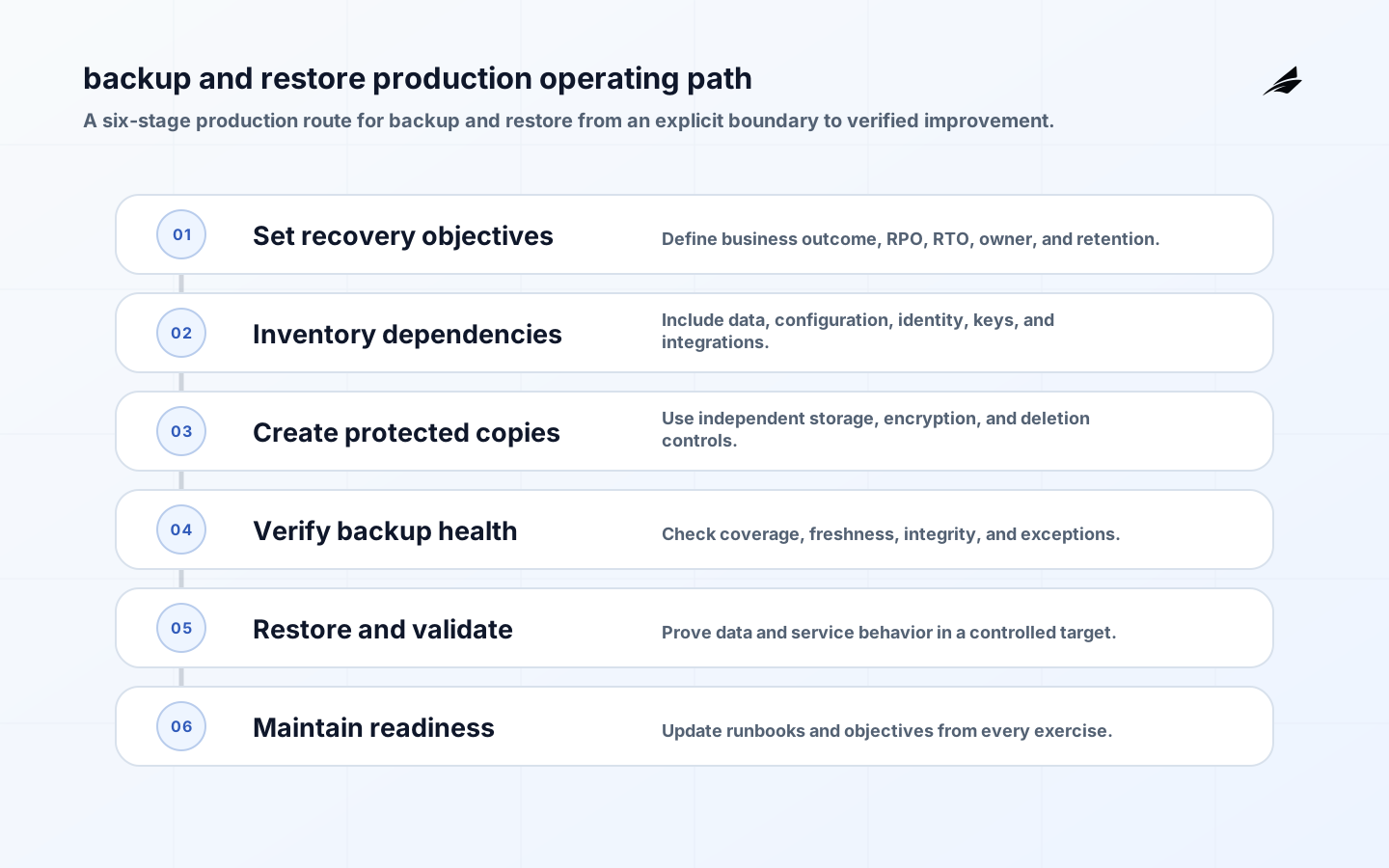
Backup and restore is a production capability only when the organization can recover the right data and service behavior within an agreed time, under realistic access and dependency conditions. A successful backup job proves that a copy was written; it does not prove that the copy is complete, decryptable, compatible with the application, or available to the people who will need it. NIST contingency planning guidance connects recovery strategy to business impact analysis, which is the right starting point for turning vague resilience aspirations into testable recovery objectives.
Key takeaways
- Treat backup and restore as an accountable production capability with an explicit owner and boundary.
- Use evidence that connects the declared change or event to the effective runtime result for backup and restore.
- Match controls to consequence: protect irreversible, customer-impacting, or security-sensitive actions most strongly in backup and restore, with dependency order and service validation.
- Test an unhappy path and a recovery path before expanding exposure.
- Review the operating signals after routine work, not only after a visible failure for backup and restore.
Set recovery promises the service can meet
Classify the systems and data that need recovery, then name the business outcome that must be restored. For each scope, set a recovery point objective, recovery time objective, owner, retention rule, source system, dependencies, and required evidence. Differentiate configuration, application artifacts, databases, object stores, identity records, encryption keys, and third-party SaaS data; they may have different backup mechanisms and restoration order. Do not let a vendor's default retention setting stand in for a recovery strategy. The right objective is determined by impact, legal obligations, and operational tolerance.
| Decision area | Question to settle | Evidence to retain |
|---|---|---|
| Objective | What must be recovered and when? | RPO, RTO, owner, and service inventory. |
| Copy | Where is protected recovery data held? | Retention, encryption, and independent account. |
| Access | Who can restore and unlock data? | Controlled identity and key recovery path. |
| Proof | What demonstrates recoverability? | Measured restore and application validation. |
Map dependencies before the first drill
Use protected copies with independent failure domains appropriate to the risk. That can include separate accounts, regions, storage classes, immutable retention, encryption, and restricted deletion permissions. Protect the key material and identity path needed to restore as carefully as the backup itself; an encrypted copy is useless if authorized recovery cannot obtain the key, while overly broad key access invites destructive misuse. Capture metadata that identifies source version, time, scope, consistency method, and integrity result. For databases, understand whether the backup represents a transactionally consistent point and how logs or replication affect recovery.

Make restoration a controlled operation. The recovery identity should be distinct from routine application credentials, and destructive restore actions should require deliberate confirmation and a recorded owner. Validate backup completion, size anomalies, encryption status, retention locks, and replication before declaring protection healthy. Monitor failed or delayed jobs with a route to action. Ransomware and operator error scenarios make immutability and least privilege especially important, but controls should not prevent an authorized responder from restoring during an emergency. Practice the balance before the emergency arrives.
| Control | Practical implementation | Signal to review |
|---|---|---|
| Coverage | Map systems and recovery dependencies. | Unprotected inventory items. |
| Protection | Use retention and restricted deletion. | Retention failures and key-access issues. |
| Restore testing | Measure end-to-end recovery regularly. | Missed RPO/RTO and failed validation. |
Prove recovery in a controlled target
Test restores on a cadence that matches criticality, using an isolated target where possible. Restore a representative data set, application configuration, and dependent access path; run integrity checks; then exercise the user workflow the recovery is meant to protect. Measure elapsed time from the decision to restore through verified availability, not merely the file-copy step. Test an inconvenient case: unavailable primary credentials, corrupted latest backup, missing index, incorrect region, or a restore that must coexist with ongoing production writes. Document the resulting procedure and its limitations.
Read restoration evidence with the owner
Report recovery readiness, not just backup volume. Useful signals include job success and lateness, coverage against the inventory, age of the newest recoverable point, restore test frequency and success, measured recovery time, key-access failures, retention or immutability status, and unresolved exceptions. Compare achieved recovery point and time with the stated objectives after each exercise. Also review restore quality: data may load successfully while application permissions, schemas, integrations, or indexes are incomplete. A credible report distinguishes copy health, restore health, and business-service recovery.
A production failure mode for backup and restore is a restored database that cannot serve users because configuration, identities, keys, indexes, or external dependencies were left out of the recovery plan. That kind of gap is dangerous because a local success signal can hide an operationally incomplete result in backup and restore, with dependency order and service validation. Add the condition to acceptance criteria and state the expected response before the next change for backup and restore. The record should show who owns the boundary, what evidence proves normal behavior, and how a responder distinguishes a transient delay from a condition that must be stopped in backup and restore, with dependency order and service validation. This turns a surprising edge case into a reviewed part of the operating model rather than a lesson trapped in one engineer's memory in backup and restore, with dependency order and service validation.
Use a regular operating review to compare current system inventory with coverage, retention, key access, restore tests, changed schemas, untested regions, and long-lived exceptions. Keep the discussion close to a real example rather than an abstract maturity score for backup and restore. Note where the team had to infer missing state, cross a permission boundary, or leave the normal workflow to understand the result in backup and restore, with dependency order and service validation. Assign one or two concrete improvements with an owner and date, then inspect them after the next ordinary production change in backup and restore, with dependency order and service validation. This cadence catches accumulated ambiguity early and prevents controls from becoming documentation that no longer describes the live system in backup and restore, with dependency order and service validation.
A practical drill should restore a representative service with normal administrative access unavailable, then rebuild prerequisites and validate the actual user workflow. Include the people and systems that would be involved outside the primary tool: on-call ownership, access approvals, deployment or recovery records, customer communication, and the final verification query in backup and restore, with dependency order and service validation. Measure the time needed to reach a safe decision, but also document why it took that long for backup and restore. The most valuable outcome is a revised procedure that a different responder can follow with the same evidence, especially when the original author is unavailable in backup and restore, with dependency order and service validation.
Keep the backup and restore review bounded but complete. Map system inventory, copy protection, retention, key access, restoration sequence, and service validation to the people who can change, inspect, and recover each element. A responsibility map should identify routine ownership as well as escalation authority, because production work crosses team boundaries at the moment a normal control fails in backup and restore, with dependency order and service validation. Document dependencies that are outside the immediate service or tool, including identity providers, registries, queues, cloud accounts, and vendors in backup and restore, with dependency order and service validation. This context lets reviewers judge blast radius before a change and gives responders a starting point when the visible symptom appears somewhere else in backup and restore, with dependency order and service validation.
Make verification concrete by retaining recovery objectives, measured restoration time, and the recovered user workflow. Compare it with an agreed baseline and record the decision to continue, pause, recover, or investigate in backup and restore, with dependency order and service validation. Verification should happen after the system has had enough time to exhibit the behavior that matters, not only at the instant an API accepts a change in backup and restore, with dependency order and service validation. When the evidence is incomplete, say so and keep exposure constrained. This is how teams preserve learning speed without confusing automation activity with a trustworthy production outcome in backup and restore, with dependency order and service validation.
Before declaring recovery readiness, verify that a protected copy, required keys, access path, application configuration, and user workflow have been restored together. The service outcome is the proof, not the existence of a backup object.
Frequently asked questions
Is replication a backup? Replication can improve availability, but it may copy corruption or deletion; it does not replace a recoverable historical copy. How many copies are enough? The answer depends on threat model and objectives, but copies should not share the same failure and deletion authority. Can we test restores in production? Prefer isolated or controlled targets; test production procedures only when the risk is understood and authorized. Who owns recovery? The service owner owns the business outcome, while platform, security, and data teams may own portions of the mechanism and access.
Define acceptance after restoration
The end of a restore exercise deserves as much design as the beginning. Define the checks that prove a service is usable: a known customer journey, record counts by critical partition, reconciliation of financial or transactional totals, permissions, encryption, scheduled jobs, outbound integrations and monitoring. Decide which checks belong to the platform operator and which require the service or business owner. Record the exact source point, target environment, elapsed time and data age. If a check fails, the runbook should say whether to continue in degraded mode, isolate the restored copy, retry a dependency or return traffic to the original system. This turns restore completed into a decision with evidence.
After the exercise, remove temporary access and data, but keep the evidence needed to improve the plan. Compare the actual sequence with the dependency map. Teams often discover that the slowest step is not copying data; it is finding a key, recreating a permission, validating an asynchronous queue or explaining which records were duplicated. Prioritize the correction that reduces uncertainty for the next operator. Recovery capability improves when the organization practices the full service path, including communication and return-to-service authority, instead of measuring only the backup job completion state.
Review recovery objectives when the business changes. A new payment method, region, retention policy or customer commitment can alter acceptable data loss even if the backup schedule is unchanged. Ask whether the restored service can satisfy the current authentication, notification and reconciliation requirements, and whether the team can communicate a partial recovery without overstating certainty. Objectives are useful only when they describe today’s service and are tested against today’s dependencies.
For technical grounding, consult NIST SP 800-34 contingency planning, the NIST backup glossary, AWS Backup and NIST contingency planning topics. Use these references to check terminology and control intent, then adapt the recovery objective to the service’s actual users and dependencies.
Reconcile the restored service, not only the restored data
A restore is incomplete until the service owner can reconcile a known business slice. For an order service, compare counts and totals for a bounded day, verify that customer and operator roles resolve correctly, and exercise the write path that follows recovery. If the restored database contains the rows but the queue, search index, payment reference, or notification state is missing, record that as a service-recovery failure rather than a successful backup test. Keep the source recovery point, target name, validation query, and decision authority in the drill evidence. This makes the next exercise comparable and exposes which dependency should be protected or rebuilt earlier. It also gives support a precise message when recovery is partial: what users can do, what is delayed, and who owns the next check.
Conclusion
Backup and restore earns confidence through verified recovery, not green job dashboards. Tie copies to explicit objectives, protect the path and keys required to use them, and practice restoring the service that users actually need. Every test should leave the team with clearer evidence and a more usable runbook. Next, read backup and restore operations, incident response planning, and cloud cost optimization.
Backup and restore becomes credible when the service owner can see the recovery objective, the operator can restore the dependencies and the team can reconcile the result. Practice the uncomfortable case before the next real outage.