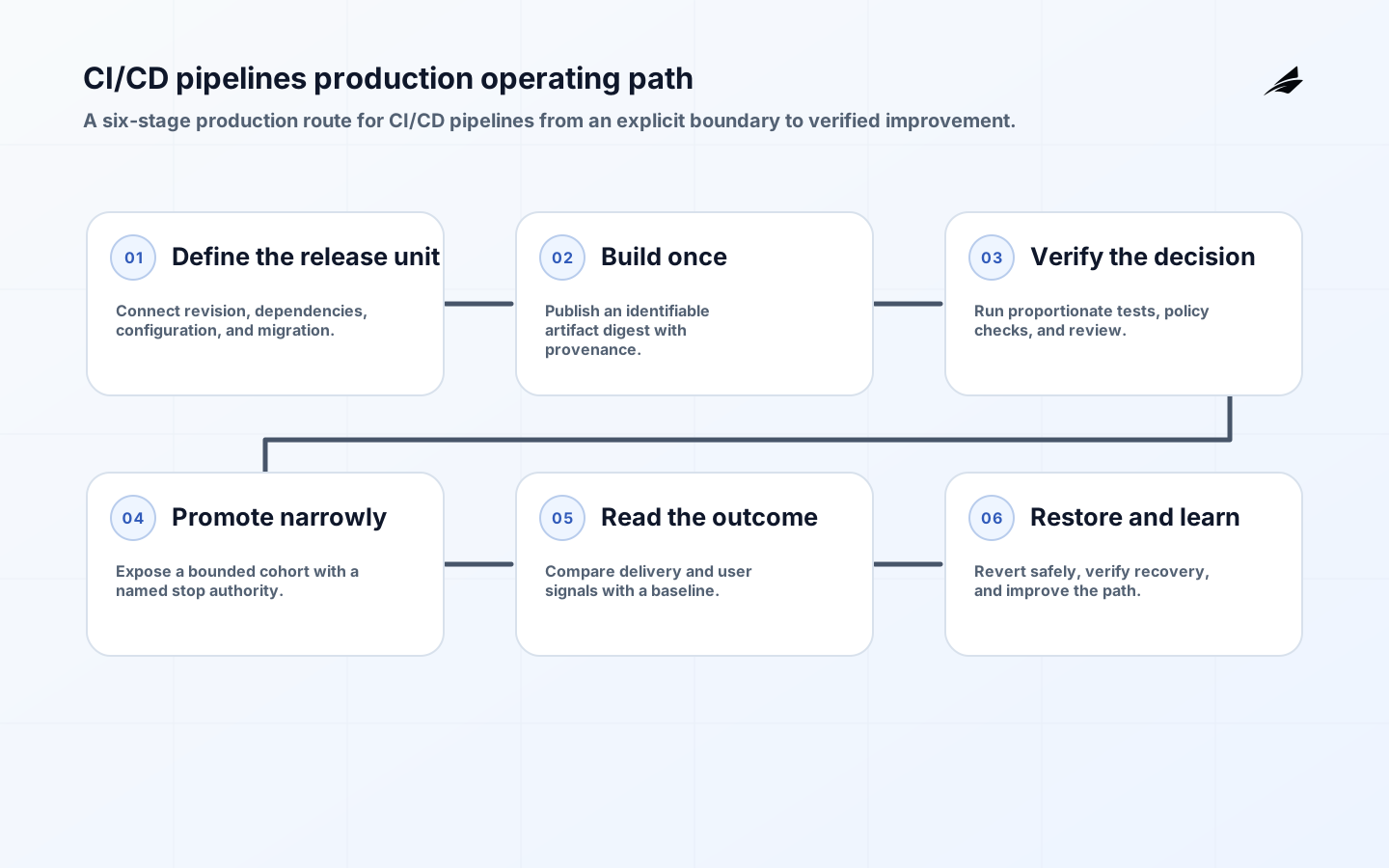
CI/CD pipelines become production infrastructure when a reviewed change can affect customers, money, security, or an on-call engineer's night. A passing build is useful evidence, but it is not the decision itself. The production question is whether the same identifiable artifact, configuration, and migration have been evaluated sufficiently for the intended exposure. Release engineering guidance and the NIST SSDF both point toward traceable, repeatable delivery practices; in day-to-day terms, a team should be able to answer what changed, who authorized it, which checks ran, and how it will be reversed.
Key takeaways
- Treat CI/CD pipelines as an accountable production capability with an explicit owner and boundary.
- Use evidence that connects the declared change or event to the effective runtime result in the release control.
- In the release control: Match controls to consequence: protect irreversible, customer-impacting, or security-sensitive actions most strongly
- Test an unhappy path and a recovery path before expanding exposure.
- Review the operating signals after routine work, not only after a visible failure in the release control.
Define the Artifact. That Reaches Production
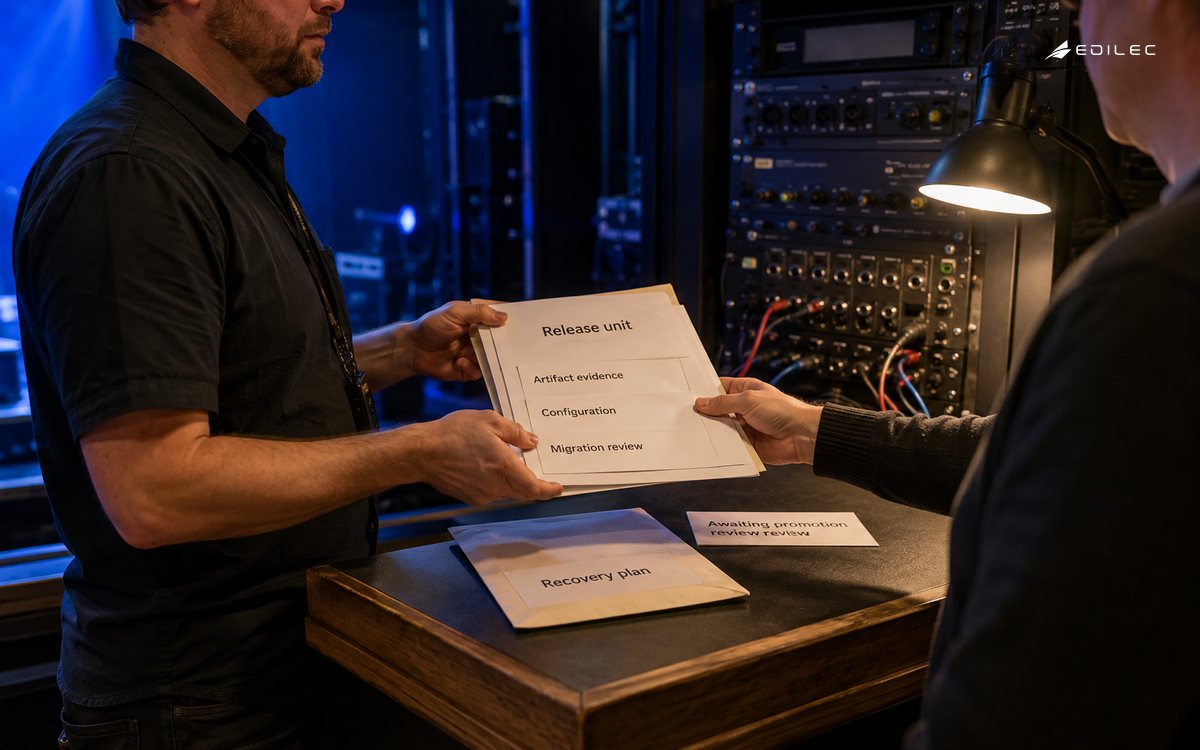
Set the release unit before choosing pipeline stages. For a service, it is normally a source revision plus locked dependencies, a built artifact digest, deployment configuration, and any schema or flag change that alters behavior. Give that unit an owner and a promotion rule. A production pipeline should not silently rebuild an image at deployment time, reuse a mutable tag as evidence, or allow a configuration change to escape the release record. This boundary makes reviews shorter because reviewers inspect a concrete change rather than a promise that a tool will do the right thing.
| Decision area | Question to settle | Evidence to retain |
|---|---|---|
| Release unit | Which artifact, configuration, and migration travel together? | Immutable digest and change record. |
| Authority | Who may promote, halt, or override? | Named role and time-stamped decision. |
| Exposure | What is the first audience? | Cohort and stop threshold. |
| Recovery | How is the prior state restored? | Tested command and verification query. |
Make Promotion Evidence Follow the Change
Build the path around immutable evidence. The build should record the source revision, build environment, dependency inputs, artifact digest, test results, and policy decisions. Promotion should move that known artifact between environments; it should not create a new one. SLSA's provenance model is helpful here because it treats traceability as a property of the build process. Access deserves the same care: the identity that publishes an artifact does not need broad production administration, and an emergency override should leave a visible, time-stamped record.
Quality gates work when they test the decision they claim to support. Unit tests find local regressions; integration and contract tests exercise boundaries; policy checks can reject known unsafe configuration; and a peer review can assess a material migration or customer consequence. Avoid turning every gate into a permanent queue. Classify changes by blast radius and reversibility, then require stronger evidence for the few changes that can create irreversible loss or widespread unavailability. A failed gate needs a readable result and a named route to resolution, not a vague red status.
| Control | Practical implementation | Signal to review |
|---|---|---|
| Artifact identity | Deploy an immutable digest. | Mismatched or missing release records. |
| Progressive exposure | Use a cohort and explicit stop rule. | Error or outcome change against baseline. |
| Rollback | Keep prior version and verification ready. | Time from stop decision to restoration. |
Start with a Cohort the Team Can Observe
Start with one service whose success can be observed within a short window. Deploy an artifact digest to a limited cohort or low-consequence environment, compare a small set of user and system signals with a baseline, and define who can halt promotion. Keep the rollback command, previous version, and verification query close to the release record. Database changes need their own compatibility plan: expand first, deploy code that tolerates both shapes, migrate data, and contract only after the old path is no longer used. This prevents a code rollback from becoming a data-recovery event.
Separate Release Health from Business Health
Measure the delivery path and the service separately. Delivery signals include lead time, failed promotions, rollback frequency, and time from a stop decision to verified restoration. Service signals should describe the user outcome, such as successful checkout, accepted document, or completed job, alongside latency and errors. An error budget or equivalent tolerance gives teams a reason to slow exposure when reliability is already degraded. Review an ordinary release as well as an incident; the routine record reveals whether the evidence chain is usable when there is no drama forcing attention.
A production failure mode for CI/CD pipelines is an artifact that passed CI but was paired with an untracked feature setting or schema assumption. That kind of gap is dangerous because a local success signal can hide an operationally incomplete result. Add the condition to acceptance criteria and state the expected response before the next change during the release control review. The record should show who owns the boundary, what evidence proves normal behavior, and how a responder distinguishes a transient delay from a condition that must be stopped in the release control. In the release control: This turns a surprising edge case into a reviewed part of the operating model rather than a lesson trapped in one engineer's memory
Use a regular operating review to review a completed release from source revision through post-deploy observation, asking whether a new engineer can locate the digest, cohort, approvals, and recovery decision. Keep the discussion close to a real example rather than an abstract maturity score in the release control. Note where the team had to infer missing state, cross a permission boundary, or leave the normal workflow to understand the result. Assign one or two concrete improvements with an owner and date, then inspect them after the next ordinary production change. In the release control: This cadence catches accumulated ambiguity early and prevents controls from becoming documentation that no longer describes the live system
A practical drill should simulate a green health check with a degrading business outcome, halt promotion, return to the compatible revision, and verify the customer result. Include the people and systems that would be involved outside the primary tool: on-call ownership, access approvals, deployment or recovery records, customer communication, and the final verification query. Measure the time needed to reach a safe decision, but also document why it took that long during the release control review. In the release control: The most valuable outcome is a revised procedure that a different responder can follow with the same evidence, especially when the original author is unavailable
Keep the CI/CD pipelines review bounded but complete. Map configuration, migrations, dependencies, and release evidence to the people who can change, inspect, and recover each element. A responsibility map should identify routine ownership as well as escalation authority, because production work crosses team boundaries at the moment a normal control fails. Document dependencies that are outside the immediate service or tool, including identity providers, registries, queues, cloud accounts, and vendors. In the release control: This context lets reviewers judge blast radius before a change and gives responders a starting point when the visible symptom appears somewhere else
Make verification concrete by retaining a routine deployment with a known baseline and a narrowly bounded cohort. Compare it with an agreed baseline and record the decision to continue, pause, recover, or investigate. Verification should happen after the system has had enough time to exhibit the behavior that matters, not only at the instant an API accepts a change. When the evidence is incomplete, say so and keep exposure constrained during the release control review. In the release control: This is how teams preserve learning speed without confusing automation activity with a trustworthy production outcome
Before expanding a pipeline, confirm that the tested artifact, deployed artifact, configuration reference, and release owner all appear in one inspectable record. That compact check catches evidence gaps that dashboards alone tend to hide.
Make the release record useful to the person who did not author the change. It should link the source revision to the artifact digest, identify the configuration and migration versions, show the first cohort, and state the business signal that can stop promotion. If a migration cannot be reversed, record the compatibility window and the forward-repair plan instead of promising a rollback that cannot restore data. This distinction is especially important for small teams: a responder may inherit the deployment during an incident and need to choose between pausing traffic, disabling a feature, or completing a forward fix. The correct choice depends on evidence captured before the release, not on how quickly the pipeline reports success.
Frequently asked questions
How much approval should a pipeline require? Require human judgment where the consequence is high, the evidence is ambiguous, or reversal is difficult; automate deterministic checks that have proven useful. Is a manual production command always bad? No. A protected, audited command can be an appropriate first control, provided it deploys the tested artifact and has an explicit owner. What is the most important rollback rule? Decide before release which signals stop expansion, who may make that call, and how the team proves that the prior version is healthy. Can a feature flag replace a rollback? A flag can reduce exposure, but it does not repair a bad migration, dependency, or infrastructure change.
Conclusion
A dependable production pipeline makes change easier to explain and safer to reverse. Begin with an immutable release unit, retain the evidence used to promote it, and expose it gradually enough that people can interpret the result. Improve the next release from failed promotions and near misses rather than adding ceremonial steps. For adjacent practices, see deployment rollback architecture, canary releases, and the CI/CD practical guide.
For CI/CD pipelines in production, the durable implementation is a release record that joins artifact identity, exposure, service evidence, and recovery authority. Start with the smallest cohort that can reveal user impact, preserve the compatibility window for migrations, and use the next ordinary release to test whether the evidence chain remains usable. A pipeline earns trust when another responder can identify what ran, why it was promoted, which signal would stop it, and how recovery was verified.
A production decision about CI/CD pipelines should be tested against a concrete operating scenario, not only a design diagram. Use the production scenario to name the input, the responsible owner, the expected signal, and the point at which the team stops or reverses the change in the release control. Evidence should include both the normal path and the first credible exception: late data, an unavailable dependency, an unexpected permission, a changed schema, a noisy alert, or a customer-visible delay in the release control. Record the observed condition and the decision made so a later reviewer can tell whether the control worked or merely appeared to work in the release control. This record is specific to this article, so its acceptance evidence should remain tied to the article's named workflow rather than a generic checklist in the release control.
Authoritative context for release control: Google SRE Book: Release Engineering; NIST Secure Software Development Framework; SLSA specification; Google SRE Book: Canarying Releases. These references anchor the article-specific guidance in current technical and operating practice, while the local owner remains responsible for applying the evidence to the release control decision.