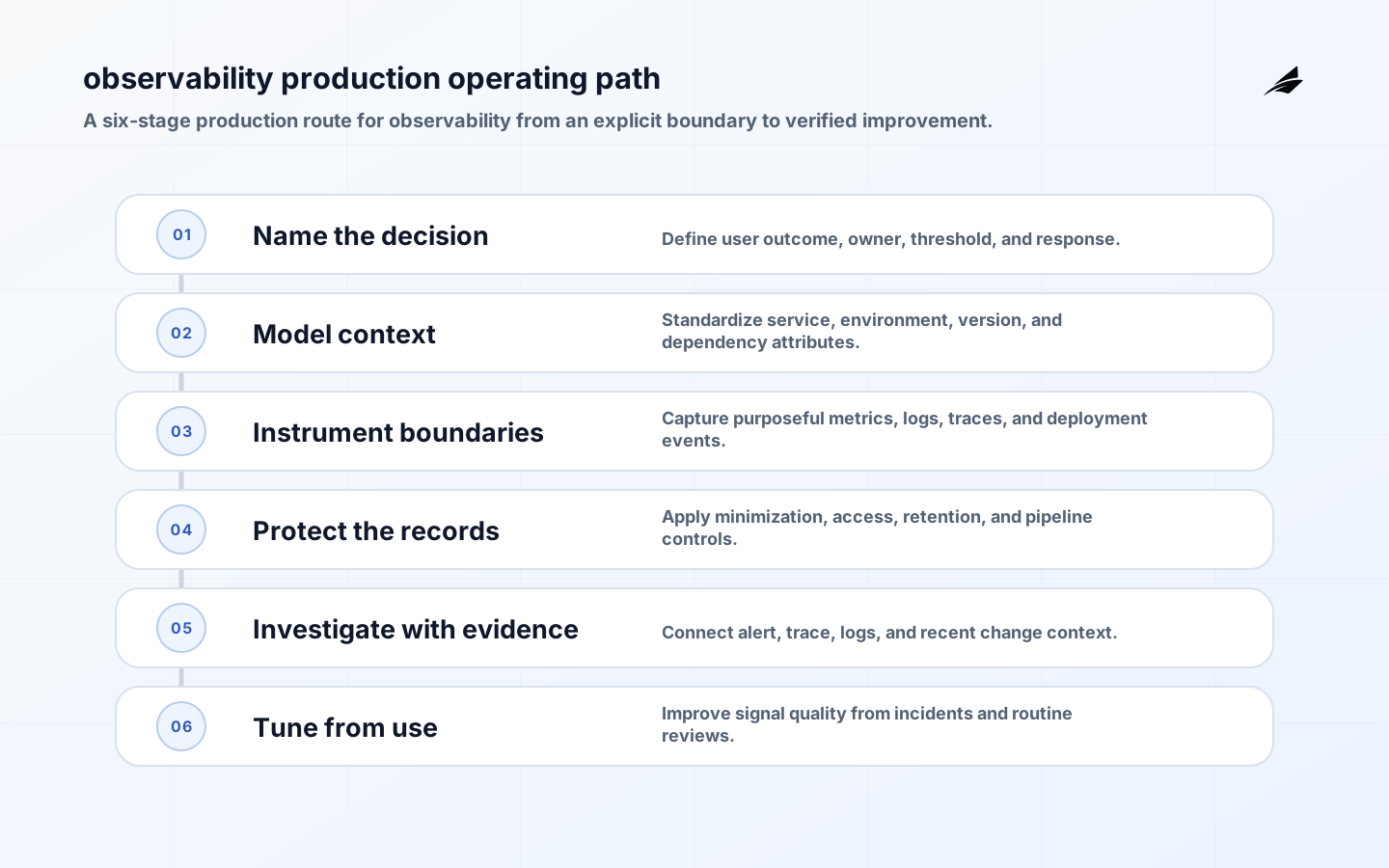
Observability is production-ready when a person can move from a user-impact signal to enough context to make a safe next decision. It is not the number of dashboards, logs, or agents installed. OpenTelemetry provides a common model for signals and resource context, while Google SRE guidance emphasizes monitoring that supports service health and diagnosis. Together they suggest a practical standard: collect telemetry because it answers an operating question, and retain it with the identity, ownership, and privacy rules needed to use it responsibly.
Observability takeaways for the on-call team
- Treat observability as an accountable production capability with an explicit owner and boundary.
- Use evidence that connects the declared change or event to the effective runtime result; signal review context remains explicit.
- Match controls to consequence: protect irreversible, customer-impacting, or security-sensitive actions most strongly; signal review context remains explicit.
- Test an unhappy path and a recovery path before expanding exposure.
- Review the operating signals after routine work, not only after a visible failure; signal review context remains explicit.
Define the user signal before instrumenting
Begin with the service outcome and the decision it should support. For example, an order service may need to know whether customers can submit an order, whether acceptance is slow, and whether a recent dependency change is responsible. Define the service-level indicator, population, exclusions, latency, owner, and threshold before creating an alert. Then identify the minimum supporting signals: request rate, errors, saturation, selected structured events, traces, and deployment context. A metric with no decision owner becomes background noise, even when it is technically accurate.
| Decision area | Question to settle | Evidence to retain |
|---|---|---|
| Outcome | What user effect matters? | Indicator, population, owner, and threshold. |
| Context | How will signals be joined? | Service, version, environment, and correlation. |
| Protection | What data can be stored or read? | Classification, retention, and access policy. |
| Action | What should an alert cause? | Runbook, urgency, and escalation owner. |
Join telemetry to the investigation context
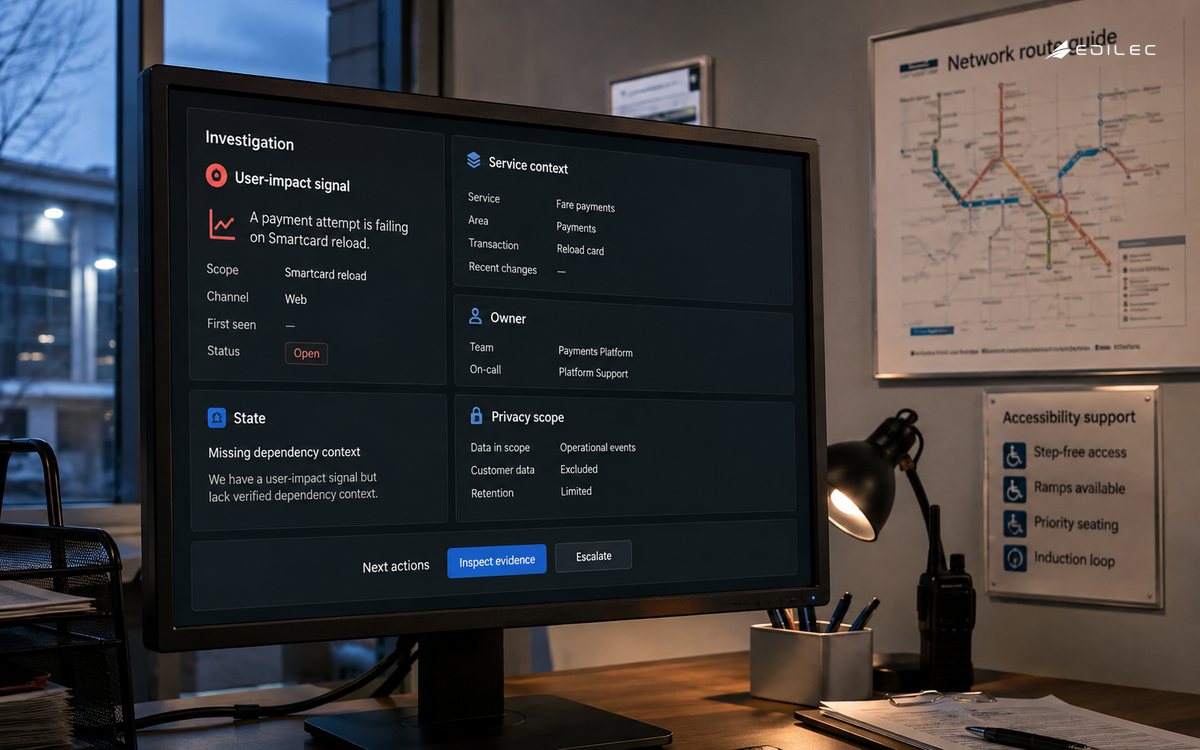
Use consistent resource attributes and correlation context so telemetry from a request can be located by service, environment, version, and dependency. Instrument boundaries first: ingress, asynchronous queues, storage calls, and external providers often explain more than an internal function counter. Logs should be structured enough to filter but should not become a copy of every payload. Metrics need stable names and controlled labels; unbounded identifiers such as user IDs, order IDs, or raw URLs create cardinality and cost problems. Sampling and retention policies should match the investigation value and sensitivity of each signal.
Make telemetry a controlled data product. Classify potentially sensitive fields, minimize collection, restrict reader access, encrypt transit and storage where applicable, and define retention and deletion behavior. Give dashboards and alerts owners who review changes and retire obsolete rules. Alert on conditions that require timely human action, with a clear runbook link and escalation route; use dashboards for exploration and trends. A page that cannot be acted on erodes trust, while a silent failure in the telemetry pipeline can create dangerous confidence during an outage.
| Control | Practical implementation | Signal to review |
|---|---|---|
| Signal design | Link indicators to a decision. | Unowned dashboards and noisy alerts. |
| Data minimization | Bound labels and redact sensitive fields. | Cardinality growth and privacy findings. |
| Pipeline health | Monitor collectors and exports. | Dropped telemetry and ingest delay. |
Exercise one request path under pressure
Instrument one critical request path end to end and use it during a planned change. Verify that the user outcome, service version, logs, metrics, and trace context agree about what happened. Deliberately trigger a bounded failure such as a dependency timeout or an invalid request, then ask a responder who did not build the dashboard to locate the cause and choose an action. This is a stronger test than admiring a graph. Add signals only when they close an investigation gap or protect a stated operational objective.
Tune the signal path from real incidents
Measure observability by its effect on decisions: time to detect meaningful user impact, time to identify a plausible cause, alert precision, investigation handoffs, and the percentage of important services with owned objectives and runbooks. Track telemetry pipeline health too, including dropped data, ingestion delay, schema changes, cardinality growth, query cost, and access anomalies. Compare alerts with actual incidents and remove rules that repeatedly wake people without changing their response. The goal is a reliable signal path, not maximal data collection.
A production failure mode for observability is an apparently healthy process metric that hides a failed user path, or a dashboard that lacks the version context needed to identify a recent change. That kind of gap is dangerous because a local success signal can hide an operationally incomplete result; signal review context remains explicit. Add the condition to acceptance criteria and state the expected response before the next change; signal review context remains explicit. The record should show who owns the boundary, what evidence proves normal behavior, and how a responder distinguishes a transient delay from a condition that must be stopped; signal review context remains explicit. This turns a surprising edge case into a reviewed part of the operating model rather than a lesson trapped in one engineer's memory; signal review context remains explicit.
Use a regular operating review to check each material page for user impact, urgency, ownership, runbook quality, freshness, access, and the evidence needed for first diagnosis. Keep the discussion close to a real example rather than an abstract maturity score; signal review context remains explicit. Note where the team had to infer missing state, cross a permission boundary, or leave the normal workflow to understand the result; signal review context remains explicit. Assign one or two concrete improvements with an owner and date, then inspect them after the next ordinary production change; signal review context remains explicit. This cadence catches accumulated ambiguity early and prevents controls from becoming documentation that no longer describes the live system; signal review context remains explicit.
A practical drill should investigate a bounded degradation starting from a customer report or alert and identify the affected population, change context, dependency, and mitigation. Include the people and systems that would be involved outside the primary tool: on-call ownership, access approvals, deployment or recovery records, customer communication, and the final verification query; signal review context remains explicit. Measure the time needed to reach a safe decision, but also document why it took that long; signal review context remains explicit. The most valuable outcome is a revised procedure that a different responder can follow with the same evidence, especially when the original author is unavailable; signal review context remains explicit.
Keep the observability review bounded but complete. Map indicators, telemetry context, alert routes, retention, access, and pipeline health to the people who can change, inspect, and recover each element. A responsibility map should identify routine ownership as well as escalation authority, because production work crosses team boundaries at the moment a normal control fails; signal review context remains explicit. Document dependencies that are outside the immediate service or tool, including identity providers, registries, queues, cloud accounts, and vendors; signal review context remains explicit. This context lets reviewers judge blast radius before a change and gives responders a starting point when the visible symptom appears somewhere else; signal review context remains explicit.
Make verification concrete by retaining the user-impact signal, supporting context, and responder action. Compare it with an agreed baseline and record the decision to continue, pause, recover, or investigate; signal review context remains explicit. Verification should happen after the system has had enough time to exhibit the behavior that matters, not only at the instant an API accepts a change; signal review context remains explicit. When the evidence is incomplete, say so and keep exposure constrained. This is how teams preserve learning speed without confusing automation activity with a trustworthy production outcome; signal review context remains explicit.
Before paging on a new signal, verify the affected user outcome, owner, urgency, supporting evidence, and runbook action. A page should shorten a decision, not create another investigation into whether the alert matters.
Use this article's decision boundary as an operating contract. Name the user or operator, trusted inputs, the owner who can act, the response window, and the safe state when evidence is late or wrong; signal review context remains explicit. Before widening scope, capture a baseline and test one normal path plus one credible exception; signal review context remains explicit. Record the version, approval, observed signal, and recovery result in the same review record; signal review context remains explicit. This makes a failure interpretable: the team can tell whether the rule, data, permission, or handoff caused the outcome; signal review context remains explicit. Keep controls close to the consequence, explanations close to the next decision, and the pilot small enough to reverse; signal review context remains explicit. At review, remove checks that create work without changing behaviour and add only the smallest next hypothesis; signal review context remains explicit. The result is a capability that can survive turnover, explain exceptions, and improve from production evidence rather than confidence alone; signal review context remains explicit. For observability, define whether each signal pages, enters a work queue, or stays available for investigation. Use OpenTelemetry, the Google SRE monitoring workbook, Prometheus instrumentation guidance, and Google SRE alerting guidance to connect telemetry to action.
FAQ: observability questions operators ask
Are logs, metrics, and traces interchangeable? They overlap but answer different questions: metrics summarize behavior, logs preserve discrete context, and traces connect work across boundaries. Should every service have an SLO? Start with services whose user outcome and owner are clear; forcing a vague objective is less useful than improving the boundary. How much telemetry should be sampled? Keep enough representative and error-focused evidence for investigations, then tune based on volume, cost, and privacy risk. Who owns observability? Service owners own the meaning and response; platform teams can provide shared collection and access capabilities.
Conclusion: observability should shorten the next decision
Useful observability is a chain from an operating question to trustworthy evidence and a decision. Define that chain before collecting more data, protect the telemetry as carefully as other operational records, and test it with real responders. This creates calmer, faster diagnosis when a production change misbehaves. Further reading: SLO planning, log aggregation operations, and the observability practical guide.
For What Changes When Observability Moves into Production, the durable implementation is a sequence of bounded decisions. State the operating context, identify the evidence that can change the decision, name the owner who can act, and record the condition that triggers review; signal review context remains explicit. This keeps the guidance useful after launch: a team can compare intended outcomes with observed behavior, explain exceptions without normalizing them, and choose the next smallest corrective action; signal review context remains explicit. For What Changes When Observability Moves into Production, the useful record preserves the evidence that lets the owner choose the next safe action.
A useful operating decision for What Changes When Observability Moves into Production begins with a specific boundary. Name the service, workflow, data set, or team in scope; then state which outcome matters and which trade-off is acceptable; signal review context remains explicit. For observability, that means separating the design choice from the controls that make it safe to operate. A small pilot should expose the assumptions most likely to fail: ownership, dependency order, permissions, capacity, timing, or evidence quality; signal review context remains explicit. Record those assumptions before implementation and revisit them after real traffic or real decisions arrive; signal review context remains explicit. When the result differs from the plan, classify the gap rather than hiding it; signal review context remains explicit. Is the issue a missing control, an incorrect model, an unmeasured dependency, or a changed requirement; signal review context remains explicit. Each answer leads to a different next action. Keep the corrective action narrow enough to test, give it an owner and review date, and preserve the evidence in the team’s normal working record; signal review context remains explicit. This approach keeps the practice useful as systems evolve because it connects day-to-day execution with a repeatable decision loop; signal review context remains explicit.