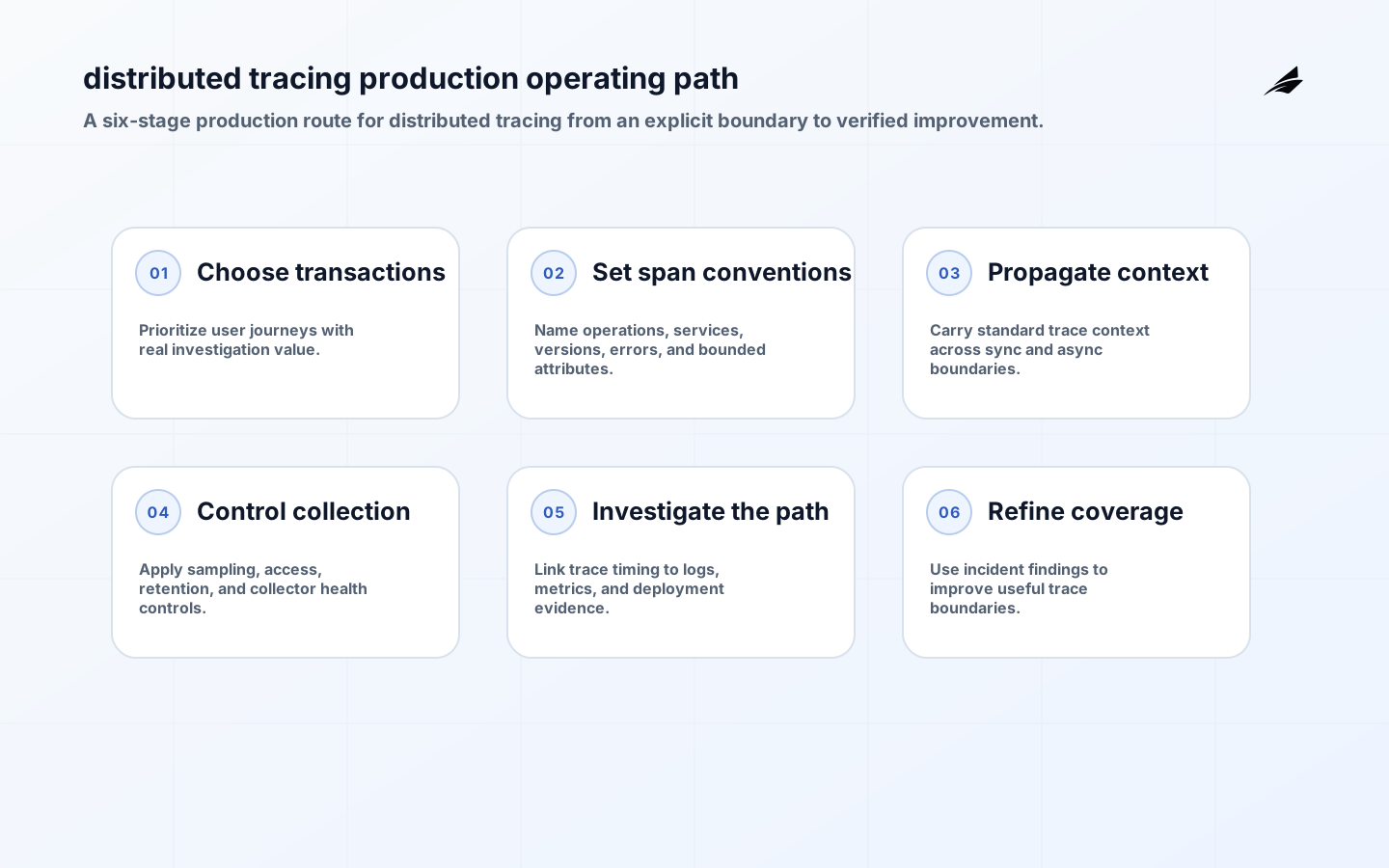
Distributed tracing becomes useful in production when it explains a real user journey across process, network, and security boundaries without creating a new privacy or cost problem (for the selected transaction). OpenTelemetry’s specification overview defines the telemetry model, while W3C Trace Context specifies a common way to propagate context between services (inside the production trace path). OpenTelemetry semantic conventions help teams give operations and attributes stable meaning. The production challenge is governance: teams must decide which operations deserve traces, what the spans mean, how context crosses asynchronous boundaries, and how long sensitive operational evidence should be available (against the retained trace baseline). The Google SRE monitoring workbook is a useful reminder to connect signals to an operational decision rather than treating collection as the outcome (by span and service).
Key takeaways for distributed tracing
- Treat distributed tracing as an accountable production capability with an explicit owner and boundary (across the trace boundary).
- Use evidence that connects the declared change or event to the effective runtime result (against the retained trace baseline).
- Match controls to consequence: protect irreversible, customer-impacting, or security-sensitive actions most strongly (at collection and access).
- Test an unhappy path and a recovery path before expanding exposure.
- Review the operating signals after routine work, not only after a visible failure (by span and service).
Decide which traces deserve production retention
Choose a small number of high-value transactions first: checkout, document submission, account creation, batch completion, or another outcome that crosses services (inside the production trace path). Define the root operation and the span boundaries at ingress, durable queues, databases, external calls, and major internal work (inside the production trace path). A trace should represent causal work, not every line of code. Establish conventions for operation names, error status, service identity, deployment version, and key attributes (inside the production trace path). If two teams name the same dependency differently, the trace will be harder to compare exactly when an incident spans their boundary (across the trace boundary).
| Decision area | Question to settle | Evidence to retain |
|---|---|---|
| Journey | Which transaction deserves a trace? | Root operation and business outcome. |
| Context | How does identity cross boundaries? | Trace-context propagation result. |
| Data | Which attributes are permitted? | Bounded semantic fields and redaction rule. |
| Coverage | What does a missing trace mean? | Sampling policy and collector health. |
Give trace context a clear owner

Propagate standard trace context through HTTP, messaging, jobs, and asynchronous callbacks where feasible (inside the production trace path). When a message is delayed or fanned out, preserve enough linkage to investigate the originating request while recognizing that one parent-child chain may not describe every business relationship (inside the production trace path). Use semantic conventions for common technologies and add domain attributes only when they are bounded, documented, and safe (inside the production trace path). Never put raw passwords, payment values, session tokens, or full customer payloads into span attributes (inside the production trace path). Trace data is operational data, not an excuse to duplicate application records (inside the production trace path).
Sampling is an engineering and governance decision. Head sampling controls volume early; tail or error-focused sampling can retain unusual or slow traces when the backend supports it (at collection and access). Whichever approach is chosen, document what a missing trace means so responders do not mistake absence for health (inside the production trace path). Restrict trace search access, set retention by use case, and monitor collector loss, queue pressure, and export failures (inside the production trace path). Instrumentation changes should be code-reviewed because a new attribute can leak data or multiply storage cost across every request (before instrumentation expands).
| Control | Practical implementation | Signal to review |
|---|---|---|
| Convention | Use stable service and operation names. | Broken service maps and ambiguous spans. |
| Sampling | Retain errors and representative paths. | Missing error traces and rising cost. |
| Privacy | Restrict attributes and reader access. | Sensitive attribute findings and access anomalies. |
Instrument one journey before expanding coverage
Start with one service boundary and one downstream dependency, then make a deliberate request and verify that the trace connects the expected spans, version information, and outcome (across the trace boundary). Test an error, a timeout, an asynchronous handoff, and a request that should not be sampled (inside the production trace path). Ask an on-call engineer to locate the trace from a customer-safe correlation reference and identify the next diagnostic step (inside the production trace path). Expand propagation only after the first path has stable names and operators have found it useful; universal instrumentation without conventions produces an expensive maze (inside the production trace path).
Read missing spans as evidence, not noise
Track trace coverage for the selected transactions, propagation success across critical boundaries, ingest delay, dropped spans, query latency, sampled error traces, and attribute-cardinality growth (inside the production trace path). More importantly, assess whether traces shorten investigation or validate a hypothesis that metrics alone could not answer (inside the production trace path). Link traces to logs and service metrics through shared context rather than forcing every trace to carry every detail (inside the production trace path). Review retention, access, and cost when traffic or instrumentation changes; a tracing design that worked for a pilot may not remain safe or affordable at full volume (before instrumentation expands).
A production failure mode for distributed tracing is a dropped propagation header, broken asynchronous link, or unbounded customer attribute that leaks data and drives trace cost (inside the production trace path). That kind of gap is dangerous because a local success signal can hide an operationally incomplete result (by span and service). Add the condition to acceptance criteria and state the expected response before the next change (before instrumentation expands). The record should show who owns the boundary, what evidence proves normal behavior, and how a responder distinguishes a transient delay from a condition that must be stopped (across the trace boundary). This turns a surprising edge case into a reviewed part of the operating model rather than a lesson trapped in one engineer's memory (inside the production trace path).
Use a regular operating review to inspect representative traces for stable root names, service identity, error status, sensitive attributes, sampling limits, and agreement with metrics (inside the production trace path). Keep the discussion close to a real example rather than an abstract maturity score (inside the production trace path). Note where the team had to infer missing state, cross a permission boundary, or leave the normal workflow to understand the result (across the trace boundary). Assign one or two concrete improvements with an owner and date, then inspect them after the next ordinary production change (for the tracing owner). This cadence catches accumulated ambiguity early and prevents controls from becoming documentation that no longer describes the live system (at collection and access).
A practical drill should exercise propagation through synchronous, queued, and external boundaries while confirming that collector failure reduces diagnosis but not service safety (inside the production trace path). Include the people and systems that would be involved outside the primary tool: on-call ownership, access approvals, deployment or recovery records, customer communication, and the final verification query (for the tracing owner). Measure the time needed to reach a safe decision, but also document why it took that long (inside the production trace path). The most valuable outcome is a revised procedure that a different responder can follow with the same evidence, especially when the original author is unavailable (against the retained trace baseline).
Keep the distributed tracing review bounded but complete. Map propagation, span naming, sampling, sensitive attributes, collector delivery, and retention to the people who can change, inspect, and recover each element (before instrumentation expands). A responsibility map should identify routine ownership as well as escalation authority, because production work crosses team boundaries at the moment a normal control fails (for the tracing owner). Document dependencies that are outside the immediate service or tool, including identity providers, registries, queues, cloud accounts, and vendors (inside the production trace path). This context lets reviewers judge blast radius before a change and gives responders a starting point when the visible symptom appears somewhere else (before instrumentation expands).
Make verification concrete by retaining a technical correlation reference, trace coverage, and an investigation result (inside the production trace path). Compare it with an agreed baseline and record the decision to continue, pause, recover, or investigate (inside the production trace path). Verification should happen after the system has had enough time to exhibit the behavior that matters, not only at the instant an API accepts a change (before instrumentation expands). When the evidence is incomplete, say so and keep exposure constrained. This is how teams preserve learning speed without confusing automation activity with a trustworthy production outcome (inside the production trace path).
Before expanding trace collection, verify context propagation, safe attributes, sampling interpretation, collector health, and investigation access for a representative journey (for the selected transaction). The trace should explain work without becoming a second customer database.
Frequently asked questions: distributed tracing in production
Do traces replace logs? No. Traces show causal timing and boundaries; logs preserve selected event detail, and metrics show aggregate health (inside the production trace path). Should every request be traced? Usually not. Choose transactions and sampling rules based on investigation value and cost. What is the safest correlation value? Use a generated technical identifier that does not expose customer data, and protect the system that maps it to business records (inside the production trace path). Why are traces broken? Common causes include missing propagators, unsupported async handoffs, inconsistent service identifiers, or an intermediary that drops headers (inside the production trace path).
Conclusion
Production tracing is a disciplined way to follow important work, not a maximal record of every request (inside the production trace path). Use shared context standards, meaningful span boundaries, and explicit retention rules so a trace can help a responder without exposing unnecessary information (inside the production trace path). That makes cross-service behavior easier to explain as systems evolve. See observability engineering notes, service meshes, and the distributed tracing practical guide (inside the production trace path).
A production tracing practice should be judged by the questions it helps a responder answer, not by the number of spans it stores (inside the production trace path). Define the journeys that matter, name the context that must cross each boundary, and decide which attributes are safe to retain before instrumentation spreads (across the trace boundary). Keep sampling and retention tied to consequence: a high-value payment or authentication path may need stronger evidence than a low-risk background task, while sensitive attributes may need removal even when a trace is useful (against the retained trace baseline). When a trace is incomplete, the operating response should say what remains unknown and which other signal can narrow the uncertainty (by span and service). Revisit the design after schema changes, asynchronous work, new privacy requirements, or a shift in service ownership (for the tracing owner). This turns tracing into a maintained diagnostic capability. It also gives leaders a defensible way to discuss cost: spend more where evidence changes a decision, and reduce collection where it only creates noise (against the retained trace baseline).
Distributed tracing is most useful when a team can move from a user-visible symptom to a bounded set of spans, owners, and decisions (for the tracing owner). Define propagation across queues and service boundaries, sampling rules, sensitive-field handling, retention, and the point where a trace becomes an incident artifact (inside the production trace path). Exercise one normal request and one partial failure, then compare the trace with logs and metrics (inside the production trace path). The resulting evidence should shorten diagnosis without creating a second uncontrolled data store (against the retained trace baseline).