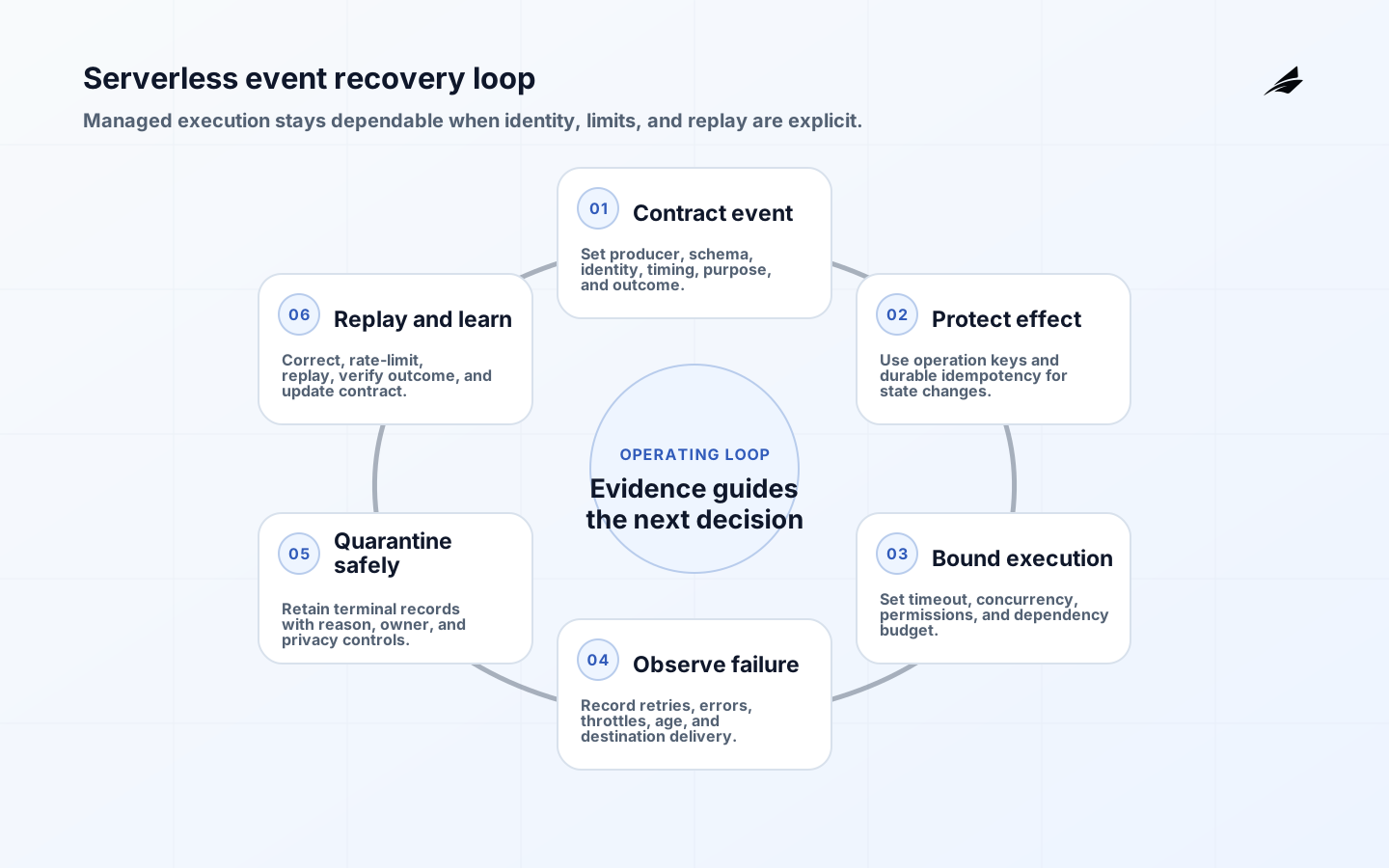
Serverless architecture changes character in production because an event can be duplicated, delayed, retried, or delivered while a downstream system is unavailable. The convenience of managed execution does not remove design choices around data ownership, permissions, concurrency, and recovery. AWS Lambda guidance, for example, explicitly addresses idempotent code, retry behavior for asynchronous invocations, and concurrency controls. A mature design treats the function as one participant in an event-driven business process, not as an isolated piece of code that happens to run on demand.
Key takeaways for serverless architecture
- Treat serverless architecture as an accountable production capability with an explicit owner and boundary.
- Test an unhappy path and a recovery path before expanding exposure.
Set the production boundary for serverless architecture
Start with the event contract. Name the producer, consumer, schema version, ordering expectation, identity context, ownership, and terminal business outcome. Decide which field serves as an idempotency key and how long a completed result must be remembered. This is more reliable than hoping an at-least-once delivery path behaves exactly once. Separate commands that change state from notifications that report it, and make the authoritative record clear. When the event crosses a security boundary, validate authorization and payload shape at the receiving side instead of trusting upstream naming conventions.
| Decision area | Question to settle | Evidence to retain |
|---|---|---|
| Event | What work and authorization does it represent? | Versioned schema and owner. |
| Repeat | How are duplicate effects prevented? | Idempotency key and stored result. |
| Capacity | What can execution overwhelm? | Concurrency limit and dependency budget. |
| Failure | Where does terminal work go? | Failure destination and replay procedure. |
Map the Event Contract to Its Operators
Bound execution intentionally. Set timeouts and memory based on observed work, and use reserved or provisioned concurrency only where it protects a real dependency or latency requirement. Concurrency is a capacity decision: uncontrolled parallel executions can overwhelm a database, partner API, or cost budget even when each invocation is individually correct. Reuse clients where the runtime permits, keep deployed dependencies focused, and put secrets in managed configuration rather than package files. The handler should emit a durable outcome or a useful failure record before it returns.
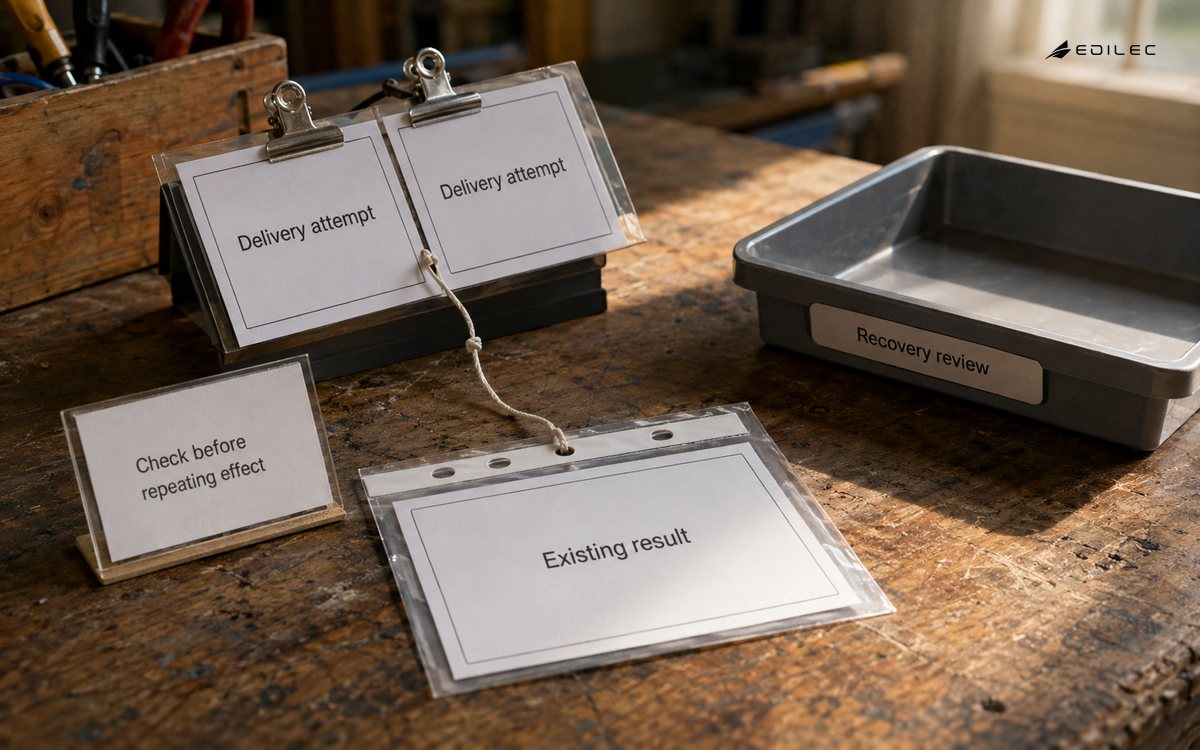
Design retries with a destination, not just an interval. For asynchronous work, distinguish transient faults from malformed inputs and business exceptions. A retryable failure should be safe to repeat; a terminal failure should go to a dead-letter or failure destination with the original event, correlation information, and an owned reprocessing procedure. Avoid logging sensitive payloads merely to make failures easy to inspect. Least-privilege execution roles, scoped event permissions, and audit records reduce the blast radius of a compromised or incorrectly configured function.
| Control | Practical implementation | Signal to review |
|---|---|---|
| Idempotency | Persist completed effect evidence. | Duplicate business actions. |
| Bounded execution | Set timeout and concurrency intentionally. | Throttles, duration, and downstream saturation. |
| Terminal routing | Use an owned failure destination. | Dead-letter age and replay results. |
Release One Event Path with Recovery Evidence
Release one event path with a measurable result before building a broad function estate. Use versioned aliases or an equivalent deployment boundary, route a small share of calls when the platform supports it, and compare completion, retry, and downstream error rates. Test delayed messages, duplicate messages, timeouts, and an unavailable dependency. A synthetic happy-path invocation is useful, but production confidence comes from proving that the process reconciles when the ordinary assumptions are false. Keep a manual procedure for pausing a trigger without losing the evidence needed to resume safely.
Read Retries, Throttles, and Business Completion Together
Measure the outcome of the event, not only invocations. Track accepted, completed, retried, dead-lettered, and reconciled work; include queue age or event age where delay matters. Pair those with duration, throttles, concurrency, error types, and downstream dependency signals. Correlation IDs should connect an incoming event to database updates, messages, and customer-facing results without exposing private data. Cost review belongs here too: high fan-out, retries, and excessive logging can be symptoms of an incorrect contract rather than merely a billing problem.
A production failure mode for serverless architecture is a duplicate, delayed, or retried event that changes state after the original business context has moved on. A duplicate or delayed event can make a success counter misleading; acceptance criteria should state the evidence that distinguishes a completed effect from a retriable failure.
Use a regular operating review to follow a representative event through schema validation, authorization, idempotency storage, retries, failure routing, and trace context.
A practical drill should replay sanitized terminal failures while checking duplicate protection, operator auditability, pause controls, and dependency capacity.
Keep the serverless architecture review bounded but complete. Map event schema, idempotency records, concurrency, retries, and failure destinations to the people who can change, inspect, and recover each element.
Make verification concrete by retaining accepted work, completed work, delayed work, and safely reconciled work. When the evidence is incomplete, say so and keep exposure constrained.
Before enabling higher event volume, verify duplicate handling, failure routing, dependency limits, and reconciliation ownership with a representative payload. This is the smallest useful proof that the event contract survives ordinary production disorder.
Keep a visible reconciliation queue with age, owner, failure reason, and replay status. It gives operations a way to distinguish delayed work from lost work and ensures that a retry policy has an accountable human boundary.
Exercise Duplicate Effects at the Dependency Edge
The most revealing serverless test is not whether a function can be invoked twice; it is whether the downstream effect remains correct when the second invocation arrives after the first one timed out. Pick one business action such as issuing a refund, reserving inventory, or sending a customer notice. Give the event a stable operation key, persist the completion result, and make the handler return the recorded outcome when the key is seen again. AWS’s Lambda guidance emphasizes idempotency for duplicate processing, but the idempotency record must live across runtime instances and have a retention period that matches the event’s replay risk.
Then vary the dependency edge: make the payment provider accept the request while the function loses its response, throttle the database, and deliver a malformed event beside a valid one. The runbook should say which failures are retried, which are quarantined, and how an operator verifies the business result before replaying anything. Keep the failure record redacted, include correlation and attempt data, and record whether the corrective action was a retry, a manual reversal, or a consumer notification. This separates reliable event processing from a platform-level success signal.
A useful acceptance decision has three independent answers: can the system prevent a duplicate effect, can a responder find a terminal record without exposing unnecessary data, and can the team prove the intended customer outcome after recovery? If any answer is no, reduce concurrency or event scope and improve the contract before increasing volume.
AWS Lambda guidance on best practices, asynchronous invocations, concurrency controls, and retained invocation records supports the production controls described here: idempotency, bounded pressure, terminal failure context, and replay evidence.
Serverless ownership becomes clearer when each event path has a small ledger. Record the producer, event version, operation key, downstream effect, retry budget, failure destination, and person who can pause or replay the path. The ledger should distinguish a transient dependency timeout from a rejected business action, because those cases need different retry and communication choices. Keep the correlation identifier with the terminal record so a responder can connect a dead-letter item to the original request without searching multiple systems.
For a production review, sample one event that completed, one that retried, and one that reached quarantine. Compare invocation time, dependency pressure, duplicate-protection state, and customer completion. This makes scaling a question about useful work and recoverability rather than raw invocation volume. It also gives the team a concrete rehearsal artifact: a responder can explain which record is safe to replay, which effect already happened, and which permission or limit must change before exposure widens.
Frequently asked questions about serverless architecture
Is serverless automatically scalable enough? The platform may scale execution, but downstream systems and budgets remain finite. Do retries make a handler reliable? Only if the handler is idempotent and failures have a deliberate terminal path. When should a function keep state? Keep durable business state in an owned data store; runtime memory is an optimization, not a correctness guarantee. Can a dead-letter queue be ignored until an incident? No. It needs an owner, retention rule, visibility, and a tested way to inspect or replay records without creating duplicate effects.
Conclusion: make serverless architecture dependable in production
A production serverless system earns its simplicity through explicit contracts and recovery behavior. Define the event and idempotency boundary, constrain what an execution can do, and make delayed or terminal work visible to a responsible person. That lets managed scaling help instead of hiding process failures. Related material: serverless architecture mistakes and fixes, distributed tracing, and incident response planning.
The design review should leave a small operational packet: the event schema, idempotency key, concurrency limit, timeout rationale, permission set, failure destination, replay command, and owner for each alarm. Keep one redacted failed record and one successful record in the test fixture so a new responder can understand the difference. If a dependency changes its rate limit or response shape, update the contract and rerun duplicate and timeout cases before widening traffic. This is the bridge between serverless architecture and incident response: the team knows which state is durable, which work is safe to repeat, and which action needs a human decision.
A serverless production review is complete when the event contract, idempotency boundary, concurrency budget, failure destination, replay procedure, and accountable owner are all visible in one operational packet. Re-run the duplicate and timeout cases after material dependency changes; managed execution is only as dependable as the recovery evidence around it.