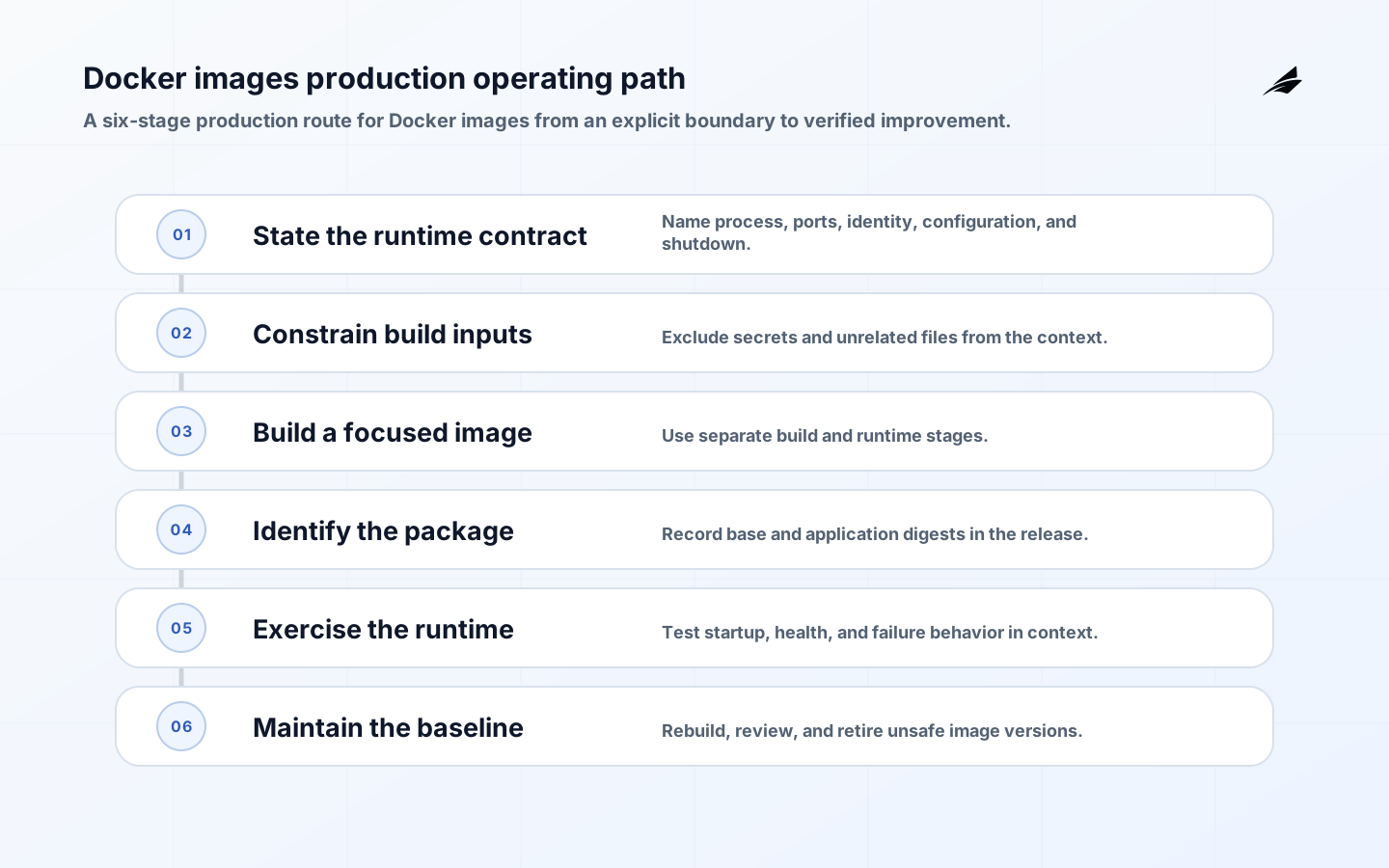
Docker images move from developer convenience to production risk when they become the packaged runtime for a customer-facing workload. The important question is not whether a container starts on a laptop; it is whether the image has a clear runtime contract, known provenance, and enough operational context for another person to diagnose it. Docker build best practices emphasizes focused images, multi-stage builds, and controlled build context; the Dockerfile reference defines instruction behavior; NIST SP 800-190 frames images, registries, orchestrators, and hosts as separate control points; and the SLSA specification gives the build provenance discussion a precise vocabulary.
Treat the image as a production contract
Promotion should answer a finite set of questions about the exact digest, not merely report that a build finished. Compare the image’s declared entrypoint, exposed ports, user identity, architecture, certificates, and writable paths with the target workload. Confirm that the runtime can reach its required dependencies under the same network policy and that shutdown completes without dropping work. Keep the evidence next to the deployment record: digest, base-image provenance, test result, scan disposition, and the owner of any accepted exception. A registry tag helps people find an image; the digest and attested build context establish which package was evaluated.
For a payments worker, add a failure fixture that omits the database secret, denies a queue permission, and fills the writable directory. The expected result is not a green process; it is a bounded startup failure with a useful log, no secret leakage, and a clear route to correction. Then exercise a graceful stop while one message is in flight and verify that retry or acknowledgement behavior matches the application contract. These checks are specific to the runtime boundary and catch defects that a static image scan or local developer run cannot see.
Key Takeaways
- Treat Docker images as an accountable production capability with an explicit owner and boundary.
- Use evidence that connects the declared change or event to the effective runtime result specifically for Docker image promotion.
- Match controls to consequence: protect irreversible, customer-impacting, or security-sensitive actions most strongly — changes docker images. — changes docker images.
- Test an unhappy path and a recovery path before expanding exposure.
- Review the operating signals after routine work, not only after a visible failure specifically for Docker image promotion.
Trace contents and provenance before promotion
Define what the image promises at runtime: executable, listening port, configuration inputs, writable locations, process identity, health behavior, and expected shutdown. Treat this contract as an interface with the platform team. An image that requires an undocumented shell, writes state into its own layer, or relies on a developer's default environment will produce avoidable failures during deployment. The same contract should identify how the application publishes its version and where an operator can find safe diagnostics without opening a privileged shell.
| Decision area | Question to settle | Evidence to retain |
|---|---|---|
| Runtime | What must the container receive and expose? | Entrypoint, ports, identity, and health behavior. |
| Build input | What must never enter the image? | Ignored files and secret-handling evidence. |
| Identity | Which package actually runs? | Application and base image digests. |
| Recovery | What returns the prior runtime? | Previous digest and rollout record. |
Test runtime permissions and shutdown behavior
Make the final image as small and specific as the workload allows. Multi-stage builds keep compilers and test tooling out of the runtime image; a .dockerignore limits accidental build inputs; and a trusted, pinned base establishes what the build starts from. Pinning needs a maintenance cadence, not permanent neglect: tags can move, and a digest identifies a precise base but does not provide future security fixes. Build the image in CI, attach its digest to the release record, and scan or evaluate it using criteria the team can actually remediate.
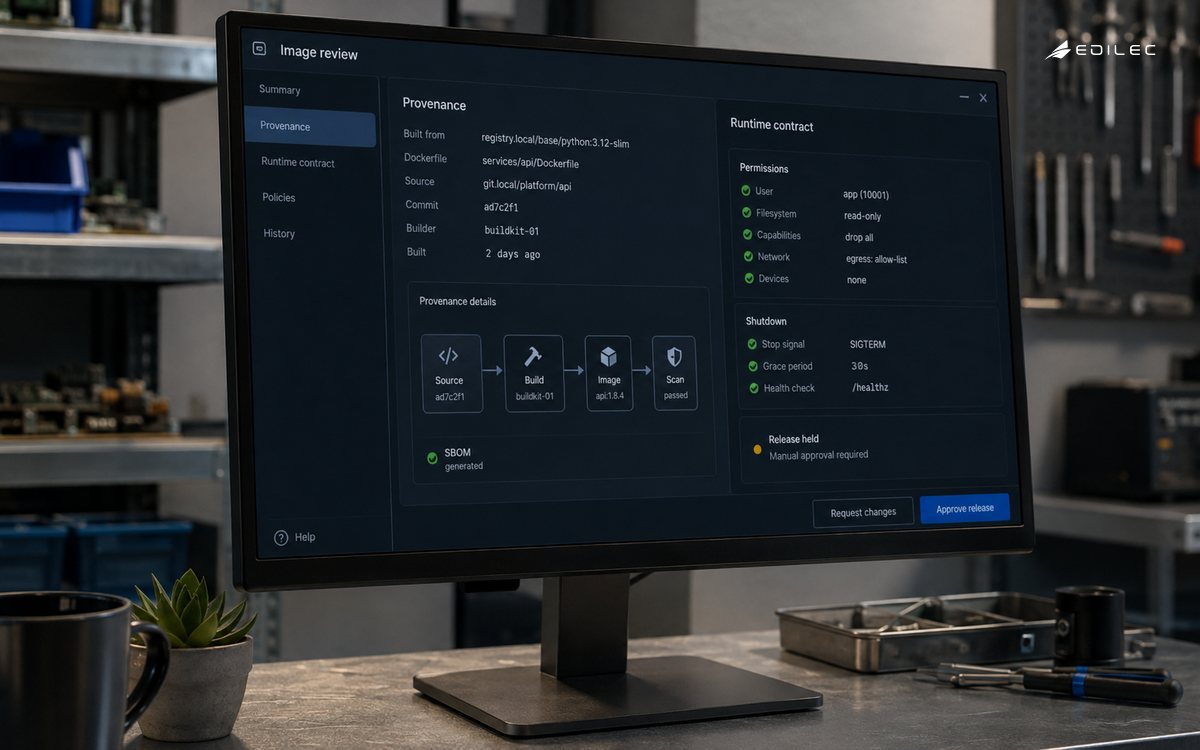
Separate build-time secrets from the final filesystem and environment. Do not pass credentials through image layers, history, or copied configuration files. Run as a non-root user where the application and platform permit it, request only required permissions, and avoid installing a troubleshooting toolbox into every production container. Image scanning is a prioritization input rather than proof of safety; teams still need to understand exploitability, exposed services, compensating controls, and the age of the base. A known high-risk image should have an explicit exception owner and expiry.
| Control | Practical implementation | Signal to review |
|---|---|---|
| Focused runtime | Use multi-stage builds and minimal dependencies. | Unexpected image growth or packages. |
| Safe identity | Run with scoped non-root permissions. | Privilege denials or break-glass use. |
| Runtime observability | Publish version and health behavior. | Restarts, startup delay, and failures. |
Roll out by digest with a recovery route
Prove the image in the environment that supplies its real configuration, identity, network policy, and storage behavior. Test startup and graceful termination under the same entrypoint and arguments used in production. Verify that a missing secret, denied dependency connection, or read-only filesystem produces an understandable failure. Promote the digest, never a convenient tag such as latest, and keep the preceding digest available for a rapid reversal. For services with state, make persistent volumes, migrations, and backup ownership explicit rather than assuming the container itself preserves data.
Observe image behavior after deployment
Watch what the runtime contract says should be observable: startup duration, health transitions, restart reasons, memory pressure, open connection failures, and the application outcome. Compare image size and build duration only when they influence a real decision; a tiny image that omits required certificates or diagnostics is not an operational win. Record the image digest in deployment events and service telemetry so a responder can correlate a new failure with the actual package that started it. Periodically rebuild from current approved bases and review changes rather than waiting for an urgent vulnerability notice.
A production failure mode for Docker images is a clean build that lacks a certificate, writable path, architecture match, or non-root permission supplied by the real platform. That kind of gap is dangerous because a local success signal can hide an operationally incomplete result — changes docker images. — changes docker images. Add the condition to acceptance criteria and state the expected response before the next change specifically for Docker image promotion. The record should show who owns the boundary, what evidence proves normal behavior, and how a responder distinguishes a transient delay from a condition that must be stopped — changes docker images. — changes docker images. This turns a surprising edge case into a reviewed part of the operating model rather than a lesson trapped in one engineer's memory — changes docker images. — changes docker images.
Use a regular operating review to inspect base and application digests, build context, final process contract, scanner findings, and changes introduced by an automatic base refresh. Keep the discussion close to a real example rather than an abstract maturity score specifically for Docker image promotion. Note where the team had to infer missing state, cross a permission boundary, or leave the normal workflow to understand the result — changes docker images. — changes docker images. Assign one or two concrete improvements with an owner and date, then inspect them after the next ordinary production change — changes docker images. — changes docker images. This cadence catches accumulated ambiguity early and prevents controls from becoming documentation that no longer describes the live system — changes docker images. — changes docker images.
A practical drill should roll back a new digest that starts but fails under traffic, then verify the prior image, configuration, and state behavior actually return. Include the people and systems that would be involved outside the primary tool: on-call ownership, access approvals, deployment or recovery records, customer communication, and the final verification query — changes docker images. — changes docker images. Measure the time needed to reach a safe decision, but also document why it took that long specifically for Docker image promotion. The most valuable outcome is a revised procedure that a different responder can follow with the same evidence, especially when the original author is unavailable — changes docker images. — changes docker images.
Keep the Docker images review bounded but complete. Map base images, runtime permissions, certificates, mounts, and graceful shutdown to the people who can change, inspect, and recover each element. A responsibility map should identify routine ownership as well as escalation authority, because production work crosses team boundaries at the moment a normal control fails — changes docker images. — changes docker images. Document dependencies that are outside the immediate service or tool, including identity providers, registries, queues, cloud accounts, and vendors — changes docker images. — changes docker images. This context lets reviewers judge blast radius before a change and gives responders a starting point when the visible symptom appears somewhere else — changes docker images. — changes docker images.
Make verification concrete by retaining the image digest, its deployment record, and the runtime version reported by the application. Compare it with an agreed baseline and record the decision to continue, pause, recover, or investigate — changes docker images. — changes docker images. Verification should happen after the system has had enough time to exhibit the behavior that matters, not only at the instant an API accepts a change — changes docker images. — changes docker images. When the evidence is incomplete, say so and keep exposure constrained. This is how teams preserve learning speed without confusing automation activity with a trustworthy production outcome — changes docker images. — changes docker images.
Before promoting an image broadly, verify its digest, runtime identity, health behavior, and required configuration in the target environment. A short acceptance record makes the next incident investigation much less speculative.
Reference checkpoints for Docker image promotion: Use Docker: Building best practices to check Docker image promotion at definition time. Use Dockerfile reference to check Docker image promotion at release time. Use NIST SP 800-190: Application Container Security Guide to check Docker image promotion at review time. Use SLSA specification to check Docker image promotion at exception time.
Frequently Asked Questions
Use these questions to check whether an image can be identified, exercised, and recovered as a production runtime package.
Conclusion
A production image is a controlled runtime package, not a compressed copy of a development machine. State its contract, minimize and identify its inputs, and test it under the permissions and configuration it will actually receive. That discipline makes failures more diagnosable and upgrades less mysterious. Related reading: container security engineering notes, Kubernetes deployment checks, and the Docker images practical guide.
For a production Docker image, durability means that another operator can identify its inputs, trust the promotion evidence, reproduce its runtime assumptions, and choose a safe response when startup or shutdown behavior changes. That is the standard that turns an image from a build artifact into an accountable release unit.
Test a base-image update that passes unit tests but fails under the production user, filesystem policy, or shutdown deadline. Promotion should stop with the digest, build inputs, failing runtime contract, owner, and recovery image recorded. That evidence makes the image reviewable instead of merely green in a build log.