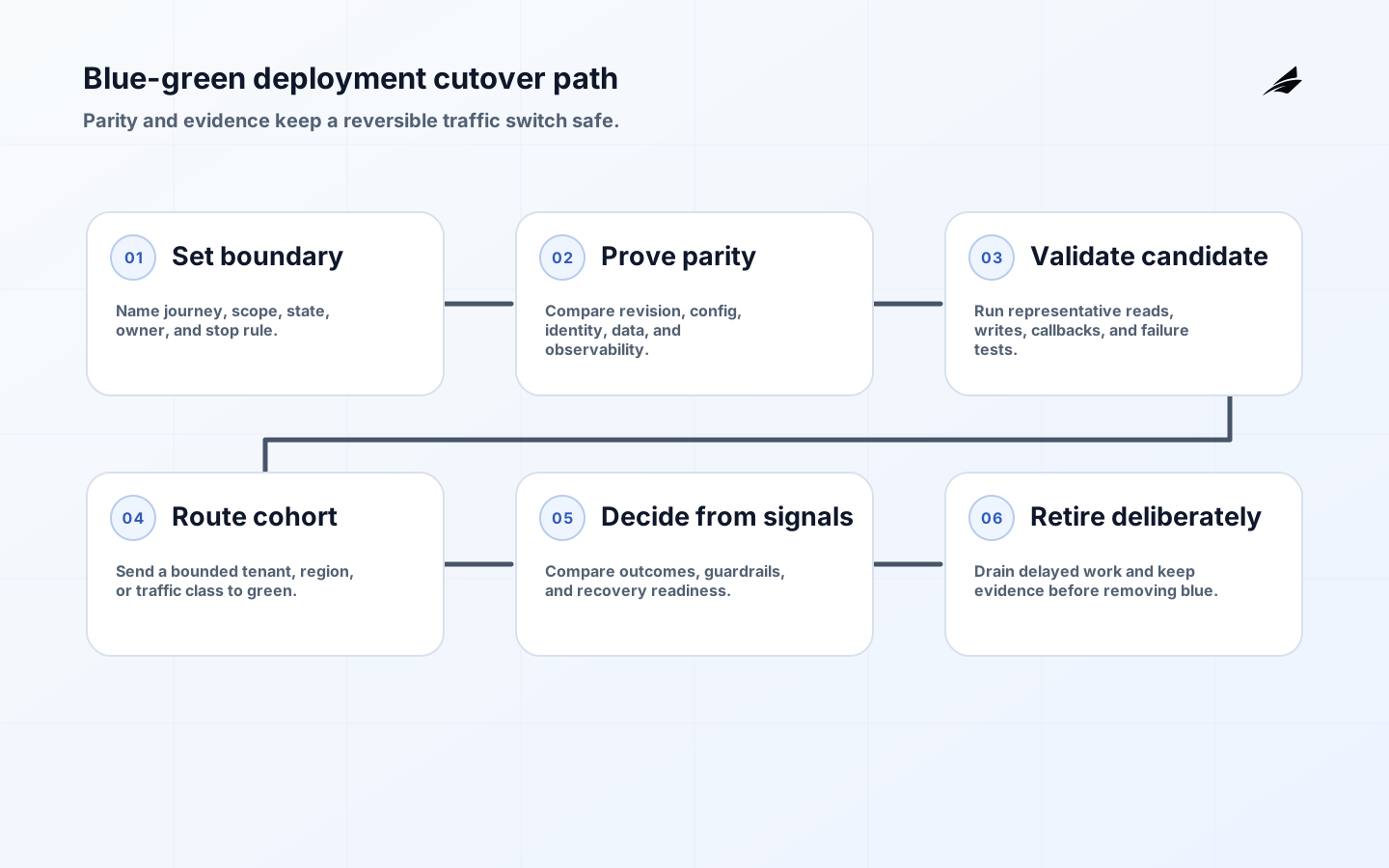
Blue-green deployment is an operating decision, not a tool category. For operations leaders, the useful question is whether maintaining two production-capable environments buys a safer traffic switch than the cost and operational complexity it adds. Consider a customer-facing service that needs a fast routing reversal but also depends on a shared database and third-party callbacks. A credible answer starts by defining the result that matters to users and the evidence that will decide whether a change helped AWS CodeDeploy blue/green deployments frames the discipline from an authoritative perspective, but the local work still needs an owner, a decision window, and a way to reverse harm. This guide treats blue-green deployment as a practical system: make the boundary visible, place controls where they can work, change one thing at a time, and learn from production evidence rather than from an impressive diagram or a vendor promise.
Start With the blue-green deployment Decision
For blue-green deployment, the boundary includes the blue and green environments, routing control, shared state, release artifact, and the period in which the prior version remains viable. The first design review should name the user, completed outcome, excluded cases, authority to approve a change, and the evidence required to continue Kubernetes deployments guide is useful context for the surrounding delivery work, but it cannot substitute for the local contract.
| Decision element | Question to settle | Evidence to retain |
|---|---|---|
| Outcome | What should improve for the user or operator? | A named journey, baseline, and acceptance condition. |
| Boundary | Where does blue-green deployment begin and end? | the blue and green environments, routing control, shared state, release artifact, and the period in which the prior version remains viable |
| Authority | Who can change, pause, or approve it? | An accountable owner and an escalation route. |
| Recovery | What is the acceptable response when it goes wrong? | A tested reversal, mitigation, or correction record. |
Make the Cutover Contract Observable
The mechanism is environment parity checks, pre-switch validation, controlled traffic routing, and explicit post-switch observation. Treat each part as a contract, not just a configuration value. Ask what data or identity crosses the boundary, when it is current, who can alter it, and what observability proves the expected path happened Kubernetes Deployments is a useful reference for the discipline around this topic. The design should also state what is deliberately out of scope.
This matters for blue-green deployment because a green dashboard can still conceal incorrect scope, missing context, or an accumulating exception.
Guard the State That the Switch Can Change
The central risk is calling two environments blue-green while configuration, identity, data, and vendor integrations differ enough that the inactive side cannot serve real traffic. For blue-green deployment, use deterministic checks for identity, scope, rate, schema, policy, and approval whenever the rule is knowable. Google Cloud deployment strategies offers an authoritative technical reference; translate it into tests that your own delivery path can repeatedly run. The operating safeguard is a parity checklist and a data migration contract that makes clear what is reversible, compatible, or requires a forward fix.
- Name the asset, user outcome, and accountable owner affected by blue-green deployment.
- Make the desired and prohibited states observable before changing production behavior.
- Practice the uncertain and failed case, including handoff, escalation, and recovery.
Pilot the Switch on a Reversible Route
For blue-green deployment, budget for environment drift detection; duplicated infrastructure without a verification habit creates false confidence. Use validate green against synthetic login and order flows, switch a small controlled route, watch business and service indicators, then retain blue until the agreed observation window closes. It does not automatically mean the deployment method failed; it means the evidence was not isolated enough to guide the next change.
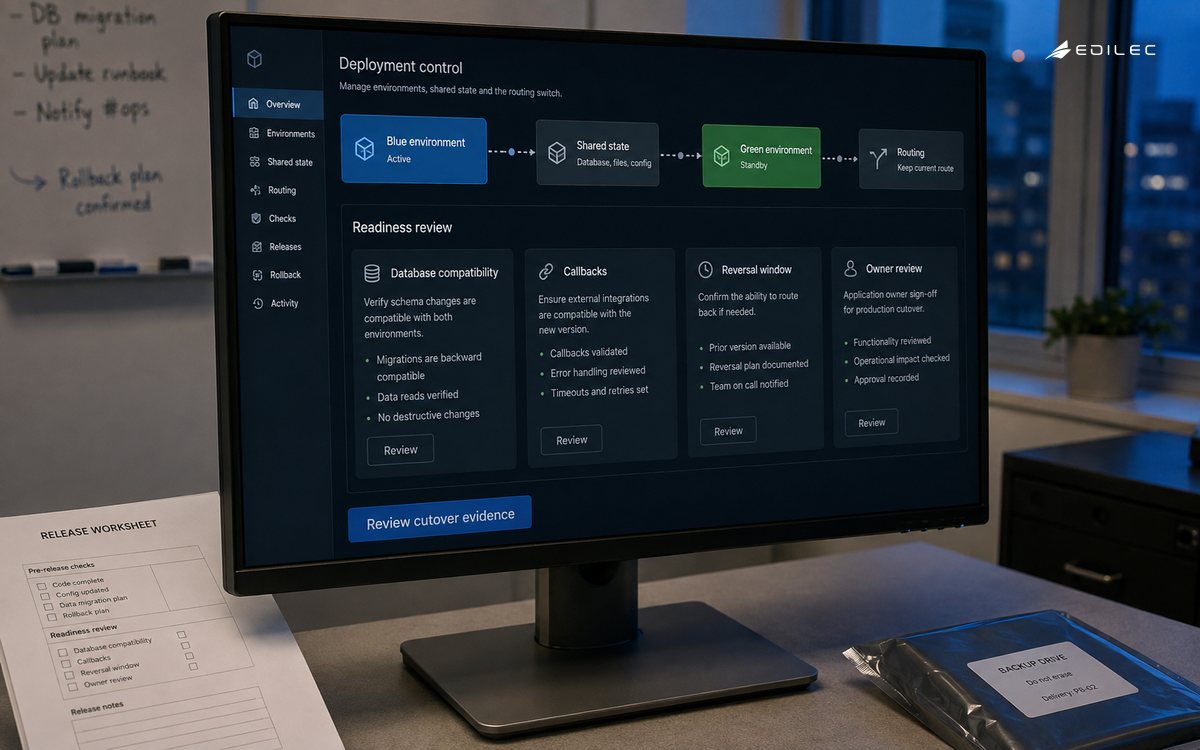
Separate data or identity changes from traffic or capacity changes where possible, and state dependencies when separation is impossible AWS CodeDeploy deployment operations is helpful for checking the technology-specific mechanics.
| Stage | Minimum practical output | Decision gate |
|---|---|---|
| Discover | Current boundary, owner, baseline, and known exceptions. | The problem is specific enough to test. |
| Design | Control points, failure path, and measurement query. | The consequence has a workable safeguard. |
| Pilot | A small scoped change with a reversal method. | Observed behavior supports a wider trial. |
| Operate | Runbook, alert owner, and review cadence. | The capability can survive normal turnover. |
| Improve | A recorded lesson and the next bounded hypothesis. | Evidence, not urgency alone, selects the next change. |
Rehearse Recovery Against Shared State
A blue-green switch is only reversible while the old revision can still interpret the state created by the new one. Before the first production cutover, list every shared boundary: database schema, session store, cache keys, queue payloads, object formats, webhook behavior, and feature flags. For each boundary, mark the change as backward-compatible, dual-read or dual-write, forward-only, or explicitly out of scope. This classification gives the release owner a concrete reason to stop rather than a vague hope that rollback will work. AWS describes blue/green deployments as provisioning a replacement environment and shifting traffic through a load balancer; the local design still has to prove what happens to work that crossed the boundary during the shift.
Use one rehearsal that resembles the real service instead of a clean-room demo. Start a long-running request, enqueue a background job, rotate a session, and exercise a write while the route moves. Then return traffic and check both customer-visible outcome and stored state. A successful HTTP health check is insufficient if a job was processed twice or a callback now points to the retired endpoint. Retain the release identifier, timestamps, route scope, and reconciliation result in the decision record so an incident responder can separate a routing defect from an expected late effect.
| Shared boundary | Proof before promotion | Stop condition |
|---|---|---|
| Schema and writes | Both revisions can read and write the deployed shape. | A new write cannot be read or safely corrected by blue. |
| Queues and workers | A job has an owner, deduplication key, and drain rule. | A return would replay an irreversible effect. |
| Sessions and cache | A representative login and cache miss survive the switch. | Users lose state or receive a stale authorization decision. |
| Callbacks | The provider route and retry behavior are verified. | A delayed callback would land on an unowned endpoint. |
Judge the Cutover by Customer and Guardrail Evidence
Use switch duration, parity drift, post-switch incident rate, and time until the prior environment can be safely retired. Review leading signals during the switch; reserve a longer observation window for cost, reliability, and behavior that settle slowly. Break the result down by affected route, tenant, or revision so a healthy aggregate cannot hide a local regression.
The cutover record should also state the retirement test: which delayed jobs, caches, support cases, and external callbacks must be quiet or reconciled before blue is removed. This prevents cost pressure from shortening the recovery window before the team has evidence that the customer journey is stable.
If the old environment is retained for cost or audit reasons, say who pays for it and who can still route traffic there. A dormant environment without ownership is not recovery; it is another unverified dependency.
Key Takeaways
- Blue-green deployment begins with a decision boundary and user outcome, not a product selection.
- The most important safeguard is a parity checklist and a data migration contract that makes clear what is reversible, compatible, or requires a forward fix.
Blue-green releases deserve a separate compatibility ledger because traffic movement and state movement do not happen at the same speed. Record the revision that owns each schema field, queue payload, session token, cache key, and callback contract. Mark each item as readable by both revisions, dual-written during transition, or forward-only. During a rehearsal, send a representative request through the candidate, create a background effect, switch the route, and verify the effect after the old environment is isolated.
An operations leader can use one release card to make the cutover legible: name the cohort, record the route decision, capture guardrail values at each checkpoint, and assign the person who accepts the remaining risk. Retirement is a proof step, not a cost-control reflex. Remove blue only after delayed work is drained, external retries are understood, support can identify the release that handled a customer case, and the recovery owner agrees that the evidence window has closed.
Frequently Asked Questions
When is blue-green deployment ready for production? A bounded blue-green production use is ready only after its boundary, owner, measurement, control, and recovery path have each been exercised. That is different from claiming the system is perfect.
Conclusion
The durable version of blue-green deployment is not a one-time project. That approach leaves operations leaders with a capability they can explain, operate, and improve instead of a fragile collection of settings.
For teams choosing between a blue-green switch and a canary release, the right question is the shape of the risk. Blue-green favors a clear replacement and fast return; a canary favors gradual exposure when routing and cohort signals are strong. The canary releases guide, Kubernetes deployments guide, and CI/CD pipelines guide give useful adjacent context. Whichever pattern is selected, keep the release ID in support data, preserve the old path until delayed effects settle, and write the decision rule before the change begins.
A release-safety gate earns trust when the next operator can explain why traffic moved, which state crossed the boundary, and what evidence permits retirement of the old environment. Keep that decision record with the release, rehearse the return path after material state changes, and let customer and guardrail signals—not schedule pressure—determine the next exposure.