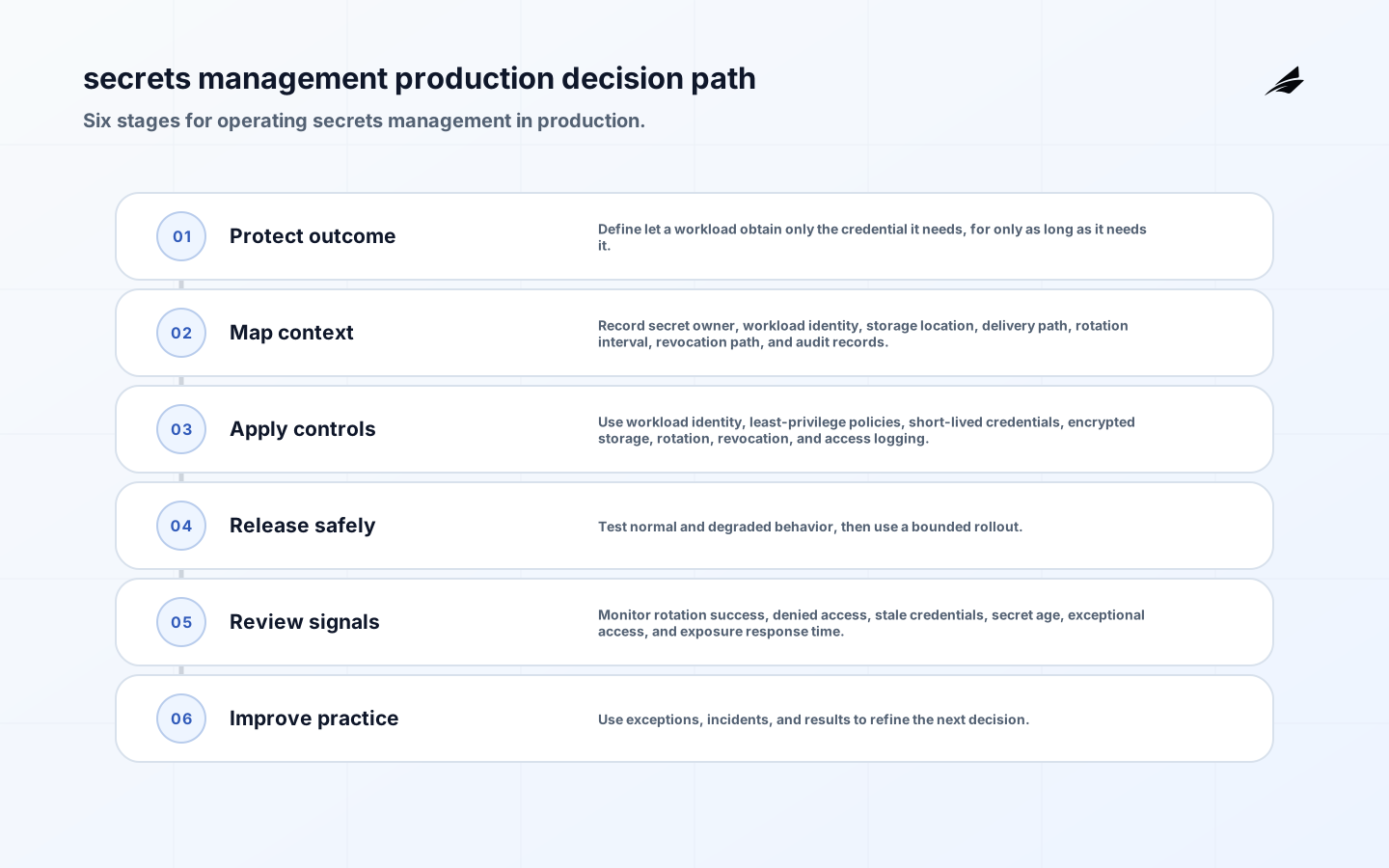
Secrets management changes character in production. A proof of concept can demonstrate a mechanism; a production capability has to keep working through ordinary changes, partial failures, handoffs, and an investigation at an inconvenient hour. The practical goal is to let a workload obtain only the credential it needs, for only as long as it needs it. Begin by naming the user-facing outcome, the accountable owner, and the evidence that will decide whether the change is helping. That discipline prevents a familiar failure: a technically plausible improvement that shifts risk into another team, another service, or an unmeasured part of the customer journey. This guide treats secrets management as an operating decision, with boundaries, controls, rollout evidence, and review habits that a team can actually use.
Set a production boundary for secrets management
Write the boundary around a workload identity performing a named operation against a named resource, not around a tool. Record secret owner, workload identity, storage location, delivery path, rotation interval, revocation path, and audit records. A useful boundary also names what is deliberately outside the first release, who may approve an exception, and what result would make the change unacceptable. The point is not exhaustive documentation; it is a shared decision that survives a handoff. When the team can point to one owner, one baseline, and one stop condition, it can learn without representing an experiment as a permanent policy. For adjacent release concerns, the operating practices in blue-green deployment are a useful comparison because both depend on observable state and a clear authority to pause.

| Boundary question | Production decision | Evidence to retain |
|---|---|---|
| Which outcome is protected? | let a workload obtain only the credential it needs, for only as long as it needs it | Named owner and baseline. |
| What is the unit of change? | a workload identity performing a named operation against a named resource | Versioned scope and dependencies. |
| Who may stop or approve? | Assign an accountable operational owner. | Escalation route and decision record. |
| What ends the experiment? | Set a measurable unacceptable condition. | Threshold and review note. |
Build evidence before automating secrets management
Production work needs stable identifiers for the workload, configuration, actor, change, and observed outcome. Connect those identifiers across deployment records, telemetry, and the operational record; otherwise a later question turns into guesswork across dashboards and chat threads. Start with a baseline collected during normal conditions, then define how data gaps and delayed telemetry are handled. Measurements should be good enough to support a decision, not merely easy to collect. Segment the data by service, version, cohort, region, or dependency when an average can hide a local problem. Keep access to the evidence proportionate to the sensitivity of the data, and retain only what an operational or legal need justifies. For secrets management, make the correlation key part of the change contract so a responder can compare the intended state with the result.
- Version the configuration and change record with the secrets management action.
- Capture normal, degraded, and recovery behavior for the same a workload identity performing a named operation against a named resource.
- Assign an owner and expected response to every decision-driving signal.
- Test whether a responder can trace an unexpected result to a change and a responsible system.
- Review data quality before using a metric as an automated gate.
Choose controls that match the secrets management risk
Controls should block known hazards early and route ambiguous cases to a named human decision. For this topic, that means workload identity, least-privilege policies, short-lived credentials, encrypted storage, rotation, revocation, and access logging. Separate execution from policy evaluation and from observation where possible. The separation makes controls testable, lets teams change a rule without losing history, and gives responders a way to contain one path without disabling all evidence. Avoid treating a successful happy-path test as validation. Exercise missing input, stale state, permission changes, dependency timeouts, and the documented recovery action. A control that detects a harmful result only after an irreversible action is useful for learning, but it is not a preventative gate.
| Risk pattern | Control | Operational check |
|---|---|---|
| placing a long-lived credential in a repository, image, build log, or shared configuration file | Use an explicit guardrail before the action. | Run a failure-mode test and inspect the record. |
| Missing or stale context | Hold, deny, or require review. | Verify the handoff contains the needed evidence. |
| Excess privilege | Use least privilege and time-bounded access. | Review access and exceptions on a schedule. |
| Recovery gap | Keep a tested containment and return procedure. | Confirm the protected outcome is restored. |
Roll out secrets management as a reversible change
Pick an initial scope with stable ownership and a measurable baseline. Agree on entry criteria, the observation window, the authority to halt, and the exact return action before enabling the new behavior. A rollout is not validated by a quiet demo; it is validated by recorded behavior under realistic load and failure. Expand only when the evidence supports the original hypothesis. Changes involving data formats, shared dependencies, permissions, or third parties deserve a separate compatibility check because they can make a local return action incomplete. Keep the change log short and usable: hypothesis, scope, observed result, exception owner, decision, and next review date. The release mechanics for platform engineering provide a useful model for progressive scope and explicit pause criteria.
Operate secrets management with decision-ready signals
Use a small, owned set of signals: rotation success, denied access, stale credentials, secret age, exceptional access, and exposure response time. For each one, document its definition, source, freshness expectation, threshold where appropriate, and expected response. Pair efficiency or delivery signals with user-impact and safety signals so that local improvement cannot mask an unacceptable trade-off. Review the signal set after changes in architecture, traffic, dependencies, or customer behavior. A metric that was useful during the first release can become misleading as the system changes. Good operations is not constant intervention; it is making routine review sufficient to catch drift before it becomes an incident.
Plan for the failure modes that production exposes
The core failure to design against is placing a long-lived credential in a repository, image, build log, or shared configuration file. Teams also encounter stale inventories, undocumented ownership, alert fatigue, manual bypasses, and a recovery process that exists only in a document. Treat each as a design input. Add a bounded exception process with an expiry, record why it was granted, and review whether it should become a supported path or be removed. During an incident, simplify the decision: protect the defined outcome first, preserve enough context to diagnose second, and defer broad cleanup until the system is stable. Rehearsals are especially valuable where an action crosses service, security, finance, or support boundaries; they reveal assumptions that a unit test cannot see.
- Test a missing dependency, stale configuration, and failed permission check.
- Rehearse the stop and return action with the people who will use it.
- Expire temporary exceptions rather than relying on memory.
- Review support contacts and manual bypasses as evidence of design friction.
- Turn recurring investigation steps into a runbook, automation, or clearer ownership rule.
Key takeaways for secrets management
- Secrets management is production-ready when its protected outcome and accountable owner are explicit.
- Measure the a workload identity performing a named operation against a named resource with evidence that links changes to observed behavior.
- Use preventive controls for known hazards and human review for genuine ambiguity.
- Make rollout scope, stop conditions, and return actions part of the release decision.
- Review rotation success, denied access, stale credentials, secret age, exceptional access, and exposure response time as a set of decisions, not as a collection of dashboard numbers.
Frequently asked questions about secrets management
What should a first production scope include? One valuable path, a baseline, named ownership, observability, and a tested way to pause or return. When should automation be allowed to act alone? When the rule is deterministic, the action is bounded, and the evidence is reliable; otherwise require review. How often should teams revisit the design? After material changes and on a regular operational cadence, using exceptions, incidents, and support demand as input. Does this replace incident management? No. It reduces preventable surprises and makes incident response more informed by preserving context and authority. For secrets management, the review owner should be able to name the protected outcome and current exception state without reconstructing it from several systems.
Conclusion: production discipline makes secrets management useful
The durable version of secrets management is not a tool setting or a one-time project. It is a repeatable operating practice: define the protected outcome, make the important state visible, apply proportionate controls, roll out reversibly, and use evidence to refine the next decision. That approach gives product, platform, security, and operations teams a shared way to move quickly without confusing activity for confidence. For secrets management, that means treating the practice as part of the service operating model, rather than as a one-off implementation milestone.