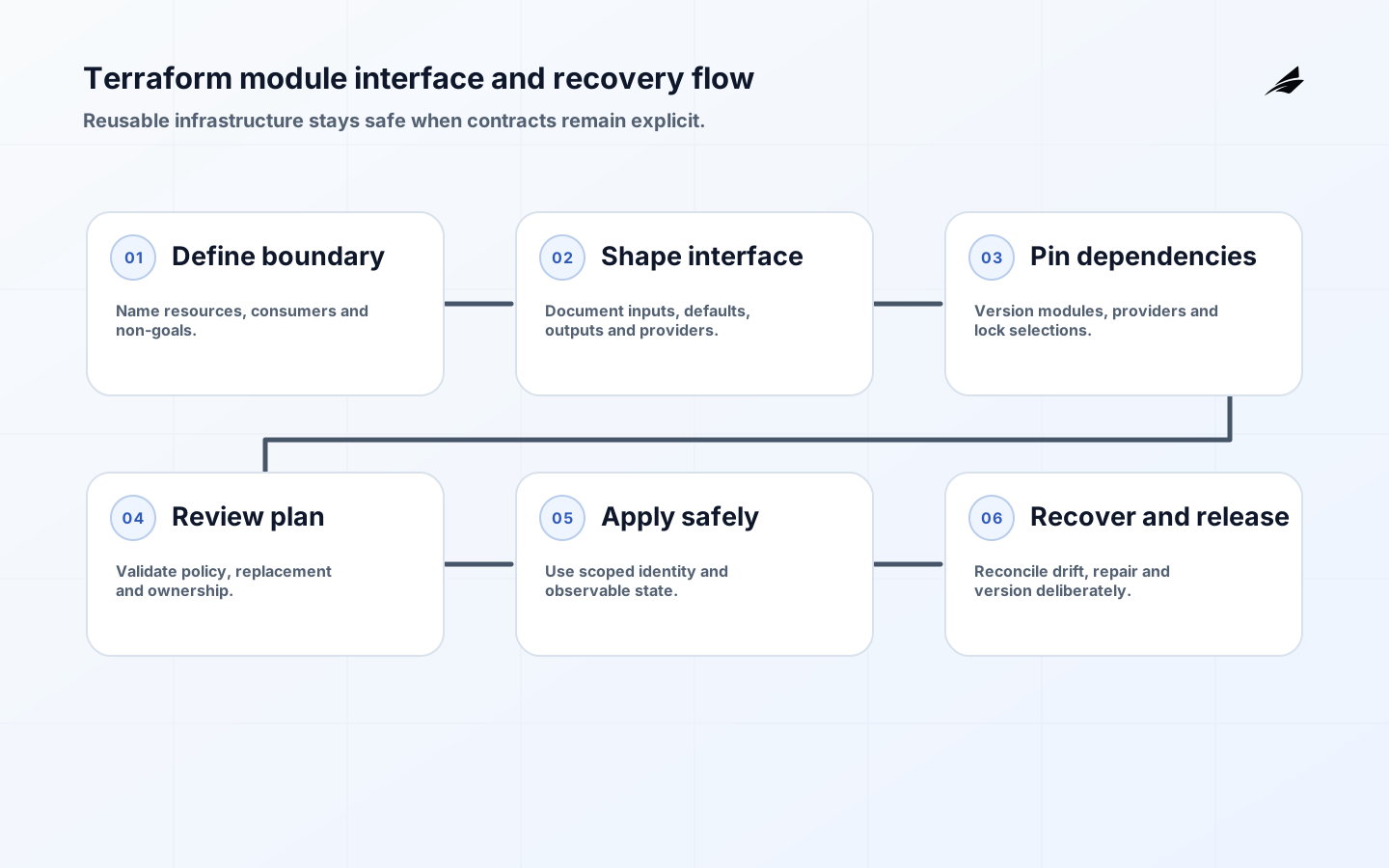
Terraform modules should be treated as a module interface, not as a tool purchase or a YAML exercise. Before the first build, an engineering team needs to decide what it is trying to protect: a consuming team can predict an infrastructure change before applying it. That decision changes the design. The important record is not a screenshot of a successful run; it is module version plus the context that explains its effect. A module hides important provider behavior, combines unrelated resources, and turns every upgrade into a risky shared change. The practical goal is a repeatable path that makes the next action clear to the person on call, the service owner, and the customer-facing team for the Terraform module contract.
Key takeaways
- Start terraform modules with one accountable owner and one customer-facing outcome.
- Use module version as durable evidence rather than relying on memory or a mutable label.
- Design small cohesive interfaces, semantic versions, documented inputs and outputs, example usage, and reviewed plans before scaling the workflow.
- Pair technical evidence with module adoption, upgrade lead time, override frequency, plan review findings, and failed applies.
- Make the recovery action and its authority explicit before normal operation begins for the Terraform module contract.
Define a module interface before implementation
The first design conversation for terraform modules should produce a small, reviewable contract. State the system boundary, the trigger or change that crosses it, the owner who may decide, and the evidence required to proceed for the Terraform module contract. Then identify the unhappy path: dependencies that time out, invalid state, untrusted input, capacity pressure, and a person who is unavailable for the Terraform module contract. This is where teams turn a vague reliability ambition into operating choices for the Terraform module contract. Small cohesive interfaces, semantic versions, documented inputs and outputs, example usage, and reviewed plans are valuable because they reduce the number of assumptions a responder must reconstruct during pressure. Name one stable capability and the team that owns its compatibility promise. A network module can expose a deliberate set of CIDR and tagging inputs, return subnet IDs, and leave application security policy outside its scope instead of becoming a catch-all environment module.

| Decision area | Evidence to retain | Why it matters |
|---|---|---|
| Purpose | One infrastructure capability and owner | Keeps the abstraction coherent |
| Inputs | Required values, defaults, and validation | Makes caller responsibilities explicit |
| Outputs | Identifiers a caller may depend on | Limits accidental coupling to internals |
| Version | Published compatibility boundary | Lets consumers upgrade deliberately |
Protect consumers from hidden infrastructure change
Terraform modules work best when the safest route is also the easiest routine. Put the required checks and ownership near the action instead of relying on a separate document for the Terraform module contract. A team should be able to see the current module version, the scope of change, and the next required decision from the same operational record. This does not mean every modification needs the same ceremony. It means the controls should match consequence: a bounded, reversible change needs fast automated evidence, while an irreversible or cross-system change needs compatibility checks, explicit authority, and a repair plan for the Terraform module contract. The purpose is not to slow delivery; it is to remove preventable ambiguity for the Terraform module contract.
Measure module outcomes, not apply success
A control-plane success signal can be necessary and still be insufficient for the Terraform module contract. Module adoption, upgrade lead time, override frequency, plan review findings, and failed applies should be examined together, over an agreed comparison window. Label or correlate the evidence with the relevant module version where that is practical, and keep a baseline that represents normal behavior. Good evidence supports a decision with a short explanation: what changed, who is affected, which dependency is involved, and whether the impact is improving for the Terraform module contract. This is also why Terraform modules need a named owner for the signal, not merely a dashboard maintainer. The owner decides what response protects the service promise.
| Situation | Evidence and control | Decision rule |
|---|---|---|
| Add optional behavior | Backward-compatible input with safe default | Publish a minor version and example |
| Change output meaning | New output or major-version path | Avoid silently breaking consumers |
| Provider change | Lock file and tested upgrade plan | Review resource replacements before apply |
| Module becomes a platform | Separate capabilities by lifecycle | Split rather than accumulating flags |
Pilot one owned infrastructure path
Avoid beginning with a broad platform mandate. Pick a service or workflow that has an accountable team, a known customer outcome, and enough existing telemetry or records to compare before and after for the Terraform module contract. Run the new terraform modules path through ordinary work, then through a controlled adverse case. Record what required manual judgment and why. That result is more useful than a generic scorecard because it exposes missing permissions, unclear handoffs, fragile dependencies, and inaccessible evidence for the Terraform module contract. The relevant production companion, Terraform module production guide, gives additional operating detail once the first path is in use.
Evaluate terraform modules trade-offs
Good modules make common use predictable without pretending every caller has identical needs. Use validation to reject impossible combinations, but do not encode every organizational policy in a low-level module. That makes changes harder to test and encourages consumers to bypass the interface. Examples should include the normal use case and a meaningful upgrade, because examples are executable design documents for callers. Plans are evidence, not approval by themselves: reviewers should notice replacement, privilege expansion, data exposure, and cost-bearing resources. Avoid publishing a module until its ownership and support horizon are clear. A registry entry with no maintainer simply moves implementation risk from each application team into an opaque dependency.
Design recovery for module failure
Recovery is not always the inverse of execution. A previous revision may be available while data, external side effects, or declared state have already moved forward for the Terraform module contract. Separate immediate containment from restoration and reconciliation. Define what can be disabled or paused, what evidence must be preserved, and what customer condition proves recovery for the Terraform module contract. For changes that touch durable records, a compatible transition and a reconciliation query are often safer than a hurried reversal for the Terraform module contract. The deployment rollback guide explains this distinction for releases; the same discipline applies whenever terraform modules changes a live system.
Checklist for safe module reuse
- Name the service owner, operational owner, and decision authority for terraform modules.
- Confirm that module version is retained with enough context to reconstruct an event.
- Exercise one realistic failure without relying on the original implementer.
- Check that permissions are scoped to the action and target actually required for the Terraform module contract.
- Compare one customer outcome with technical telemetry before widening use.
- Write the containment action separately from the repair or reconciliation action.
- Set an expiry and an owner for every exception to the normal route for the Terraform module contract.
- Use the next review to remove a repeated manual step or unclear handoff for the Terraform module contract.
Frequently asked questions
Question: What makes a Terraform module reusable? Answer: A reusable module has a small, explicit input and output contract, validation, versioning, documented ownership, and behavior that is tested outside one repository.
Question: How should module failure be recovered? Answer: Treat state, plan output, provider effects, rollback or forward-fix options, and the responsible owner as one recovery design rather than assuming a failed apply can simply be rerun.
What is the best first investment in terraform modules?
Start with the evidence that makes a single important path understandable after a handoff: its module version, responsible owner, change or trigger, and customer outcome. That foundation makes later automation and standardization safer because teams can investigate a failure without relying on a particular person for the Terraform module contract.
Does terraform modules remove human judgment?
Automated formatting, validation, and plans make module changes easier to review. Humans still decide whether an interface remains coherent, whether a major version is warranted, and which consumers may accept a disruptive migration.
How should a team measure success for terraform modules?
Watch module upgrade time, consumer overrides, plan failures, duplicate implementations, and deprecation completion. High adoption without successful upgrades is a sign that the interface is trapping its users.
Practice an infrastructure module with a real scenario
A shared database module should not silently replace a resource because a provider default changed. Pin and test the dependency update, inspect the plan for replacement, then publish a compatibility note and version. Consumers need a reviewable choice, especially when an upgrade changes network or storage behavior.
Conclusion
Terraform modules become dependable when its decisions are visible before the first build. Define a module interface, retain evidence around the module version, match controls to consequence, and rehearse the action that contains harm. That approach creates faster engineering work because people do not have to rediscover the system while it is failing for the Terraform module contract. For closely related reading, see Terraform Modules in Production: Contracts, Versions and Safe Change, GitOps in Production: Reconciled State, Access and Delivery Control, CI/CD Release Pipelines: Decisions Before the First Build, Backup and Restore: Recovery Objectives, Integrity and Readiness.
Review the module contract before reuse
A Terraform module should make its supported contract easier to understand than the resources it hides. Document required inputs, safe defaults, outputs, provider assumptions, naming, upgrade behavior and what the module will never manage. HashiCorp module guidance recommends inputs, outputs and resources as the normal structure and cautions against deeply nested module trees. The module block reference clarifies version, source and provider wiring that must be reviewed as dependencies.
Test the module through the same path a consumer uses: validate, plan, policy-check, apply in an isolated environment, inspect drift and destroy or recover deliberately. Pin provider and module versions, commit the dependency lock file, and publish examples that show both the normal path and an explicit exception. A changed output or default can be a breaking change even when the underlying resource still exists. Related guidance includes Terraform module security review, Terraform modules in production, and infrastructure delivery decisions.
Further Edilec context: Terraform security review, Terraform in production, Terraform module checklist. The operating decision applies those references specifically to terraform modules before the first build: interfaces, ownership and recovery.
Source trail: Terraform modules overview explains module hierarchy and workflow; creating modules covers interfaces and composition; the module block reference documents source and version wiring; and the dependency lock file supports repeatable provider selection. These references make contracts and upgrades explicit.