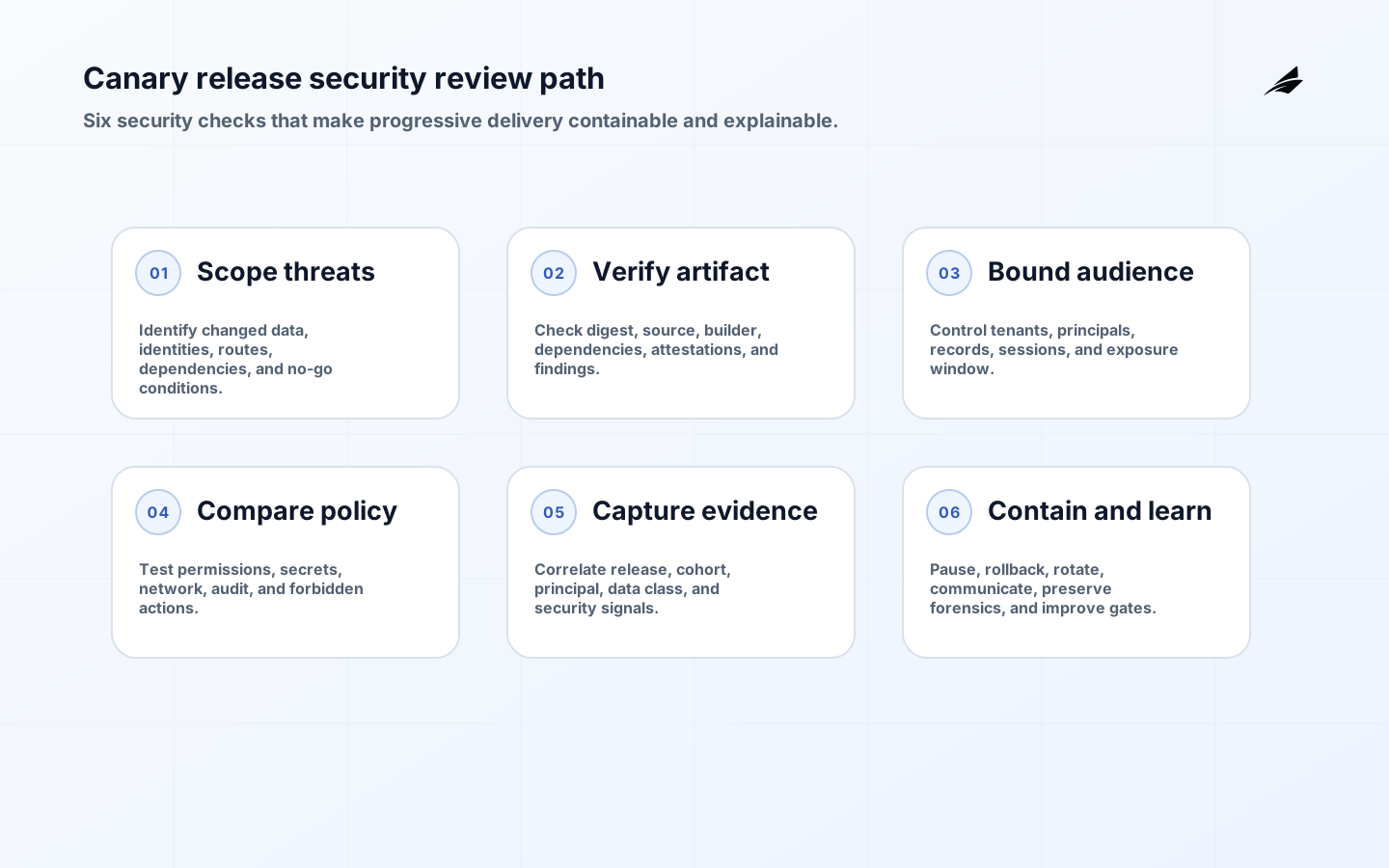
A canary can lower the number of users exposed to a defective release, but it is not automatically a security control. The candidate may contain an untrusted artifact, a changed identity policy, a new data path, or a vulnerable dependency. A secure canary therefore evaluates both service behavior and the conditions under which the candidate is allowed to run. Google's canarying guidance defines canarying as a partial and time-limited deployment whose evaluation informs promotion. The related canary releases practical guide covers the broader release mechanics; this review concentrates on security evidence and failure containment.
Define the security scope
List what changes beyond application behavior: base image, dependencies, permissions, network routes, secrets, configuration, feature flags, data access, logging, and external integrations. Identify the audience that may receive the canary and the data it may handle. A small percentage of traffic is not a small security scope if it includes privileged operators, sensitive tenants, or a shared database. Set explicit no-go conditions such as an unverified artifact, an unexpected outbound connection, a new privilege, missing audit events, or a failure to isolate test data. The security review should happen before traffic moves and remain active through promotion and rollback.
| Security surface | Review question | Control evidence |
|---|---|---|
| Artifact | Can the candidate be traced to reviewed source and build inputs? | Digest, provenance, signatures or attestations, and scan results. |
| Audience | Which users, tenants, or operators can receive it? | Routing rule, cohort definition, and exclusion list. |
| Identity | What can the candidate read or change? | Role diff, policy test, and runtime identity. |
| Data | Does the release alter collection, storage, or exposure? | Schema, redaction, encryption, and retention review. |
| Recovery | Can exposure stop without losing control of state? | Rollback, feature disablement, and incident runbook. |
Verify artifact provenance
A release process should know what it is deploying and how it was produced. SLSA provides a vocabulary for build provenance and supply-chain assurance, while the Google SRE release engineering chapter emphasizes reproducible, automated, tested artifacts. Verify the source revision, builder, dependency resolution, base image, test results, and artifact digest before the canary begins. Do not allow an operator to replace the candidate artifact during the observation window without creating a new release record. If a vulnerability or provenance gap appears, the secure response is pause or quarantine, not a silent exception.
- Deploy an immutable artifact identity that matches the artifact tested in pre-release checks.
- Attach source, builder, dependencies, base, tests, and security findings to the release record.
- Verify signatures or attestations at the deployment boundary where supported.
- Block untraceable, unexpectedly rebuilt, or policy-incompatible artifacts.
- Keep the previous-good artifact available for a controlled rollback.
Bound the audience and data
Choose a canary cohort for both operational representativeness and security containment. Exclude privileged accounts, regulated data, or high-value transactions until the candidate has earned more confidence, unless those paths are the specific risk under test and have additional safeguards. Define how routing interacts with tenant isolation, session stickiness, caches, queues, and background jobs. Review whether the candidate can access data that the control version cannot. Record the cohort rule so an investigator can reconstruct who was exposed. Security review is incomplete if the team cannot answer which identities, records, and actions crossed the new path.
Compare runtime identity and policy
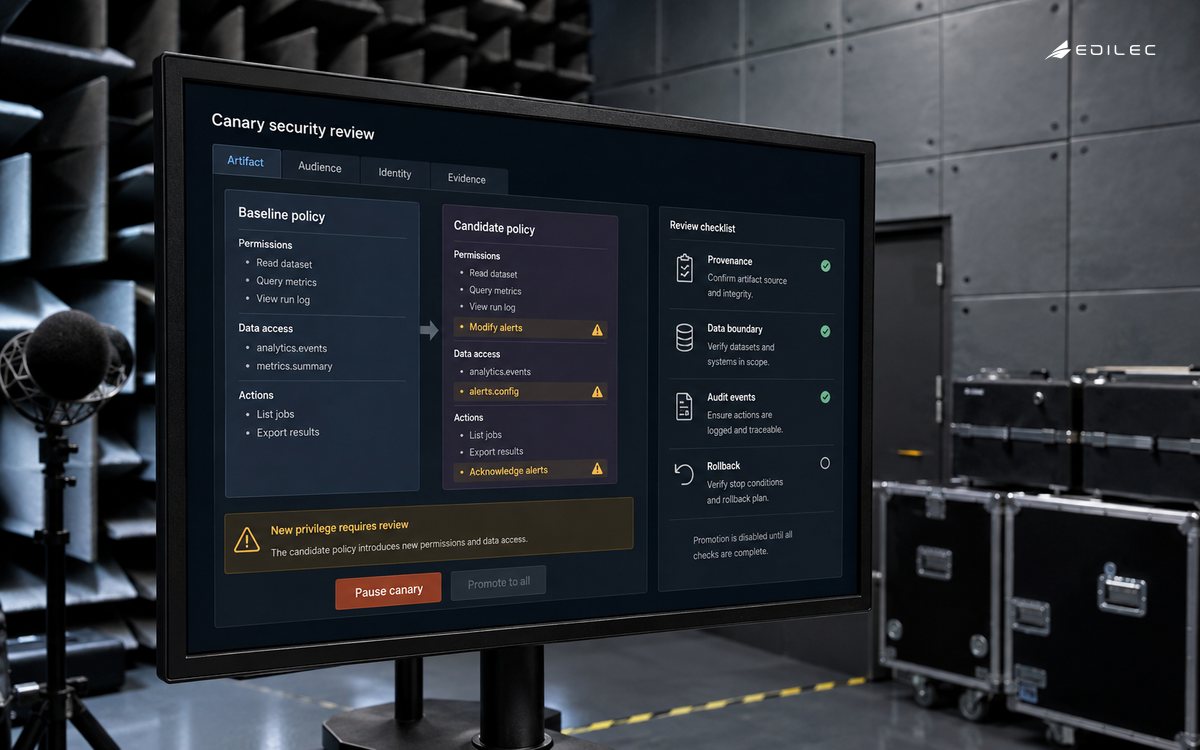
Compare the candidate's permissions with the control rather than assuming they are equivalent. Review service roles, network policy, secret mounts, filesystem access, administrator paths, feature flags, and data-retention settings. Test both expected and forbidden actions. A release can pass functional checks while gaining access to a new bucket, API, or database table. Apply policy-as-code or explicit authorization tests where possible and keep the result with the canary evidence. NIST SSDF is a useful primary reference for integrating secure practices into software development and release instead of leaving them to an ad hoc review.
Instrument for security evidence
Make release identity, cohort, principal, action, data class, and policy result available in logs and traces without exposing unnecessary content. Compare authentication failures, authorization denials, outbound connections, secret access, rate-limit behavior, and audit-event volume between candidate and control. Define alerts for unexpected privilege use, data egress, sensitive endpoint access, and disabled logging. Preserve enough evidence to investigate a suspicious event after traffic returns to the control. Avoid treating a clean dashboard as proof that no security event occurred; absence of telemetry can be the failure.
| Security signal | Candidate comparison | Stop condition |
|---|---|---|
| Authorization denials | Expected changes for the new path | Unexpected access success or broad denial spike. |
| Outbound traffic | Known destinations and volume | New destination, unusual volume, or unapproved protocol. |
| Secret access | Expected keys and frequency | Unlisted secret, privilege escalation, or error burst. |
| Audit events | Complete and correctly attributed records | Missing, malformed, or uncorrelated security events. |
| Vulnerability findings | Candidate-specific exposure and reachability | Critical reachable issue or provenance failure. |
Make pause and rollback secure
The security response must be faster than the release process. Give an authorized operator or automation the ability to stop routing, disable a feature, revoke a credential, quarantine an artifact, and restore the previous version. Define what happens to sessions, queues, writes, database migrations, and long-running jobs. If the candidate has handled sensitive data, rollback alone may not undo exposure; the response may require token rotation, access review, record inspection, and incident notification. Test the runbook in a non-production environment with realistic permissions. A recovery path that only the original implementer can execute is not a reliable control.
Review after promotion
After promotion, close the evidence loop. Record the decision, approving roles, observations, exceptions, and residual risk. Confirm that temporary routing rules, elevated permissions, debug logging, test accounts, and cohort exclusions were removed or documented. Compare incidents, near misses, vulnerability reports, and audit findings with the canary hypothesis. If the process blocked a healthy release, understand whether the evidence threshold or the control design was too conservative. If it missed a security issue, add the failure to automated tests and change the promotion gate. Secure progressive delivery improves only when each release leaves the process stronger than it found it.
Review threats through the release path
A concise threat model makes a canary security review concrete. Ask what an attacker could gain from the candidate, which identities or data it can reach, how the candidate can be manipulated through inputs or dependencies, and what evidence would reveal misuse. Include compromised build inputs, malicious configuration, stolen credentials, tenant-boundary failures, and an operator who makes an unsafe override. Map each threat to a preventive, detective, and recovery control. The result should influence the cohort, telemetry, and promotion gate rather than remain a document nobody consults.
Software supply-chain evidence should be checked where the artifact enters the environment. A secure build is not enough if the registry can be overwritten or the deployment process resolves a mutable tag. Verify the digest, provenance, signatures or attestations, and policy status at promotion. Keep a record of the exact artifact that handled the canary cohort. If a later investigation finds a compromised dependency, the team should be able to identify the affected release, exposure window, and rollback target without reconstructing the build from memory.
Data exfiltration may not show up as an error. Monitor outbound destinations, unusual volume, new protocols, access to sensitive stores, and changes in response size or serialization. Compare candidate and control behavior, but account for the fact that the candidate may legitimately use a new dependency. Use allowlists or egress controls where practical and make exceptions time-bound. If a canary changes data collection, logging, or retention, include that in the security scope and obtain the appropriate review before exposure.
Authorization tests should cover both positive and negative cases. Verify that the candidate can perform intended actions for the intended principal and cannot perform similar actions for a different tenant, role, environment, or record state. Test expired credentials, rotated secrets, denied network paths, and malformed identity context. Keep the test results with the release evidence. A candidate that fails closed may produce more visible errors during a canary, but that is preferable to a release that succeeds by quietly broadening access.
Forensics begins before the incident. Keep release identity, routing changes, policy versions, principal access, and security-relevant actions correlated and time-ordered. Make sure log retention covers the observation window and that operators can access the evidence without granting themselves broad production permissions. After rollback, preserve the candidate and its records for investigation rather than deleting it immediately. A secure release path makes containment fast while keeping enough evidence to understand whether the issue was a defect, a misconfiguration, or an attack.
Secrets require a special canary plan. If the candidate uses a new credential, define its scope, rotation owner, access log, and revocation action before exposure. Avoid sharing a powerful secret between control and candidate when separate identities can contain the blast radius. Test expiration and revocation, including what happens to in-flight requests and retries. If a secret might have been exposed through logs or errors, the response must rotate it and inspect access rather than trusting a traffic rollback to remove the risk.
Security gates should be proportional but non-negotiable for the relevant risk. A low-risk presentation change may need artifact and permission checks with lightweight cohort monitoring. A release that changes authorization or handles regulated data needs deeper policy tests, a smaller or more controlled audience, and named security approval. Write the difference into the release policy so teams do not negotiate it from scratch under deadline pressure. Proportionate review makes the safe path practical while preserving stronger controls where the consequence demands them.
Include communication in the security canary plan. Define who is notified when promotion pauses, what information customer support receives, and how an affected tenant or user is contacted if exposure becomes material. Keep the message factual and tied to the evidence: candidate identity, exposure window, known impact, containment, and next review point. Clear communication prevents operators from improvising inconsistent explanations while the technical response is still developing, and it makes the release process accountable to the people who may experience its consequences.
Frequently asked questions
Question: Does a canary replace secure development? Answer: No; it adds bounded evidence about the candidate's artifact, identity, data access, telemetry, and containment. Question: What should stop promotion? Answer: Untrusted provenance, unexpected privilege, unsafe egress, missing audit evidence, harmful data exposure, or a rollback path that cannot be executed.
Does a secure canary replace secure development?
Answer: No. It adds controlled runtime evidence and exposure limits to secure development, provenance, least privilege, and incident response.
What should stop a security canary?
Answer: Unexpected privilege, unapproved data access, missing audit events, provenance gaps, suspicious egress, or a recovery action that cannot be executed should stop it.
Who owns promotion evidence?
Answer: The release owner coordinates it, while service, security, and operations owners verify the parts of the boundary they are accountable for.
Does canarying prevent a security incident? No. It limits exposure and can improve detection, but it cannot replace secure development, least privilege, monitoring, or incident response. Compare the plain-language canary guide and CI/CD principles when integrating these checks into delivery. Should privileged users be in the canary? Usually exclude them for containment, unless privileged behavior is the risk being tested and extra safeguards are in place. Is a vulnerability scan enough? No; provenance, reachability, permissions, data, and runtime evidence also matter. Can rollback undo a data exposure? Not necessarily; rotate credentials, inspect access, and follow the incident process. Who approves promotion? The owner of the release should have an explicit security and operational review path proportionate to the change.
Key takeaways
- Review artifact, audience, identity, data, telemetry, and recovery as one security scope.
- Verify provenance and immutable identity before the candidate receives traffic.
- Use a cohort that is representative enough to reveal risk but bounded enough to contain it.
- Compare policy and runtime permissions with the control and stop on unexpected access.
- Make pause, rollback, credential rotation, and post-release review executable and owned.
Conclusion
A secure canary release is a controlled security experiment inside the delivery process. It proves what is running, limits who and what it can reach, exposes the evidence needed to compare behavior, and preserves a rapid path to containment. Those practices make progressive delivery safer without pretending that a small traffic percentage eliminates responsibility.