Serverless backpressure is the set of controls that prevents elastic producers and consumers from overwhelming a slower dependency. A function platform may add workers in seconds, but a database still has a connection ceiling, an external API still has a quota and a human review queue still has finite capacity. If consumer concurrency follows incoming demand without regard to that bottleneck, convenient scaling becomes an overload amplifier. Latency rises, timeouts trigger retries, duplicate work grows and the dependency spends its remaining capacity on requests that will not finish.
Backpressure does not mean making every component slow. It means preserving useful throughput by deciding what to admit, buffer, defer, prioritize or reject. The AWS Builders' Library load-shedding guidance explains why a system should shed excess work before overload causes broad failure. In event-driven systems, that decision spans the producer, queue, event-source mapping, function and downstream client. No single concurrency knob can supply a complete policy.
Start with the protected dependency budget
Measure sustainable throughput under the latency and error objective, not the highest rate reached in a short benchmark. Identify limiting dimensions: database connections, write units, transactions per second, memory, lock contention, third-party requests or per-tenant quota. Reserve capacity for interactive traffic, recovery and administrative work. If one invocation can issue several concurrent calls, translate the dependency budget through fan-out and duration. A function concurrency of one hundred can create far more than one hundred downstream operations.
Represent the budget as policy owned by the downstream service, then allocate it across consumers. Include a safety margin and a lower recovery threshold so traffic does not oscillate around saturation. Where tenants share a dependency, give critical or contracted traffic a protected share and cap abusive cohorts. Recalculate after query, batch-size or connection-pooling changes. Backpressure configuration is part of capacity management, not a one-time serverless setting.
| Signal | What it reveals | Control it should influence | Misleading interpretation |
|---|---|---|---|
| Oldest message age | Whether useful work is meeting time objective | Admission, concurrency and capacity escalation | Queue depth alone determines urgency |
| Dependency saturation | Remaining ability to complete calls | Consumer cap and load shedding | More workers will always help |
| Throttle and timeout rate | Rejected or excessively slow work | Retry budget and concurrency reduction | Every failure deserves an immediate retry |
| Completion throughput | Useful work leaving the system | Safe ramp-up after recovery | Invocation count equals progress |
| Dead-letter rate | Work exceeding retry policy | Isolation and repair workflow | Dead-letter storage is successful processing |
Control admission before the queue becomes the incident
Reject, defer and prioritize deliberately
At synchronous boundaries, enforce request size, tenant quota, deadlines and dependency health before expensive work begins. Return a clear retryable or terminal response and, where possible, a retry-after value. At asynchronous boundaries, decide whether an event is mandatory, replaceable or perishable. Coalesce state-refresh events, discard superseded work and reject payloads that cannot finish before their business deadline. A queue is valuable when it represents an intentional delay, not when it hides demand that can never be served.
Use separate queues or priority fields when classes have different value and cost, but prevent starvation. Limit producer rate when one source can flood a shared path. For scheduled fan-out, add jitter and partitions so thousands of functions do not wake simultaneously. Where upstream control is impossible, a thin admission function can validate, meter and route before work reaches expensive consumers. Make every rejection observable by reason and tenant so protection does not become silent data loss.
Define a queue safety envelope
Set objectives for oldest-message age, maximum useful age, depth, payload size, retention and drain time. Calculate how long the backlog would take to clear at sustainable downstream throughput while normal arrivals continue. Configure visibility timeout beyond credible processing duration and extend it only for live work. Use a dead-letter queue with redrive policy and owner, but never treat it as an archive that exempts the team from repair. Encrypt sensitive payloads and minimize personal data because buffering increases retention and access surface.
Cap concurrency at the consumer and event source
Reserved concurrency can protect both the dependency and other functions sharing an account pool. AWS documents that Lambda continues scaling toward its concurrency limit and that per-function controls can bound execution in its scaling behavior guidance. Start from the dependency budget divided by worst-case calls per invocation, then validate with representative duration and connection reuse. Leave headroom for variance and failed attempts. A cap set from average behavior can still overload the dependency at a slow percentile.
Queue event sources add another control plane. AWS SQS event-source scaling documentation describes maximum concurrency controls for how aggressively a mapping invokes a function. Use mapping-level limits when several queues feed the same function or when one queue deserves a bounded share. Coordinate batch size and batch window: larger batches reduce invocation overhead but can hold more work behind one slow record and increase the scope of a retry.
Design retries as a finite resource
Classify errors as terminal, transient, throttled or unknown. Do not retry validation failures, missing resources that are contractually absent or business conflicts that require a new command. For transient failures, use exponential backoff with jitter and an attempt or elapsed-time budget. Honor downstream retry guidance. Put a circuit breaker around an unhealthy dependency so queued work waits without repeatedly consuming function time and connections. The retry budget must include retries performed by SDKs, the function runtime, event source and producer.
AWS notes in its SQS error-handling guidance that failed batches can reappear and that partial batch responses can prevent successfully processed records from being retried. Use item-level results where supported and make effects idempotent with a business key, conditional write or deduplication record. Set the key's retention longer than the maximum delivery and redrive window. Idempotency does not make retries free; it prevents duplicate effects while backoff and budgets prevent duplicate load.
| Failure mode | Unsafe reaction | Backpressure control | Recovery proof |
|---|---|---|---|
| Database connection saturation | Increase function concurrency | Cap consumers and reserve interactive capacity | Connections and latency fall while completion continues |
| Third-party 429 responses | Retry every event immediately | Honor delay, open circuit and bound attempts | Call rate stays below quota and backlog drains |
| One poison message | Retry the whole batch forever | Partial failure response and dead-letter isolation | Healthy records complete once |
| Producer burst | Scale all consumers to account limit | Admission quota, visible queue and controlled ramp | Oldest age returns within objective |
| Dependency recovery | Release full backlog at once | Additive ramp with saturation feedback | Throughput rises without renewed throttling |
Close the overload feedback loop with useful-work signals
Alert on oldest useful age, dependency saturation, completion rate, throttle ratio, retry attempts, concurrency, in-flight messages and dead-letter arrivals. Queue depth needs context: a large queue of short jobs may be healthy, while a small queue containing one-hour-old payment commands is not. Correlate signals by event type and tenant. Count completed business effects rather than successful function invocations, because a function can return success after merely deferring or partially handling work.
Automated control should reduce admission or concurrency quickly and increase it cautiously. Use bounded steps, cooldowns and an emergency floor for critical traffic. Keep a manual override with expiry and audit trail. Test the controller against delayed metrics and partial dependency failure so it cannot chase noise. During recovery, estimate the drain time and decide whether old work remains valuable; dropping an expired refresh can be safer than spending scarce capacity on it.
Test overload as an end-to-end state
Generate a representative burst while slowing the downstream dependency. Include uneven tenant traffic, poison records, timeouts after side effects and an unavailable third party. Verify admission decisions, queue age, consumer caps, idempotency, partial failures, dead-letter routing and operator dashboards. Then restore the dependency and confirm that the backlog ramps within its sustainable budget instead of producing a second incident. A load test that ends before drain and reconciliation misses the most dangerous phase.
Record the tested envelope: arrival profile, payload mix, concurrency, batch size, downstream limit, maximum age, completion rate and recovery time. Tie production alarms and configuration to that envelope. Repeat after material changes to function duration, database client behavior, event shape or retry libraries. Serverless platforms change capacity automatically; teams remain responsible for proving that the whole system changes at a rate its dependencies can survive.
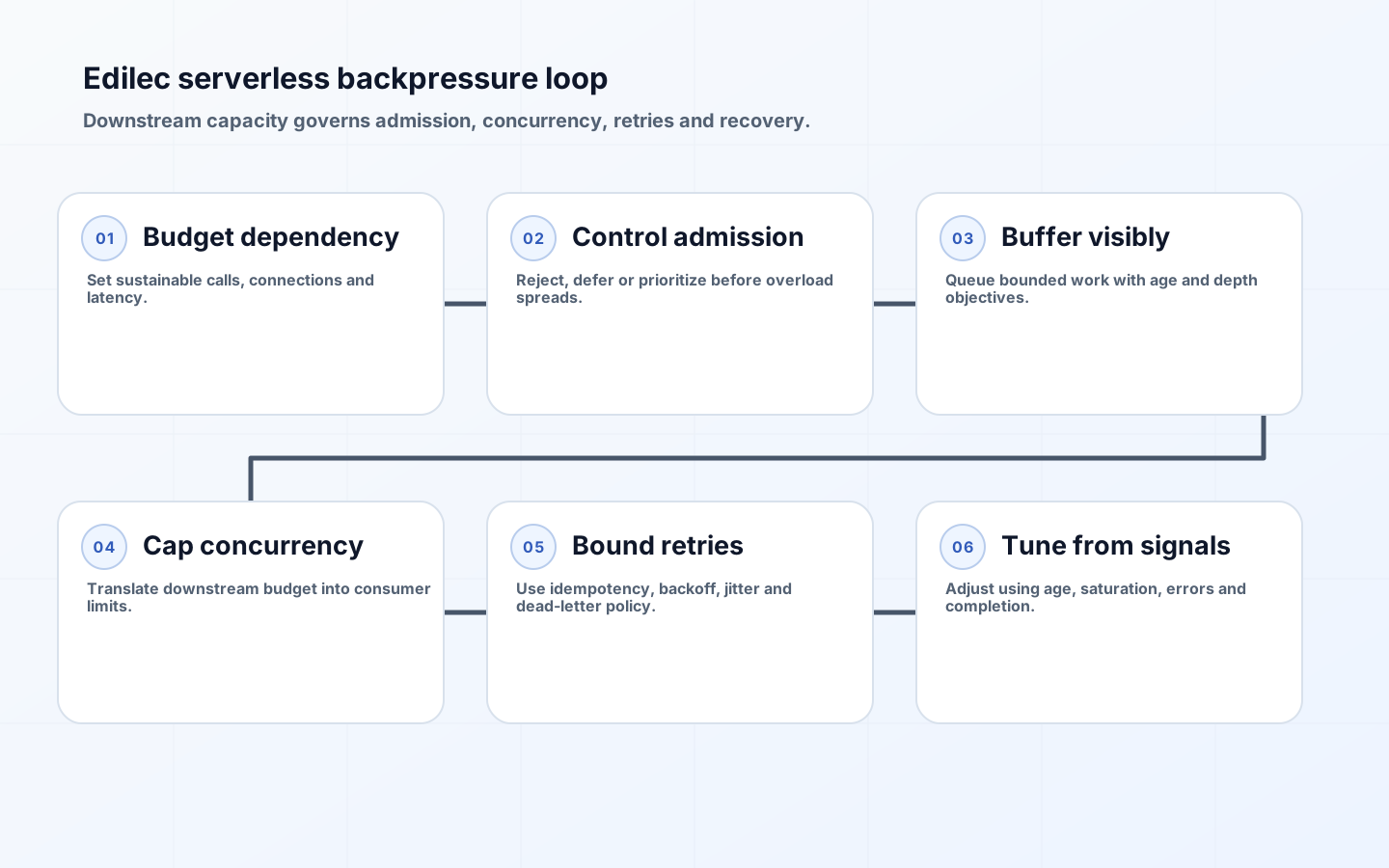
Use the six-stage Edilec serverless backpressure loop
Budget the dependency, control admission, buffer visibly, cap concurrency, bound retries and tune from completion signals. Each stage constrains the next. If the dependency budget is unknown, a queue and concurrency limit can only postpone or relocate overload rather than control it.
Key takeaways for serverless backpressure
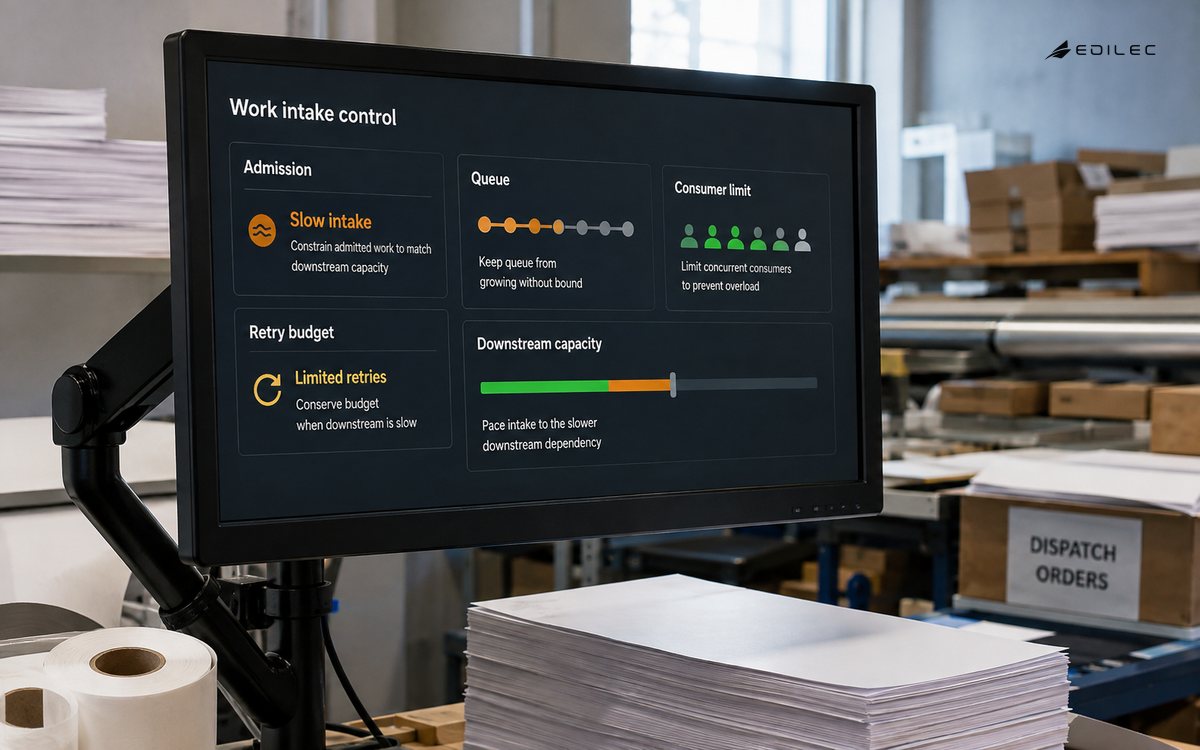
- Translate the slowest dependency's sustainable budget into consumer and per-tenant limits.
- Treat queues as bounded, measured delay with age and drain objectives.
- Coordinate admission, event-source scaling, function concurrency, batches and downstream clients.
- Use finite, jittered retries with idempotent effects and poison-message isolation.
- Ramp recovery from useful completion and saturation signals, not backlog pressure alone.
Frequently asked questions about serverless backpressure
Is adding a queue enough to create backpressure?
No. A queue absorbs a bounded burst, but producers can still outpace sustainable throughput and consumers can still overwhelm a dependency. Admission, queue-age objectives, concurrency caps and retry budgets provide the control policy.
Is provisioned concurrency an overload control?
Provisioned concurrency prepares execution environments to reduce startup latency. Reserved concurrency allocates and caps concurrent executions. Neither replaces downstream budgeting, though a reserved cap is a useful enforcement point.
Should concurrency increase whenever queue depth rises?
Only while the protected dependency has measured headroom and useful completion improves. If saturation or throttling is rising, more concurrency can reduce throughput. Use oldest age, completion and dependency signals together.
Conclusion
Reliable serverless systems scale according to the capacity of the work they depend on, not merely the demand waiting to run. Explicit admission, bounded queues, coordinated concurrency, disciplined retries and feedback from useful completion let the system degrade predictably, protect priority work and recover without turning its backlog into the next overload event.