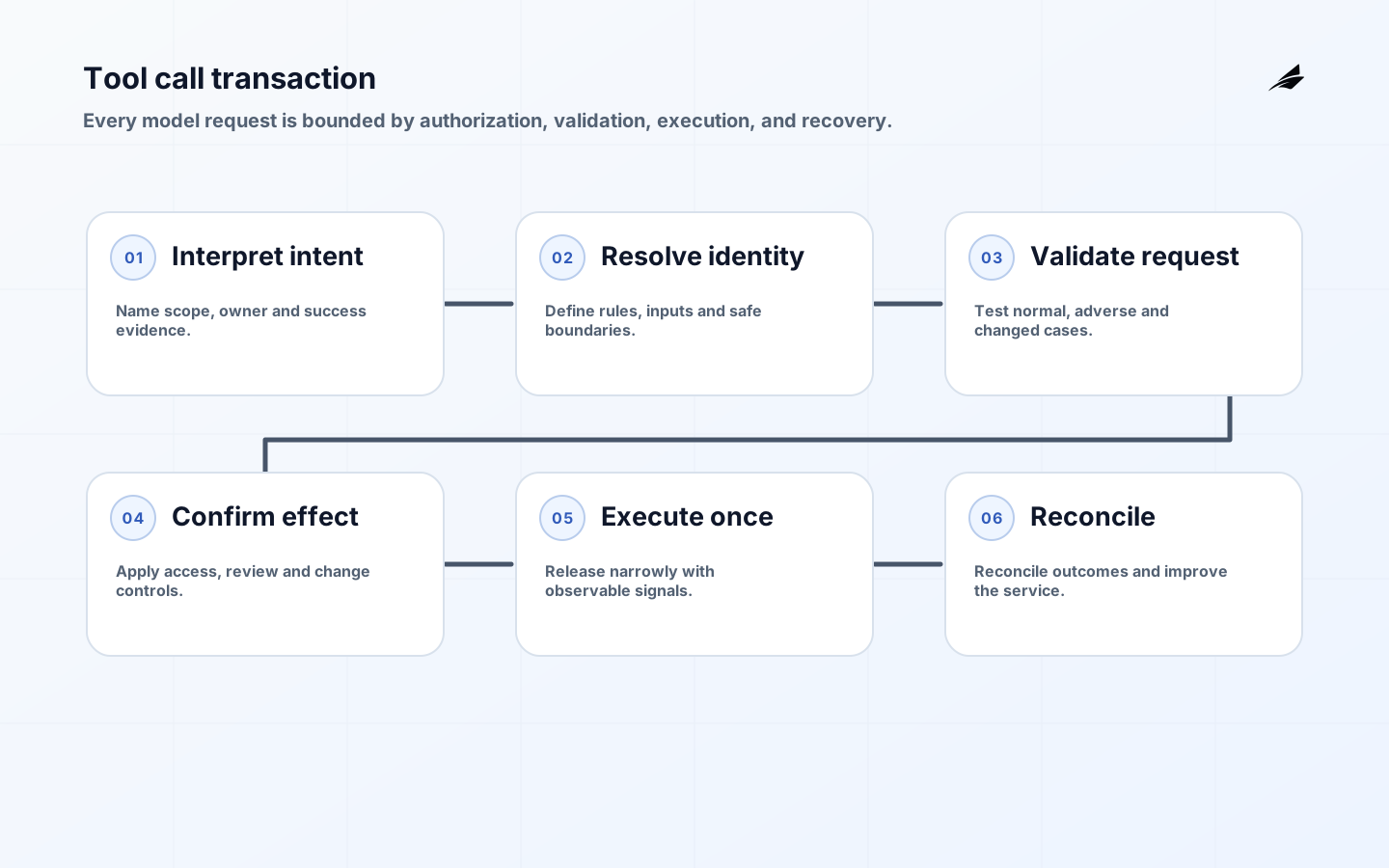
Tool calling lets a model move from proposing language to requesting an operation: query inventory, create a ticket, calculate a quote, or submit a change. That transition creates a security boundary. The model may suggest arguments, but trusted application code must decide whether the caller, purpose, resource, and requested effect are authorized. CTOs therefore need to treat each call as a transaction with validation, bounded credentials, idempotency, audit evidence, and a recoverable failure path. A polished demonstration says little about behavior under prompt injection, stale state, partial outages, or repeated retries. Start with one tool whose effects are reversible and whose owner can define valid parameters and outcomes. Then connect the design to the tool-calling cost guide, model evaluation operating guide, and LLM observability guide to cover economics, behavioral testing, and production diagnosis.
Set the operating boundary for tool calling
Scope the first implementation as a precise capability statement: an authenticated inventory planner may ask the agent to read stock and open purchase orders, then draft—but not place—a replenishment order below a stated value. List the callable operations, allowed resource set, maximum spend or record count, required confirmation, and data the model must never send to a tool. Bind these constraints to the user's identity at execution time, not to instructions in the conversation. The boundary should also cover call frequency, session duration, and whether one tool's result may feed another. If a request falls outside that envelope, return an intelligible refusal or a review task. This turns “the agent has access” into an authorization contract that engineers can test and security teams can review.
| Tool-call boundary | Required engineering choice | Transaction evidence |
|---|---|---|
| Permitted capability | Enumerate tools, resource scope, call budget, and effects requiring confirmation. | Capability contract, domain owner, and approval policy. |
| Caller and arguments | Authenticate the principal and validate typed values against current resource policy. | Tool, principal, normalized arguments, policy result, and request ID. |
| External effect | Confirm destination state before the assistant reports that a write succeeded. | API response, idempotency key, resulting record, and user message. |
| Containment | Provide per-tool disablement, credential revocation, and an authorized compensation route. | Affected traces, containment actor, correction, and reconciliation result. |
Test tool calling against real work
Test the complete call boundary rather than grading only the model's chosen tool name. Include valid requests, malformed identifiers, unauthorized tenants, excessive quantities, embedded instructions from retrieved content, ambiguous confirmations, tool timeouts, and responses that violate the declared schema. Force duplicate delivery and out-of-order results to verify that retries cannot repeat a side effect. For every case, record whether the system should call, ask a clarifying question, request approval, decline, or escalate. Assertions should cover normalized arguments, policy decision, credential scope, call count, cost ceiling, destination state, and user-visible explanation. Re-run this suite when a model, prompt, tool description, authorization rule, or downstream API changes. Red-team cases are especially valuable when they cross tool boundaries, because individually harmless read and write operations can compose into an unauthorized effect.
| Tool-call test | Assertions across the boundary | Expected handling |
|---|---|---|
| Authorized read | Identity, resource scope, parameter normalization, response mapping, and cost. | Return the permitted result with a trace reference. |
| Ambiguous write | Missing target, unclear quantity, stale context, or absent confirmation. | Ask for precise input or route to a named approver. |
| Injected instruction | Untrusted content attempts to select a tool, reveal a secret, or expand authority. | Ignore the instruction, deny the effect, and retain security evidence. |
| Uncertain completion | The API times out after a possible commit and the agent attempts a retry. | Resolve by idempotency key and destination state before another write. |
Assign controls and ownership for tool calling
Divide responsibility among the AI platform owner, the owner of each connected system, and the business authority for the resulting action. The platform team can enforce common schemas, secret handling, tracing, and call budgets; it cannot decide who may refund a customer or alter a production resource. The domain owner defines that policy and approves the tool contract. A separate risk or finance reviewer may be needed for high-value effects. Authorization belongs in deterministic code that evaluates the current principal and resource, while argument validation uses allowlists, types, ranges, and referential checks before invocation. Human approval should display the exact proposed effect and material context, not a vague request to “continue.” The NIST AI RMF functions—Govern, Map, Measure, and Manage—offer a useful structure for assigning these design, evaluation, monitoring, and response duties.
- Require a domain owner to approve the semantics and authorization policy of every exposed tool.
- Issue short-lived credentials for the authenticated user and requested resource instead of sharing an agent-wide secret.
- Validate tool selection and arguments in trusted application code before any external invocation.
- Display exact target, values, and material consequence when a person must confirm a proposed effect.
- Redact sensitive payloads in traces while retaining identifiers needed to investigate the external transaction.
Measure live tool calling behavior
Production telemetry should reconstruct a call without exposing secrets. Retain a trace identifier, user and service principal, model and prompt versions, selected tool, policy outcome, validated argument summary, latency, token and provider cost, tool response class, retry count, approval event, and confirmed downstream effect. Redact sensitive payload values while preserving stable references that an authorized investigator can resolve. Watch denial rate, validation failures, calls per task, repeated side-effect attempts, abandoned approval requests, tool-specific error budgets, and cases where the agent reported success without a matching system change. Segment by tool and workflow; a global success rate can conceal one dangerous write capability. Each alert needs a containment action such as disabling a tool, reducing its scope, switching the workflow to read-only, or routing work through the ordinary application until the owner completes review.
| Signal | Why it matters | Review response |
|---|---|---|
| calls per completed task | Shows whether the bounded task is producing acceptable work. | Sample cases and identify a version or source pattern. |
| rejected calls | Shows whether review is catching material problems. | Inspect evidence and adjust the decision boundary. |
| retry depth | Shows whether the fallback path has a real owner. | Escalate capacity or change the route. |
| and cost per approved outcome | Shows whether automation shifts burden downstream. | Compare against the manual baseline and recover if needed. |
Run and recover tool calling safely
Recovery begins with stopping new effects while preserving evidence. Operators need a per-tool kill switch, rapid credential revocation, queue pause, and a way to identify every call made by a suspect session or release. For write tools, document the compensating operation: cancel an unapproved order, revert a configuration through the supported change system, or flag a financial record for authorized correction. Never assume that repeating the inverse command safely restores state. Some actions are irreversible or have external consequences, so the domain owner must validate compensation. During a tool outage, the assistant should state that the operation did not complete and direct the user to the normal application; it must not infer success from an accepted request. Rehearse this procedure and verify that audit records remain available after credentials and sessions are revoked.
- Let users report an incorrect or surprising operation from the trace shown in their task history.
- Disable the affected write tool independently so read-only and unrelated workflows can continue.
- Query the destination by idempotency key before deciding whether a timed-out operation needs compensation.
- Have the domain owner approve reversal, cancellation, or record correction when the effect is material.
- Add the failure and neighboring cases to regression tests before credentials or call limits are restored.
Classify tool-call incidents by control layer before tuning the prompt. The model may have selected the wrong operation; the tool description may be ambiguous; authorization may have admitted an invalid principal; schema validation may have accepted a dangerous value; the downstream API may have timed out after committing; or the agent may have misrepresented the response. Each cause has a different owner and corrective action. Record the original trace, intended outcome, actual external state, containment, and policy or implementation change. Add the case to regression tests, along with adjacent inputs that exercise the same boundary. A changed business rule should update the authorization contract and effective date, not be smuggled into conversational wording. This discipline prevents repeated prompt edits from masking defects in identity, transaction handling, or API semantics that a language model cannot reliably repair.
Release checklist
- Each callable operation has a domain owner, typed schema, resource boundary, and declared side effects.
- Execution policy authenticates the principal and checks authorization independently of conversational instructions.
- Writes carry idempotency protection, bounded retries, destination confirmation, and meaningful user status.
- Telemetry connects proposed arguments, policy decision, approval, API response, and final system state without leaking secrets.
- Operators have exercised tool disablement, credential revocation, manual continuation, and effect reconciliation.
Before granting another tool or increasing transaction limits, review sampled traces with the connected-system owner, security, product, and the operators who handle exceptions. Compare the proposed arguments, authorization evidence, approval screen, actual API response, and final state in the system of record. Include denied and interrupted calls, because a correct refusal or safe timeout is part of service quality. Check whether users are learning to phrase requests that bypass intended review, whether approvals have become mechanical, and whether retries or manual follow-up create duplicate work. Expansion criteria should be specific: no unexplained side effects in the observation window, tested credential isolation, bounded cost and call volume, acceptable exception ageing, and a recovery exercise completed by the on-call team. These conditions measure trustworthy reach, not how often the agent manages to invoke something.
Design each tool call as a transaction

Consider an assistant that may issue a customer refund. A safe tool contract names order, amount, currency, reason, evidence, requester, value limit, and idempotency key. Trusted code authenticates the user, resolves current entitlement, validates captured funds, and confirms the customer-visible effect. Execution returns a durable provider reference, and reconciliation verifies the refund. After a timeout, check the idempotency key instead of asking the model to guess whether money moved.
Use this review with the article tables and linked Edilec guides. Sample completed records as well as exceptions, retain the rule and source versions that produced each outcome, and assign every corrective action to a policy, data, interface, integration, security, or operating owner. Metrics indicate where to investigate; representative cases reveal what must change. Before scope expands, repeat the exercise with an unavailable dependency, a delayed message, an unauthorized user, and a correction after the nominal process has finished. This review is specific to tool execution and uncertain outcomes.
- Split read propose and execute tools.
- Authorize user tenant object and value.
- Validate schemas and business invariants.
- Confirm consequential external effects.
- Bound steps time cost and retries.
- Log outcome and recovery evidence.
Key takeaways
- Treat every model-proposed operation as an untrusted transaction request until policy and schema checks pass.
- Grant only the resource scope and lifetime required for the current authenticated task.
- Test injection, malformed arguments, duplicate delivery, partial failure, and ambiguous completion before enabling writes.
- Expand tool authority only after traces prove containment and recovery work under realistic dependency failure.
Frequently asked questions
Which tool should a team expose first? Prefer a narrow read operation or a reversible draft action with stable API semantics, clear ownership, and useful audit output. When is confirmation necessary? Require it when the user must exercise judgment over a material effect; show the exact resource, values, and consequences being approved. Can the model decide authorization from the conversation? No. The application must authenticate the principal and evaluate policy against current resource context. How should retries work? Reads can usually retry within a budget, but writes need idempotency keys and confirmation of the destination state. When is broader access justified? Only after representative traces show valid parameter handling, isolation between users and tenants, predictable costs, safe behavior during dependency failure, and a practiced way to contain and compensate erroneous effects.
Conclusion
For the adjacent operating question, read AI Tool Calling: Cost, Security, and Scaling Guide. For tool calling, use it to compare the specific control choices, evidence, and escalation route before widening the workflow.
Reliable tool calling comes from a narrow authority envelope around every operation. Authenticate outside the model, validate proposed arguments, control retries, and confirm the external result before reporting success. When the team can trace, disable, and safely recover each capability, adding a new tool becomes an engineering change with known obligations rather than another leap of trust.