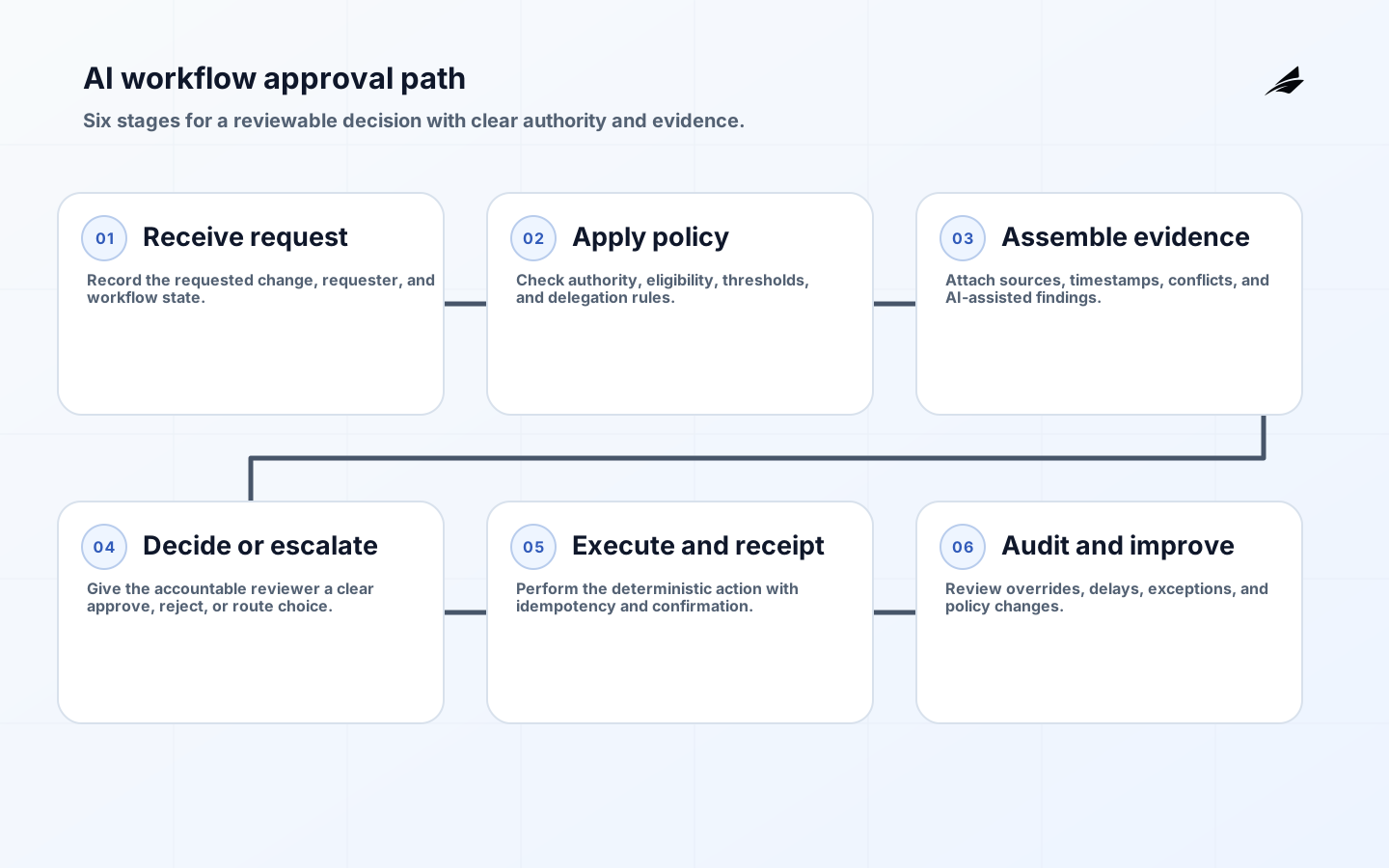
AI workflow approvals are not simply a button placed after a model response. They are a decision system: someone requests a change, software assembles relevant evidence, policy determines who may decide, an accountable person or rule makes the decision, and the result is executed and recorded. AI can make that process faster by extracting facts, comparing documents, drafting a recommendation, or identifying missing information. It should not blur who had the authority to approve. The NIST Generative AI Profile provides a useful discipline here: map the context, roles, impacts, and controls before optimizing the model interaction.
Name The Decision And Authority
Describe the actual decision in a sentence: approve a supplier exception, release a document for publication, grant a temporary access request, or authorize a payment change. Then name the accountable approver, the required evidence, the policy conditions, delegation rule, service-level expectation, and appeal or exception path. A model-generated recommendation can be useful input, but it is not an approval. Make the workflow distinguish draft, submitted, under review, approved, rejected, expired, and executed states. That prevents a user interface from making a probability or summary look like a binding result. Engineering teams can use the AI agents guide for the broader boundary between assistance and action.

| Workflow element | Question to answer | Implementation artifact |
|---|---|---|
| Decision | What changes if this request is approved? | A typed request with a clear state transition. |
| Authority | Who may approve this case and who may delegate? | Policy rules tied to current identity and role data. |
| Evidence | What must be true or documented first? | A visible evidence bundle with source and timestamp. |
| Execution | What happens after the decision? | A deterministic, idempotent action with a receipt and recovery path. |
Assemble Evidence With Provenance
An approver should see the facts needed to decide, their sources, freshness, and any uncertainty. If AI extracts a clause from a contract or summarizes a case history, preserve the original source reference and show what was omitted or unresolved. Do not invite reviewers to rubber-stamp a polished paragraph. Surface policy checks, conflicts, missing fields, and thresholds alongside the recommendation. Keep sensitive material scoped to the reviewer’s permission. This evidence bundle should remain stable enough to audit later; when live data changes, record the version or time of evaluation. That is more useful than retaining a bare “approved by AI” label, which explains neither the decision nor the controls.
- Show the requester, request version, and requested state change.
- Attach source identifiers and timestamps to extracted or summarized facts.
- Explain why a recommendation was produced and where uncertainty remains.
- Prevent a reviewer from approving outside their current authority.
- Record the decision, rationale, and execution receipt in the workflow history.
Design Escalation Not Just Approval
The most important approval experience may be the case that should not be approved or rejected automatically. Design routes for missing evidence, conflicting policy, unavailable approvers, suspected fraud, and requests outside the standard rule. Define who owns the clock when a case escalates and what users see while it waits. An AI system can help package a case for the next reviewer, but the routing criteria should be deterministic and reviewable. OWASP guidance matters here because an AI-generated recommendation can be manipulated by untrusted inputs; it must never be the sole gate for a consequential action.
Test Policy, Time, And Exceptions
Test with role changes, delegated authority, expired requests, conflicting evidence, duplicate submission, and a policy update between recommendation and approval. Verify that the system rechecks relevant conditions at execution time. Test the reviewer interface for understandable risk: can someone identify what is being changed, compare sources, and decline without losing the case? Capture time-to-decision and rework, but do not optimize them by hiding evidence. The NCSC secure AI guidance supports a secure lifecycle approach in which changes, monitoring, and incident response are planned rather than improvised.
| Scenario | Control that should hold | Evidence to retain |
|---|---|---|
| Approver role revoked | Approval is refused even if the screen was already open. | Current authorization result and attempted action. |
| Policy revised | The request is re-evaluated or clearly marked stale. | Policy version, evaluation time, and re-review outcome. |
| Duplicate submission | Only one business change is executed. | Idempotency key, request lineage, and execution receipt. |
| AI extraction uncertain | Case routes to review with the original document available. | Confidence indicator, source location, and reviewer rationale. |
Operate The Approval System
Assign an owner for policy, workflow configuration, model-assisted extraction, and downstream execution. Review overrides, rejected recommendations, late approvals, repeated exceptions, and audit findings. Those signals may point to unclear policy, inadequate data, a brittle extraction step, or capacity constraints rather than an AI problem. Version workflow changes and use staged rollout for high-impact rules. Keep a review pack with representative cases and expected outcomes. A well-run approval system improves trust because people can see that automation speeds evidence work while authority, exceptions, and accountability remain explicit.
Roll Out With Assurance Evidence
Launch an approval workflow with a controlled population and a review pack that contains representative approved, rejected, delegated, expired, and escalated cases. Compare the new path with the existing process for completeness of evidence, time to decision, rework, and ability to explain an outcome. Train reviewers on what the system has checked and what it has not checked. A reviewer who believes an AI summary is a compliance determination may click faster while making a worse decision. Make the interface reveal the policy state and source evidence at the point of approval, then collect feedback from the people who must resolve exceptions after the fact.
Assurance is ongoing because policy and organizational structure change. Schedule periodic tests of approval limits, separation of duties, delegates, expired requests, and audit export. When a team changes a threshold or adds an AI extraction step, treat it as a workflow change requiring cases and rollback evidence. Measure both speed and quality: a reduced queue time is not a win if later correction, appeals, or incidents increase. With that rhythm, the approval system becomes a dependable control plane for work rather than a fragile automation layer that only appears orderly in normal conditions.
| Assurance check | What to demonstrate | Why it matters |
|---|---|---|
| Authority check | The same request is correctly accepted or rejected as roles and delegates change. | Approval is valid only under current organizational authority. |
| Evidence check | A reviewer can reach each source and identify its version or timestamp. | Makes the decision explainable months later. |
| Execution check | Approved requests produce one verifiable downstream change and rejected ones produce none. | Separates decision state from business effect. |
| Exception check | Missing or conflicting cases have a named route and service expectation. | Prevents stalled work from becoming invisible work. |
Be careful with approval thresholds generated from patterns in past decisions. Historical behavior may encode exceptions, bias, or informal delegation that policy did not intend to preserve. Use analytics to identify where reviewers spend time, but express the actual rule in reviewable policy and test it with accountable owners. When an AI suggestion is shown, record whether the reviewer accepted it, changed it, or ignored it, and investigate patterns by case type rather than judging individual reviewers. The purpose is to improve the workflow’s evidence and fairness, not to pressure people into agreeing with automation.
Finally, make approvals understandable to requesters as well as reviewers. A status update should say what evidence is missing, who owns the next decision, and when the request will expire or be reconsidered. Clear status reduces duplicate submissions and removes the pressure to bypass the controlled route through informal messages.
Where a decision has regulatory, contractual, or financial consequence, involve the policy and assurance owners early. They can identify required evidence, retention, explanation, and escalation criteria before engineering has encoded an attractive but incomplete approval screen. This reduces expensive redesign after the workflow has become embedded in daily operations.
Approval analytics should lead to a focused improvement backlog. Repeated evidence requests may suggest a missing intake field; frequent delegation may suggest a poor role design; late decisions may reveal unclear service ownership. The best outcome is not more approval clicks. It is a clearer policy and a smaller set of cases that genuinely need judgment.
Keep the approval record usable after systems evolve. Store stable references to policy, source evidence, identities, and execution receipts rather than only screen text that a future interface cannot reconstruct. That modest design choice protects auditability when teams migrate workflow software or revise the presentation layer.
When a policy is intentionally ambiguous, record that ambiguity and route it to the appropriate decision maker. Pretending that a model can resolve an unsettled business rule only makes the later correction harder to defend.
Key Takeaways
- Define the decision, accountable authority, evidence, and execution before adding AI assistance.
- Show source-backed evidence and uncertainty to the reviewer.
- Model recommendations are inputs; current policy and identity determine approval.
- Design escalation, expiry, delegation, and recovery as first-class states.
- Audit the decision and downstream execution, not merely the generated text.
Frequently Asked Questions
Can low-risk requests be approved automatically? Yes, when deterministic policy clearly establishes eligibility and the system records the decision. AI may assist with extracting or organizing facts, but automatic approval should rest on rules the organization can inspect and change.
What should reviewers see? The requested change, relevant source facts, policy outcome, uncertainty or conflicts, who requested it, and the consequence of approval. The review screen should support a real decision, not a ceremonial click.
Conclusion
The strongest AI workflow approvals make the right decision easier, not less visible. Engineer the state machine, evidence, authority, exceptions, and execution controls first. Then use AI where it reduces information work while leaving responsibility where the business needs it to remain.