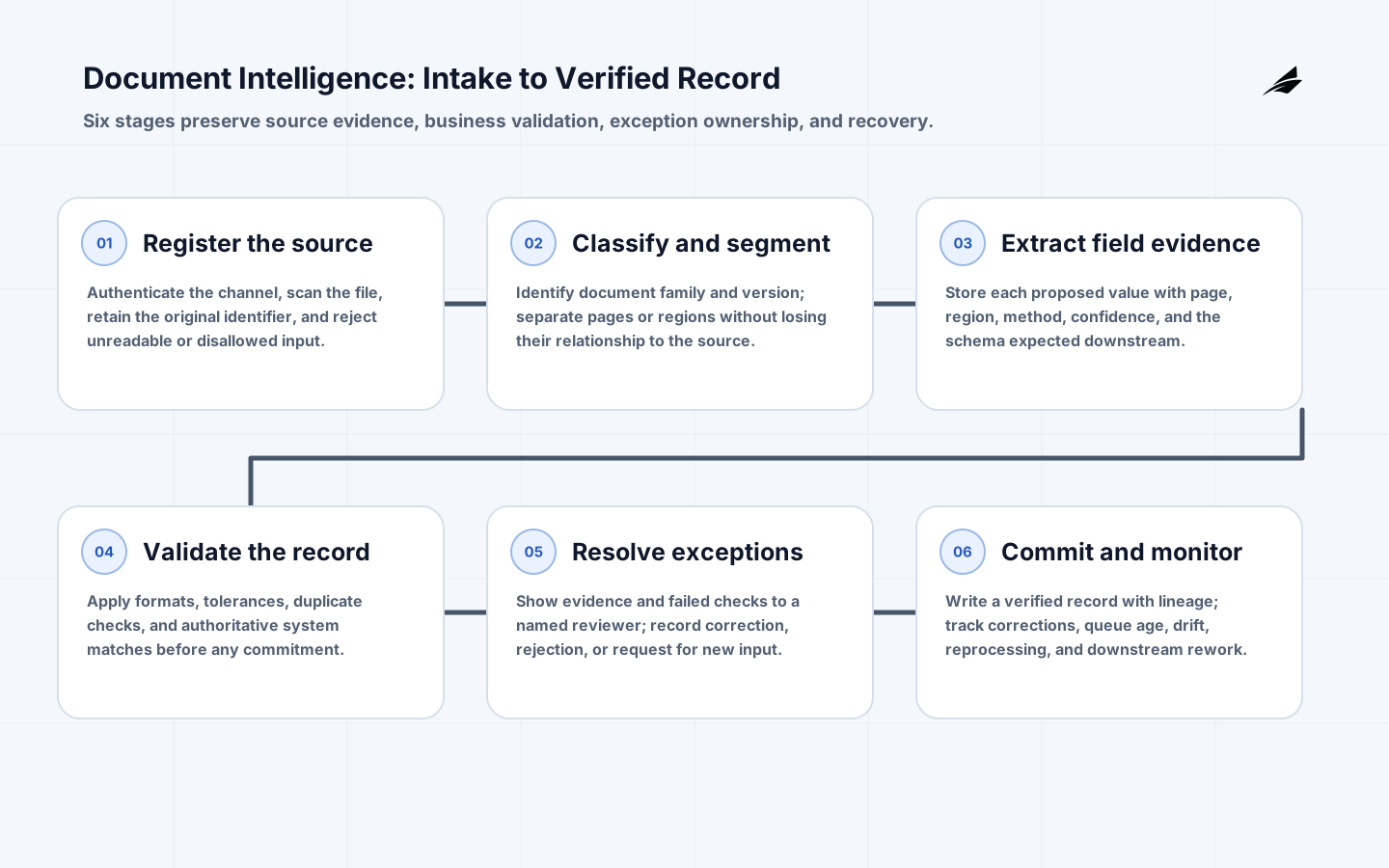
Document intelligence uses software and AI techniques to classify documents, extract fields, compare content, and route exceptions. Its practical value is not that a model can read a PDF. It is that an operations team can reduce repetitive intake work while preserving the evidence, controls, and recovery needed for a business record. An invoice, application, certificate, or contract often arrives with uneven layout, missing values, scanned pages, and context that changes the meaning of a field. The NIST Generative AI Profile is useful because it pushes teams to assess the system in its intended context, including the cost when an extraction is wrong.
Map The Document Decision
Start at the operational decision, not the file format. Is the team deciding whether an application is complete, matching an invoice to a purchase order, routing a claim, or creating a case record? Define the incoming document types, required fields, source of truth, acceptance criteria, reviewer role, and consequence of error. A field may be safe to prefill but unsafe to post automatically. For instance, extracting an invoice number can speed review; setting a payment status may require matching, tolerance checks, and approval. A narrow map gives teams a sensible first release and connects document work to AI workflow approvals.

| Stage | Question | Control |
|---|---|---|
| Intake | Is this file expected, readable, and permitted? | Authenticate source where possible, scan uploads, and retain original identifiers. |
| Classification | What document type and version is it? | Use a confidence threshold and route unknown classes to review. |
| Extraction | Which fields are needed for the next step? | Capture value, page or region reference, and extraction confidence. |
| Decision | Can the workflow proceed? | Validate against authoritative records and route exceptions rather than guessing. |
Preserve Field-Level Evidence
A useful extraction result includes more than a string. Store the source file reference, page or region, document version, extraction method, time, and confidence or review state. Present the original document next to the proposed value where a person needs to decide. This makes it possible to correct a single field without discarding the whole case, and it gives auditors an understandable path from a system record back to source evidence. Do not flatten uncertain text into a final database value just because the format looks plausible. If a document says “net 30” in a clause but a header says something else, that conflict should be explicit rather than silently resolved by the most fluent output.
- Keep the original file immutable and link derived values back to it.
- Use normalized field schemas with units, dates, currencies, and validation rules.
- Show source locations to reviewers for consequential extractions.
- Record whether a human accepted, changed, or rejected each proposed field.
- Retain enough metadata to reprocess documents after a model or rule change.
Build An Exception Queue
The exception queue is the product, not a failure to automate. It should receive unreadable files, unknown types, low-confidence fields, missing mandatory values, conflicting records, policy exceptions, and suspected tampering. Give reviewers the tools to see the proposed data, original evidence, validation result, and next action without rebuilding the case in email. Measure queue age, repeat exception causes, correction rate, and downstream rework. This reveals whether the real bottleneck is document variability, unclear policy, poor source quality, or a model limitation. OWASP guidance also matters when documents are untrusted input; their contents must not redefine workflow policy or trigger unrestricted actions.
Test Real Document Variation
A credible test set includes scanned copies, rotated pages, multi-language documents, similar templates with different semantics, handwritten notes, missing pages, duplicates, and supplier-specific variations. Include the hard cases that currently generate manual follow-up. Test field accuracy, document classification, evidence location, validation results, queue routing, and the final business outcome. Test access too: a reviewer should not receive an unrelated customer document merely because it was similar. The NCSC guidance supports treating testing, deployment, monitoring, and incident handling as a continuous operating responsibility.
| Operational signal | What it means | Possible improvement |
|---|---|---|
| High correction on one field | The extraction target or source layout is unstable. | Add deterministic validation, template handling, or mandatory review for that field. |
| Long exception age | Review capacity or ownership is unclear. | Set routing priorities, service levels, and explicit escalation. |
| Duplicate documents | Intake is creating duplicate cases or uploads. | Use file and business-key checks before downstream processing. |
| Low downstream match rate | Extracted data does not align with the system of record. | Inspect normalization rules, source quality, and matching tolerances. |
Operate A Document Quality Loop
Assign ownership across intake, document schemas, validation rules, exception operations, and model configuration. Review changes to templates, regulations, suppliers, and downstream systems because each can change extraction performance. Keep a representative case pack and run it before altering a model, prompt, OCR engine, or threshold. Feed reviewed corrections back into the appropriate layer rather than indiscriminately retraining on everything. Some corrections show that a document owner needs to improve the source template; others show that a business rule needs clarification. This closed loop keeps document intelligence tied to a measurable operational service rather than a one-off demonstration.
Roll Out By Document Family
Choose a document family with enough volume to matter and enough consistency to learn from: one supplier invoice pattern, one application type, or one policy form. Baseline the current handling time, correction rate, queue age, and downstream mismatch rate. Configure the workflow to produce a proposed record and an evidence-rich review screen before allowing any automatic posting. During the pilot, sample both accepted and rejected extractions, including cases where a reviewer did not change the field. That catches false confidence, where an apparently correct value is accepted because verification is too costly. Expand to the next document family only after owners understand its distinct variability and policy requirements.
Operations leaders should also plan the human capacity that automation shifts rather than removes. Early success often creates a surge of exceptions from documents that were previously rejected informally or handled in personal inboxes. Define priority rules, staffing expectations, escalation, and feedback capture for that new queue. Review whether upstream partners can improve templates or data submission, because the cheapest extraction error is one that never enters the system. The strongest programs use the evidence from review to improve both incoming documents and the automation that handles them.
| Pilot check | Evidence of readiness | Owner |
|---|---|---|
| Document coverage | Reviewed examples include the real layouts, scans, and exceptions seen in the target queue. | Operations and document owner. |
| Field validation | Every proposed value has a rule, source location, or reviewer state. | Business system owner. |
| Queue operations | Exceptions have priority, service level, and a route for missing information. | Operations manager. |
| Reprocessing plan | The team can re-run affected documents after a rule or model change without duplicating records. | Engineering owner. |
A mature document intelligence service distinguishes automation confidence from business confidence. A model may be highly confident that it read a number correctly, while the number may still fail a purchase-order match or require a different currency rule. Keep those signals separate in the interface and in metrics. This helps reviewers focus on the decision they own instead of trying to interpret a black-box score. It also makes improvement more precise: an OCR issue, a document classification issue, a field interpretation issue, and a validation-rule issue belong to different owners and should not all be treated as one generic extraction problem.
Keep the acceptance criteria visible to the people who maintain upstream templates and partner integrations. A recurring exception is valuable evidence: it may justify a better required field, a machine-readable attachment, or a revised submission instruction. Improving the document at its source often creates more durable value than trying to infer around every variation.
When a document is reprocessed, keep lineage between the original proposal, the revised extraction, reviewer decisions, and the downstream record. That prevents a later audit from confusing a correction with a duplicate transaction. It also lets operations quantify whether a model or rule update truly improved historical quality.
Include a periodic quality sample even for document types that appear stable. Supplier layouts, scanners, and regulations shift gradually, and aggregate performance can look healthy until a small but important variant fails. Sampling accepted work is necessary because exception queues only reveal the cases the system already recognized as uncertain.
Before expanding, confirm that the pilot’s gains persist across ordinary seasonal volume and staffing changes. A workflow that succeeds only with a specialist watching every exception has not yet become reliable operational capacity.
That proof should include the backlog and rework created after the document leaves the intake team.
Key Takeaways
- Design around a business decision and its error cost, not generic document reading.
- Preserve original files and field-level provenance.
- Validate extracted values against authoritative records before committing them.
- Treat exception handling as a first-class workflow with owners and measures.
- Test the messy document variation that creates real operational work.
Frequently Asked Questions
Can document intelligence post directly to an ERP? It can, but only after field validation, current authorization, duplicate protection, and any required approval. Many teams begin by creating a review-ready draft or a structured exception case.
Is OCR enough? OCR turns images into text. Document intelligence adds classification, field interpretation, validation, workflow routing, evidence presentation, and measurement of the business result.
Conclusion
Document intelligence pays off when it reduces the time between an incoming file and a correct, evidenced next step. Map the decision, keep fields connected to their sources, validate what matters, and give exceptions a deliberate home. That lets operations gain speed without losing the ability to explain or repair a record.