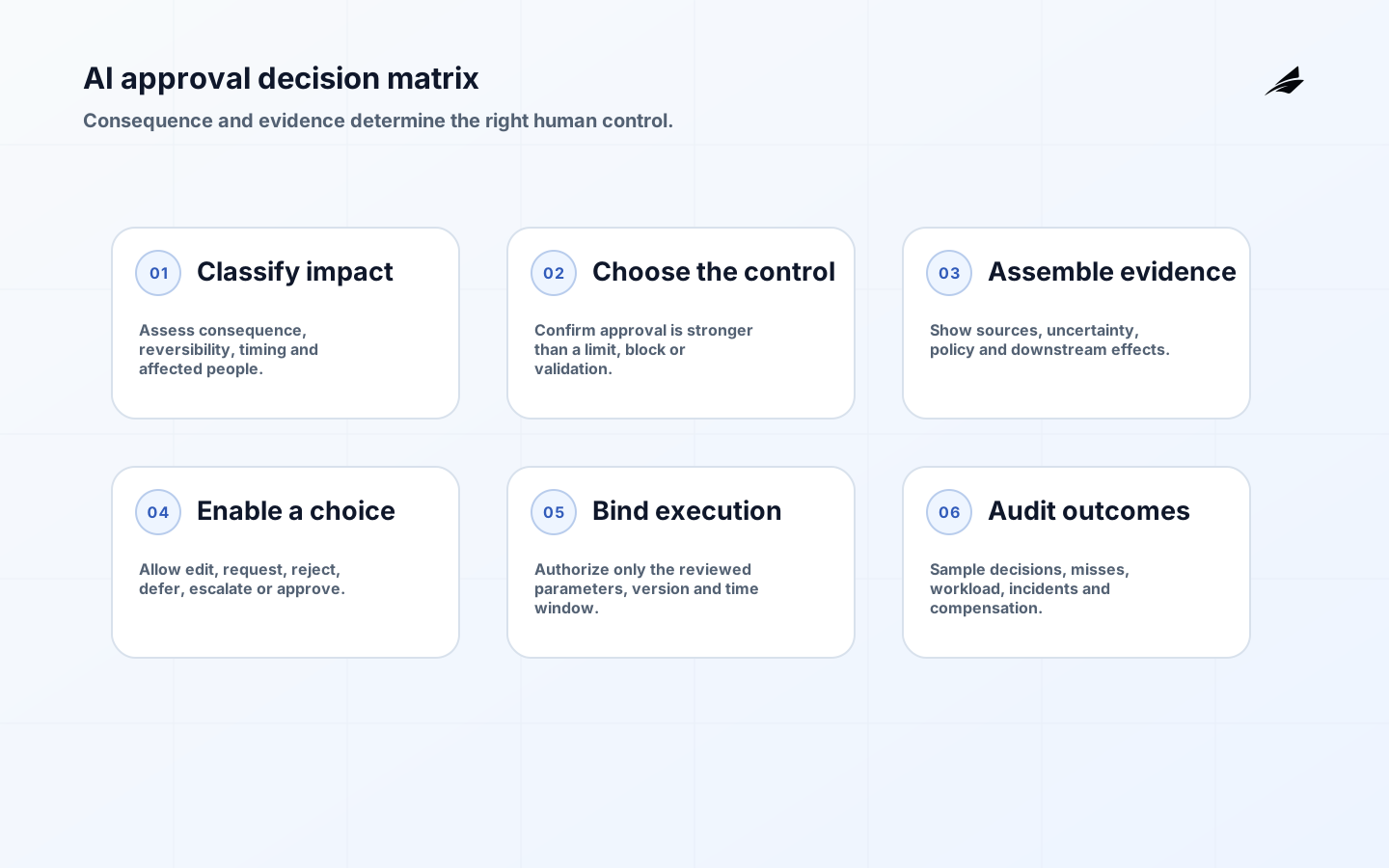
AI workflow approvals are product decisions about authority, evidence and responsibility. Adding an Approve button after a model response does not create meaningful oversight. A reviewer needs enough context to detect a bad recommendation, a real choice to change or reject it, time and competence to decide, and an exception route when evidence is incomplete. The system must then enforce the approved scope rather than treating approval as a ceremonial click.
Product teams should begin with the consequence of a wrong action. Drafting a low-risk internal summary is different from releasing payment, changing access, rejecting a customer claim or publishing regulated advice. The NIST AI Risk Management Framework organizes risk work around Govern, Map, Measure and Manage; an approval should be one designed control inside that wider operating system.
For adjacent design choices, see Edilec's guides to document intelligence operations, human-in-the-loop automation, AI agents for business approvals, and agent tool permissions.
Key takeaways
- Base approval depth on consequence, reversibility, uncertainty and policy.
- Show source evidence and material uncertainty, not only a confident recommendation.
- Separate the reviewer who decides from the system component that executes.
- Make correction, rejection, deferral and escalation first-class outcomes.
- Measure reviewer effectiveness and downstream harm, not approval rate alone.
Decide whether approval is the right control
An approval is appropriate when a person has legitimate authority and information to judge the proposed action. It is weak when reviewers cannot independently assess the evidence, receive too many cases or are pressured to accept. Some risks are better addressed by removing model access to an action, requiring deterministic validation, limiting transaction value, using two-person authorization or keeping the workflow manual. Do not use human review to excuse an unsafe system boundary.

Classify actions before designing screens. Consider impact on people, money, rights, privacy, security and service continuity; likelihood of model or data error; reversibility; time sensitivity; and ability to verify. The EU AI Act includes specific human-oversight duties for applicable high-risk systems, but applicability and implementation require qualified legal analysis. The official regulation should be read in context rather than converted into a generic product checklist.
| Action class | Example | Default control | Why |
|---|---|---|---|
| Informational | Draft an internal meeting summary | User edits before use | Low consequence and easy correction |
| Bounded reversible | Create a CRM follow-up task | Confirmation plus undo | Effect is visible and recoverable |
| Material operational | Release a supplier payment | Authorized approval with independent checks | Financial loss and fraud exposure |
| Sensitive people decision | Recommend an employment action | Qualified human decision outside automatic execution | Rights, fairness and context matter |
| Security-critical | Grant privileged access | Policy validation and strong multi-party authority | Compromise may be difficult to contain |
| Prohibited | Action outside approved purpose | Block and record attempt | No reviewer should legitimize forbidden use |
Build a reviewable evidence packet
The review surface should state the requested outcome, affected subject, proposed action, source records, policy or rule, model-produced rationale, uncertainty indicators, conflicts, downstream effects and deadline. Highlight what changed since the last review. Link to the original evidence rather than presenting an untraceable synthesis. If retrieval or extraction omitted a page, the interface must not imply that the file was fully considered.
Confidence is only useful when calibrated for the task and shown with an action rule. A probability-like score from one component may not represent end-to-end correctness. Present concrete warnings such as missing required evidence, conflicting customer identifiers or an amount outside historical range. The NIST Generative AI Profile emphasizes measurement and evaluation across lifecycle risks; reviewers need evidence from those controls, not a decorative model score.
Design choices, not confirmation theater
Offer outcomes that match the real decision: approve as proposed, approve with changes, request evidence, reject, defer or escalate. Require a reason when it supports learning or accountability, but use structured choices plus optional notes instead of demanding repetitive prose. For irreversible or unusually consequential actions, add a final summary of scope and require explicit confirmation close to execution. Never preselect approval.
Prevent automation bias through product design. Do not visually bury contradictory evidence, use urgency language generated by the model or show a polished rationale before the underlying facts. Rotate quality-review samples and give reviewers feedback on missed errors. The UK ICO's AI and data protection guidance is a useful primary reference where personal data and automated decisions are involved, subject to jurisdiction.
Bind approval to controlled execution
The approval artifact should identify the exact action, parameters, evidence version, requester, reviewer, authority, time and expiry. Execution must verify that the artifact is valid and unchanged. If the payment amount, recipient, model output or governing record changes, require re-approval. Use idempotency keys so retries do not duplicate an action, and make the execution service enforce limits independently of the user interface or model.
Separate duties for high-risk workflows. The model may prepare a proposal, an authorized person may decide and a bounded service may execute; none should silently acquire the other's power. Log tool calls and business results with privacy-aware retention. Reconcile the approved intent with actual outcome. An API response marked successful is insufficient if the bank rejected the payment or the identity platform applied a different role.
| Approval artifact field | Purpose | Invalidation trigger | Audit question |
|---|---|---|---|
| Action and parameters | Bounds what may execute | Any material parameter change | Was the executed action identical? |
| Evidence version | Preserves the review basis | Source correction or new required evidence | What did the reviewer actually see? |
| Authority | Proves decision rights | Role removal or expired delegation | Was the reviewer authorized then? |
| Expiry | Limits stale decisions | Deadline or policy window passes | Was execution timely? |
| Policy version | Connects decision to rule | Material policy update | Which rule governed the choice? |
| Outcome reference | Links intent to effect | Execution failure or compensation | Did the approved result occur? |
Example: an invoice exception
An intake service extracts supplier, purchase order, amount and bank details. Deterministic checks find that the amount matches the purchase order but the bank account differs from the approved supplier record. The model summarizes the discrepancy; it cannot update the supplier or release payment. The reviewer sees both documents, change history and fraud policy, then routes the case to supplier verification instead of approving an exception.
After an independent team confirms the supplier through an approved channel, the master record changes under separate authority. The invoice returns with the new record version, and a finance approver reviews the payment. This path is slower than one-click approval but preserves separation of duties. A useful product metric is how quickly genuine exceptions resolve without unauthorized release, not how many AI proposals receive approval.
Test reviewers and the whole control
- Seed obvious, subtle and policy-dependent errors into representative cases.
- Measure whether reviewers detect them and how long evidence inspection takes.
- Change evidence after approval and verify that execution stops.
- Attempt an action above the approved amount or outside the approved recipient.
- Remove a reviewer's role and test active delegation and queued cases.
- Replay execution and prove there is no duplicate side effect.
- Simulate unavailable evidence, model service and downstream tool.
- Review performance differences across user and case groups where relevant.
Measure approval quality in production
Track decision accuracy from audited samples, material errors caught, material errors approved, overrides, evidence requests, escalation age, reviewer workload, time to safe resolution, unauthorized execution attempts and compensation. Compare performance by action class and interface version. A rising approval rate may signal better proposals or reviewer fatigue; only outcome and audit evidence can distinguish them.
Create thresholds that trigger action: pause automatic proposals after a severe incident, reduce allowed scope when evaluation falls, add staffing when queues threaten deadlines and retrain users when audit misses rise. The NIST AI RMF Playbook offers suggested governance and management actions; product teams should map applicable actions to named owners and retained evidence.
Version approval policy and temporary exceptions
Approval requirements change with products, laws, fraud patterns and operational maturity. Store policy as a versioned decision asset with owner, effective date, scope and tests. A case should record the policy version that routed it and the rule that required review. Before changing a threshold or authority level, replay historical cases to estimate queue volume and identify newly exposed consequences. Publish material changes to reviewers before activation.
Handle temporary exceptions as expiring grants, not configuration drift. Record rationale, risk owner, affected actions, compensating controls, start and end time, and review requirement. Alert before expiry and remove the exception automatically where safe. Sample decisions made under it and reconcile outcomes. This is particularly important during incidents, when pressure to unblock work can turn an emergency approval path into an undocumented permanent bypass.
AI workflow approvals FAQ
Should every AI output be approved by a person?
No. Match controls to risk. Low-impact drafts may need ordinary user editing, while prohibited or security-critical actions may need hard boundaries beyond a single approval.
Can a confidence threshold decide which cases need review?
It can contribute after task-specific calibration, but consequence, missing evidence, policy and distribution shift also matter. Test the complete routing rule against representative cases.
Does human approval transfer responsibility away from the product team?
No. Teams remain responsible for system boundaries, evidence quality, usability, evaluation and operations. A reviewer cannot compensate for a control that withholds necessary information or permits unapproved execution.
Conclusion
AI workflow approvals work when authorized people can understand, challenge and change a proposal, and when the system binds their decision to a controlled action. Classify consequences, design honest evidence, protect reviewer capacity, test the full control and learn from outcomes. That is meaningful human oversight; a button alone is not.