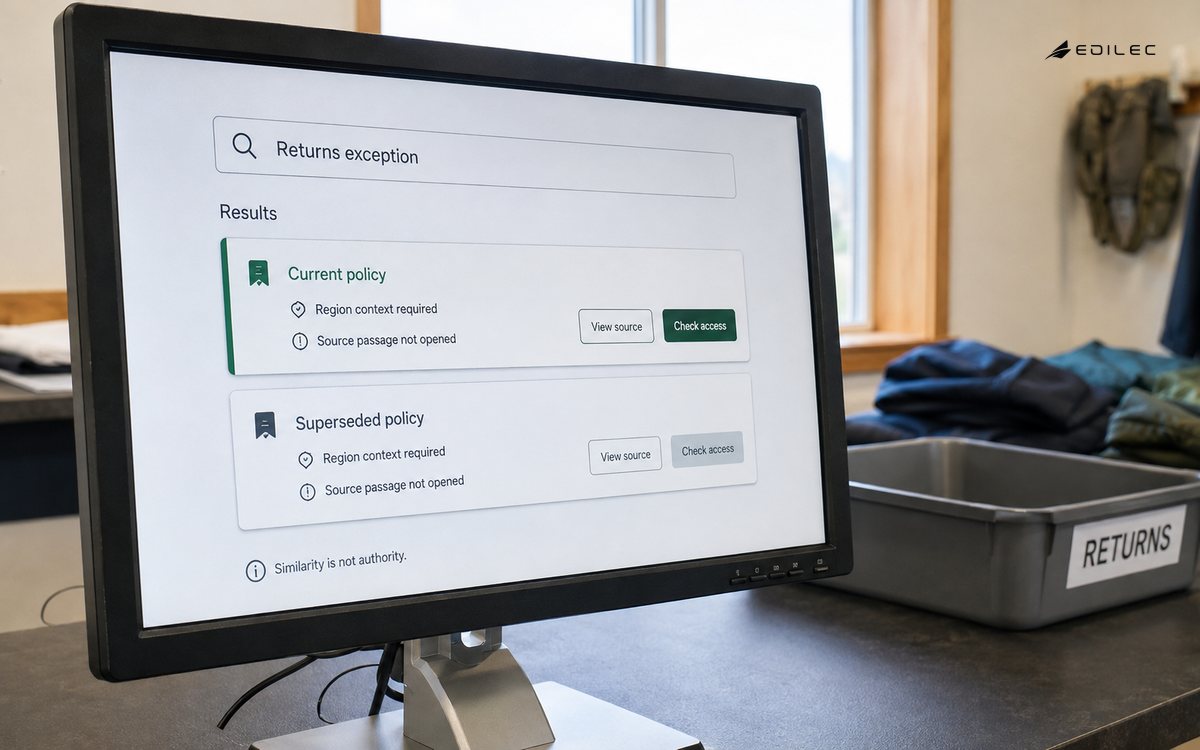
Semantic search should be treated as an operating capability, not a feature label. The decision for a CTO is whether a requester can find the current, permitted passage behind a business question. A policy search assistant is useful only when it can distinguish a current returns exception from an older regional policy, and show the operator the governing source. The NIST Generative AI Profile frames this work as a lifecycle concern: map intended use and impacts, measure performance and risks, manage the response, and govern the responsibilities around it. That is a useful antidote to a demonstration that proves a model can produce an answer but says nothing about authority, evidence, or recovery.
Start With the Semantic Search Decision
Write the job in one sentence, then write the unacceptable outcome beside it. For semantic search, the operating question is not whether the technology is impressive; it is whether a named person can complete a bounded task with appropriate evidence and control. A high similarity score is often mistaken for proof. It says nothing about version, permissions, completeness, or whether a short chunk reverses the meaning of the surrounding rule. The NIST AI Risk Management Framework supports this discipline by connecting intended context, measurement, governance, and management rather than treating risk as a late security review. related guide is a useful adjacent reference, but it should not replace a local description of the decision owner and failure boundary.
| Decision element | Question to settle | Evidence to keep |
|---|---|---|
| User and outcome | Who uses semantic search, and what completed work changes for them? | A task definition, accountable owner, and a measurable acceptance condition. |
| Authority boundary | What may be read, drafted, proposed, submitted, or changed? | A policy rule, identity claim, approval record, and revocation path. |
| Failure response | What happens when evidence is absent, conflicting, stale, or unsafe? | A visible abstention, escalation route, and incident or correction record. |
Build an Evidence Boundary
Create a source register with an owner, effective date, classification, language, retention rule, and durable link. Chunk by decision boundary rather than by a convenient character count; eligibility conditions and approval limits frequently need to stay together. This is where seemingly small implementation choices become operational commitments. A source link or event record must remain meaningful after a deployment, an employee role change, or a correction. The UK National Cyber Security Centre guidance emphasizes secure design, development, deployment, and operation as connected activities. Use that lifecycle view to assign an owner to the inputs, the policy, and the response when semantic search behaves unexpectedly.
- Name the source systems, people, and decisions that semantic search depends on; do not bury them in configuration alone.
- Classify information and actions by consequence, then choose controls that operate at the boundary where the consequence occurs.
- Keep an inspectable record of the input, material context, policy result, and output or side effect for cases that matter.
- Design a correction path that can remove or repair a bad record and tell an operator what work may have been affected.
- Practice the uncertain case. A system that can only handle happy-path inputs has not yet earned autonomy.
Put Controls Where They Can Enforce
Apply entitlement filters before candidates reach a model, preserve source and version metadata through ranking, and give the interface an explicit no-evidence state. Treat a changed embedding model, chunking policy, or corpus connector as a retrieval release, not a silent maintenance task. The OWASP guidance for LLM applications is particularly relevant when untrusted content can influence model behaviour or tool use: controls need to survive hostile and malformed inputs, not merely ordinary requests. For semantic search, prefer deterministic enforcement for identity, limits, destinations, schemas, and approvals. A model can help interpret context; it should not be the final authority for a rule that a service can verify directly.
| Control layer | What it protects | Practical test |
|---|---|---|
| Identity and access | The requester, source, and action scope. | Change membership or role and confirm the prohibited result remains unavailable. |
| Data and context | Currency, completeness, and permitted use of evidence. | Inject an obsolete, conflicting, or incomplete record and verify the response routes appropriately. |
| Action and recovery | Side effects, spend, external calls, and correction. | Force a validation failure or denied approval and confirm the state is safe and observable. |
Measure the Work, Not Just Uptime
Use judged queries that include acronyms, stale terminology, negation, conflicting rules, and questions that should return no answer. Track target-passage recall, rank position, access-filter failures, stale-result rate, and the proportion of answers a reviewer can trace to a source. Keep a small, versioned evaluation set close to the workflow and add real failures after review. Distinguish service availability from decision quality: a system can have low latency and still provide the wrong evidence or trigger costly rework. Review results with the people who understand the task, then turn recurring failure patterns into a test, a source repair, a product change, or a tighter boundary.
Release in Bounded Steps
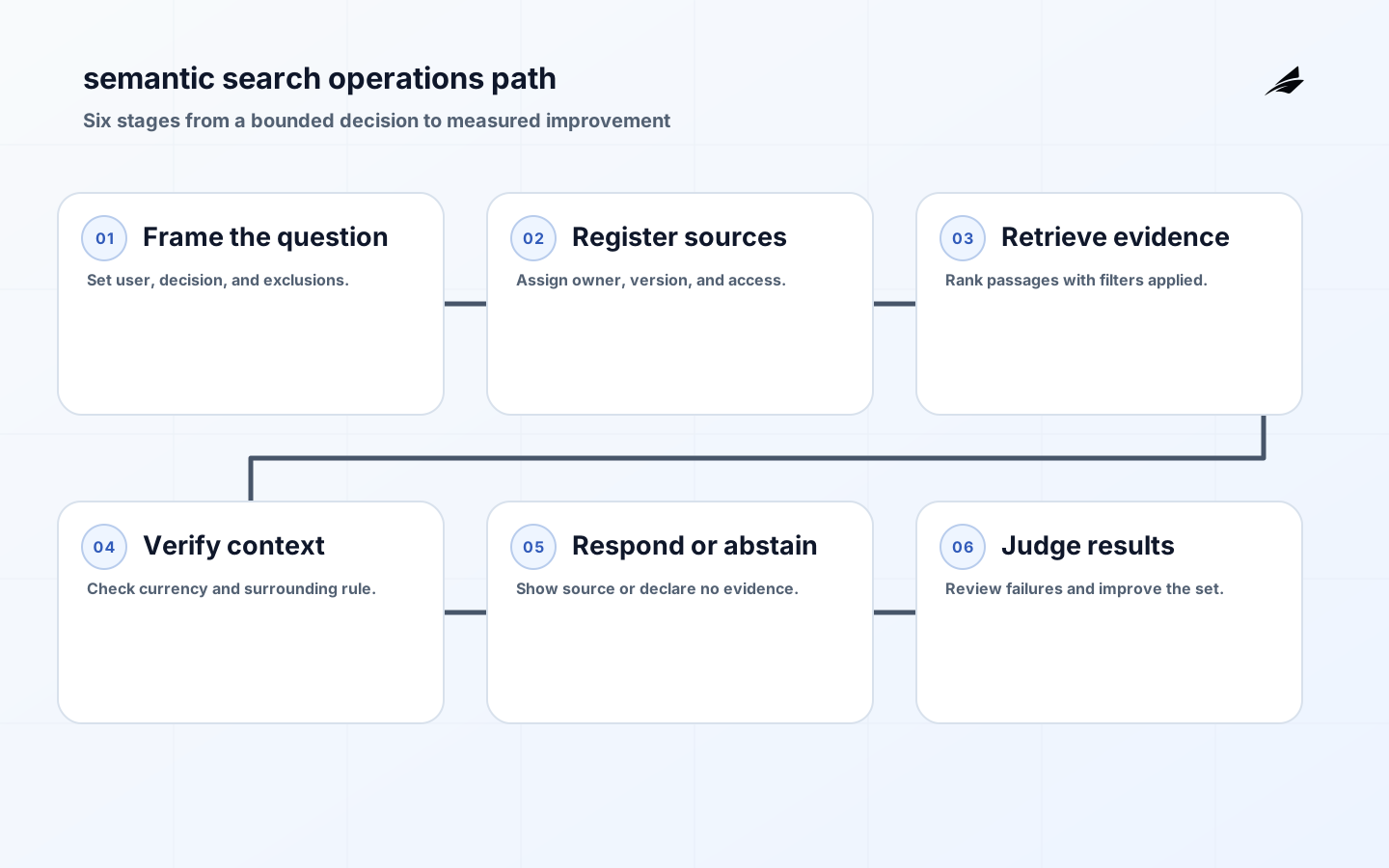
Start with one decision class, such as internal policy lookup for support supervisors. Run it beside the current process, sample disagreements, and fix source ownership before expanding to adjacent teams. Define a rollback condition before release, including who can disable the capability and how a human completes the work during recovery. Small launches are valuable when they are instrumented and reviewed; they are not a license to skip permissions, source checks, or error handling. Record the decision to expand with the same care as the initial decision to use semantic search.
Operate semantic search as a Living Service
A semantic search service needs a review cadence because its corpus changes in ways that ordinary uptime monitoring will not reveal. Ask source owners to review the highest-impact records, sample queries that led to no answer, and inspect result changes after a connector, parser, or index release. Separate a retrieval miss from a legitimate abstention: the first may require repairing coverage or ranking, while the second may be the correct answer when no permitted, current record exists. Product and operations leaders should also review whether people follow the cited source or bypass the tool, because that behaviour often reveals gaps in source clarity or interface context. Keep examples of successful retrievals as well as failures, then use both to set acceptable ranges by query class. A request for an exact product policy deserves different treatment from exploratory research. This cadence turns semantic search from a one-time index build into a service whose evidence can be challenged, corrected, and improved without pretending that every question has a single automatic answer.
Keep Review Evidence Actionable
Keep a decision log for material relevance changes. For each change, record the affected sources, test queries, reviewer judgment, rollout date, and rollback trigger. This gives a CTO evidence for whether investment should improve source stewardship, ranking, access control, or the user interface.
Assign Accountable Owners
Assign ownership across the whole retrieval chain. A knowledge owner approves source changes, an identity owner defines entitlements, and a product owner accepts relevance trade-offs. Their review should include a short change record showing which queries and records changed, whether the result became safer or merely different, and what users need to know. This separation prevents a search tuning exercise from quietly changing policy interpretation.
Key Takeaways
- Semantic search earns trust through a defined job and a named decision owner.
- Evidence, identity, and action boundaries must be explicit before a wider launch.
- Controls are strongest when enforced by deterministic services at the point of consequence.
- Evaluation should include difficult, absent, stale, and adversarial cases, not only successful examples.
- Expansion is a governed operating decision supported by outcomes, not a reward for a polished demo.
Frequently Asked Questions
Semantic search is not the same as a chat interface. Search retrieves and ranks evidence; generation may summarize that evidence. Keep the retrieval evaluation visible even when the experience includes a conversational answer. The practical next step is to select one workflow, write its evidence and authority boundaries, and create a small set of cases a domain reviewer can judge. That produces much more useful learning than a broad rollout with no shared definition of success.
Write the semantic-search architecture decision record
Before selecting a vector store or reranker, document the retrieval job and alternatives. State why lexical search, filters, synonyms, navigation, or curated answers are insufficient on their own. Define the corpus, entitlement model, freshness target, multilingual needs, latency budget, and cost boundary. Then record whether the design uses keyword, vector, hybrid, or reranked retrieval and what evidence justified that choice. Current search platforms commonly combine lexical and vector signals because exact identifiers and semantic similarity solve different problems. A CTO should insist on an evaluation that separates candidate recall from final ranking and answer quality. Otherwise a polished response can conceal that the required source never entered the candidate set.
| Decision | Evidence to compare | Architecture consequence |
|---|---|---|
| Keyword versus vector | Exact terms, synonyms, concepts, and identifiers | Single or hybrid candidate retrieval |
| Chunking | Passage recall with conditions intact | Parser and source-coordinate design |
| Reranking | Top-result relevance and added latency | Candidate depth and service budget |
| Authorization | Denied-document and mixed-role tests | Pre-retrieval filters and index partitioning |
| Freshness | Change-to-search and deletion latency | Incremental indexing and revocation path |
Architecture review should keep component choices in context. The plain-language semantic search guide aligns technical terms with user expectations, the CTO guide to RAG systems explains where retrieval sits in the answer path, and the LLM observability guide shows how to preserve version, evidence, latency, and outcome signals in production.
Conclusion
Semantic search becomes dependable when its operating constraints are visible: what it is for, what information it may use, what it may do, who can intervene, and how the organisation knows it is improving. Start with the consequential decision, preserve the evidence around it, and make uncertainty a safe state rather than something the system hides.