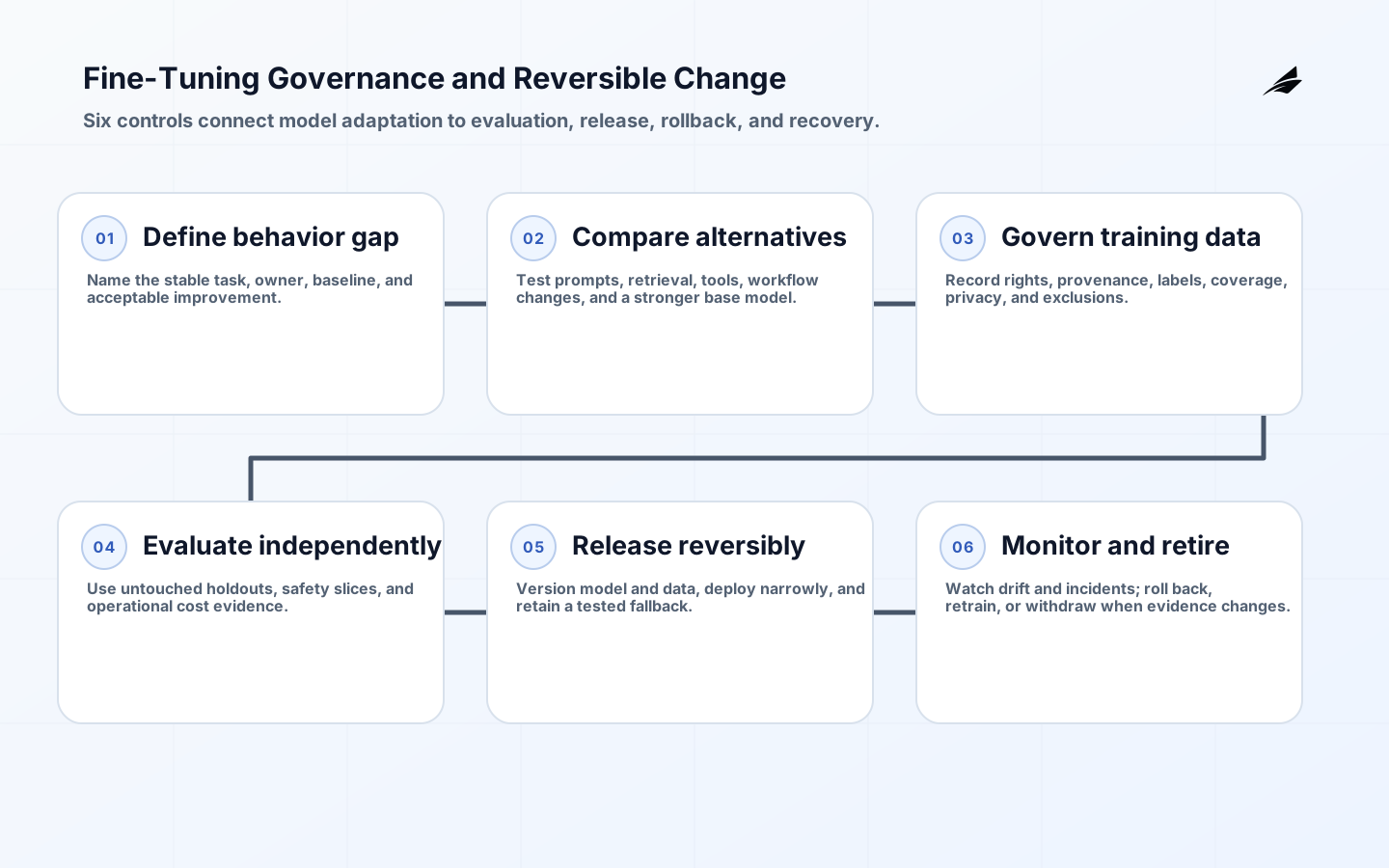
Fine-tuning is a production change to model behavior, not a shortcut for filling a knowledge gap. A responsible decision starts with a repeatable behavior problem, a data set the organization is allowed to use, and an evaluation set that can expose regressions. It also ends with a release that can be withdrawn without losing work or confusing users. This guide gives product and engineering leaders a practical path from the first problem statement to post-release review. For a plain-language orientation, pair it with The Plain-language Guide to Fine-tuning Decisions.
Understand What Fine-Tuning Changes
Fine-tuning changes how a base model responds to patterns represented in training examples. It can improve a stable style, classification boundary, output format, or tool-selection habit. It does not automatically make the model a current system of record, confer authorization, or guarantee that an answer reflects a policy updated after training. Current facts and access decisions usually belong in retrieval and deterministic services. The Retrieval Pipelines for Product Teams guide is a useful companion when the problem is evidence access rather than behavior.
Choose the Smallest Effective Intervention
Before commissioning training, reproduce the problem with a fixed prompt set and compare four remedies: a clearer prompt or schema, retrieval from an approved source, a deterministic rule or tool, and fine-tuning. Record the expected improvement and the new failure modes each remedy introduces. If a prompt change solves the issue without increasing review effort, training adds unnecessary lifecycle cost. If the task depends on a policy that changes every month, retrieval is generally easier to refresh than weights. Fine-tuning becomes more credible when the target behavior is stable and appears across varied inputs.
| Observed problem | First remedy to test | Evidence needed before training |
|---|---|---|
| The answer omits a required field or uses inconsistent structure. | Prompt constraints, structured output validation, and a clearer example. | A held-out set showing that formatting errors persist after the prompt and validator are improved. |
| The answer needs a current contract clause or account detail. | Permission-aware retrieval connected to the authoritative record. | A source freshness and access test proving that the right evidence reaches the model. |
| The model repeatedly applies a stable classification or tone rule. | A labeled example set and a baseline comparison against the current model. | A measurable gap across representative cases, including ambiguous and refusal cases. |
| The workflow must approve a payment, access change, or legal commitment. | A deterministic policy and human approval gate outside the model. | A design showing that model output remains advisory and cannot create authority. |
Define the Behavior Gap
Write a one-page decision brief before anyone curates examples. Name the user, the trigger, the input boundary, the desired output, and the business consequence of an error. State what the model must refuse or hand to a person. A useful objective is observable: when an authenticated support agent supplies a ticket and approved product notes, the system classifies the issue into one queue and returns a validated reason code. It is much stronger than a request to make the assistant smarter.
- Define a baseline using the current model, prompt, retrieval configuration, and validator.
- Separate quality targets from safety gates; a more fluent answer cannot compensate for an unsafe disclosure.
- Set explicit exclusions, such as unsupported languages, sensitive fields, or decisions requiring a licensed reviewer.
- Assign one owner for the behavior contract and another reviewer who did not curate every training example.
- Write a stop rule for the experiment: no release when a critical refusal, access, or factuality gate regresses.
The brief should also identify the system of record. Generated text may summarize a customer record, but it should not become the record merely because it sounds confident. Keep the source identifier, retrieval timestamp, model version, policy version, and final human or system outcome connected in the trace. NIST's AI Risk Management Framework and its Generative AI Profile both emphasize lifecycle governance, measurement, and documented response.
Treat Training Data as a Controlled Asset
A good data set teaches the intended behavior rather than preserving every accidental habit in historical responses. Remove duplicates, stale instructions, private material without a valid use basis, and examples whose labels depend on information unavailable at inference time. Inspect the long tail: a neat collection of easy examples can hide the exact ambiguity that causes operational harm. The OpenAI data-format guidance is a provider-specific reference for making examples resemble production inputs; the underlying discipline applies to any training stack.
| Data record | What to capture | Why it matters |
|---|---|---|
| Provenance | Source system, owner, collection date, permission basis, and transformation history. | Lets a reviewer explain whether an example may be used and recreate how it changed. |
| Task context | The user role, input shape, relevant tools, and constraints that existed at decision time. | Prevents labels from relying on hidden context that production requests will not contain. |
| Label rationale | Expected answer, allowed alternatives, refusal condition, and the reviewer who approved it. | Turns disagreement into a curatable issue instead of silently encoding one person's guess. |
| Split membership | Training, validation, or final holdout assignment with a stable record identifier. | Stops near-duplicate examples from leaking into evaluation and overstating generalization. |
Keep a final holdout that is not used to choose prompts, filters, hyperparameters, or checkpoints. Include normal requests, missing fields, conflicting evidence, adversarial instructions, out-of-scope questions, and cases that must be escalated. The holdout should resemble the deployment distribution without becoming a snapshot of only yesterday's tickets. If privacy requires redaction or synthetic examples, record which properties were changed and verify that the transformation did not remove the decision difficulty.
Evaluate the Whole Workflow
A training loss or benchmark score is not a release decision. Evaluate the candidate beside the baseline with the same inputs, retrieval state, tools, and output validator. Score task success, required-field completeness, refusal behavior, unauthorized disclosure, reviewer correction, latency, and cost. Review a sample manually with domain experts who can identify a plausible but operationally wrong answer. NIST's Measure guidance recommends documented, repeatable testing and monitoring rather than a one-time demonstration.

Set Release Gates That Reflect Consequence
Use hard gates for failures that must never be traded away: disclosure of restricted information, bypass of approval, invented evidence, unsafe tool arguments, or failure to escalate a defined high-risk case. Use comparative targets for softer measures such as reviewer editing time or average response quality. An aggregate score can conceal a severe regression in a small but important group, so report results by workflow, user role, language, and exception class where those distinctions affect risk. The OWASP Top 10 for LLM Applications provides a practical security test vocabulary for prompt manipulation, sensitive information disclosure, and excessive agency.
- Run deterministic checks on every candidate output before any side effect.
- Compare the candidate and baseline on the same cases, with disagreements routed for review.
- Record false accepts, false refusals, abstentions, and human corrections separately.
- Test tool calls with malformed, over-privileged, and replayed arguments.
- Require a written decision that names the residual risk, approver, and rollback trigger.
Release Gradually and Keep Recovery Practical
A reversible release has more than an old model identifier. Preserve the prior model, prompt and schema versions, retrieval configuration, policy checks, feature flags, and data-set manifest. Make the fallback executable by the on-call team, then rehearse it with a representative request. Roll out first to an internal cohort or a low-consequence queue, compare live corrections with the offline holdout, and expand only when the owner can explain the result. A rollback that requires rebuilding the environment is a hope, not a control.
Scenario: Support Triage Without Hidden Authority
Imagine a support team whose assistant drafts a queue, reason code, and short handoff note from an authenticated ticket. The team first tests a schema and retrieval change. Fine-tuning is justified only after the same classification habit remains inconsistent across products and ticket styles. The new model may propose a queue, but a policy service checks that the queue exists, the ticket is visible to the agent, and the issue is not in a mandatory escalation category. A reviewer can correct the proposal, and that correction becomes a labeled candidate for the next evaluation cycle rather than an invisible overwrite.
The operating record for each request should make the decision reconstructable: request class, permitted evidence, model and prompt versions, validator result, reviewer action, final queue, and any downstream change. If a product policy changes, the team can disable the tuned model, switch to the baseline, and update retrieval without pretending that the old weights understood the new rule. This is the difference between adapting behavior and embedding authority.
Operate and Reassess After Launch
| Signal | Inspect it by | Response |
|---|---|---|
| Behavior quality | Task class, user role, product version, and correction reason. | Add a failing case to evaluation, investigate the cause, and avoid retraining from an unreviewed correction. |
| Safety and authority | Refusal class, policy decision, tool validation, and access result. | Pause the candidate when a hard gate fails; route affected work to the known safe path. |
| Data drift | Input shape, vocabulary, source freshness, and label distribution. | Review whether the contract changed and whether retrieval or a new data collection is the better remedy. |
| Operational burden | Latency, inference cost, queue age, review time, and fallback frequency. | Adjust routing or capacity only after checking that quality and safety remain within their gates. |
Schedule a review when a policy, base model, tool, source, or user population changes, not only when a dashboard turns red. Retire a tuned model when its task disappears, its data rights expire, its failure pattern is no longer acceptable, or a simpler approach now meets the target. Keep an archive of the decision and evidence so retirement is an accountable change rather than an unexplained deletion.
Key Takeaways
- Start with a stable, measurable behavior gap and compare prompting, retrieval, rules, and interface changes before training.
- Document permission, provenance, labeling rationale, and split membership for every training example.
- Protect a final holdout and test ordinary, ambiguous, hostile, unauthorized, and unavailable cases.
- Use hard safety and authority gates alongside comparative quality and operating measures.
- Release with versioned dependencies, a rehearsed fallback, an owner, and an explicit rollback trigger.
- Turn corrections and incidents into reviewed evaluation cases, not automatic training data.
Frequently Asked Questions
Should fine-tuning store changing business knowledge?
Usually no. Use an authoritative, permission-aware retrieval path for facts that change and reserve tuning for a stable response behavior. A tuned model can learn how to cite or format retrieved evidence, but it should not be the only place a current rule exists.
How much training data is enough?
There is no useful universal count. Start with coverage of the behavior contract, including edge cases, and let the holdout show whether the candidate generalizes. More duplicated or weakly labeled examples can make the evidence worse, not better.
What should trigger a rollback?
Predefine triggers such as a hard safety failure, a meaningful rise in reviewer corrections, an unavailable dependency, or a drift pattern outside the tested contract. The trigger should identify who can act, which version is safe, and how unfinished work is reconciled.
Conclusion: Make Adaptation Reversible
Fine-tuning earns its place when it solves a named behavior problem that simpler controls cannot, and when the team can show what changed, what was tested, and how to recover. Keep current knowledge and authority outside the weights, make evaluation independent enough to challenge the builder, and let measured operating evidence determine whether the adaptation remains in service.