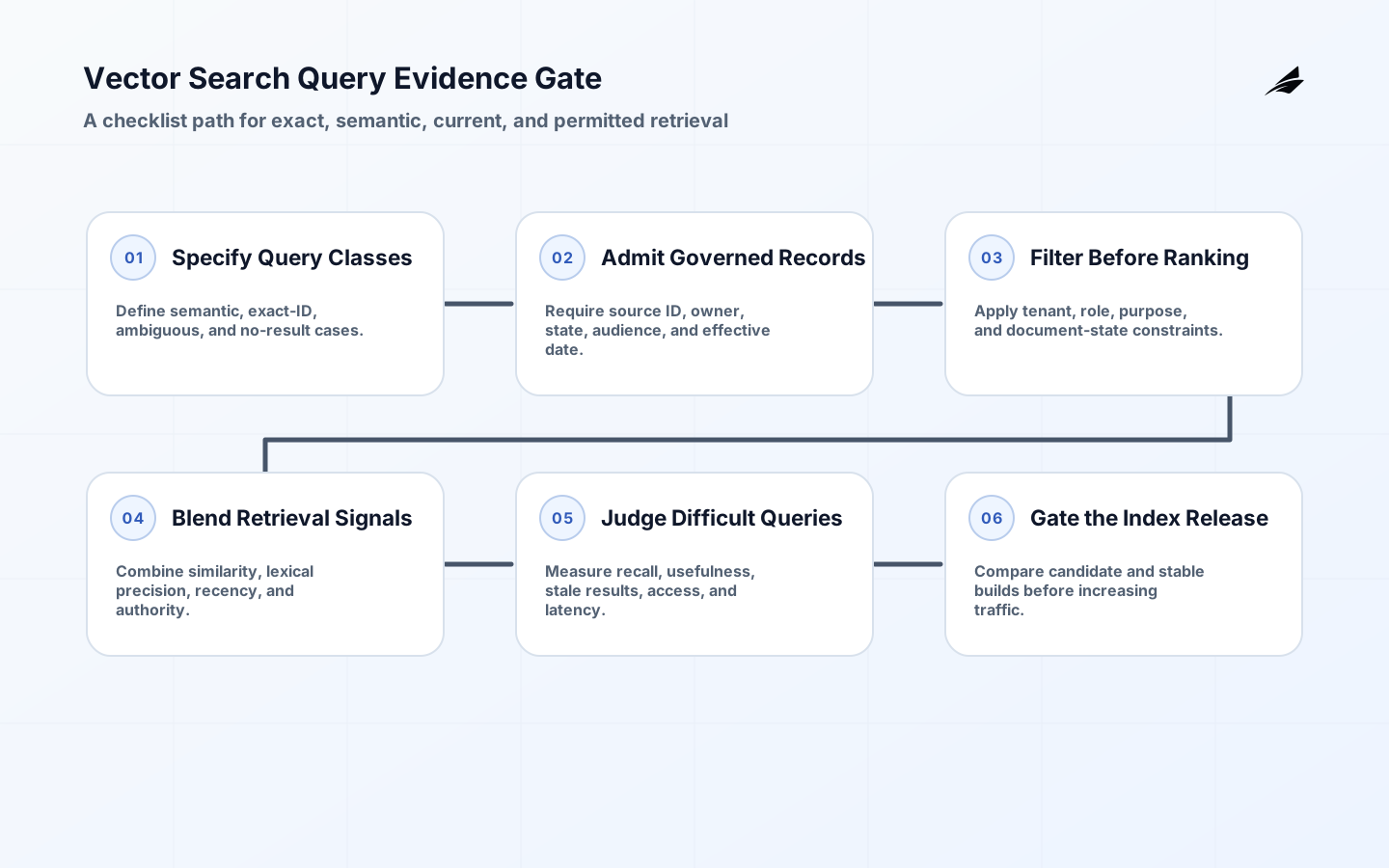
Vector search retrieves items whose representations are close in a numerical space, making it useful when a user's wording differs from the wording in the right document, product, image, or case. In production, closeness is not the same as relevance, permission, authority, or freshness. A support procedure can be very similar to an old incident and still be the wrong result. A reliable vector search service therefore combines embeddings and nearest-neighbor retrieval with metadata filters, lexical signals, source lifecycle, evaluation, and a visible fallback. This checklist is for teams moving from a compelling similarity demo to an operation that other people can safely depend on.
1. Define relevance for a specific job
Describe the user, query classes, corpus, and action the search will support. For an internal support workflow, relevant may mean that an authenticated specialist receives an approved, current procedure for the correct product and customer context. It does not mean the nearest paragraph in a global archive. Write examples of desired matches, unacceptable near-matches, exact identifiers, and questions that should return no result. The NIST AI Risk Management Framework helps connect relevance choices to the impact of a wrong result. This definition becomes the basis for a judged query set.

| Query class | Desired behavior | Common error |
|---|---|---|
| Exact error code | Prioritize lexical precision. | Semantically similar but wrong product. |
| How-to question | Recover related approved procedure. | Retired operational guidance. |
| Account-specific request | Filter by tenant and role first. | Cross-customer disclosure. |
| Unknown terminology | Clarify or abstain. | Confidently guessing intent. |
2. Build an index with governed metadata
Each indexed item should carry a stable source ID, owner, document state, access scope, effective date, content type, and embedding or index version. Chunk at meaningful boundaries and retain title and section context so the result can be inspected. Determine how additions, corrections, deletions, and permission changes propagate. An index without lifecycle controls becomes a second, less accountable copy of company knowledge. Record failures in parsing and embedding instead of silently dropping content; missing records can be as harmful as irrelevant ones when a workflow assumes the search is complete.
- Create an index admission rule for approved, attributable source records.
- Attach access and lifecycle metadata to every vector, not only the parent document.
- Use idempotent updates and deletion verification to prevent stale duplicates.
- Keep source, embedding-model, and index versions available for investigation.
3. Filter before and combine signals after
Authenticate and apply access, tenant, and source-state filters before candidate ranking. Then combine vector similarity with lexical matching, recency, source authority, and task-specific signals. Approximate nearest-neighbor methods such as HNSW can make retrieval fast at scale, but their parameters alter recall and latency. Compression approaches described in Product Quantization research create further trade-offs. Choose configuration through measured quality and service objectives, not a default index setting. Return source context so a person can judge the result rather than trusting a score.
| Retrieval decision | Trade-off | Operational check |
|---|---|---|
| Candidate count | Recall versus latency and cost. | Expected sources appear in judged cases. |
| Metadata filters | Safety versus broad recall. | No cross-scope result leakage. |
| Hybrid ranking | Precision versus complexity. | Compare query-class slices. |
| Index parameters | Speed versus approximate recall. | Load test with relevance evaluation. |
4. Evaluate retrieval quality and drift
Use a versioned evaluation set that identifies expected source records or acceptable abstentions. Include exact names, paraphrases, acronyms, ambiguous language, recently changed documents, restricted records, and queries that should fail closed. Track recall at a practical rank, ranking usefulness, stale-source rate, access-filter compliance, latency, and zero-result rate. Inspect results by source family, language, user role, and query type. Re-run the set after changing the embedding model, chunking, index parameters, ranking logic, or corpus. An index can remain fast while its relevance quietly drifts.
- Sample high-score results for semantic but operationally wrong matches.
- Test deletion and permission-change propagation in every release cycle.
- Keep hard cases that prompted incidents as regression examples.
- Measure user reformulation and bypass behavior as signals of retrieval weakness.
5. Operate for freshness, scale, and recovery
Set service objectives for ingest delay, query latency, index availability, deletion propagation, and evaluation regression. Monitor source-to-index lag, failed embeddings, index size growth, query distribution, filter denials, tail latency, and cost. Plan capacity around expected corpus growth and query concurrency, but do not scale an index before confirming it retrieves the right evidence. The NCSC secure AI guidance supports treating operational security and maintenance as part of system development. Operators need a way to pause a source, roll back an index version, and direct users to a known search fallback.
6. Release changes with an evidence gate
Release vector search changes behind a cohort or shadow comparison when possible. Record the corpus, embedding, index, and ranking versions serving every evaluated release. Require the judged set to meet relevance and access thresholds before traffic increases; also inspect a small sample of real queries with source owners. Roll back when expected sources disappear, stale content reappears, filters fail, or latency breaches the service objective. Change management may sound formal for search, but it is what lets the team improve relevance without losing the ability to explain a regression.
Use query analysis to improve vector search deliberately
Keep a query-analysis routine that looks at the language users actually use rather than only at benchmark prompts. Group zero-result queries, heavily reformulated searches, short sessions that end in a manual route, and results that receive corrections. Then inspect whether the cause is vocabulary mismatch, missing content, an overly strict filter, a poor chunk boundary, an exact-identifier need, or an index regression. Each cause calls for a different remedy. Adding more vectors will not solve an absent procedure, and relaxing an access filter to improve recall would create a more serious failure. Query analysis makes the relationship between user behavior and index design visible to both search engineers and content owners.
Plan index maintenance around observable milestones: source-volume growth, new language coverage, model replacement, metadata schema changes, and service-level regressions. Before a major reindex, establish the expected corpus count, deletion state, evaluation results, capacity requirement, and rollback position. During the change, compare stable and candidate indexes on the same queries and watch both relevance and tail latency. After release, sample results from the new workload, not only the original test set. This operating discipline is useful even for a small corpus because it prevents the first large change from becoming a mystery. Vector search is easier to improve when every change has a known evidence baseline.
Vector search implementation checklist
- Write expected matches, unacceptable near-matches, exact identifiers, and valid abstentions for the first query classes.
- Require source owner, lifecycle state, effective date, audience, and stable identifier before embedding any content.
- Keep chunk context, source links, access metadata, embedding version, and index version attached to every vector.
- Propagate additions, corrections, permission changes, and deletions through the index and associated caches predictably.
- Authenticate requesters and filter tenant, role, document state, and purpose before candidate ranking begins.
- Combine vector similarity with lexical precision, recency, source authority, and task-specific ranking signals where evaluation supports it.
- Test approximate-index parameters against both expected-source recall and production-like latency and capacity conditions.
- Build judged query sets covering paraphrases, acronyms, ambiguity, restrictions, source changes, and zero-result cases.
- Measure practical-rank recall, stale-result rate, access compliance, tail latency, user reformulation, and bypass behavior.
- Sample high-similarity results that are operationally wrong to catch deceptive near-neighbor matches.
- Reconcile indexed counts, source states, and timestamps against the governed corpus on a regular cadence.
- Version corpus, chunking, embedding, index parameters, filters, and ranking logic for release and investigation.
- Shadow major reindexes or ranking changes and compare them with the stable service before broad traffic shifts.
- Set rollback criteria for missing expected evidence, reappearing retired content, filter failures, and service degradation.
- Keep a documented alternate search or manual knowledge route for users during index recovery or maintenance.
Keep an index decision record beside the evaluation results. It should name the corpus scope, chunking and metadata rules, embedding model, approximate-search settings, hybrid ranking signals, filter order, expected service objectives, and rollback reference. When a query suddenly changes behavior, this record gives operators a finite set of hypotheses to test rather than an opaque similarity system to debate. Update it after planned reindexing or an incident-driven change. The record is also useful for capacity planning because it connects index growth and latency choices to the relevance evidence that justified the configuration in the first place.
Key takeaways
- Define relevant evidence for a job before choosing an embedding or index method.
- Carry source authority, lifecycle, and access metadata into the vector index.
- Use filters and hybrid signals so similarity cannot bypass control requirements.
- Evaluate recall, freshness, and access behavior whenever the corpus or index changes.
Vector search FAQ
Do we need vector search for every knowledge base? No. Exact search may be sufficient where terminology is stable and precise. Add vector retrieval when judged queries show that phrasing variation prevents users from finding approved evidence.
What does a similarity score mean? It is a ranking signal from a particular embedding and index configuration. It is not a universal confidence measure and should not be used as an authorization or business-policy decision.
How can we remove an indexed record safely? Track source and index identifiers, propagate a deletion event through every index and cache, test the result with queries, and retain an audit record that removal completed.
Conclusion
Vector search becomes reliable when teams treat it as a governed retrieval service, not a mathematical shortcut. Define operational relevance, index accountable metadata, filter and rank deliberately, test lifecycle changes, and preserve recovery controls. That allows similarity to help people find evidence without allowing a close match to become an unexamined decision.