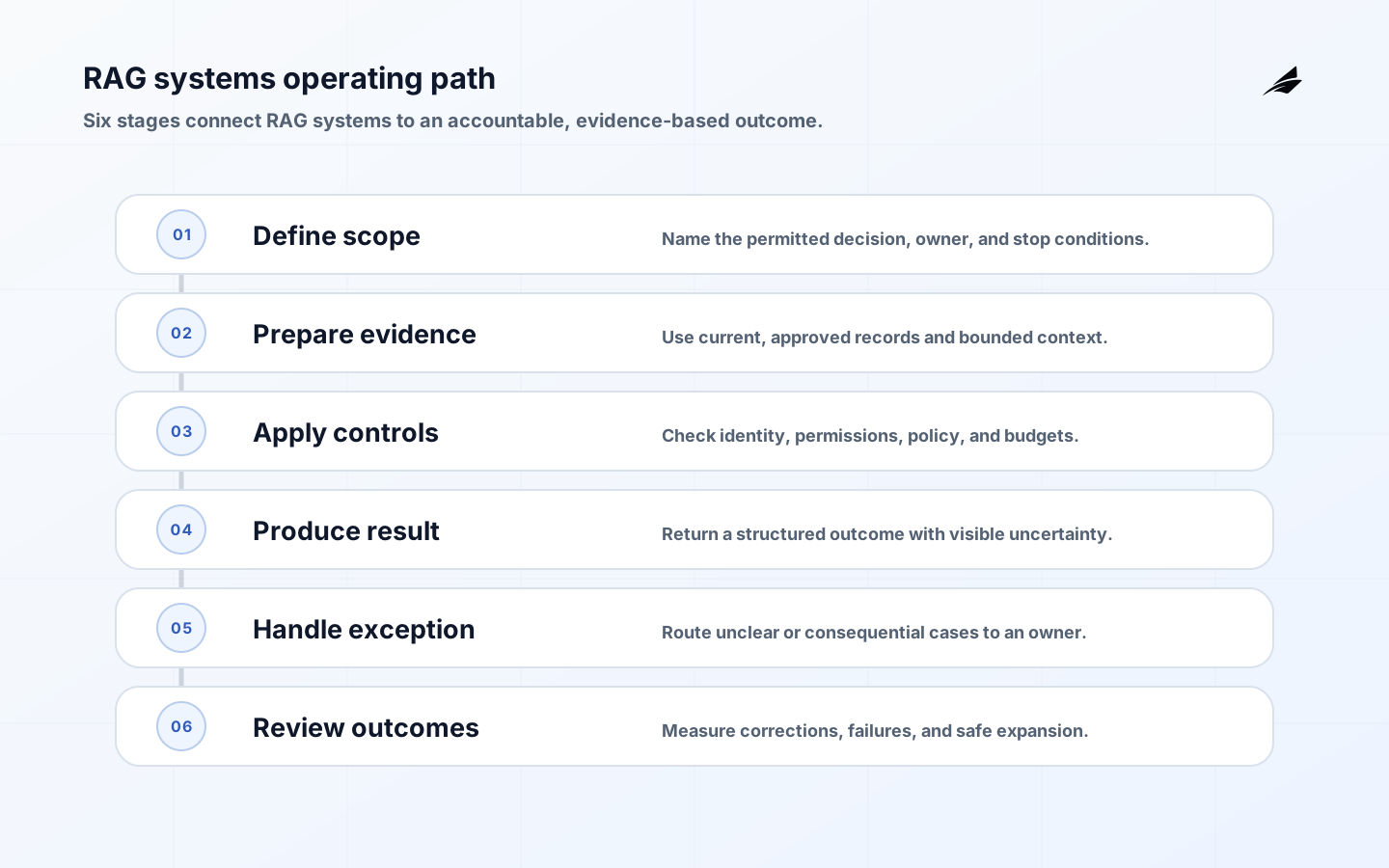
RAG systems are useful only when they improve the specific decision they were introduced to support. For operations leaders, that starts with a concrete job: answer a defined question with current, permitted evidence rather than relying only on what a model learned earlier. An internal policy assistant retrieves the currently effective travel rule for the requester’s region, shows the cited passage, and abstains when no approved source supports a claim. The design question is therefore not whether a model can produce an impressive demonstration. It is whether the system can produce a useful result with the right evidence, authority, cost, and recovery path. This guide treats RAG systems as an operational capability with a named owner, bounded inputs, measurable outcomes, and a deliberate way to stop or hand work back when the conditions are not met. The companion RAG systems checklist explores related implementation choices in more depth.
Set the RAG systems boundary
Write the boundary before selecting a provider or interface. Name the requester, the decision or task, the records and tools in scope, the allowed side effects, and the conditions that require abstention or handoff. The NIST AI Risk Management Framework is helpful because it organizes risk work around governance, mapping, measurement, and management rather than treating it as a launch checklist. For RAG systems, the smallest credible boundary is usually one role, one repeatable question class, one approved evidence set, and one accountable workflow owner. That gives the team something real to test and makes expansion a decision based on observed results instead of optimism.

| Boundary question | Practical choice | Evidence to keep |
|---|---|---|
| Who can use it? | A named role with an authenticated purpose for answer a defined question with current, permitted evidence rather than relying only on what a model learned earlier. | Identity, access decision, and request context. |
| What may it use? | Approved records, tools, and current business rules only. | Owner, version, classification, and effective date. |
| What may it do? | Return a bounded result or propose a reversible next step. | Output, authorization result, and handoff record. |
| When does it stop? | Uncertain, out-of-scope, sensitive, or policy-conflicted cases. | Reason code, destination, and final disposition. |
Choose the smallest architecture that can prove value
The working mechanism for this use case is source governance, access filtering, chunked retrieval, ranking, grounded answer construction, citations, and evaluation. Each part should earn its complexity. Start with the simplest alternative that preserves the evidence and control needed for the job, then compare it on representative work rather than on a hand-picked demo. The NIST generative AI profile emphasizes that risk depends on the context of use; a low-impact drafting aid and a system that changes a customer record deserve different controls. A good technical design makes uncertainty visible. It does not manufacture certainty by hiding source gaps, missing fields, or an unsupported inference behind fluent language.
| Approach | When it fits | What to test before release |
|---|---|---|
| Model-only answer | Fast to deploy, but weak for changing or auditable knowledge. | Accuracy on a representative task set and failure handling. |
| Search results only | Highly inspectable, but leaves synthesis and navigation to the user. | Coverage, latency, permissions, and reviewer usability. |
| Grounded RAG response | Uses retrieved evidence with citations, abstention, and monitoring controls. | Outcome quality, recovery behavior, and operating cost. |
Build an evidence-first workflow
Treat every important result as a small case file. Capture the version of the workflow, the requester context, the input or source references permitted for retention, the system’s proposed result, the policy checks performed, and the eventual outcome. That trace is not bureaucracy for its own sake: it lets a reviewer explain why the system behaved as it did and gives engineers a reproducible example when it did not. The UK NCSC secure AI development guidance is a useful reminder to consider security across design, development, deployment, and operation. For RAG systems, use stable identifiers rather than asking a reviewer to reconstruct a result from a changing interface.
- Assign a product or operations owner for the RAG systems decision, not merely for the model integration.
- Represent source state explicitly: published, superseded, expired, pending review, or unavailable.
- Validate structured fields and permissions in trusted application code before any side effect.
- Give reviewers the evidence, uncertainty, and reason for escalation in the same work view.
- Make the safe fallback useful: a source link, queued case, or request for a missing detail is better than a fabricated answer.
- Version prompts, configurations, datasets, and policy rules so a changed outcome can be investigated.
Evaluate realistic work before widening scope
Build an evaluation set from completed work, difficult edge cases, known failures, and cases the system should decline. Freeze a held-out portion before tuning prompts, policies, or model settings. Then judge both the output and the operational consequence: did the user receive sufficient evidence, did the workflow respect permissions, did a human make the right decision when involved, and did the case reach a reliable end state? RAG systems should be measured through answer support rate, citation correctness, retrieval recall, unsupported-claim rate, stale-source exposure, access violations, and reviewer corrections. Slice results by request type, source condition, user role, and time period; aggregate averages can conceal the exact population that will experience harm or rework.
| Evaluation slice | Question to answer | Release implication |
|---|---|---|
| Routine cases | Does the system reduce work without reducing verified quality? | Automate only the proven, low-impact path. |
| Ambiguous cases | Does it surface uncertainty and route the case correctly? | Strengthen abstention and reviewer context. |
| Adversarial or malformed input | Can untrusted content alter authority or escape validation? | Block, isolate, and test the control boundary. |
| Changed source or policy | Does the result reflect the effective version and preserve history? | Re-index, re-evaluate, or pause the feature. |
Operate the controls, not just the model
Retrieval does not make a response true; irrelevant, conflicting, or malicious content can still influence generation. That is why an operational review should include product, security, data or content owners, and the people who resolve exceptions. The OWASP Top 10 for LLM applications highlights risks such as prompt injection, insecure output handling, excessive agency, and unbounded consumption. Translate those categories into tests of the actual workflow: malicious text in a retrieved item, a tool response with unexpected fields, a request beyond the user’s role, an exhausted budget, and an unavailable dependency. A control is credible when it has an owner, a trigger, retained evidence, and a defined response.
Monitoring should connect technical signals to accountable service outcomes. Review changes in answer support rate, citation correctness, retrieval recall, unsupported-claim rate, stale-source exposure, access violations, and reviewer corrections, but also sample completed cases with the people who know the real work. Ask whether the result had enough evidence, whether the intended person retained meaningful control, whether an exception reached the right owner, and whether the claimed benefit survived correction work. Keep a small issue register that records severity, affected scope, mitigation, and the decision to resume or narrow the workflow. This makes RAG systems easier to improve because the team learns from concrete cases rather than from scattered anecdotes.
Key takeaways
- RAG systems begins with a bounded operational decision, not an abstract capability claim.
- Evidence, permissions, and recovery criteria belong in the product design from the first release.
- Compare simpler alternatives against representative work before adding model or pipeline complexity.
- Treat policy checks and authorization as trusted service responsibilities, not as instructions for a model.
- Use held-out cases, difficult examples, and correction data to decide whether to widen scope.
Release in stages and manage change
Release RAG systems as a sequence of controlled decisions. Begin with read-only or advisory use for a limited group, compare results with the existing process, and publish the conditions for the next stage. Before adding a new source, model, tool, policy rule, or higher action limit, identify the evaluations that could change and rerun them against a fixed baseline. Keep a simple rollback procedure that removes the affected configuration, preserves the case trace, and tells users what service remains available. This turns change management into part of product quality: teams can learn from a narrow release without quietly expanding authority faster than evidence.
Frequently asked questions
When is RAG systems ready for production? It is ready for a narrowly defined production use when the owner can state the permitted job, demonstrate evaluation on representative and adverse cases, show that access and action controls are independently enforced, and operate a useful handoff or rollback path. A high benchmark score alone is not enough. Should every result have a human review? No. Review intensity should follow consequence and uncertainty. Routine, reversible work may be sampled; high-impact, novel, sensitive, or low-confidence cases should reach a person with the authority and context to decide. Measure whether review actually changes outcomes. What should the first dashboard show? Start with outcome quality, exceptions, policy denials, corrections, source or configuration changes, and cost or latency per successful task. Those measures connect the feature to work that someone owns. How do we handle a failure? Preserve the trace, stop the affected scope when necessary, route the case to a named owner, correct the source or control, and add a regression example before re-enabling the capability.
Conclusion
The practical test for RAG systems is modest and demanding: can it help a real person complete a defined task while keeping evidence, authority, uncertainty, and recovery visible? Begin with a constrained workflow, evaluate the cases that make people uneasy as well as the easy wins, and expand only when the operating evidence supports it. That discipline produces a service teams can improve and trust, rather than a demonstration that becomes harder to explain once it meets real work.