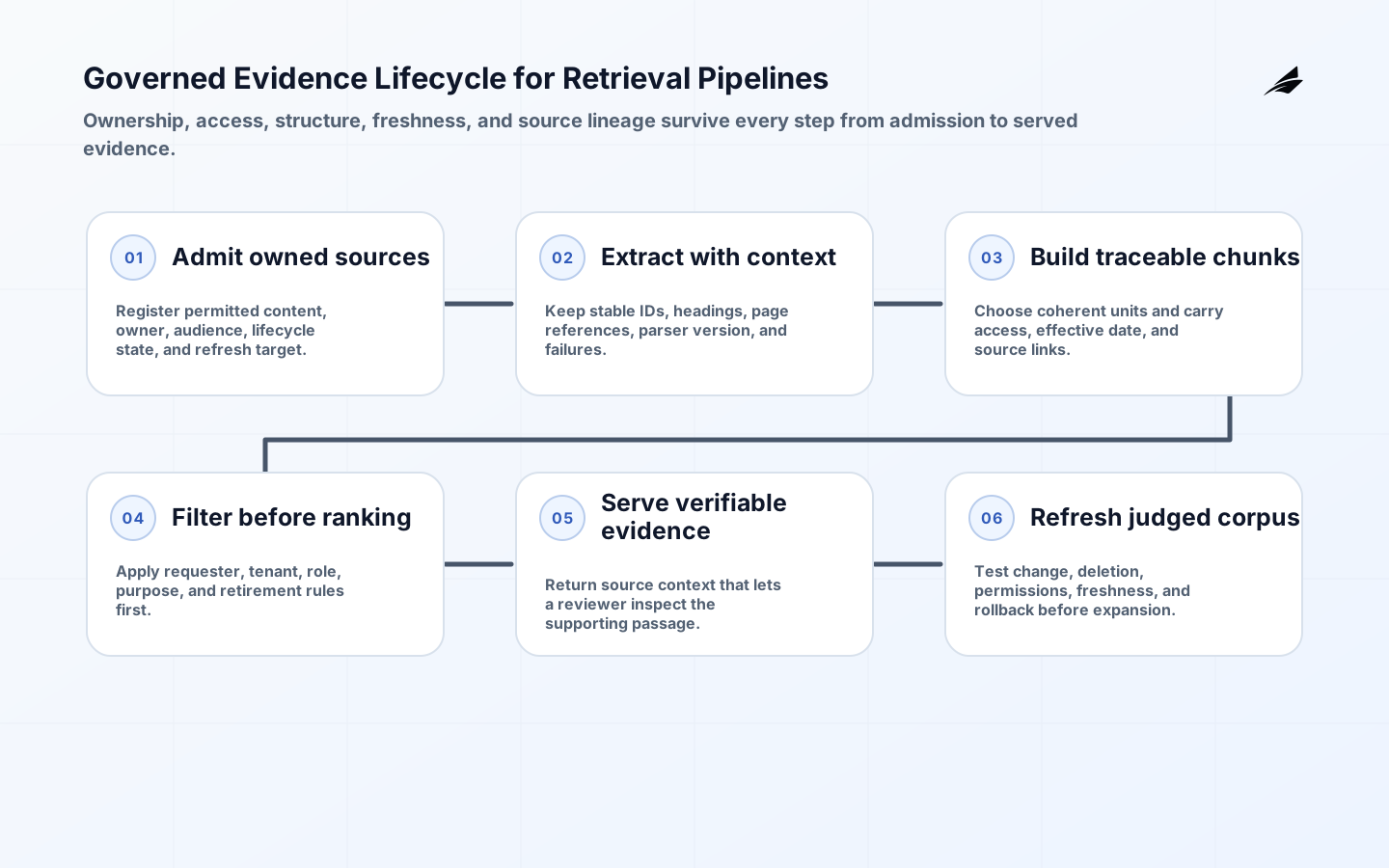
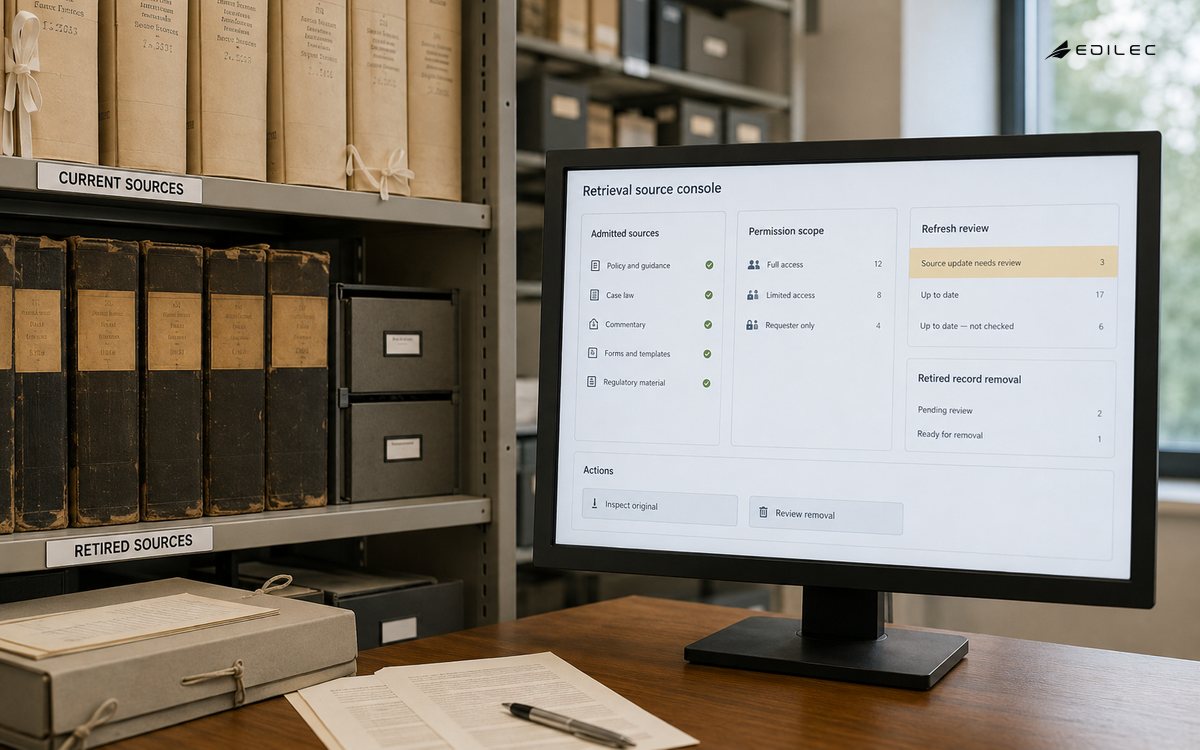
A retrieval pipeline is the path that turns source records into evidence a person or AI application can use at query time. Teams often focus on the final search box or answer model, yet most reliability is determined earlier: which records were admitted, how they were split, what metadata survived, when they were refreshed, and which requester may retrieve them. A retrieval pipeline for a growing team should make every answer traceable to a governed source. It should also make it possible to remove a retired record quickly. Retrieval pipelines in practice offers implementation context; this guide concentrates on operational decisions and test evidence.
Define the retrieval pipeline boundary
Specify the decision the pipeline supports before choosing an embedding service or vector store. A first use case might help support agents find current technical procedures; it does not make compliance determinations or search unrestricted collaboration data. List permitted sources, excluded sources, owners, refresh expectations, users, and the output a downstream system may consume. The NIST AI Risk Management Framework helps turn these choices into accountable governance. A pipeline boundary prevents ingestion from becoming an uncontrolled copy of every document the organization has ever produced.
| Stage | Decision | Operational record |
|---|---|---|
| Ingestion | Which systems and document states qualify? | Source register and admission rule. |
| Preparation | How are text and metadata transformed? | Parser and chunking version. |
| Indexing | Where is searchable representation stored? | Index and corpus version. |
| Serving | Who can retrieve which evidence? | Identity, filters, and request trace. |
Govern ingestion and document preparation
Ingestion should capture a stable source identifier, owner, access scope, effective date, document state, and extraction outcome. Preserve enough source context to reconstruct a result later, including headings, page or section references, and parser version. Chunking is a retrieval tradeoff: tiny chunks may lose prerequisites; very large chunks may bury the relevant instruction. Choose boundaries around coherent work units and test them with actual questions. The RAG research paper demonstrates the value of combining retrieved material with generation, but a production pipeline still needs locally meaningful source lifecycle rules.
- Reject or quarantine documents that cannot be attributed to an owner and access policy.
- Store extraction failures and low-quality scans for remediation instead of silently indexing partial text.
- Retain source links and structural context beside every chunk.
- Make reprocessing idempotent so an update does not create duplicate evidence.
Retrieve, filter, and rerank in the right order
At query time, authenticate the requester first and apply tenant, role, document-state, and purpose filters before ranking candidates. Use lexical, semantic, and metadata signals according to the query class, then return enough context for a reviewer to verify the evidence. Reranking may improve relevance, but it should never resurrect a record filtered out for access or retirement. The Dense Passage Retrieval work is relevant when comparing retrieval approaches; the service-level requirement is simpler: no result should bypass a permission or source-status rule because it scores well.
| Failure mode | Pipeline control | Verification |
|---|---|---|
| Retired content appears | State filter and deletion propagation. | Query after retirement event. |
| Private record leaks | Pre-ranking access filter. | Cross-role and cross-tenant tests. |
| Weak context is used | Chunk lineage and source preview. | Reviewer inspection sample. |
| Index becomes stale | Refresh objective and alert. | Compare source and index timestamps. |
Evaluate evidence quality, not fluent output
Build an evaluation set that labels the desired source, not merely a preferred answer. Include questions that need exact matches, differently phrased requests, ambiguous terms, missing evidence, and recently changed policies. Score retrieval recall at the candidate stage, ranking usefulness, citation correctness, permission compliance, and freshness. A generated answer can sound correct while resting on the wrong passage, so inspect the retrieved evidence directly. Segment results by source family, user role, and document age. This gives source owners actionable feedback instead of an undifferentiated complaint that the assistant is unreliable.
- Record expected sources and acceptable abstentions for each judged query.
- Test removal, permission changes, and source updates as first-class scenarios.
- Compare retrieval metrics before and after parser, embedding, or ranking changes.
- Use incident reports to add high-impact misses to the regression set.
Secure the pipeline and its maintenance path
Retrieved content can contain malicious or misleading instructions, and ingestion connectors can have broad access. Apply least privilege to connectors, validate file types and extraction behavior, isolate processing where appropriate, and treat source text as data rather than a directive to the application. The OWASP LLM guidance is useful when considering indirect prompt injection and data exposure. Log ingestion, transformations, access decisions, and result provenance. Recovery should include the ability to pause a connector, revert an index version, and reissue a corrected corpus.
Release pipeline changes as evidence changes
Use a small, owned corpus for the first release, then add source families one at a time. Run a new pipeline version against the judged set before it serves users and compare its output with the stable version. Define service objectives for refresh delay, failed ingestion, access-filter failures, and evaluation regressions. A source owner should approve changes to content policy, while a technical owner manages extraction and index operations. This division makes changes recoverable when a polished search result masks a poor evidence path.
Manage pipeline dependencies and data contracts
A retrieval pipeline depends on more than a source connector and an index. It depends on source-system APIs, authentication, parsers, storage, embedding services, queueing, metadata schemas, and the application that serves results. Make those dependencies visible in a data contract. The contract should say which fields are mandatory, what a missing field means, how retries work, which event represents deletion, and who receives an alert when freshness falls behind. This is especially important when source systems allow edits without emitting reliable change events. A quiet ingestion failure can look like a relevance issue weeks later. By recording expected freshness and update behavior, the team can test the path before users are left with outdated evidence.
Use replayable, privacy-reviewed samples to test pipeline changes. A replay should exercise parsing, metadata mapping, access filtering, retrieval, and result display against a known source snapshot. Compare the new output with the stable version and investigate differences that affect authority, access, or expected evidence. For high-value corpora, add reconciliation: periodically compare the source register with indexed IDs, states, and timestamps to find records that were missed, duplicated, or not removed. This is not administrative overhead. It is the practical mechanism that tells an operator whether the index represents the governed corpus they think they are serving. A dependable pipeline can demonstrate completeness limits and recover them; an opaque one merely returns whatever happened to arrive.
Retrieval pipeline implementation checklist
- Document source systems, connector scopes, owners, update signals, and expected refresh intervals.
- Require stable source IDs, lifecycle state, audience labels, and effective dates before indexing.
- Record parser, chunking, metadata-mapping, embedding, and index versions for every release.
- Quarantine extraction failures and incomplete records instead of silently creating partial searchable content.
- Keep structural context such as titles, sections, pages, and source links beside every chunk.
- Make ingestion idempotent so retries cannot create duplicate evidence or conflicting versions.
- Apply authentication and metadata filters before candidate retrieval and downstream answer generation.
- Test change, deletion, and permission events from the source system through search-serving behavior.
- Use judged queries that label expected sources, unacceptable sources, and acceptable abstentions.
- Measure source freshness, candidate recall, ranking usefulness, access failures, and result correction.
- Reconcile the source register with index IDs and timestamps on a scheduled operational cadence.
- Alert a named owner when connector failures or lag breach the documented service objective.
- Run parser, embedding, or ranking changes against replayable source snapshots before serving users.
- Keep a rollback index and a manual knowledge route for failed or disputed retrieval behavior.
- Review user feedback with source owners so content repair and pipeline repair are not confused.
A pipeline readiness review should end with a live trace of one record from source through user result. Follow its source ID, ownership and access metadata, extraction result, chunks, embeddings, index entry, request filter, ranked result, and display citation. Then repeat the trace for a deletion or access change. This is more revealing than an architecture diagram because it proves whether metadata is actually preserved at the boundaries where systems hand work to one another. If the team cannot trace a representative record, it cannot confidently diagnose a stale result or demonstrate that a restricted record was excluded. Make this trace a repeatable release exercise.
Key takeaways
- Retrieval pipelines begin with governed sources, not embeddings.
- Preserve owner, state, access, and lineage metadata through every transformation.
- Filter for permission and retirement before relevance ranking.
- Evaluate desired evidence and source lifecycle events before broadening the corpus.
Retrieval pipelines FAQ
How often should a retrieval index refresh? Match the refresh objective to the consequence of stale information. A release procedure may need rapid propagation; a stable reference archive may be updated on a scheduled cycle. Measure the actual delay.
Should chunks overlap? Sometimes. Overlap can preserve context at a boundary, but excessive overlap duplicates evidence and can skew ranking. Test chunk sizes and overlap with real questions and source previews.
What is the most important retrieval metric? There is no single one. Track whether a permitted, current, expected source appears where a user can use it, then pair that with freshness and access-control checks.
Conclusion
A retrieval pipeline earns trust when it can show its work. Govern source admission, carry context and access metadata through indexing, test evidence rather than surface fluency, and make replacement or removal routine. Those habits give a growing team a foundation for useful AI answers without turning knowledge management into an opaque model dependency.