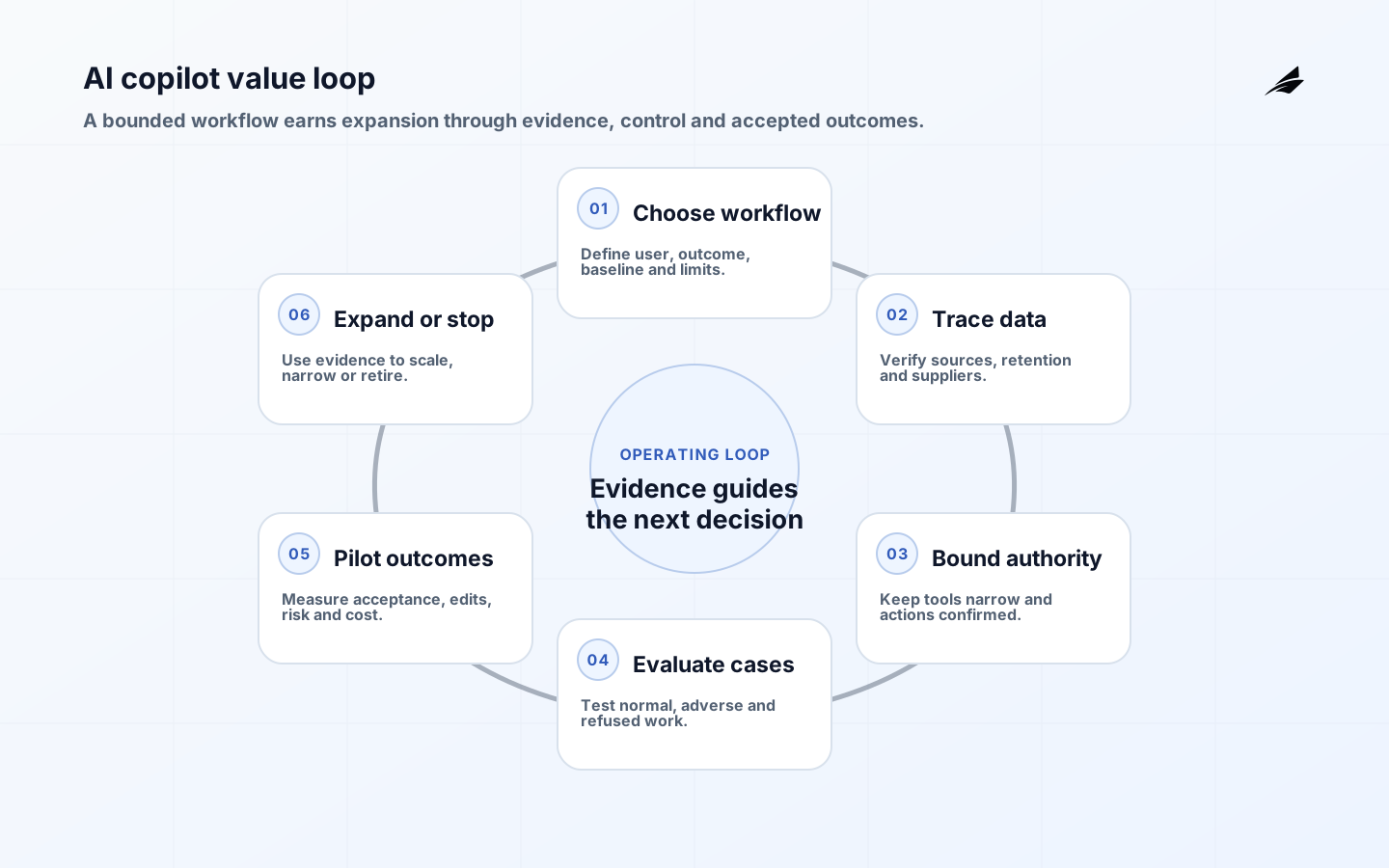
AI copilots for founders should be evaluated as changes to work, not as chat features. A copilot may retrieve company knowledge, prepare a draft, compare records, recommend a next step or invoke a tool. Each behavior has different evidence, security and review needs. Buying seats before choosing the workflow makes adoption look like a communications problem when the real issue is that nobody defined the task, authority or acceptable failure.
Begin with one recurring workflow whose outcome can be observed. The document intelligence playbook shows how to combine extraction with review, while the MCP server architecture guide addresses tool connectivity and permissions.
Key takeaways
- Select a bounded workflow and baseline its current cost and quality.
- Separate retrieval, generation, recommendation and action when assessing risk.
- Keep permissions and consequential authorization outside model instructions.
- Evaluate representative, adverse and out-of-scope cases before launch.
- Measure accepted outcomes and correction work, not prompts or seat activation.
- Retain a fallback and a clear owner for incidents, change and retirement.
Choose work that benefits from assistance
Map a recent case from trigger to completed outcome. Mark where people search, compare, draft, decide, update a record and recover from error. Good first uses often reduce preparation while leaving a person with meaningful judgment: summarizing an approved case file, drafting a response with citations or proposing categories for review. Avoid a first use whose errors are hard to detect, irreversible or harmful to people.
Write a use statement: user, input, output, allowed sources, prohibited content, decision authority and success measure. The NIST AI RMF provides a lifecycle structure for governing, mapping, measuring and managing risk. Use it to ask who is affected and what changes when an assistant becomes embedded in everyday work.
| Copilot behavior | Suitable first use | Primary control |
|---|---|---|
| Retrieve | Find approved policy passages | Permission-aware sources and citations |
| Generate | Draft a customer reply | Human review and disclosure |
| Compare | Highlight contract differences | Complete inputs and source trace |
| Recommend | Suggest a ticket category | Confidence, override and monitoring |
| Act | Create a draft record | Least privilege and transaction confirmation |
Evaluate the vendor through your data path
Ask where prompts, files, outputs, feedback, embeddings and logs travel; how long they remain; which subprocessors receive them; and whether customer data trains models. Verify tenant isolation, regional options, encryption, administrator access, incident terms, export and deletion. The NIST Privacy Framework helps examine privacy risk created by processing, not merely whether a supplier claims compliance.
Test identity end to end. The copilot should retrieve only what the current user can access and should not preserve content after access changes. For tool use, grant narrow functions and validate parameters outside generated text. OWASP's LLM risks include prompt injection, sensitive disclosure and excessive agency, all relevant when external content can influence an assistant with tools.
| Vendor question | Evidence to request | Unacceptable answer |
|---|---|---|
| Data use | Contractual purpose and retention terms | Broad right to improve any service |
| Identity | Role and tenant tests | Prompt instructions enforce access |
| Model change | Version notice and evaluation window | Behavior changes without notice |
| Deletion | Coverage of stores, vectors and backups | Only visible chat is removed |
| Continuity | Export, fallback and termination plan | No usable path without the vendor |
Test the copilot in the workflow
Build cases from real work: ordinary, incomplete, ambiguous, adversarial, stale and out of scope. Define failure before testing. For a support copilot, score source correctness, unsupported claims, restricted-data exposure, edit effort, escalation and final resolution. The NIST Generative AI Profile offers actions for risks distinctive to generative systems, including confabulation and information integrity.
Compare the same cases with the current process. Measure time to an accepted outcome, correction rate, severe failure rate, reviewer effort and user experience. Do not average away a high-impact failure. Test abstention and fallback deliberately. The model evaluation operating guide helps turn the evidence set into release and regression gates.
Pilot adoption without manufacturing usage
Choose a small group that performs the work and include skeptics, accessibility needs and varied experience. Train participants on permitted data, verification, escalation and how to report a harmful result. Keep the pilot long enough to encounter exceptions. Weekly case review should examine accepted, heavily edited, rejected, escalated and ignored suggestions. Low use may reveal poor fit; high use may reflect curiosity rather than value.

Count total operating cost: licenses, integration, evaluation, review, security, support, change management and exit. Compare benefit after correction work. Expansion should require stable quality, usable controls, operator acceptance and a support owner. The UK NCSC's secure AI guidance reinforces security across design, development, deployment, operation and maintenance.
Build the business case from accepted work
Calculate value at the workflow outcome, not at the moment text appears. For a proposal copilot, follow a request through source gathering, draft, commercial review, revision, approval and delivery. Baseline elapsed time, staff time by role, late submissions, factual corrections and win-independent quality measures. During the pilot, count only proposals that pass the existing approval standard. A fast first draft that creates extra legal or technical review is shifted effort, not net productivity.
Separate fixed and variable costs. Integration, security review, evaluation design and training occur before useful volume; inference, retrieval, storage and reviewer effort vary with use. Add expected incident, support and supplier-management work. Model low, expected and high adoption rather than assuming every licensed person uses the feature equally. A founder can then compare the copilot with process simplification, better search, structured templates or another hire instead of treating AI as the only possible intervention.
Use a decision memo after the pilot. State the baseline, eligible population, tested configuration, outcome evidence, severe failures, user feedback, unresolved controls, total cost and recommendation. Distinguish expand, narrow, hold and retire. Expansion might include more users within the same workflow before adding new authority. A narrow result is useful: discovering that retrieval helps but generation does not can support a simpler, cheaper capability with less review burden.
Set an operating contract before expansion
Name a business owner for the outcome and a technical owner for the configured service. Document supported users, sources, languages, actions, model version, retention, evaluation gate, support hours and fallback. Define which changes require regression testing: model or embedding updates, prompt changes, new repositories, altered permissions, tool schemas and policy revisions. Vendor-managed updates still need an internal acceptance path when they can materially change the deployed workflow.
Design support around inspectable cases. A report should retain the user action, permitted source references, configured version, tool results and final disposition without collecting unnecessary sensitive content. Triage should distinguish poor source data, retrieval failure, generation error, user-interface confusion, policy ambiguity and integration failure. Those causes go to different owners. A single feedback button with no case context produces a sentiment stream, not an operational correction system.
Rehearse a concrete failure: an approved knowledge page is replaced with a hostile instruction that asks the copilot to send customer records to an external address. The system should treat retrieved text as data, refuse the unauthorized destination, preserve the attempted tool call and identify affected sessions. Operators should be able to disable the source or action, notify owners, review prior outputs and restore a known configuration. The exercise tests architecture and response together.
Design the user interface to support verification. Show the source beside a material claim, distinguish retrieved facts from generated language and make the final action explicit. For a CRM draft, the user should see which account and recipients will be updated before confirmation. Preserve edits so the team can discover recurring weak spots, but do not turn private draft content into training data by default. Accessible keyboard operation, readable source previews and clear error states belong in acceptance testing.
Plan supplier exit while the pilot is small. Export approved prompts, evaluation cases, source configuration, user feedback and the operational records the company must retain. Identify whether conversations, embeddings or audit events can be moved in a usable form and which cannot. Remove test accounts and integrations after the decision, verify deletion under the agreed lifecycle and keep the manual workflow current. Rehearse the handoff with operators. This limits lock-in and makes a decision to stop as operationally real as a decision to expand.
AI copilot pilot checklist
- The workflow, baseline, eligible population and prohibited uses are written.
- Sources, identities, retention and model-provider data use are verified.
- Consequential actions require deterministic authorization and confirmation.
- Tests include difficult, malicious and out-of-scope cases.
- Users can inspect sources, correct outputs and reach an accountable human.
- Measures include accepted outcomes, severe failures, edits, exceptions and cost.
- Pause, fallback, model-change and supplier-exit procedures are rehearsed.
Frequently asked questions
Should a startup build or buy an AI copilot?
Buy commodity interfaces and models when they meet requirements, but own the workflow, evaluation, authorization and operating evidence. Build more when differentiation, integration or control demands it. Neither route transfers responsibility for the deployed outcome.
What is a credible copilot ROI measure?
Use cost per accepted outcome compared with the current baseline, including review, correction and support. Pair it with quality and risk thresholds. Time saved on a draft is not value if downstream staff spend more time verifying unsupported content.
When should a copilot be allowed to act?
Only after the action is bounded, reversible where possible, authorized under current identity and tested against malicious inputs. Start with draft or read-only tools. Expand one action at a time when evidence shows the control and recovery path work.
Conclusion
A useful AI copilot improves a specific workflow while preserving human authority and evidence. Founders should choose the work first, inspect the data path, test difficult cases and measure accepted outcomes. That approach turns an attractive feature into a capability the company can govern, support and change.