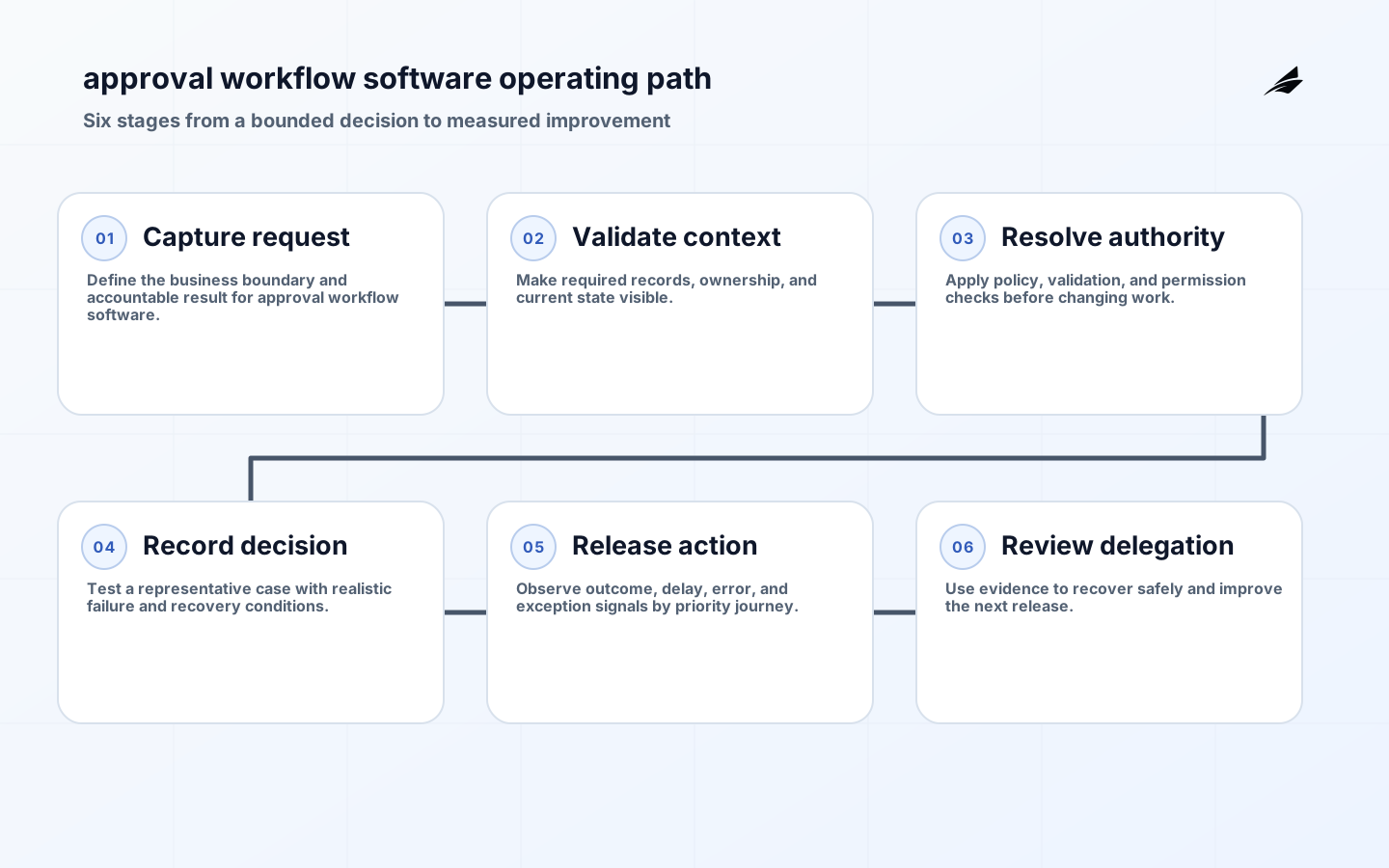
Approval workflow software goes wrong when a team treats the visible interface or endpoint as the product and leaves the operating decisions implicit. When a commercial exception or spending request needs a quick decision but the normal approver may be absent, the team must still explain why the decision was valid. Even a normal-looking request crosses people, records, and dependencies. The useful design question is not "which framework should we choose?" but "what result can a user rely on, who is accountable for it, and what happens when the normal route cannot continue?" Start with one consequential journey. Define its trigger, completion test, deadline, owner, and manual fallback. That gives founders a bounded decision they can test before they spread the work across every adjacent process.
Key takeaways for approval workflow software
- Start with one approval workflow software journey and a measurable completed outcome.
- Make authority and state changes explicit; a screen or endpoint is not the source of truth.
- Test adverse conditions before broad rollout, including incomplete data and dependency failure.
- Use operational measures to decide what to improve, simplify, or stop.
Define the outcome before building approval workflow software
The first deliverable should be a short operating contract, not a feature inventory. For approval workflow software, name the business outcome, the people permitted to act, the authoritative source for each fact, and the evidence a later reviewer will need. Walk recent real cases with operators; include a late change, a missing field, and a dependency outage. Those cases expose rules that a happy-path workshop misses. The practical discovery guide is a useful companion because it turns assumptions into interviewable acceptance conditions.
| Decision area | Rule to agree | Evidence to retain |
|---|---|---|
| Outcome boundary | State where the priority journey starts, ends, pauses, and hands off. | Named owner, representative case, and acceptance test. |
| Authority | Specify who may perform request, validate, route and under which condition. | Role, policy version, and decision record. |
| Source of truth | Assign an authoritative source for request, policy, threshold. | Identifier, effective time, and reconciliation rule. |
| Recovery | Describe the controlled response when a dependency or required fact is unavailable. | Reason, queue owner, next action, and closure reference. |
Model state and ownership in approval workflow software
Model request, policy, threshold, approver, delegation, evidence, and decision separately before deciding where they appear on a screen or in a payload. Each record needs a stable identifier, an owner, an allowed-change rule, and a useful history. A projection can be copied for speed, but copying does not transfer authority. Add time deliberately: record when an event occurred, when it was received, and when a correction became effective. This prevents a delayed message or report refresh from silently overwriting a more recent business decision.
Design actions and controls, not just screens
Design the path around actions, not pages. The relevant actions for this topic are request, validate, route, approve, reject, delegate, and release. For every action, state the preconditions, the actor, the policy being evaluated, the outcome, and the audit event. Make invalid states difficult to create instead of asking support staff to repair them later. A narrow, well-instrumented route is more valuable than an ambitious release whose rules exist only in tribal memory.

| Control | Implementation question | Observable check |
|---|---|---|
| Identity and permission | How is the actor identified and authorised for this action? | Denied attempts and privileged actions are visible. |
| Validation | Which facts must be present, current, and internally consistent? | Invalid input produces a useful, safe response. |
| Idempotency and concurrency | What happens when the action is retried or changes arrive out of order? | The record avoids duplicate or lost work. |
| Auditability | Can a reviewer reconstruct the action, policy, actor, and outcome? | A case can be explained without reading application logs. |
Prove a small release before expansion
For approval workflow software, delivery should prove behavior under representative conditions. Use realistic but protected data, actual role combinations, and failure responses from dependencies. Confirm that a retried request is safe, a timed-out call has a visible state, and an operator can see the next responsible person. Keep the release reversible: feature flags, migration checkpoints, read-only modes, or a documented manual queue are all legitimate controls when they preserve the record and avoid duplicate work. Teams should rehearse the named fallback with the people who will actually use it, then record what made the recovery slower or unclear.
Measure approval workflow software in operation
Avoid measuring activity alone. Decision time, overdue approvals, delegation use, exception rate, and reversals after release are useful when they are attached to a decision: whether to change a budget, fix a dependency, simplify a route, or stop a rollout. Segment measures by journey and state so an average cannot hide a broken priority path. Review a small set regularly with the people who can alter the process. Pair technical signals with the operator's view of rework and customer delay.
Run a authority review before expanding
A focused authority review is the fastest way to expose assumptions in approval workflow software. Bring the accountable business owner, an operator, an engineer, and someone responsible for support or risk. Follow one representative record from trigger to completion. Ask what evidence arrives, what rule is applied, how authority is established, what a user sees after a failure, and how the team knows the work is complete. Record disagreements as decisions to resolve, not as vague follow-up notes. This creates a usable backlog: each item has an owner, a test case, and a consequence if it remains unresolved.
For a commercial exception, separate the request from the decision and the release. The requester can supply context, the approver can apply policy, and the execution service can act only on a durable approved decision. Delegation needs its own effective dates, scope, and evidence; forwarding an email is not delegation. When a threshold or policy changes, make the version used by each decision visible so a later review does not reinterpret the past.
Technical choices should reinforce that operational design. Use contracts and validation at boundaries, structured logs and traces for diagnosis, and automated checks for rules that would otherwise be remembered by a single person. Keep configuration and policy versions discoverable. During release, observe the priority route first and compare results with the agreed baseline. When a signal worsens, prefer a bounded rollback or a reduced service mode over a rushed, opaque fix. That discipline makes approval workflow software easier to change because the team can see both the intended behavior and the evidence from the last real decision.
Approval flows need sensible urgency without normalising bypasses. Define a documented escalation path for an absent approver, a deadline that threatens customer harm, and a genuine emergency. The escalation should create more evidence, not less: why the normal route could not be used, who accepted the risk, and what reconciliation follows. Make the normal request easy to complete with the information an approver actually needs. A short, contextual decision is usually faster than a chain of messages asking for omitted facts.
The handover matters as much as the build. For approval workflow software, leave the accountable team with a concise operating note: the priority journey, its owner, the current policy assumptions, the dashboards or traces to inspect, and the first recovery action. Review it after the first live exception rather than waiting for a major incident. A note that is updated from real work becomes a useful control; a document written only for launch becomes an unreliable memory of what the system was supposed to do.
Common approval workflow software mistakes to avoid
- Building around email approvals without context, delegated access that exceeds policy, and a final action occurring before the decision is durable rather than a named business outcome.
- Making the normal path fast while leaving the exception path ownerless.
- Confusing a reporting copy or UI state with the authoritative business record.
- Treating deployment as the finish line instead of rehearsing recovery and review.
- Collecting metrics without stating the decision each metric is meant to support.
Use authoritative guidance in context
The governing sources are practical rather than decorative. OWASP Transaction Authorization Cheat Sheet and OWASP Authorization Cheat Sheet help distinguish durable controls from product preferences. Use them to challenge a design, then write the local rule in language that the accountable team can operate.
Frequently asked questions about approval workflow software
How small should the first release be for approval workflow software? Small enough that one accountable group can explain every state, decision, handoff, and recovery route. It should still complete a real case, not merely demonstrate a component. When should automation stop for human review? Stop when a required fact is ambiguous, the policy cannot be evaluated safely, or the consequence of a wrong action exceeds the agreed tolerance. Preserve the case state and give the reviewer the evidence needed to decide. What makes a measure useful? A useful measure has an owner, a threshold or trend to watch, and a stated response. A number that no one can act on is telemetry, not management information.
Conclusion: make approval workflow software operable
Good approval workflow software is a disciplined way to make work dependable. Define one outcome, model the record and authority behind it, prove the unhappy paths, and keep enough evidence to improve the next decision. That sequence gives founders a system they can operate with confidence instead of a polished surface that fails at the first exception.