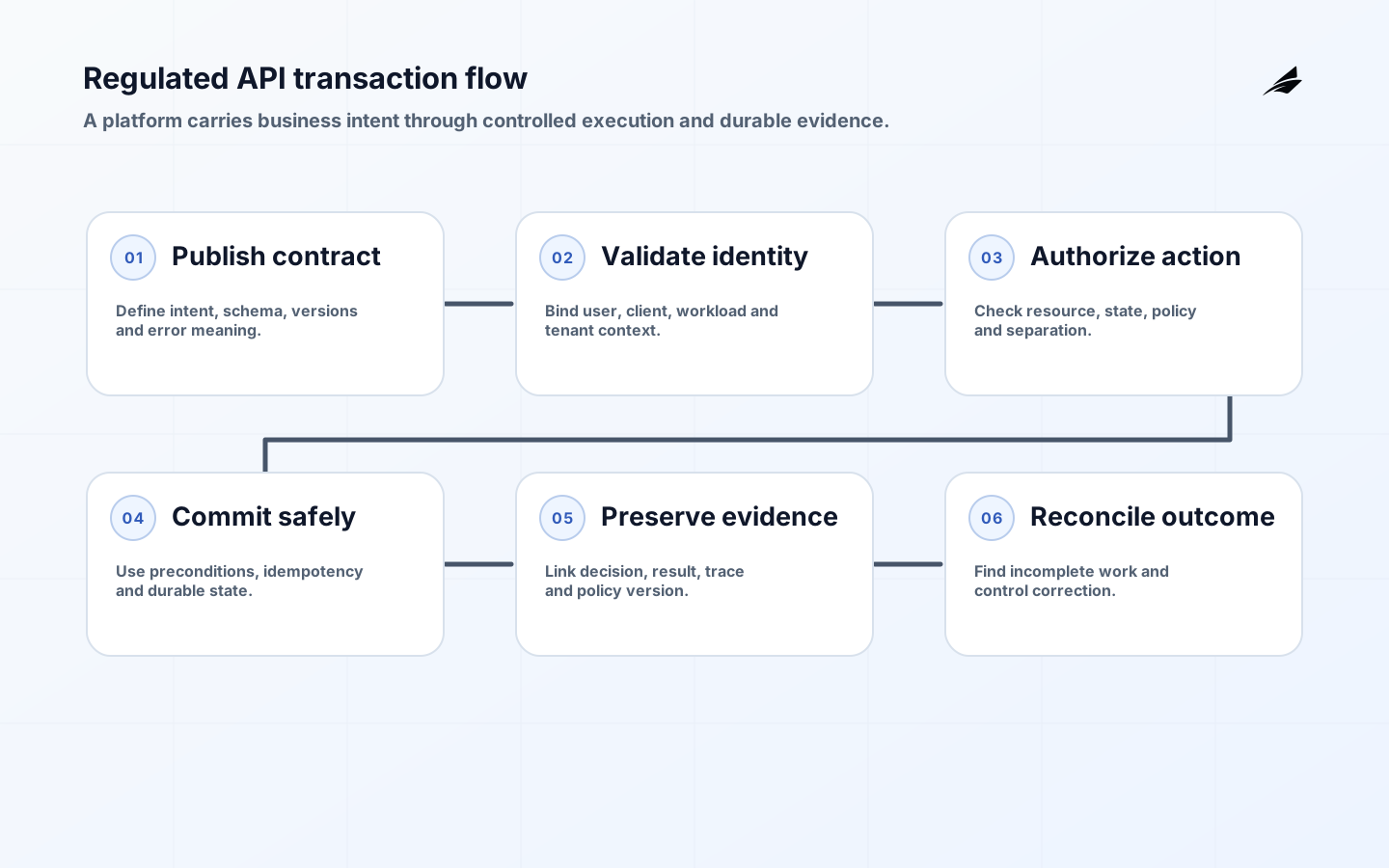
API platform design for regulated business processes must preserve business meaning from a caller’s intent through authorization, state change, downstream execution and later review. A gateway can terminate transport and apply shared limits, but it cannot decide whether a particular claim may be approved or which record version is legally effective. Those decisions belong in owned domain services with versioned contracts and recoverable state transitions.
Frame the platform with Edilec's API platform planning guide, approval workflow design guide and developer handoff guide. They connect interface design to business ownership and the operational responsibilities that survive launch.
Define a platform contract for regulated actions
Select one material command and document its actor, purpose, authoritative inputs, preconditions, allowed state transition, approval rule, idempotency behavior, result, evidence and correction path. Express the public request and response with a machine-readable contract, but maintain a separate business description that policy owners can review. Schema compatibility is necessary and insufficient: an unchanged field can acquire a different meaning, validation rule or effective-time interpretation.

| Platform concern | Shared capability | Domain responsibility |
|---|---|---|
| Contract | Schema registry, publication and compatibility checks | Business meaning, preconditions and result semantics |
| Identity | Credential validation and workload identity | Resource and action authorization |
| Reliability | Timeouts, limits, retries and routing | Idempotency, state transition and compensation |
| Evidence | Trace IDs, immutable event transport and retention tools | Decision reason, policy version and record linkage |
| Change | Deployment path, version inventory and deprecation signals | Migration acceptance and consumer impact |
| Operations | Health signals and incident coordination | Business reconciliation and corrective action |
Use the OpenAPI Specification to describe HTTP interfaces and RFC 9457 to return machine-readable problem details without exposing sensitive internals. The OWASP API Security project provides a current risk model for object authorization, resource consumption, inventory and unsafe downstream consumption. OpenTelemetry can connect gateway, service, queue and dependency evidence through one trace context.
Run consumer-driven and domain acceptance tests against a production-like path. Verify repeated commands, concurrent updates, stale preconditions, unavailable dependencies, malformed downstream data, revoked authority and partial completion. A regulated workflow needs a durable receipt even when processing is asynchronous, plus reconciliation that can find accepted work with no final result. Publish deprecation dates and observe real consumer migration before retiring a version. Platform maturity is demonstrated when teams can change a contract without losing policy, evidence or recovery—not when the gateway exposes the most features.
Key takeaways
- Frame API platform design around a measurable outcome and one bounded end-to-end journey.
- Name the service owning the business capability and its versioned contract, not the database table behind it before designing copied data, automation, or interface polish.
- Model explicit states: received, authenticated, authorized, validated, accepted, completed, rejected, and compensating.
- Enforce protected actions at the service boundary and preserve a recovery path.
- Release with representative service businesses and improve using observed exceptions, not opinions alone.
Define the API platform design boundary
Write the outcome in plain language and make its boundary testable. For this work, that means provide controlled service capabilities without unnecessary data exposure or silent duplicate effects. Treat each regulated service command as a working unit with a trigger, stable identifier, accountable owner, completion condition, and an understood error consequence. A boundary also names what is outside the first release. That protects the team when adjacent requests arrive from other parts of the organization. Review the boundary with API consumers, platform engineers, policy owners, and operational reviewers. Ask what evidence they need, which action they may take, and what happens when information is incomplete. The answer should be specific enough that a release reviewer can identify valid completion without interpreting a broad business aspiration.
| Question | Decision to document | Evidence to collect |
|---|---|---|
| Outcome | provide controlled service capabilities without unnecessary data exposure or silent duplicate effects | Baseline timing, rework, and named business owner |
| Working unit | A regulated service command with stable identity and lifecycle | Recent normal and difficult cases |
| Authority | the service owning the business capability and its versioned contract, not the database table behind it | System owner, permitted editors, and policy reference |
| Completion | Durable result, visible confirmation, and recovery condition | Result record, receipt, and reconciliation rule |
| First release | One complete decision loop and its exceptions | Deferred work with owner and review date |
Model state, data, and authority
A state model prevents API platform design from degrading into a collection of disconnected pages. Use states that explain what happened, what may occur next, who can act, and what is blocking progress: received, authenticated, authorized, validated, accepted, completed, rejected, and compensating. Avoid a generic pending status that hides whether the regulated service command awaits data, a decision, a dependency, or manual repair. For material fields, record the authoritative source, effective time, update expectation, and permitted editors. A display copy can be useful, but it is not automatically allowed to correct the source. Retain the identifier that connects the initiating request, action, downstream call, and recovery activity. This gives operations and engineering a shared route to investigate disagreements without relying on inbox archaeology.
Design controls and recovery
Control design should fit the consequence of the action. In this case, separate identity, resource scope, policy validation, and execution so a credential never grants unlimited record authority. Apply permission at the command or API boundary using the current actor, object, relationship, and requested action. Hiding a menu can improve clarity, but it cannot secure a direct request. The OWASP Application Security Verification Standard gives practical checks for authorization, validation, logging, and session handling. Plan a legible response when an action is denied, a dependency times out, or records disagree. A visible exception owned by a real person is safer than a silent retry or undocumented workaround. Significant changes should retain prior state, actor, time, reason, and correlation identifier while avoiding unnecessary personal data in diagnostic records.
| Condition | Expected behavior | Operational evidence |
|---|---|---|
| Information missing | Hold work in a recoverable state and state what is needed. | Validation result and next owner |
| Unauthorized request | Deny at the service boundary without exposing unrelated records. | Actor, action, object scope, review event |
| Dependency failure | Use bounded retry or compensation and expose recovery. | Correlation identifier, attempt history, exception owner |
| Replay or duplicate | Prevent repeated effect and return known outcome. | Request identity, prior result, idempotency decision |
| Manual override | Require authority, reason, and follow-up where appropriate. | Before-and-after state and policy basis |
Build a thin operational slice
Prove the full path before broadening the surface. Define a narrow contract with examples, identifiers, error semantics, idempotency, limits, and operational ownership. Include identity, retrieval of trusted context, allowed transition, usable outcome message, audit event, observable failure, and supportable recovery. Make integration behavior explicit: contract, expected time, duplicate behavior, and the owner who investigates a rejection or delay. The Secure Software Development Framework connects these requirements to secure design, implementation, verification, and release evidence. A thin slice is not a mock-up; it is a production-shaped capability whose behavior remains understandable when conditions are ordinary and when they are inconvenient.
Verify quality with real conditions
Verify forbidden calls, tenant boundaries, malformed input, replayed commands, partial failure, compatibility, and telemetry. Include keyboard users, assistive technology users, unreliable networks, and non-default data conditions in the review. WCAG 2.2 is useful for focus visibility, error identification, status messages, target size, and accessible authentication. Define acceptance evidence before implementation: expected outcome, protected boundary, error condition, data condition, and named observer. Pair workflow checks with contract and integration checks, then explore places where a person may misread status or take an irreversible action. Quality is not a release-day ceremony; it is credible assurance for the risks that would make this work unsafe or untrustworthy.
Operate and improve after release
Onboard one known consumer, publish deprecation policy, monitor use, and retire versions only with migration evidence. Instrument intent and outcome, not merely page loads. A correlation identifier across browser, service, and dependency activity connects a reported issue to its actual path; the OpenTelemetry Specification provides common concepts for traces, metrics, and logs. Review cycle time, failed transitions, queue age, corrections, and recovery time alongside user observation. DORA research also encourages teams to look at delivery performance with organizational outcomes rather than treating deployment frequency as success by itself. Retire old reports, credentials, and manual steps only after the replacement has earned trust in real work.
Define release evidence
For API platform design, make operational behavior part of the consumer contract. A caller needs to know the difference between a request that is invalid, a request that is not permitted, a request accepted for asynchronous work, and a request that completed with a recoverable downstream problem. Document stable error codes and the safe caller response, rather than expecting every consumer to interpret free-form messages. Publish time and rate expectations that match actual service capacity, then observe whether consumers retry in ways that amplify failure. For sensitive operations, keep audit evidence separate from broad request logging and make access to the evidence itself controlled. Before a version change, test real consumer payloads and failure handling, not only the generated client. A platform earns trust when it gives consumers enough certainty to build safely while retaining the service owner's ability to evolve internals deliberately. Review a small set of production traces with a consumer team to confirm that documented outcomes and retries match the behavior their software actually observes. Treat these trace reviews as contract maintenance: they expose undocumented client assumptions before a service evolution turns them into a production compatibility incident.
Frequently asked questions
What belongs in the first API platform design release?
Begin with coherent business capabilities and dependable consumer contracts, not a catalog of internal storage.
How should the team decide what to automate?
Idempotency needs a documented request identity, retained outcome evidence, and deliberate conflict and expiry behavior.
Conclusion
API platform design is successful when it makes consequential work legible, controlled, and easier to improve. Start with the operational outcome, establish data and decision authority, build one complete transition with recovery, and judge the result by what people can safely achieve. That sequence gives clients and internal teams a capability that remains useful when information is missing, dependencies fail, or the original project team is no longer nearby.