Compliance-ready delivery is the practice of making security, privacy, and operational obligations visible in the way software is designed, changed, released, and supported. It does not mean claiming that a product is universally compliant; obligations vary by jurisdiction, contract, data, customer, and system boundary. It means that a team can identify the applicable requirement, name the control that addresses it, show where the control is enforced, test whether it works, retain evidence, and respond when it fails. That chain should exist during ordinary delivery. A folder assembled before an audit is weak evidence because it may describe intended behavior without proving the released system or the current operating process.
Set the operating boundary for compliance-ready delivery
Set the boundary in ordinary language. For this guide, the work concerns a customer-facing service that processes regulated or contract-sensitive information. The desired result is to release a service whose controls, owners, and operating evidence can be explained without reconstructing decisions after the fact. The decisions that make the result credible are which obligations apply, which controls meet them, and who may accept a bounded residual risk. Write down what becomes harmful if the decision is wrong, who owns the affected resource, and which systems provide the trusted facts. A clear boundary tells a reviewer which workflow needs a negative test, which person can approve an exception, and when a change should force the plan back into review. Do not let a policy name stand in for this work.
| Planning area | Decision to make | Evidence of readiness |
|---|---|---|
| Protected outcome | State how the team will release a service whose controls, owners, and operating evidence can be explained without reconstructing decisions after the fact. | Named owner and impact statement. |
| Decision boundary | Record which obligations apply, which controls meet them, and who may accept a bounded residual risk. | Approved examples and denial cases. |
| Dependencies | Name identity, data, platform, supplier, and operating dependencies. | Failure behavior and recovery contact. |
| Review | Set a trigger for reconsidering the control. | Dated cadence and escalation path. |
Design a control that people can operate
The operating control is a traceable control statement with an objective, implementation owner, verification evidence, and review date. It must change a real outcome and have an accountable owner; a statement of intent is not enough. Describe the normal case, the denied case, a time-limited exception, and a dependency outage. Decide which inputs are authoritative, how fresh they must be, and who can change the rule. Keep enforcement close to the service that owns the record or action, especially when a browser, gateway, spreadsheet, or upstream system could be bypassed. The person on call should be able to understand the control without reconstructing its meaning from several unrelated tools.
- Name the protected outcome and accountable owner before choosing a tool.
- Use the smallest practical access, configuration, data set, or recovery action.
- Make exceptions attributable, time-bounded, and visible to the resource owner.
- Prove an invalid request or condition is refused through a realistic negative test.
- Review after material product, people, supplier, dependency, or incident change.
Make the control real in delivery
Make the plan part of delivery rather than a document created at the end. Connect each requirement to a component, configuration setting, operating procedure, or test that can demonstrate the intended behavior. Use versioned changes for high-impact settings and preserve the reviewer, reason, and expected outcome. Test cases should include a legitimate request as well as a wrong tenant, stale condition, expired approval, malformed input, or unavailable dependency. When a weakness remains, record its consequence, temporary safeguard, remediation owner, and expiry so a release decision is honest rather than silently optimistic. For compliance-ready delivery, link each promise to a concrete release artifact: a requirement, configuration record, test result, approval, or restoration exercise. A privacy obligation that is not reflected in the deletion path and backup process remains an aspiration. Before release, the control owner should be able to show the exact system behavior, the exception route, and the next review triggered by a contract, data, or architecture change.
| Operating checkpoint | What to verify | Pause or escalate when |
|---|---|---|
| Control coverage | A real component or procedure implements every important decision. | A high-impact path has no owner, test, or safe failure behavior. |
| Access and data | The team understands exposure for customer records, production configurations, approval decisions, and privileged credentials. | A privileged, cross-boundary, or export path bypasses the intended rule. |
| Evidence | Relevant actions and changes are attributable and retrievable. | Logs, approvals, or restoration evidence are incomplete. |
| Residual risk | An accountable person accepts a narrow, dated exception. | The exception lacks an expiry, compensating safeguard, or follow-up owner. |
Run and review compliance-ready delivery
Run compliance-ready delivery as a recurring decision. Give routine review work to the people who understand the business consequence, technical scope, and operating evidence. Capture material changes, denied attempts, emergency actions, and exceptions with enough context to investigate later. Avoid measuring success only by the number of tickets closed or events collected. A useful measure answers whether the team can prevent a harmful action, notice a control failure, and recover access or service safely. Review on a meaningful trigger such as a release, identity change, supplier change, incident, or new integration.
Plan for failure and recovery
Resilience is part of the control, not a separate project. Decide ahead of time what the system does when an identity source, policy service, log pipeline, key store, or third-party dependency fails. For destructive or privacy-sensitive work, refusal may be the safe response; for lower-risk activity, a bounded read-only or temporary route may be appropriate. Make emergency access narrow, attributable, and automatically expiring. Exercise one realistic scenario and record whether the team can identify impact, contain the problem, restore the needed capability, validate the result, and close the temporary exception. For this service, test recovery of the evidence as well as recovery of the application. Teams should be able to retrieve a change record, access decision, and verification result during a customer question or incident. If evidence is held by a provider or pipeline, confirm the retention, access route, and failure notification. That exercise exposes whether the control can be demonstrated when it matters.
Build a control-to-evidence record that changes with the service
The NIST Secure Software Development Framework organizes secure practices so they can fit different development lifecycles, while OWASP ASVS supplies versioned, testable application-security requirements. The NIST Cybersecurity Framework 2.0 connects governance with identification, protection, detection, response, and recovery. For evidence portability, OSCAL defines machine-readable models for control catalogs, implementation descriptions, and assessments. Incident evidence belongs to the same operating model: NIST SP 800-61 Rev. 3 places response across cybersecurity risk management rather than treating it as an isolated emergency procedure.
| Control record | Required question | Durable evidence |
|---|---|---|
| Objective | What risk or obligation does the control address? | Mapped requirement and approved interpretation |
| Enforcement | Where can the system actually allow or deny? | Versioned policy, configuration, or code reference |
| Assessment | How is effective operation tested? | Scenario, result, reviewer, date, exceptions |
| Recovery | What happens when the control fails? | Incident route, containment, correction, follow-up |
For each material control, record the objective, scope, accountable owner, implementing components, enforcement point, test method, evidence location, review cadence, exceptions, and failure response. Keep configuration and test results linked to the released version. A control that depends on a manual review should identify the queue, reviewer authority, due time, sampling rule, and escalation path; “reviewed regularly” is not an operating specification. Automate collection where the source is reliable, but do not confuse collection with assessment. A green configuration check may not prove that an access decision protected the intended data. Sample complete business scenarios and periodically exercise negative paths. When a control changes, preserve the prior state and explain the transition so historical decisions remain interpretable.
Related implementation guidance
The security review before launch guide helps turn release risk into a bounded decision. Use the vendor access management guide for third-party administration, and the application hardening guide for implementation-level verification.
Follow the compliance-ready delivery decision flow
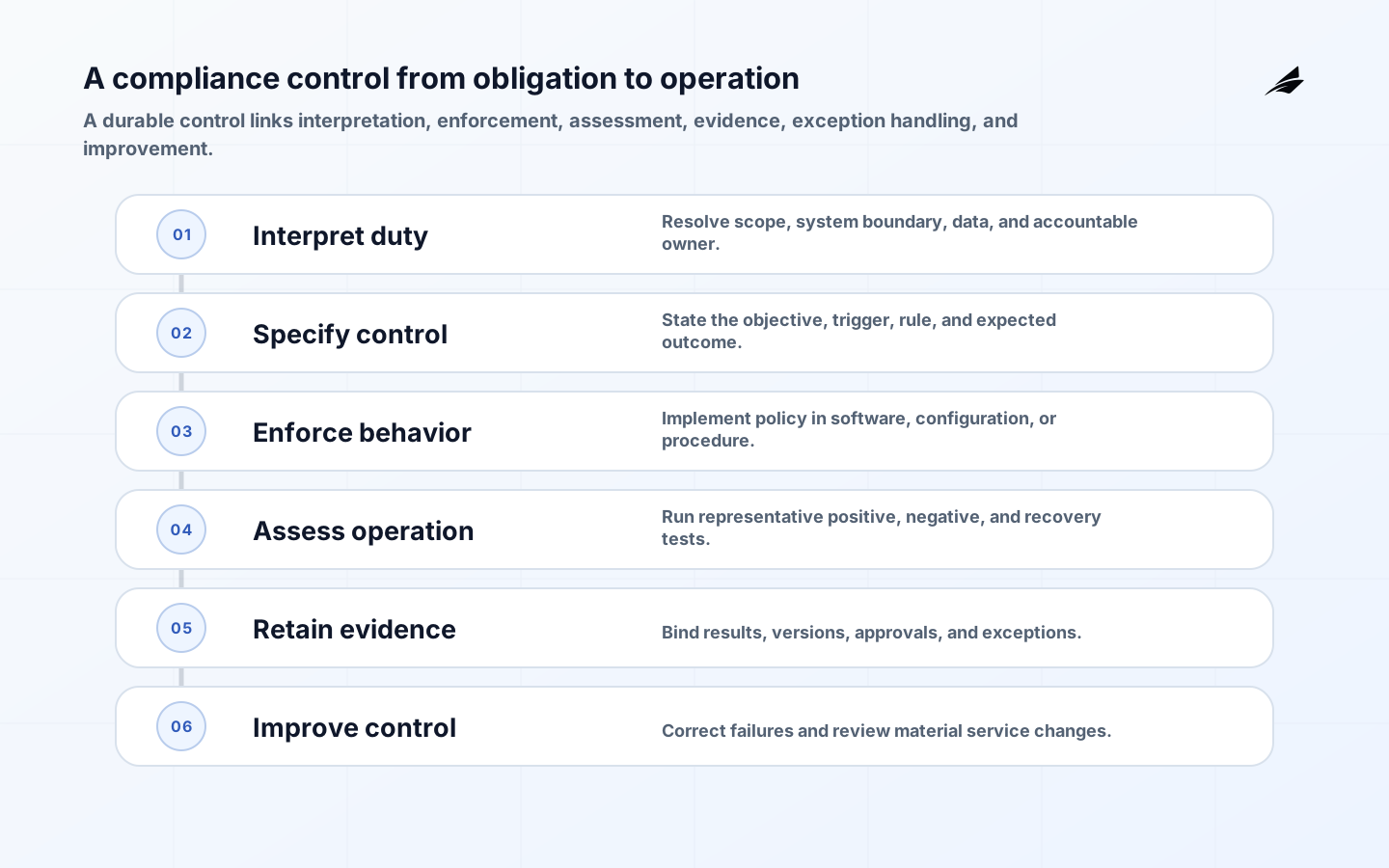
The six-stage decision flow makes the handoffs visible. It starts with a defined protected outcome, gathers the facts needed for a decision, applies a controlled rule, records the action, and finishes with a review that can improve the next cycle. The diagram belongs here because compliance-ready delivery depends on a sequence that a team can inspect during design, release, and incident response. It is not a substitute for engineering detail; it is a shared map of responsibility.
Key takeaways
- Compliance-ready delivery is strongest when the outcome, owner, and decision boundary are explicit.
- Every material control needs a practical implementation, a negative test, and retrievable evidence.
- A time-bounded exception is safer than an informal permanent bypass.
- Recovery behavior should be chosen and exercised before a dependency fails.
- Use product, people, supplier, and incident changes to trigger focused review.
Frequently asked questions
Conclusion
Compliance-ready delivery becomes dependable when it is tied to the assets and decisions that matter. Keep the scope bounded, make the owner and enforcement point clear, preserve usable evidence, and rehearse failure handling before urgency forces improvisation. In practice, the next review should examine one recent compliance-ready delivery decision from start to finish: the request or change, the resource affected, the person or workload involved, the rule applied, the evidence retained, and the recovery consequence if the decision had been wrong. Ask whether another accountable person could understand and repeat that decision with the available records. Where the answer is no, improve the ownership, data quality, test, or operating procedure before expanding scope. This small discipline turns routine changes into feedback that strengthens both access control and resilience.