Compliance-ready delivery means that a product team can connect an obligation to a working control, a release decision and retrievable evidence. It does not mean promising that every feature or release is certified. A product leader's job is to make commitments visible early enough that architecture and workflow can satisfy them, then ensure that evidence is produced by ordinary delivery. When compliance appears only before a customer review or audit, teams scramble for screenshots that may show a setting but not whether the control operated consistently.
Start with the product's actual commitments: contracts, laws, policies, risk decisions and customer expectations. Translate them into outcomes and accountable owners rather than copying framework language into tickets. NIST's Secure Software Development Framework describes practices for preparing the organization, protecting software, producing well-secured software and responding to vulnerabilities. Product leaders can connect those practices to Edilec's security review before launch, threat modeling guide and compliance-ready control planning.
Translate obligations into product outcomes
A requirement such as “access must be reviewed” is incomplete until the team defines population, reviewer, frequency or trigger, evidence and overdue behavior. “Encrypt sensitive data” needs data scope, key ownership, supported flows, backup treatment and exception handling. Write a control statement in ordinary language: who performs or enforces what, on which object, under which condition, and what record demonstrates the result. Legal, security, privacy, product and engineering should agree on the outcome before implementation is selected.
Not every obligation belongs in code. Some require a supplier review, support procedure, incident notification route or record-retention decision. Connect each control to the product surface and operating team it affects. This prevents the backlog from becoming a disconnected list of security stories and policy tasks. It also exposes conflicts early, such as an analytics feature that requests longer retention than the privacy purpose permits or a support promise that depends on logs the platform does not retain.
| Commitment | Product outcome | Release evidence |
|---|---|---|
| Least privilege | Roles permit only defined business actions | Permission tests and approved role map |
| Change control | Production receives reviewed, traceable artifacts | Source, build, approval and deployment record |
| Data minimization | Feature collects and retains only needed data | Data map, purpose and deletion test |
| Availability | Critical workflow has a tested recovery target | Restore exercise and dependency results |
| Vulnerability response | Findings have severity, owner and due date | Scan result, decision and remediation record |
| Incident notice | Team can determine impact and notify owners | Runbook exercise and contact verification |
Build a control ownership model
Assign one accountable control owner and the teams that implement, operate, review and rely on it. A product manager may own the business outcome, platform engineering may implement the guardrail, security may define assurance, and operations may respond to failures. Avoid ownership by committee. If everyone can approve an exception, no one is clearly accountable. Define a backup owner and escalation route because personnel changes are a common source of stale evidence and controls.
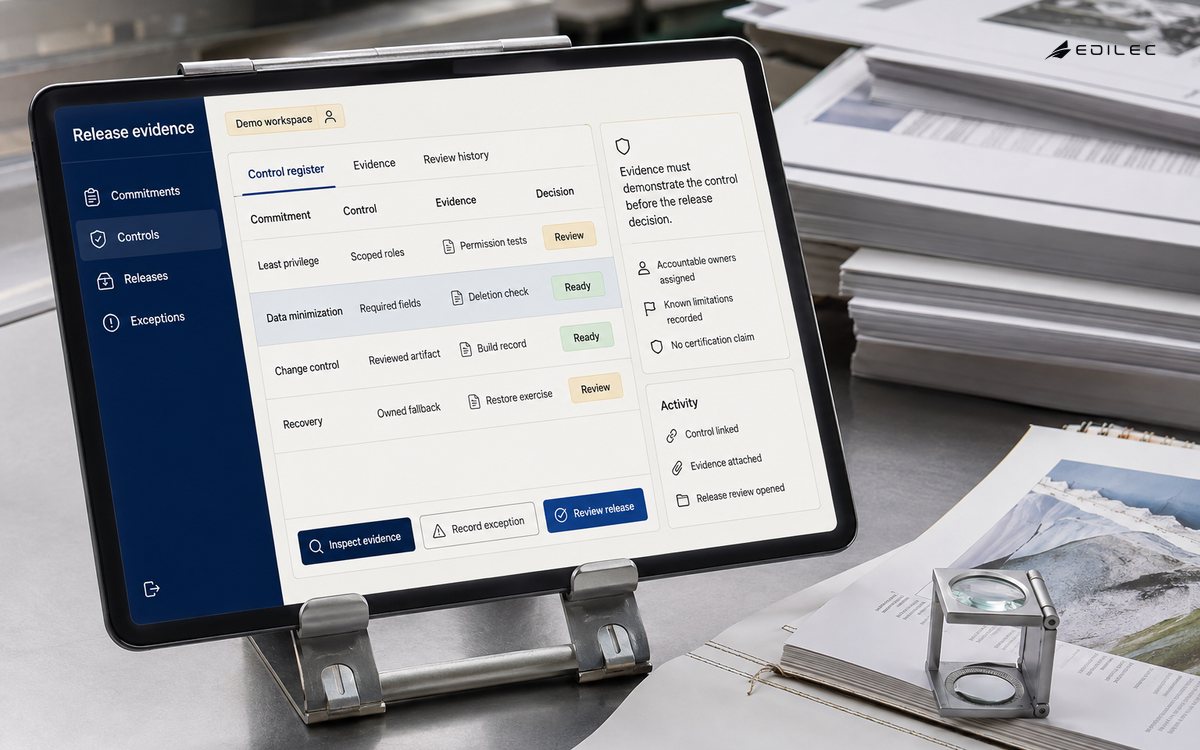
Maintain a compact control register linked to product components and evidence sources. It should record scope, owner, rationale, implementation, test, evidence location, review trigger, dependencies, known limitations and approved exceptions. Do not duplicate evidence into a compliance folder if the durable source is a deployment system or ticket record; link to a protected, retained record. The register is a map for review, not a second operational database that drifts away from reality.
Design evidence into the delivery path
A release should produce evidence as a side effect of doing the work correctly. Source control records review; the build system records dependencies, checks and artifact identity; deployment records target and outcome; access systems record privileged changes. Protect the integrity and retention of these records. SLSA v1.2 offers a structured way to reason about build provenance and artifact integrity. The aim is not to adopt every level immediately, but to make it possible to answer what source produced the artifact, how it was built and where it ran.
Evidence must demonstrate the control, not merely activity. A ticket marked complete does not prove that unauthorized access was denied. A vulnerability scan does not prove that findings were triaged and remediated. A backup configuration does not prove restoration. Prefer automated records linked to negative tests, reconciliations and exercises. Where human judgment is essential, capture the decision, reviewer, information considered, expiry and follow-up. Sample evidence periodically for completeness before a customer asks for it.
- Use immutable artifact identifiers across build, approval and deployment.
- Record negative tests for authorization and tenant boundaries.
- Retain exceptions with scope, compensating control and expiry.
- Link supplier evidence to the service and obligation it supports.
- Test restoration and incident communication, not only written plans.
- Restrict evidence access when it contains security or personal data.
Use risk-based release gates
Release gates should respond to change risk. A text correction does not need the same review as a new payment integration, authentication change or cross-border data flow. Define triggers based on data class, privileged behavior, new supplier, public exposure, architecture change and unresolved high-severity findings. The gate identifies the reviewer and required evidence. Avoid a universal questionnaire that trains teams to answer mechanically and delays low-risk work without improving consequential decisions.
| Change signal | Additional review | Stop condition |
|---|---|---|
| New personal data | Privacy purpose, minimization and retention | No lawful purpose or deletion route |
| New privileged action | Threat model and authorization tests | Bypass or unowned emergency access |
| New external supplier | Security, privacy, resilience and exit review | Material obligation cannot be met |
| Authentication change | Account recovery and abuse scenarios | Unsafe migration or weak fallback |
| Major dependency update | Compatibility, provenance and vulnerability review | Unresolved critical exposure |
| Recovery design change | Restore and failover exercise | Target cannot be demonstrated |
A gate can approve, reject, request evidence or accept a bounded exception. The exception decision should state consequence, temporary safeguard, owner, deadline and customer impact. Product leaders should see aggregate exception age and recurrence because repeated waivers indicate a roadmap or architecture problem. Emergency release paths still need traceability and retrospective review. Speed comes from prepared authority and automation, not from deleting accountability during an incident.
Operate controls after launch
Many controls degrade after release. Permissions accumulate, suppliers change, logs stop arriving, data outlives its purpose and runbooks lose current contacts. Define indicators that reveal whether the control continues to work: stale privileged access, failed deletion jobs, missing log sources, overdue vulnerabilities, expired supplier evidence, restoration results and open exceptions. The OWASP Software Assurance Maturity Model helps teams examine governance, design, implementation, verification and operations as a connected software lifecycle rather than a one-time launch review.
Control failures are product incidents when they affect commitments. Give them severity, communication and follow-up appropriate to impact. A missing audit stream may not interrupt users, but it can remove the ability to investigate a sensitive action. Include compliance-related dependencies in service ownership and incident exercises. NIST CSF 2.0's Govern function is useful here: leadership decisions, roles and supply-chain risks belong alongside technical protection and response.
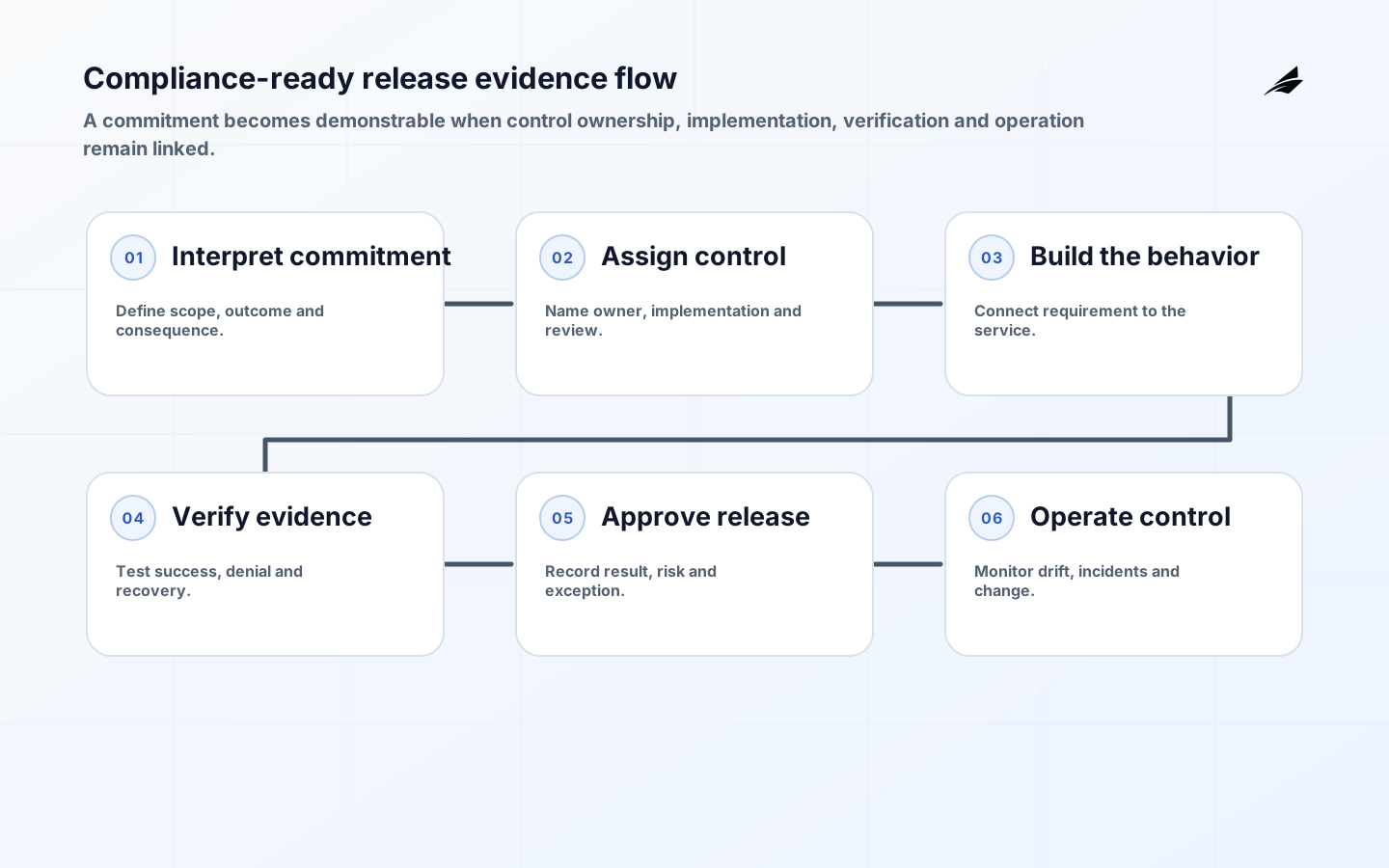
Connect each release to a traceable evidence flow
The diagram moves from obligation to operating review. The team interprets the commitment, assigns a control, implements it in the service, verifies positive and negative behavior, approves release with evidence, and monitors the control after launch. Each stage produces an artifact needed by the next. This makes a compliance question answerable from the delivery record instead of reconstructed from memory months later.
Use a product-level scorecard
A useful scorecard reports readiness and exposure, not the number of documents created. Track critical controls without owners or tests, high-risk changes awaiting review, evidence collection failures, exceptions by age, overdue remediation, access-review completion, restore success and repeated incident causes. Separate design debt from operating failure. A control that has not been implemented is a roadmap risk; a control that should be operating but is not is an incident or defect.
Review the scorecard with roadmap and service health rather than in an isolated compliance meeting. A repeated exception may require product redesign; an evidence gap may require pipeline work; a failed recovery exercise may change launch sequencing. Connecting these findings to prioritization gives control owners the capacity to fix causes instead of repeatedly documenting symptoms.
Key takeaways
- Translate obligations into owned, testable product outcomes before implementation.
- Let normal delivery systems generate protected, retrievable evidence.
- Use risk signals to scale release review instead of applying one universal checklist.
- Treat exceptions as dated product risk with compensating controls and follow-up.
- Monitor control operation after launch and respond to evidence gaps.
- Keep external claims aligned with actual product scope and evidence.
Frequently asked questions
Does compliance-ready mean certified?
No. It means the product is built and operated so relevant controls and evidence can be evaluated. Certification or attestation has separate scope, criteria, assessor and period requirements.
When should a startup begin this work?
Begin when customer data, privileged workflows or contractual commitments appear. Start with a small control register, access boundaries, release traceability, incident ownership and restoration evidence rather than copying a large framework.
Who owns compliance in a product team?
Leadership owns commitments and risk. Product, engineering, security, privacy, legal and operations own specific outcomes. A compliance specialist may coordinate evidence, but cannot operate every control on behalf of those teams.
Conclusion
Compliance-ready delivery is disciplined product management under explicit obligations. Define what must be true, assign ownership, implement and test the control, preserve release evidence, and monitor the result after launch. Product leaders who integrate those steps into discovery, architecture and operation reduce audit disruption and, more importantly, build services whose security and reliability commitments can be demonstrated rather than merely asserted.